1990 Edition
CIA World Factbook 1990 (Project Gutenberg)
Geography
Climate
tropical marine, mild, little seasonal temperature variation
Coastline
501 km
Comparative area
slightly less than three times the size of Rhode Island
Contiguous zone
12 nm;
Continental shelf
200 m;
Environment
many small rivers and high central mountains ensure land is well watered; south coast relatively dry; fertile coastal plain belt in north
Extended economic zone
200 nm;
Land boundaries
none
Land use
8% arable land; 9% permanent crops; 51% meadows and pastures; 25% forest and woodland; 7% other
Natural resources
some copper and nickel; potential for onshore and offshore crude oil
Note
important location between the Dominican Republic and the Virgin Islands group along the Mona Passage--a key shipping lane to the Panama Canal; San Juan is one of the biggest and best natural harbors in the Caribbean
Terrain
mostly mountains with coastal plain belt in north; mountains precipitous to sea on west coast
Territorial sea
12 nm
Total area
9,104 km2; land area: 8,959 km2
People and Society
Birth rate
19 births/1,000 population (1990)
Death rate
8 deaths/1,000 population (1990)
Ethnic divisions
almost entirely Hispanic
Infant mortality rate
17 deaths/1,000 live births (1990)
Labor force
1,062,000; 23% government, 20% trade, 18% manufacturing, 4% agriculture, 35% other (1988)
Language
Spanish (official); English is widely understood
Life expectancy at birth
68 years male, 76 years female (1990)
Literacy
89%
Nationality
noun--Puerto Rican(s); adjective--Puerto Rican
Net migration rate
- 11 migrants/1,000 population (1990)
Organized labor
115,000 members in 4 unions; the largest is the General Confederation of Puerto Rican Workers with 35,000 members (1983)
Population
3,291,207 (July 1990), growth rate 0.1% (1990)
Religion
mostly Christian, 85% Roman Catholic, 15% Protestant denominations and other
Total fertility rate
2.2 children born/woman (1990)
Government
Administrative divisions
none (commonwealth associated with the US)
Capital
San Juan
Constitution
ratified 3 March 1952; approved by US Congress 3 July 1952; effective 25 July 1952
Diplomatic representation
none (commonwealth associated with the US)
Elections
Governor--last held 8 November 1988 (next to be held November 1992); results--Rafael Hernandez Colon (PPD) 48.7%, Baltasar Corrada Del Rio (PNP) 45.8%, Ruben Barrios Martinez (PIP) 5.5%; Senate--last held 8 November 1988 (next to be held November 1992); results--percent of vote by party NA; seats--(27 total) PPD 18, PNP 8, PIP 1; House of Representatives--last held 8 November 1988 (next to be held November 1992); results--percent of vote by party NA; seats--(53 total) PPD 36, PNP 15, PIP 2
Executive branch
US president, US vice president, governor
Flag
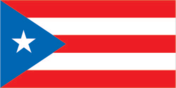
five equal horizontal bands of red (top and bottom) alternating with white; a blue isosceles triangle based on the hoist side bears a large white five-pointed star in the center; design based on the US flag
Independence
none (commonwealth associated with the US)
Judicial branch
Supreme Court
Leaders
Chief of State--President George BUSH (since 20 January 1989); Vice President Dan QUAYLE (since 20 January 1989); Head of Government Governor Rafael HERNANDEZ Colon (since 2 January 1989)
Legal system
based on English common law
Legislative branch
bicameral Legislative Assembly consists of an upper house or Senate and a lower house or House of Representatives
Long-form name
Commonwealth of Puerto Rico
National holiday
Constitution Day, 25 July (1952)
Other political or pressure groups
all have engaged in terrorist activities--Armed Forces for National Liberation (FALN), Volunteers of the Puerto Rican Revolution, Boricua Popular Army (also known as the Macheteros), Armed Forces of Popular Resistance
Political parties and leaders
Popular Democratic Party (PPD), Rafael Hernandez Colon; New Progressive Party (PNP), Baltasar Corrado del Rio; Puerto Rican Socialist Party (PSP), Juan Mari Bras and Carlos Gallisa; Puerto Rican Independence Party (PIP), Ruben Berrios Martinez; Puerto Rican Communist Party (PCP), leader(s) unknown
Suffrage
universal at age 18; indigenous inhabitants are US citizens, but do not vote in US presidential elections
Type
commonwealth associated with the US
Economy
Agriculture
accounts for 4% of labor force; crops--sugarcane, coffee, pineapples, tobacco, bananas; livestock--cattle, chickens; imports a large share of food needs
Aid
none
Budget
revenues $4.9 million; expenditures $4.9 million, including capital expenditures of $NA (FY88)
Currency
US currency is used
Electricity
4,149,000 kW capacity; 14,050 million kWh produced, 4,260 kWh per capita (1989)
Exchange rates
US currency is used
Exports
$13.2 billion (f.o.b., FY88); commodities--sugar, coffee, petroleum products, chemical, metal products, textiles, electronic equipment; partners--US 87%
External debt
$NA
Fiscal year
1 July-30 June
GNP
$18.4 billion, per capita $5,574; real growth rate 4.9% (FY88)
Imports
$11.8 billion (c.i.f., FY88); commodities--chemicals, clothing, food, fish products, crude oil; partners--US 60%
Industrial production
growth rate 5.8% (FY87)
Industries
tourism, manufacturing, pharmaceuticals, chemicals, food processing, petroleum refining
Inflation rate (consumer prices)
33% (December 1987-88)
Overview
Puerto Rico has one of the most dynamic economies in the Caribbean region. Industry has surpassed agriculture as the primary sector of economic activity and income. Encouraged by duty-free access to the US and by tax incentives, US firms have invested heavily in Puerto Rico since the 1970s. Important new industries include pharmaceuticals, electronics, textiles, petrochemicals, and processed foods. Sugar production has lost out to dairy production and other livestock products as the main source of income in the agricultural sector. Tourism has traditionally been an important source of income for the island.
Unemployment rate
12.8% (December 1988)
Communications
Airports
33 total; 23 usable; 19 with permanent-surface runways; none with runways over 3,659 m; 3 with runways 2,440-3,659 m; 4 with runways 1,220-2,439 m
Highways
13,762 km paved
Ports
San Juan, Ponce, Mayaguez, Arecibo
Railroads
100 km rural narrow-gauge system for hauling sugarcane; no passenger railroads
Telecommunications
2,000,000 radio receivers; 810,000 TV receivers; 769,140 telephones; stations--69 AM, 42 FM, 24 TV (1984)
Military and Security
Note
defense is the responsibility of the US; paramilitary National Guard; police force of 10,050 men and women (1984)