1999 Edition
CIA World Factbook 1999 (Internet Archive)
Geography
Area
total: 312,683 sq km land: 304,510 sq km water: 8,173 sq km
Area--comparative
slightly smaller than New Mexico
Climate
temperate with cold, cloudy, moderately severe winters with frequent precipitation; mild summers with frequent showers and thundershowers
Coastline
491 km
Elevation extremes
lowest point: Raczki Elblaskie -2 m highest point: Rysy 2,499 m
Environment--current issues
situation has improved since 1989 due to decline in heavy industry and increased environmental concern by postcommunist governments; air pollution nonetheless remains serious because of sulfur dioxide emissions from coal-fired power plants, and the resulting acid rain has caused forest damage; water pollution from industrial and municipal sources is also a problem, as is disposal of hazardous wastes
Environment--international agreements
party to: Air Pollution, Antarctic-Environmental Protocol, Antarctic Treaty, Biodiversity, Climate Change, Endangered Species, Environmental Modification, Hazardous Wastes, Law of the Sea, Marine Dumping, Nuclear Test Ban, Ozone Layer Protection, Ship Pollution, Wetlands signed, but not ratified: Air Pollution-Nitrogen Oxides, Air Pollution-Persistent Organic Pollutants, Air Pollution-Sulphur 94, Climate Change-Kyoto Protocol
Geographic coordinates
52 00 N, 20 00 E
Geography--note
historically, an area of conflict because of flat terrain and the lack of natural barriers on the North European Plain
Irrigated land
1,000 sq km (1993 est.)
Land boundaries
total: 2,888 km border countries: Belarus 605 km, Czech Republic 658 km, Germany 456 km, Lithuania 91 km, Russia (Kaliningrad Oblast) 206 km, Slovakia 444 km, Ukraine 428 km
Land use
arable land: 47% permanent crops: 1% permanent pastures: 13% forests and woodland: 29% other: 10% (1993 est.)
Location
Central Europe, east of Germany
Map references
Europe
Maritime claims
exclusive economic zone: defined by international treaties territorial sea: 12 nm
Natural hazards
NA
Natural resources
coal, sulfur, copper, natural gas, silver, lead, salt
Terrain
mostly flat plain; mountains along southern border
People and Society
Age structure
0-14 years: 20% (male 3,921,093; female 3,734,223) 15-64 years: 68% (male 13,076,231; female 13,243,716) 65 years and over: 12% (male 1,762,135; female 2,871,531) (1999 est.)
Birth rate
10.61 births/1,000 population (1999 est.)
Death rate
9.72 deaths/1,000 population (1999 est.)
Ethnic groups
Polish 97.6%, German 1.3%, Ukrainian 0.6%, Byelorussian 0.5% (1990 est.)
Infant mortality rate
12.76 deaths/1,000 live births (1999 est.)
Languages
Polish
Life expectancy at birth
total population: 73.06 years male: 68.93 years female: 77.41 years (1999 est.)
Literacy
definition: age 15 and over can read and write total population: 99% male: 99% female: 98% (1978 est.)
Nationality
noun: Pole(s) adjective: Polish
Net migration rate
-0.4 migrant(s)/1,000 population (1999 est.)
Population
38,608,929 (July 1999 est.)
Population growth rate
0.05% (1999 est.)
Religions
Roman Catholic 95% (about 75% practicing), Eastern Orthodox, Protestant, and other 5%
Sex ratio
at birth: 1.06 male(s)/female under 15 years: 1.05 male(s)/female 15-64 years: 0.99 male(s)/female 65 years and over: 0.61 male(s)/female total population: 0.95 male(s)/female (1999 est.)
Total fertility rate
1.45 children born/woman (1999 est.)
Government
Administrative divisions
16 provinces (wojewodztwa, singular--wojewodztwo); Dolnoslaskie, Kujawsko-Pomorskie, Lodzkie, Lubelskie, Lubuskie, Malopolskie, Mazowieckie, Opolskie, Podkarpackie, Podlaskie, Pomorskie, Slaskie, Swietokrzyskie, Warminsko-Mazurskie, Wielkopolskie, Zachodniopomorskie
Capital
Warsaw
Constitution
16 October 1997; adopted by the National Assembly on 2 April 1997; passed by national referendum 23 May 1997
Country name
conventional long form: Republic of Poland conventional short form: Poland local long form: Rzeczpospolita Polska local short form: Polska
Data code
PL
Executive branch
chief of state: President Aleksander KWASNIEWSKI (since 23 December 1995) head of government: Prime Minister Jerzy BUZEK (since NA October 1997), Deputy Prime Ministers Leszek BALCEROWICZ (since 31 October 1997), Janusz TOMASZEWSKI (since 31 October 1997) cabinet: Council of Ministers responsible to the prime minister and the Sejm; the prime minister proposes, the president appoints, and the Sejm approves the Council of Ministers elections: president elected by popular vote for a five-year term; election first round held 5 November 1995, second round held 19 November 1995 (next to be held NA November 2000); prime minister and deputy prime ministers appointed by the president and confirmed by the Sejm election results: Aleksander KWASNIEWSKI elected president in 1995; percent of popular vote, second round--Aleksander KWASNIEWSKI 51.7%, Lech WALESA 48.3%; Jerzy BUZEK selected prime minister in 1997
Flag description
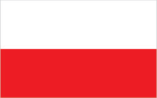
two equal horizontal bands of white (top) and red; similar to the flags of Indonesia and Monaco which are red (top) and white
Government type
democratic state
Independence
11 November 1918 (independent republic proclaimed)
International organization participation
Australia Group, BIS, BSEC (observer), CBSS, CCC, CE, CEI, CERN, EAPC, EBRD, ECE, EU (applicant), FAO, IAEA, IBRD, ICAO, ICFTU, ICRM, IDA, IEA (observer), IFC, IFRCS, IHO, ILO, IMF, IMO, Inmarsat, Intelsat, Interpol, IOC, IOM, ISO, ITU, MINURSO, MONUA, NAM (guest), NSG, OAS (observer), OECD, OPCW, OSCE, PCA, PFP, UN, UNCTAD, UNDOF, UNESCO, UNHCR, UNIDO, UNIFIL, UNIKOM, UNMIBH, UNMOP, UNMOT, UNOMIG, UNPREDEP, UPU, WCL, WEU (associate partner), WFTU, WHO, WIPO, WMO, WToO, WTrO, ZC Diplomatic representation in the US: chief of mission: Ambassador Jerzy KOZMINSKI chancery: 2640 16th Street NW, Washington, DC 20009 consulate(s) general: Chicago, Los Angeles, and New York Diplomatic representation from the US: chief of mission: Ambassador Daniel FRIED embassy: Aleje Ujazdowskie 29/31 00-054, Warsaw P1 mailing address: American Embassy Warsaw, US Department of State, Washington, DC 20521-5010 (pouch) consulate(s) general: Krakow
Judicial branch
Supreme Court, judges are appointed by the president on the recommendation of the National Council of the Judiciary for an indefinite period; Constitutional Tribunal, judges are chosen by the Sejm for nine-year terms Political parties and leaders: post-Communist: Democratic Left Alliance or SLD (Social Democracy of KALINOWSKI] post-Solidarity parties: Freedom Union or UW; note--Democratic Union non-Communist, non-Solidarity: Movement for the Reconstruction of Political pressure groups and leaders: powerful Roman Catholic Church; Solidarity (trade union); All Poland Trade Union Alliance or OPZZ (trade union)
Legal system
mixture of Continental (Napoleonic) civil law and holdover communist legal theory; changes being gradually introduced as part of broader democratization process; limited judicial review of legislative acts although under the new constitution, the Constitutional Tribunal ruling will become final as of October 1999; court decisions can be appealed to the European Court of Justice in Strasbourg
Legislative branch
bicameral National Assembly or Zgromadzenie Narodowe consists of the Sejm (460 seats; members are elected under a complex system of proportional representation to serve four-year terms) and the Senate or Senat (100 seats; members are elected by a majority vote on a provincial basis to serve four-year terms) elections: Sejm elections last held 21 September 1997 (next to be held by NA September 2001); Senate--last held 21 September 1997 (next to be held by NA September 2001) election results: Sejm--percent of vote by party--AWS 33.8%, SLD 27.1%, UW 13.4%, PSL 7.3%, ROP 5.6%, MN 0.4%, other 12.4%; seats by party--AWS 201, SLD 164, UW 60, PSL 27, ROP 6, MN 2; Senate--percent of vote by party--NA; seats by party--AWS 51, SLD 28, UW 8, ROP 5, PSL 3, independents 5; note--seats by party in the Sejm as of December 1997: AWS 200, SLD 164, UW 60, PSL 26, ROP 4, MN 2, other 4 note: four seats are constitutionally assigned to ethnic German parties
National holiday
Constitution Day, 3 May (1791); Independence Day, November 11 (1918)
Suffrage
18 years of age; universal
Economy
Agriculture--products
potatoes, fruits, vegetables, wheat; poultry, eggs, pork, beef, milk, cheese
Budget
revenues: $36.5 billion expenditures: $38.3 billion, including capital expenditures of $NA (1997 est.)
Currency
1 zloty (Zl) = 100 groszy
Debt--external
$42 billion (1997)
Economic aid--recipient
$4.312 billion (1995)
Economy--overview
Poland today stands out as one of the most successful and open transition economies. The privatization of small and medium state-owned companies and a liberal law on establishing new firms marked the rapid development of a private sector now responsible for 70% of economic activity. In contrast to the vibrant expansion of private non-farm activity, the large agriculture component remains handicapped by structural problems, surplus labor, inefficient small farms, and lack of investment. The government's determination to enter the EU as soon as possible affects all aspects of its economic policies. Improving Poland's worsening current account deficit also is a priority. To date, the government has resisted pressure for protectionist solutions and continues to support regional free trade initiatives. The government export strategy emphasizes a more aggressive export assistance program. Warsaw continues to hold the budget deficit to less than 2% of GDP. Further progress on public finance depends mainly on comprehensive reform of the social welfare system and privatization of Poland's remaining state sector. Restructuring and privatization of "sensitive sectors" (e.g., coal, steel, and telecommunications) has begun. Long-awaited privatizations in aviation and energy are scheduled for 1999.
Electricity--consumption
132.291 billion kWh (1996)
Electricity--exports
7.925 billion kWh (1996)
Electricity--imports
5.485 billion kWh (1996)
Electricity--production
134.731 billion kWh (1996)
Electricity--production by source
fossil fuel: 97.09% hydro: 2.91% nuclear: 0% other: 0% (1996)
Exchange rates
zlotych (Zl) per US$1--3.5409 (January 1999), 3.4754 (1998), 3.2793 (1997), 2.6961 (1996), 2.4250 (1995); note--a currency reform on 1 January 1995 replaced 10,000 old zlotys with 1 new zloty; 22,723 (1994)
Exports
$27.2 billion (f.o.b., 1997)
Exports--commodities
manufactured goods, chemicals 57%, machinery and equipment 21%, food and live animals 12%, mineral fuels 7%, other 3%
Exports--partners
Germany 32.9%, Russia 8.4%, Italy 5.9%, Ukraine 4.7%, Netherlands 4.7%, France 4.4%
Fiscal year
calendar year
GDP
purchasing power parity--$263 billion (1998 est.)
GDP--composition by sector
agriculture: 5.1% industry: 26.6% services: 68.3% (1997)
GDP--per capita
purchasing power parity?$6,800 (1998 est.)
GDP--real growth rate
5.6% (1998 est.)
Household income or consumption by percentage share
lowest 10%: 4% highest 10%: 22.1% (1992)
Imports
$38.5 billion (f.o.b., 1997)
Imports--commodities
manufactured goods, chemical 43%, machinery and equipment 36%, mineral fuels 9%, food and live animals 8%, other 4%
Imports--partners
Germany 24.1%, Italy 9.9%, Russia 6.3%, UK 5.5%, US 4.5%, France 5.9%
Industrial production growth rate
7.9% (1998 est.)
Industries
machine building, iron and steel, coal mining, chemicals, shipbuilding, food processing, glass, beverages, textiles
Inflation rate (consumer prices)
11% (1998 est.)
Labor force
17.4 million (1998 est.)
Labor force--by occupation
industry and construction 29.9%, agriculture 26%, services 44.1% (1996)
Population below poverty line
23.8% (1993 est.)
Unemployment rate
10% (1998)
Communications
Radio broadcast stations
AM 27, FM 75, shortwave 1 (1994 est.)
Radios
9.9 million registered (1996)
Telephone system
underdeveloped and outmoded system; government aims to have 10 million telephones in service by 2000; the process of partial privatization of the state-owned telephone monopoly has begun domestic: cable, open wire, and microwave radio relay; 3 cellular networks international: satellite earth stations--2 Intelsat, NA Eutelsat, 2 Inmarsat (Atlantic and Indian Ocean regions), and 1 Intersputnik (Atlantic Ocean region)
Telephones
8.2 million (1996)
Television broadcast stations
150 (1997)
Televisions
9.4 million registered (1996)
Transportation
Airports
92 (1998 est.) Airports--with paved runways: total: 74 over 3,047 m: 2 2,438 to 3,047 m: 25 1,524 to 2,437 m: 38 914 to 1,523 m: 6 under 914 m: 3 (1998 est.) Airports--with unpaved runways: total: 18 2,438 to 3,047 m: 1 1,524 to 2,437 m: 1 914 to 1,523 m: 9 under 914 m: 7 (1998 est.)
Heliports
3 (1998 est.)
Highways
total: 377,048 km paved: 247,721 km (including 264 km of expressways) unpaved: 129,327 km (1997 est.)
Merchant marine
total: 61 ships (1,000 GRT or over) totaling 1,162,954 GRT/1,866,462 DWT ships by type: bulk 53, cargo 3, chemical tanker 2, roll-on/roll-off cargo 1, short-sea passenger 2 (1998 est.)
Pipelines
crude oil and petroleum products 2,280 km; natural gas 17,000 km (1996) Ports and harbors: Gdansk, Gdynia, Gliwice, Kolobrzeg, Szczecin, Swinoujscie, Ustka, Warsaw, Wrocaw
Railways
total: 24,313 km broad gauge: 652 km 1.520-m gauge standard gauge: 22,243 km 1.435-m gauge (11,648 km electrified; 8,978 km double track) narrow gauge: 1,418 km various gauges including 1.000-m, 0.785-m, 0.750-m, and 0.600-m (1996)
Waterways
3,812 km navigable rivers and canals (1996)
Military and Security
Military branches
Army, Navy, Air and Air Defense Force
Military expenditures--dollar figure
$3.3 billion (1998)
Military expenditures--percent of GDP
2.2% (1998)
Military manpower--availability
males age 15-49: 10,417,314 (1999 est.) Military manpower--fit for military service: males age 15-49: 8,104,484 (1999 est.)
Military manpower--military age
19 years of age
Military manpower--reaching military age annually
males: 334,420 (1999 est.)
Transnational Issues
Disputes--international
none
Illicit drugs
major illicit producer of amphetamines for the international market; transshipment point for Asian and Latin American illicit drugs to Western Europe