1996 Edition
CIA World Factbook 1996 (Project Gutenberg)
Introduction
Description
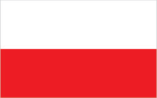
two equal horizontal bands of white (top) and red; similar to the flags of Indonesia and Monaco which are red (top) and white
Location
52 00 N, 20 00 E -- Central Europe, east of Germany Flag ----
Geography
Area
- comparative area
- slightly smaller than New Mexico
- land area
- 304,510 sq km
- total area
- 312,683 sq km
Climate
temperate with cold, cloudy, moderately severe winters with frequent precipitation; mild summers with frequent showers and thundershowers
Coastline
491 km
Environment
- current issues
- situation has improved since 1989 due to decline in heavy industry and increased environmental concern by postcommunist governments; air pollution nonetheless remains serious because of sulfur dioxide emissions from coal-fired power plants, and the resulting acid rain has caused forest damage; water pollution from industrial and municipal sources is also a problem, as is disposal of hazardous wastes
- international agreements
- party to - Air Pollution, Antarctic-Environmental Protocol, Antarctic Treaty, Climate Change, Endangered Species, Environmental Modification, Hazardous Wastes, Marine Dumping, Nuclear Test Ban, Ozone Layer Protection, Ship Pollution, Wetlands, Whaling; signed, but not ratified - Air Pollution-Nitrogen Oxides, Air Pollution-Sulphur 94, Biodiversity, Law of the Sea
- natural hazards
- NA
Geographic coordinates
52 00 N, 20 00 E
Geographic note
historically, an area of conflict because of flat terrain and the lack of natural barriers on the North European Plain
International disputes
none
Irrigated land
1,000 sq km (1989 est.)
Land boundaries
- border countries
- Belarus 605 km, Czech Republic 658 km, Germany 456 km, Lithuania 91 km, Russia (Kaliningrad Oblast) 206 km, Slovakia 444 km, Ukraine 428 km
- total
- 2,888 km
Land use
- arable land
- 48%
- forest and woodland
- 29%
- meadows and pastures
- 13%
- other
- 10% (1992)
- permanent crops
- 0%
Location
Central Europe, east of Germany
Map references
Europe
Maritime claims
- exclusive economic zone
- defined by international treaties
- territorial sea
- 12 nm
Natural resources
coal, sulfur, copper, natural gas, silver, lead, salt
Terrain
- mostly flat plain; mountains along southern border
- highest point
- Rysy 2,499 m
- lowest point
- Raczki Elblaskie -2 m
People and Society
Age structure
0-14 years: 22% (male 4,399,649; female 4,188,824) 15-64 years: 66% (male 12,754,272; female 12,930,275) 65 years and over: 12% (male 1,654,526; female 2,715,019) (July 1996 est.)
Birth rate
11.92 births/1,000 population (1996 est.)
Death rate
10.08 deaths/1,000 population (1996 est.)
Ethnic divisions
Polish 97.6%, German 1.3%, Ukrainian 0.6%, Byelorussian 0.5% (1990 est.)
Infant mortality rate
12.4 deaths/1,000 live births (1996 est.)
Languages
Polish
Life expectancy at birth
- female
- 76.41 years (1996 est.)
- male
- 68.02 years
- total population
- 72.1 years
Literacy
- age 15 and over can read and write (1978 est.)
- female
- 98%
- male
- 99%
- total population
- 99%
Nationality
- adjective
- Polish
- noun
- Pole(s)
Net migration rate
-0.4 migrant(s)/1,000 population (1996 est.)
Population
38,642,565 (July 1996 est.)
Population growth rate
0.14% (1996 est.)
Religions
Roman Catholic 95% (about 75% practicing), Eastern Orthodox, Protestant, and other 5%
Sex ratio
- all ages
- 0.95 male(s)/female (1996 est.)
- at birth
- 1.06 male(s)/female
- under 15 years
- 1.05 male(s)/female 15-64 years: 0.99 male(s)/female 65 years and over: 0.61 male(s)/female
Total fertility rate
1.69 children born/woman (1996 est.)
Government
Administrative divisions
49 provinces (wojewodztwa, singular - wojewodztwo); Biala Podlaska, Bialystok, Bielsko Biala, Bydgoszcz, Chelm, Ciechanow, Czestochowa, Elblag, Gdansk, Gorzow, Jelenia Gora, Kalisz, Katowice, Kielce, Konin, Koszalin, Krakow, Krosno, Legnica, Leszno, Lodz, Lomza, Lublin, Nowy Sacz, Olsztyn, Opole, Ostroleka, Pila, Piotrkow, Plock, Poznan, Przemysl, Radom, Rzeszow, Siedlce, Sieradz, Skierniewice, Slupsk, Suwalki, Szczecin, Tarnobrzeg, Tarnow, Torun, Walbrzych, Warszawa, Wloclawek, Wroclaw, Zamosc, Zielona Gora
Capital
Warsaw
Constitution
interim "small constitution" came into effect in December 1992 replacing the communist-imposed constitution of 22 July 1952; new democratic constitution being drafted
Data code
PL
Diplomatic representation in US
- chancery
- 2640 16th Street NW, Washington, DC 20009
- chief of mission
- Ambassador Jerzy KOZMINSKI
- telephone
- [1] (202) 234-3800 through 3802
Executive branch
- cabinet
- Council of Ministers is responsible to the president and the Sejm; the prime minister appointed and the Sejm approved the Council of Ministers
- chief of state
- President Aleksander KWASNIEWSKI (since 23 December 1995) was elected for a five-year term by popular vote; election first round held 5 November 1995, second round held 19 November 1995 (next to be held NA November 2000); results - second round Aleksander KWASNIEWSKI 51.7%, Lech WALESA 48.3%
- head of government
- Prime Minister Wlodimierz CIMOSZEWICZ (since 7 February 1996), Deputy Prime Ministers Roman JAGIELINSKI (since NA), Grzegorz KOLODKO (since NA), and Miroslaw PIETRIEWICZ (since NA) were appointed by the Sejm
FAX
- [1] (202) 328-6271
- [48] (2) 628-82-98
- consulate(s) general
- Chicago, Los Angeles, and New York
- consulate(s) general
- Krakow
Flag
two equal horizontal bands of white (top) and red; similar to the flags of Indonesia and Monaco which are red (top) and white
Independence
11 November 1918 (independent republic proclaimed)
International organization participation
Australia Group, BIS, BSEC (observer), CBSS, CCC, CE, CEI, CERN, EBRD, ECE, EU (applicant), FAO, IAEA, IBRD, ICAO, ICFTU, ICRM, IDA, IFC, IFRCS, ILO, IMF, IMO, Inmarset, Intelsat, Interpol, IOC, IOM, ISO, ITU, MINURSO, NACC, NAM (guest), NSG, OAS (observer), OSCE, PCA, PFP, UN, UNAVEM III, UNCRO, UNCTAD, UNDOF, UNESCO, UNIDO, UNIFIL, UNIKOM, UNMOT, UNOMIG, UNPREDEP, UNPROFOR, UPU, WCL, WEU (associate partner), WFTU, WHO, WIPO, WMO, WToO, WTrO, ZC
Judicial branch
Supreme Court, judges are appointed by the president on the recommendation of the National Council of Judiciary
Legal system
mixture of Continental (Napoleonic) civil law and holdover communist legal theory; changes being gradually introduced as part of broader democratization process; limited judicial review of legislative acts; has not accepted compulsory ICJ jurisdiction
Legislative branch
- bicameral National Assembly (Zgromadzenie Narodowe) post-communist parties (PSL 34, SLD 37), post-Solidarity parties (UW 6, NSZZ 12, BBWR 2), non-communist, non-Solidarity (independents 7, unaffiliated 1, vacant 1) post-communist parties (SLD 171, PSL 132), post-Solidarity parties (UW 74, UP 41, BBWR 16), non-communist, non-Solidarity (KPN 22)
- note
- four seats are constitutionally assigned to ethnic German parties
Name of country
- conventional long form
- Republic of Poland
- conventional short form
- Poland
- local long form
- Rzeczpospolita Polska
- local short form
- Polska
National holiday
Constitution Day, 3 May (1791)
Other political or pressure groups
powerful Roman Catholic Church; Solidarity (trade union); All Poland Trade Union Alliance (OPZZ), trade union
Political parties and leaders
- non-Communist non-Solidarity
- Confederation for an Independent Poland (KPN), Leszek MOCZULSKI; German Minority (MN), Georg PORYLKA; Union of Real Politics (UPR), Janusz KORWIN-MIKKE; Democratic Party (SD), Antoni MACKIEWICZ
- post-Communist
- Democratic Left Alliance (SLD) (Social Democracy of Poland), Jozef OLEKSY; Polish Peasant Party (PSL), Waldemar PAWLAK
- post-Solidarity parties
- Freedom Union (UW; Democratic Union and Liberal Democratic Congress merged to form Freedom Union), Leszek BALCEROWICZ; Christian-National Union (ZCHN), Marian PILKA; Center Alliance Party (PC), Jaroslaw KACZYNSKI; Peasant Alliance (PL), Gabriel JANOWSKI; Solidarity Caucus (NSZZ), Marian KRZAKLEWSKI; Union of Labor (UP), Ryszard BUGAJ; Christian-Democratic Party (PCHD), Pawel LACZKOWSKI; Conservative Party, Aleksander HALL; Nonparty Reform Bloc (BBWR)
Sejm
elections last held 19 September 1993 (next to be held no later than 19 September 1997); results - percent of vote by party NA; seats - (460 total)
Senate (Senat)
elections last held 19 September 1993 (next to be held no later than 19 September 1997); results - percent of vote by party NA; seats - (100 total)
Suffrage
18 years of age; universal
Type of government
democratic state
US diplomatic representation
- chief of mission
- Ambassador Nicholas Andrew REY
- embassy
- Aleje Ujazdowskie 29/31, Warsaw
- mailing address
- American Embassy Warsaw, Unit 1340, APO AE 09213-1340
- telephone
- [48] (2) 628-30-41
Economy
Agriculture
potatoes, milk, fruits, vegetables, wheat; poultry and eggs; pork, beef
Budget
- expenditures
- $37.8 billion, including capital expenditures of $NA (1995 est.)
- revenues
- $34.5 billion
Currency
1 zloty (Zl) = 100 groszy
Economic aid
- recipient
- Western governments and institutions pledged $22 billion in grants and loans during 1990-94, but much of the money has not been disbursed
Economic overview
In 1995, Poland continued to make good progress in the difficult transition to a market economy that began on 1 January 1990, when the new democratic government instituted "shock therapy" by decontrolling prices, slashing subsidies, and drastically reducing import barriers. Although real GDP fell sharply in 1990 and 1991, in 1992 Poland became the first country in the region to resume economic growth with a 2.6% increase. Growth advanced to 3.8% in 1993, 5.2% in 1994, and 6.5% in 1995. Most of the growth since 1991 had come from the booming private sector, which now accounts for about 60% of GDP, due in large part to the creation of new private firms. The slow pace of privatization picked up somewhat in 1995, as 512 smaller state enterprises were transferred to private National Investment Funds under the Mass Privatization Program, but large-scale industry remains largely in state hands. Industrial production increased 10.2% in 1995, following a 13.2% rise in 1994, yet remains about 13% below the 1989 level. Inflation, which had approached 1,200% annually in early 1990, fell to 21.6% in December 1995, as the government held the 1995 budget deficit to less than 3% of GDP. After peaking at 16.9% in July 1994, unemployment gradually fell to 14.9% in December 1995 - although the rate still approaches 30% in some regions. The trade and current account balances officially are in deficit but in fact both have comfortable surpluses because of large, unrecorded sales to cross-border visitors. Prospects for 1996 are good, with the government promising to push privatization and social welfare reform. Economic growth should remain above 5%, with inflation dropping below 20% by yearend 1996 and unemployment continuing its slow decline. As for external debt, the burden was sharply reduced by reschedulings and write-offs of both private and official debt during 1991-94.
Electricity
- capacity
- 31,120,000 kW
- consumption per capita
- 3,000 kWh (1993)
- production
- 133.7 billion kWh
Exchange rates
zlotych (Zl) per US$1 - 2.55 (January 1996) 2.4250 (1995); note - a currency reform on 1 January 1995 replaced 10,000 old zlotys with 1 new zloty; 22,723 (1994), 18,115 (1993), 13,626 (1992), 10,576 (1991)
Exports
- $22.2 billion (f.o.b., 1995 est.)
- commodities
- intermediate goods 27.5%, machinery and transport equipment 19.8%, miscellaneous manufactures 20.5%, foodstuffs 11.6%, fuels 9.1% (1994)
- partners
- Germany 35.7%, Netherlands 5.9%, Russia 5.4%, Italy 4.9% (1994)
External debt
$42.1 billion (yearend 1995 est.)
Fiscal year
calendar year
GDP
purchasing power parity - $226.7 billion (1995 est.)
GDP composition by sector
- agriculture
- 7%
- industry
- 38%
- services
- 55% (1993)
GDP per capita
$5,800 (1995 est.)
GDP real growth rate
6.5% (1995 est.)
Illicit drugs
illicit producer of opium for domestic consumption and amphetamines for the international market; transshipment point for Asian and Latin American illicit drugs to Western Europe; producer of precursor chemicals
Imports
- $23.4 billion (f.o.b., 1995 est.)
- commodities
- machinery and transport equipment 28.9%, intermediate goods 20.2%, chemicals 14.7%, fuels 10.4%, miscellaneous manufactures 9.9%
- partners
- Germany 27.5%, Italy 8.4%, Russia 6.8%, UK 5.3% (1994)
Industrial production growth rate
10.2% (1995)
Industries
machine building, iron and steel, coal mining, chemicals, shipbuilding, food processing, glass, beverages, textiles
Inflation rate (consumer prices)
21.6% (December 1995)
Labor force
- 17.743 million (1994 annual average)
- by occupation
- industry and construction 32.0%, agriculture 27.6%, trade, transport, and communications 14.7%, government and other 25.7% (1992)
Unemployment rate
14.9% (December 1995)
Communications
Branches
Army, Navy, Air and Air Defense Force
Defense expenditures
exchange rate conversion - $2.4 billion, 2.4% of GDP (1995)
Manpower availability
- males age 15-49
- 10,267,551
- males fit for military service
- 7,994,460
- males reach military age (19) annually
- 324,960 (1996 est.)
Radio broadcast stations
AM 27, FM 27, shortwave 0
Radios
10.9 million (1993 est.)
Telephone system
- underdeveloped and outmoded system; government aims to have 10 million phones in service by the year 2000
- domestic
- cable, open wire, and microwave radio relay
- international
- satellite earth stations - NA Intelsat, NA Eutelsat, 1 Inmarsat (Atlantic and Indian Ocean Regions), and 1 Intersputnik (Atlantic Ocean Region)
Telephones
5 million (1994)
Television broadcast stations
40 (Russian repeaters 5)
Televisions
9.6 million Defense
Transportation
Airports
- total
- 134
- with paved runways 1 524 to 2 437 m
- 27
- with paved runways 2 438 to 3 047 m
- 30
- with paved runways 914 to 1 523 m
- 3
- with paved runways over 3 047 m
- 2
- with paved runways under 914 m
- 7
- with unpaved runways 1 524 to 2 437 m
- 10
- with unpaved runways 2 438 to 3 047 m
- 5
- with unpaved runways 914 to 1 523 m
- 32
- with unpaved runways under 914 m
- 18 (1994 est.)
Highways
- paved
- 235,247 km (including 257 km of expressways)
- total
- 367,000 km (excluding farm, factory, and forest roads)
- unpaved
- 131,753 km (1992 est.)
Merchant marine
- note
- Poland owns an additional 18 ships (1,000 GRT or over) totaling 179,913 DWT operating under the registries of The Bahamas, Liberia, Saint Vincent and the Grenadines, Vanuatu, and Cyprus (1995 est.)
- ships by type
- bulk 73, cargo 36, chemical tanker 4, container 7, oil tanker 1, passenger 1, roll-on/roll-off cargo 4, short-sea passenger 5
- total
- 131 ships (1,000 GRT or over) totaling 2,093,491 GRT/3,167,660 DWT
Pipelines
crude oil 1,986 km; petroleum products 360 km; natural gas 4,600 km (1992)
Ports
Gdansk, Gdynia, Gliwice, Kolobrzeg, Szczecin, Swinoujscie, Ustka, Warsaw, Wrocaw
Railways
- broad gauge
- 656 km 1.520-m gauge
- narrow gauge
- 1,855 km various gauges including 1.000-m, 0.785-m, 0.750-m, and 0.600-m (1995)
- standard gauge
- 22,655 km 1.435-m gauge (11,496 km electrified; 8,978 km double track)
- total
- 25,166 km
Waterways
3,997 km navigable rivers and canals (1991)