2017 Edition
CIA World Factbook 2017 Archive (HTML)
Introduction
Background
The Philippine Islands became a Spanish colony during the 16th century; they were ceded to the US in 1898 following the Spanish-American War. In 1935 the Philippines became a self-governing commonwealth. Manuel QUEZON was elected president and was tasked with preparing the country for independence after a 10-year transition. In 1942 the islands fell under Japanese occupation during World War II, and US forces and Filipinos fought together during 1944-45 to regain control. On 4 July 1946 the Republic of the Philippines attained its independence. A 20-year rule by Ferdinand MARCOS ended in 1986, when a "people power" movement in Manila ("EDSA 1") forced him into exile and installed Corazon AQUINO as president. Her presidency was hampered by several coup attempts that prevented a return to full political stability and economic development. Fidel RAMOS was elected president in 1992. His administration was marked by increased stability and by progress on economic reforms. In 1992, the US closed its last military bases on the islands. Joseph ESTRADA was elected president in 1998. He was succeeded by his vice-president, Gloria MACAPAGAL-ARROYO, in January 2001 after ESTRADA's stormy impeachment trial on corruption charges broke down and another "people power" movement ("EDSA 2") demanded his resignation. MACAPAGAL-ARROYO was elected to a six-year term as president in May 2004. Her presidency was marred by several corruption allegations but the Philippine economy was one of the few to avoid contraction following the 2008 global financial crisis, expanding each year of her administration. Benigno AQUINO III was elected to a six-year term as president in May 2010 and was succeeded by Rodrigo DUTERTE in May 2016. The Philippine Government faces threats from several groups, some of which are on the US Government's Foreign Terrorist Organization list. Manila has waged a decades-long struggle against ethnic Moro insurgencies in the southern Philippines, which has led to a peace accord with the Moro National Liberation Front and ongoing peace talks with the Moro Islamic Liberation Front. The decades-long Maoist-inspired New People's Army insurgency also operates through much of the country. The Philippines faces increased tension with China over disputed territorial and maritime claims in the South China Sea.
Geography
Area
- 300,000 sq km 298,170 sq km 1,830 sq km
- land
- 298,170 sq km
- total
- 300,000 sq km
- water
- 1,830 sq km
Area - comparative
slightly less than twice the size of Georgia; slightly larger than Arizona
Climate
tropical marine; northeast monsoon (November to April); southwest monsoon (May to October)
Coastline
36,289 km
Elevation
- 442 m lowest point: Philippine Sea 0 m highest point: Mount Apo 2,954 m
- elevation extremes
- lowest point: Philippine Sea 0 m
- highest point
- Mount Apo 2,954 m
- mean elevation
- 442 m
Environment - current issues
uncontrolled deforestation especially in watershed areas; soil erosion; air and water pollution in major urban centers; coral reef degradation; increasing pollution of coastal mangrove swamps that are important fish breeding grounds
Environment - international agreements
- Biodiversity, Climate Change, Climate Change-Kyoto Protocol, Desertification, Endangered Species, Hazardous Wastes, Law of the Sea, Marine Dumping, Ozone Layer Protection, Ship Pollution, Tropical Timber 83, Tropical Timber 94, Wetlands, Whaling Air Pollution-Persistent Organic Pollutants
- party to
- Biodiversity, Climate Change, Climate Change-Kyoto Protocol, Desertification, Endangered Species, Hazardous Wastes, Law of the Sea, Marine Dumping, Ozone Layer Protection, Ship Pollution, Tropical Timber 83, Tropical Timber 94, Wetlands, Whaling
- signed, but not ratified
- Air Pollution-Persistent Organic Pollutants
Geographic coordinates
13 00 N, 122 00 E
Geography - note
- favorably located in relation to many of Southeast Asia's main water bodies: the South China Sea, Philippine Sea, Sulu Sea, Celebes Sea, and Luzon Strait for decades, the Philippine archipelago was reported as having 7,107 islands; in 2016, the national mapping authority reported that hundreds of new islands had been discovered and increased the number of islands to 7,641 - though not all of the new islands have been verified
- note 1
- favorably located in relation to many of Southeast Asia's main water bodies: the South China Sea, Philippine Sea, Sulu Sea, Celebes Sea, and Luzon Strait
- note 2
- for decades, the Philippine archipelago was reported as having 7,107 islands; in 2016, the national mapping authority reported that hundreds of new islands had been discovered and increased the number of islands to 7,641 - though not all of the new islands have been verified
Irrigated land
16,270 sq km (2012)
Land boundaries
0 km
Land use
- 41% arable land 18.2%; permanent crops 17.8%; permanent pasture 5% 25.9% 33.1% (2011 est.)
- agricultural land
- 41%
- forest
- 25.9%
- other
- 33.1% (2011 est.)
Location
Southeastern Asia, archipelago between the Philippine Sea and the South China Sea, east of Vietnam
Map references
Southeast Asia
Maritime claims
- irregular polygon extending up to 100 nm from coastline as defined by 1898 treaty; since late 1970s has also claimed polygonal-shaped area in South China Sea as wide as 285 nm 200 nm to the depth of exploitation
- continental shelf
- to the depth of exploitation
- exclusive economic zone
- 200 nm
- territorial sea
- irregular polygon extending up to 100 nm from coastline as defined by 1898 treaty; since late 1970s has also claimed polygonal-shaped area in South China Sea as wide as 285 nm
Natural hazards
- astride typhoon belt, usually affected by 15 and struck by five to six cyclonic storms each year; landslides; active volcanoes; destructive earthquakes; tsunamis significant volcanic activity; Taal (311 m), which has shown recent unrest and may erupt in the near future, has been deemed a Decade Volcano by the International Association of Volcanology and Chemistry of the Earth's Interior, worthy of study due to its explosive history and close proximity to human populations; Mayon (2,462 m), the country's most active volcano, erupted in 2009 forcing over 33,000 to be evacuated; other historically active volcanoes include Biliran, Babuyan Claro, Bulusan, Camiguin, Camiguin de Babuyanes, Didicas, Iraya, Jolo, Kanlaon, Makaturing, Musuan, Parker, Pinatubo, and Ragang
- volcanism
- significant volcanic activity; Taal (311 m), which has shown recent unrest and may erupt in the near future, has been deemed a Decade Volcano by the International Association of Volcanology and Chemistry of the Earth's Interior, worthy of study due to its explosive history and close proximity to human populations; Mayon (2,462 m), the country's most active volcano, erupted in 2009 forcing over 33,000 to be evacuated; other historically active volcanoes include Biliran, Babuyan Claro, Bulusan, Camiguin, Camiguin de Babuyanes, Didicas, Iraya, Jolo, Kanlaon, Makaturing, Musuan, Parker, Pinatubo, and Ragang
Natural resources
timber, petroleum, nickel, cobalt, silver, gold, salt, copper
Population - distribution
population concentrated where good farmlands lie; highest concentrations are northwest and south-central Luzon, the southeastern extension of Luzon, and the islands of the Visayan Sea, particularly Cebu and Negros; Manila is home to one-eighth of the entire national population
Terrain
mostly mountains with narrow to extensive coastal lowlands
People and Society
Age structure
- 33.39% (male 17,764,826/female 17,050,168) 19.16% (male 10,199,389/female 9,780,025) 36.99% (male 19,597,675/female 18,964,900) 5.97% (male 2,844,739/female 3,375,139) 4.49% (male 1,930,273/female 2,748,942) (2017 est.)
- 0-14 years
- 33.39% (male 17,764,826/female 17,050,168)
- 15-24 years
- 19.16% (male 10,199,389/female 9,780,025)
- 25-54 years
- 36.99% (male 19,597,675/female 18,964,900)
- 55-64 years
- 5.97% (male 2,844,739/female 3,375,139)
- 65 years and over
- 4.49% (male 1,930,273/female 2,748,942) (2017 est.)
Birth rate
23.7 births/1,000 population (2017 est.)
Children under the age of 5 years underweight
19.9% (2013)
Contraceptive prevalence rate
55.1% (2013)
Death rate
6.1 deaths/1,000 population (2017 est.)
Dependency ratios
- 58.2 7.2 13.8 (2015 est.)
- elderly dependency ratio
- 7.2
- potential support ratio
- 13.8 (2015 est.)
- total dependency ratio
- 58.2
- youth dependency ratio
- 51
Drinking water source
- urban: 93.7% of population rural: 90.3% of population total: 91.8% of population urban: 6.3% of population rural: 9.7% of population total: 8.2% of population (2015 est.)
- rural
- 9.7% of population
- total
- 8.2% of population (2015 est.)
- urban
- 6.3% of population
Education expenditures
2.7% of GDP (2009)
Ethnic groups
Tagalog 28.1%, Cebuano 13.1%, Ilocano 9%, Bisaya/Binisaya 7.6%, Hiligaynon Ilonggo 7.5%, Bikol 6%, Waray 3.4%, other 25.3% (2000 census)
Health expenditures
4.7% of GDP (2014)
HIV/AIDS - adult prevalence rate
0.1% (2016 est.)
HIV/AIDS - people living with HIV/AIDS
56,000 (2016 est.)
Hospital bed density
1 beds/1,000 population (2011)
Infant mortality rate
- 21.4 deaths/1,000 live births 24.3 deaths/1,000 live births 18.3 deaths/1,000 live births (2017 est.)
- female
- 18.3 deaths/1,000 live births (2017 est.)
- male
- 24.3 deaths/1,000 live births
- total
- 21.4 deaths/1,000 live births
Languages
Filipino (official; based on Tagalog) and English (official); eight major dialects - Tagalog, Cebuano, Ilocano, Hiligaynon or Ilonggo, Bicol, Waray, Pampango, and Pangasinan
Life expectancy at birth
- 69.4 years 65.9 years 73.1 years (2017 est.)
- female
- 73.1 years (2017 est.)
- male
- 65.9 years
- total population
- 69.4 years
Literacy
- age 15 and over can read and write 96.3% 95.8% 96.8% (2015 est.)
- definition
- age 15 and over can read and write
- female
- 96.8% (2015 est.)
- male
- 95.8%
- total population
- 96.3%
Major infectious diseases
- high bacterial diarrhea, hepatitis A, and typhoid fever dengue fever and malaria leptospirosis (2016)
- degree of risk
- high
- food or waterborne diseases
- bacterial diarrhea, hepatitis A, and typhoid fever
- vectorborne diseases
- dengue fever and malaria
- water contact disease
- leptospirosis (2016)
Major urban areas - population
MANILA (capital) 12.946 million; Davao 1.63 million; Cebu City 951,000; Zamboanga 936,000 (2015)
Maternal mortality rate
114 deaths/100,000 live births (2015 est.)
Median age
- 23.5 years 23.1 years 24 years (2017 est.)
- female
- 24 years (2017 est.)
- male
- 23.1 years
- total
- 23.5 years
Mother's mean age at first birth
- 23 years median age at first birth among women 25-29 (2013 est.)
- note
- median age at first birth among women 25-29 (2013 est.)
Nationality
- Filipino(s) Philippine
- adjective
- Philippine
- noun
- Filipino(s)
Net migration rate
-2 migrant(s)/1,000 population (2017 est.)
Obesity - adult prevalence rate
6.4% (2016)
Population
104,256,076 (July 2017 est.)
Population distribution
population concentrated where good farmlands lie; highest concentrations are northwest and south-central Luzon, the southeastern extension of Luzon, and the islands of the Visayan Sea, particularly Cebu and Negros; Manila is home to one-eighth of the entire national population
Population growth rate
1.57% (2017 est.)
Religions
Catholic 82.9% (Roman Catholic 80.9%, Aglipayan 2%), Muslim 5%, Evangelical 2.8%, Iglesia ni Kristo 2.3%, other Christian 4.5%, other 1.8%, unspecified 0.6%, none 0.1% (2000 census)
Sanitation facility access
- urban: 77.9% of population rural: 70.8% of population total: 73.9% of population urban: 22.1% of population rural: 29.2% of population total: 26.1% of population (2015 est.)
- rural
- 29.2% of population
- total
- 26.1% of population (2015 est.)
- urban
- 22.1% of population
School life expectancy (primary to tertiary education)
- 13 years 12 years 13 years (2013)
- female
- 13 years (2013)
- male
- 12 years
- total
- 13 years
Sex ratio
- 1.05 male(s)/female 1.04 male(s)/female 1.04 male(s)/female 1.03 male(s)/female 0.84 male(s)/female 0.72 male(s)/female 1.01 male(s)/female (2016 est.)
- 0-14 years
- 1.04 male(s)/female
- 15-24 years
- 1.04 male(s)/female
- 25-54 years
- 1.03 male(s)/female
- 55-64 years
- 0.84 male(s)/female
- 65 years and over
- 0.72 male(s)/female
- at birth
- 1.05 male(s)/female
- total population
- 1.01 male(s)/female (2016 est.)
Total fertility rate
3.02 children born/woman (2017 est.)
Unemployment, youth ages 15-24
- 15% 14.3% 16% (2015 est.)
- female
- 16% (2015 est.)
- male
- 14.3%
- total
- 15%
Urbanization
- 44.2% of total population (2017) 1.57% annual rate of change (2015-20 est.)
- rate of urbanization
- 1.57% annual rate of change (2015-20 est.)
- urban population
- 44.2% of total population (2017)
Government
Administrative divisions
- 80 provinces and 39 chartered cities Abra, Agusan del Norte, Agusan del Sur, Aklan, Albay, Antique, Apayao, Aurora, Basilan, Bataan, Batanes, Batangas, Biliran, Benguet, Bohol, Bukidnon, Bulacan, Cagayan, Camarines Norte, Camarines Sur, Camiguin, Capiz, Catanduanes, Cavite, Cebu, Compostela, Cotabato, Davao del Norte, Davao del Sur, Davao Oriental, Dinagat Islands, Eastern Samar, Guimaras, Ifugao, Ilocos Norte, Ilocos Sur, Iloilo, Isabela, Kalinga, Laguna, Lanao del Norte, Lanao del Sur, La Union, Leyte, Maguindanao, Marinduque, Masbate, Mindoro Occidental, Mindoro Oriental, Misamis Occidental, Misamis Oriental, Mountain, Negros Occidental, Negros Oriental, Northern Samar, Nueva Ecija, Nueva Vizcaya, Palawan, Pampanga, Pangasinan, Quezon, Quirino, Rizal, Romblon, Samar, Sarangani, Siquijor, Sorsogon, South Cotabato, Southern Leyte, Sultan Kudarat, Sulu, Surigao del Norte, Surigao del Sur, Tarlac, Tawi-Tawi, Zambales, Zamboanga del Norte, Zamboanga del Sur, Zamboanga Sibugay Angeles, Antipolo, Bacolod, Baguio, Butuan, Cagayan de Oro, Caloocan, Cebu, Cotabato, Dagupan, Davao, General Santos, Iligan, Iloilo, Lapu-Lapu, Las Pinas, Lucena, Makati, Malabon, Mandaluyong, Mandaue, Manila, Marikina, Muntinlupa, Naga, Navotas, Olongapo, Ormoc, Paranaque, Pasay, Pasig, Puerto Princesa, Quezon, San Juan, Santiago, Tacloban, Taguig, Valenzuela, Zamboanga (2012)
- chartered cities
- Angeles, Antipolo, Bacolod, Baguio, Butuan, Cagayan de Oro, Caloocan, Cebu, Cotabato, Dagupan, Davao, General Santos, Iligan, Iloilo, Lapu-Lapu, Las Pinas, Lucena, Makati, Malabon, Mandaluyong, Mandaue, Manila, Marikina, Muntinlupa, Naga, Navotas, Olongapo, Ormoc, Paranaque, Pasay, Pasig, Puerto Princesa, Quezon, San Juan, Santiago, Tacloban, Taguig, Valenzuela, Zamboanga (2012)
- provinces
- Abra, Agusan del Norte, Agusan del Sur, Aklan, Albay, Antique, Apayao, Aurora, Basilan, Bataan, Batanes, Batangas, Biliran, Benguet, Bohol, Bukidnon, Bulacan, Cagayan, Camarines Norte, Camarines Sur, Camiguin, Capiz, Catanduanes, Cavite, Cebu, Compostela, Cotabato, Davao del Norte, Davao del Sur, Davao Oriental, Dinagat Islands, Eastern Samar, Guimaras, Ifugao, Ilocos Norte, Ilocos Sur, Iloilo, Isabela, Kalinga, Laguna, Lanao del Norte, Lanao del Sur, La Union, Leyte, Maguindanao, Marinduque, Masbate, Mindoro Occidental, Mindoro Oriental, Misamis Occidental, Misamis Oriental, Mountain, Negros Occidental, Negros Oriental, Northern Samar, Nueva Ecija, Nueva Vizcaya, Palawan, Pampanga, Pangasinan, Quezon, Quirino, Rizal, Romblon, Samar, Sarangani, Siquijor, Sorsogon, South Cotabato, Southern Leyte, Sultan Kudarat, Sulu, Surigao del Norte, Surigao del Sur, Tarlac, Tawi-Tawi, Zambales, Zamboanga del Norte, Zamboanga del Sur, Zamboanga Sibugay
Capital
- Manila 14 36 N, 120 58 E UTC+8 (13 hours ahead of Washington, DC, during Standard Time)
- geographic coordinates
- 14 36 N, 120 58 E
- name
- Manila
- time difference
- UTC+8 (13 hours ahead of Washington, DC, during Standard Time)
Citizenship
- no at least one parent must be a citizen of the Philippines no 10 years
- citizenship by birth
- no
- citizenship by descent only
- at least one parent must be a citizen of the Philippines
- dual citizenship recognized
- no
- residency requirement for naturalization
- 10 years
Constitution
several previous; latest ratified 2 February 1987, effective 11 February 1987 (2016)
Country name
- Republic of the Philippines Philippines Republika ng Pilipinas Pilipinas named in honor of King PHILLIP II of Spain by Spanish explorer Ruy LOPEZ de VILLALOBOS, who visited some of the islands in 1543
- conventional long form
- Republic of the Philippines
- conventional short form
- Philippines
- etymology
- named in honor of King PHILLIP II of Spain by Spanish explorer Ruy LOPEZ de VILLALOBOS, who visited some of the islands in 1543
- local long form
- Republika ng Pilipinas
- local short form
- Pilipinas
Diplomatic representation from the US
- Ambassador Sung KIM (since 6 December 2016) 1201 Roxas Boulevard, Manila 1000 PSC 500, FPO AP 96515-1000 [63] (2) 301-2000 [63] (2) 301-2017
- chief of mission
- Ambassador Sung KIM (since 6 December 2016)
- embassy
- 1201 Roxas Boulevard, Manila 1000
- FAX
- [63] (2) 301-2017
- mailing address
- PSC 500, FPO AP 96515-1000
- telephone
- [63] (2) 301-2000
Diplomatic representation in the US
- Ambassador (vacant); Charge d'Affaires Ad interim Patrick Ang CHUASOTO (since 30 June 2016) 1600 Massachusetts Avenue NW, Washington, DC 20036 [1] (202) 467-9300 [1] (202) 328-7614 Chicago, Honolulu, Los Angeles, New Yoek, Saipan (Northern Mariana Islands), San Francisco, Tamuning (Guam)
- chancery
- 1600 Massachusetts Avenue NW, Washington, DC 20036
- chief of mission
- Ambassador (vacant); Charge d'Affaires Ad interim Patrick Ang CHUASOTO (since 30 June 2016)
- consulate(s) general
- Chicago, Honolulu, Los Angeles, New Yoek, Saipan (Northern Mariana Islands), San Francisco, Tamuning (Guam)
- FAX
- [1] (202) 328-7614
- telephone
- [1] (202) 467-9300
Executive branch
- President Rodrigo DUTERTE (since 30 June 2016); Vice President Leni ROBREDO (since 30 June 2016); note - the president is both chief of state and head of government President Rodrigo DUTERTE (since 30 June 2016); Vice President Leni ROBREDO (since 30 June 2016) Cabinet appointed by the president with the consent of the Commission of Appointments, an independent body of 25 Congressional members including the Senate president (ex officio chairman), appointed by the president president and vice president directly elected on separate ballots by simple majority popular vote for a single 6-year term; election last held on 9 May 2016 (next to be held in May 2022) Rodrigo DUTERTE elected president; percent of vote - Rodrigo DUTERTE (PDP-Laban) 39%, Manuel "Mar" ROXAS (LP) 23.5%, Grace POE (independent) 21.4%, Jejomar BINAY (UNA) 12.7%, Miriam Defensor SANTIAGO (PRP) 3.4%; Leni ROBREDO elected vice president; percent of vote Leni ROBREDO (LP) 35.1%, Bongbong MARCOS (independent) 34.5%, Alan CAYETANO 14.4%, Francis ESCUDERO (independent) 12%, Antonio TRILLANES (independent) 2.1%, Gregorio HONASAN (UNA) 1.9%
- cabinet
- Cabinet appointed by the president with the consent of the Commission of Appointments, an independent body of 25 Congressional members including the Senate president (ex officio chairman), appointed by the president
- chief of state
- President Rodrigo DUTERTE (since 30 June 2016); Vice President Leni ROBREDO (since 30 June 2016); note - the president is both chief of state and head of government
- election results
- Rodrigo DUTERTE elected president; percent of vote - Rodrigo DUTERTE (PDP-Laban) 39%, Manuel "Mar" ROXAS (LP) 23.5%, Grace POE (independent) 21.4%, Jejomar BINAY (UNA) 12.7%, Miriam Defensor SANTIAGO (PRP) 3.4%; Leni ROBREDO elected vice president; percent of vote Leni ROBREDO (LP) 35.1%, Bongbong MARCOS (independent) 34.5%, Alan CAYETANO 14.4%, Francis ESCUDERO (independent) 12%, Antonio TRILLANES (independent) 2.1%, Gregorio HONASAN (UNA) 1.9%
- elections/appointments
- president and vice president directly elected on separate ballots by simple majority popular vote for a single 6-year term; election last held on 9 May 2016 (next to be held in May 2022)
- head of government
- President Rodrigo DUTERTE (since 30 June 2016); Vice President Leni ROBREDO (since 30 June 2016)
Flag description
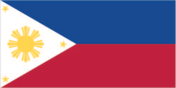
- two equal horizontal bands of blue (top) and red; a white equilateral triangle is based on the hoist side; the center of the triangle displays a yellow sun with eight primary rays; each corner of the triangle contains a small, yellow, five-pointed star; blue stands for peace and justice, red symbolizes courage, the white equal-sided triangle represents equality; the rays recall the first eight provinces that sought independence from Spain, while the stars represent the three major geographical divisions of the country: Luzon, Visayas, and Mindanao; the design of the flag dates to 1897 in wartime the flag is flown upside down with the red band at the top
- note
- in wartime the flag is flown upside down with the red band at the top
- two equal horizontal bands of blue (top) and red; a white equilateral triangle is based on the hoist side; the center of the triangle displays a yellow sun with eight primary rays; each corner of the triangle contains a small, yellow, five-pointed star; b
- Luzon, Visayas, and Mindanao; the design of the flag dates to 1897
Government type
presidential republic
Independence
4 July 1946 (from the US)
International law organization participation
accepts compulsory ICJ jurisdiction with reservations; accepts ICCt jurisdiction
International organization participation
ADB, APEC, ARF, ASEAN, BIS, CD, CICA (observer), CP, EAS, FAO, G-24, G-77, IAEA, IBRD, ICAO, ICC (national committees), ICCt, ICRM, IDA, IFAD, IFC, IFRCS, IHO, ILO, IMF, IMO, IMSO, Interpol, IOC, IOM, IPU, ISO, ITSO, ITU, ITUC (NGOs), MIGA, MINUSTAH, NAM, OAS (observer), OPCW, PCA, PIF (partner), UN, UNCTAD, UNESCO, UNHCR, UNIDO, Union Latina, UNMIL, UNMOGIP, UNOCI, UNWTO, UPU, WCO, WFTU (NGOs), WHO, WIPO, WMO, WTO
Judicial branch
- Supreme Court (consists of a chief justice and 14 associate justices) justices are appointed by the president on the recommendation of the Judicial and Bar Council, a constitutionally created, 6-member body that recommends Supreme Court nominees; justices serve until age 70 Court of Appeals; Sandiganbayan (special court for corruption cases of government officials); Court of Tax Appeals; regional, metropolitan, and municipal trial courts; sharia courts
- highest court(s)
- Supreme Court (consists of a chief justice and 14 associate justices)
- judge selection and term of office
- justices are appointed by the president on the recommendation of the Judicial and Bar Council, a constitutionally created, 6-member body that recommends Supreme Court nominees; justices serve until age 70
- subordinate courts
- Court of Appeals; Sandiganbayan (special court for corruption cases of government officials); Court of Tax Appeals; regional, metropolitan, and municipal trial courts; sharia courts
Legal system
mixed legal system of civil, common, Islamic, and customary law
Legislative branch
- bicameral Congress or Kongreso consists of the Senate or Senado (24 seats; members directly elected in multi-seat constituencies by majority vote; members serve 6-year terms with one-half of the membership renewed every 3 years) and the House of Representatives or Kapulungan Ng Mga Kinatawan (297 seats; 238 members directly elected in single-seat constituencies by simple majority vote and 59 representing minorities directly elected by party-list proportional representation vote; members serve 3-year terms) Senate - elections last held on 9 May 2016 (next to be held in May 2019); House of Representatives - elections last held on 9 May 2016 (next to be held in May 2019) Senate - percent of vote by party - LP 31.3%, NPC 10.1%, UNA 7.6%, Akbayan 5.0%, other 30.9%, independent 15.1%; seats by party - LP 6, NPC 3, UNA 4, Akbayan 1, other 10; House of Representatives - percent of vote by party - LP 41.7%, NPC 17.0%, UNA 6.6%, NUP 9.7%, NP 9.4%, independent 6.0%, others 10.1%; seats by party - LP 115, NPC 42, NUP 23, NP 24, UNA 11, other 19, independent 4, party-list 59
- description
- bicameral Congress or Kongreso consists of the Senate or Senado (24 seats; members directly elected in multi-seat constituencies by majority vote; members serve 6-year terms with one-half of the membership renewed every 3 years) and the House of Representatives or Kapulungan Ng Mga Kinatawan (297 seats; 238 members directly elected in single-seat constituencies by simple majority vote and 59 representing minorities directly elected by party-list proportional representation vote; members serve 3-year terms)
- election results
- Senate - percent of vote by party - LP 31.3%, NPC 10.1%, UNA 7.6%, Akbayan 5.0%, other 30.9%, independent 15.1%; seats by party - LP 6, NPC 3, UNA 4, Akbayan 1, other 10; House of Representatives - percent of vote by party - LP 41.7%, NPC 17.0%, UNA 6.6%, NUP 9.7%, NP 9.4%, independent 6.0%, others 10.1%; seats by party - LP 115, NPC 42, NUP 23, NP 24, UNA 11, other 19, independent 4, party-list 59
- elections
- Senate - elections last held on 9 May 2016 (next to be held in May 2019); House of Representatives - elections last held on 9 May 2016 (next to be held in May 2019)
National anthem
- "Lupang Hinirang" (Chosen Land) Jose PALMA (revised by Felipe PADILLA de Leon)/Julian FELIPE music adopted 1898, original Spanish lyrics adopted 1899, Filipino (Tagalog) lyrics adopted 1956; although the original lyrics were written in Spanish, later English and Filipino versions were created; today, only the Filipino version is used
- lyrics/music
- Jose PALMA (revised by Felipe PADILLA de Leon)/Julian FELIPE
- name
- "Lupang Hinirang" (Chosen Land)
- note
- music adopted 1898, original Spanish lyrics adopted 1899, Filipino (Tagalog) lyrics adopted 1956; although the original lyrics were written in Spanish, later English and Filipino versions were created; today, only the Filipino version is used
National holiday
Independence Day, 12 June (1898); note - 12 June 1898 was date of declaration of independence from Spain; 4 July 1946 was date of independence from the US
National symbol(s)
- three stars and sun, Philippine eagle; national colors: red, white, blue, yellow
- three stars and sun, Philippine eagle; national colors
- red, white, blue, yellow
Political parties and leaders
Akbayon [Machris CABREROS] Laban ng Demokratikong Pilipino (Struggle of Filipino Democrats) or LDP [Edgardo ANGARA] Lakas ng EDSA-Christian Muslim Democrats or Lakas-CMD [Ferdinand Martin ROMUALDEZ] Liberal Party or LP [Francis PANGILINAN] Nacionalista Party or NP [Manuel "Manny" VILLAR] Nationalist People's Coalition or NPC [Eduardo COJUNGCO, Jr.] National Unity Party or NUP [Albert GARCIA] PDP-Laban [Aquilino PIMENTEL III] People's Reform Party or PRP [Narcisco SANTIAGO] Puwersa ng Masang Pilipino (Force of the Philippine Masses) or PMP [Joseph ESTRADA] United Nationalist Alliance or UNA
Political pressure groups and leaders
Black and White Movement or BWM [Vicente ROMANO] People Action (Kilosbayan)
Suffrage
18 years of age; universal
Economy
Agriculture - products
rice, fish, livestock, poultry, bananas, coconut/copra, corn, sugarcane, mangoes, pineapple, cassava
Budget
- $46.24 billion $53.68 billion (2016 est.)
- expenditures
- $53.68 billion (2016 est.)
- revenues
- $46.24 billion
Budget surplus (+) or deficit (-)
-2.4% of GDP (2016 est.)
Central bank discount rate
3.56% (31 December 2016) 6.19% (31 December 2015)
Commercial bank prime lending rate
5.64% (31 December 2016 est.) 5.58% (31 December 2015 est.)
Current account balance
$601 million (2016 est.) $7.266 billion (2015 est.)
Debt - external
$75.01 billion (31 December 2016 est.) $77.73 billion (31 December 2015 est.)
Distribution of family income - Gini index
44.4 (2015 est.) 46 (2012 est.)
Economy - overview
The economy has been relatively resilient to global economic shocks due to less exposure to troubled international securities, lower dependence on exports, relatively resilient domestic consumption, large remittances from about 10 million overseas Filipino workers and migrants, and a rapidly expanding outsourcing industry. During 2016, the current account balance narrowed to its lowest level since the 2008 global financial crisis, but nevertheless mustered a surplus for a 14th consecutive year. International reserves remain at comfortable levels and the banking system is stable. Efforts to improve tax administration and expenditures management have helped ease the Philippines' debt burden and tight fiscal situation. The Philippines received investment-grade credit ratings on its sovereign debt under the former AQUINO administration and has had little difficulty financing its budget deficits. However, weak absorptive capacity and implementation bottlenecks have prevented the government from maximizing its expenditure plans. Although it has improved, the low tax-to-GDP ratio remains a constraint to supporting increasingly higher spending levels and sustaining high and inclusive growth over the longer term. Economic growth has accelerated, averaging 6.1% per year from 2011 to 2016, compared with 4.5% under the MACAPAGAL-ARROYO government; and competitiveness rankings have improved. Although 2016 saw a record year for net foreign direct investment inflows, FDI to the Philippines has continued to lag regional peers, in part because the Philippine constitution and other laws restrict foreign ownership in important activities/sectors - such as land ownership and public utilities. Although the economy grew at a faster pace under the AQUINO government, challenges to achieving more inclusive growth remain. Wealth is concentrated in the hands of the rich. The unemployment rate declined from 7.3% to 5.5% between 2010 and 2016 but the jobs are low paying and tedious. Underemployment hovers at around 18% to 19% of the employed. At least 40% of the employed work in the informal sector. Poverty afflicts more than a fifth of the population. More than 60% of the poor reside in rural areas, where the incidence of poverty (about 30%) is more severe - a challenge to raising rural farm and non-farm incomes. Continued efforts are needed to improve governance, the judicial system, the regulatory environment, the infrastructure, and the overall ease of doing business. 2016 saw the election of President Rodrigo DUTERTE, who has pledged to make inclusive growth and poverty reduction his top priority. DUTERTE believes that illegal drug use, crime and corruption are key barriers to economic development among the lower income class. This administration wants to reduce the poverty rate to 14% and graduate the economy to upper-middle income status by the end of President DUTERTE’s term in 2022. Key themes under the government’s Ten-Point Socioeconomic Agenda include continuity of macroeconomic policy, tax reform, higher investments in infrastructure and human capital development, and improving competitiveness and the overall ease of doing business. The administration has vowed to address spending bottlenecks and is pushing for congressional passage of a Comprehensive Tax Reform Program to help finance more aggressive infrastructure and social spending, starting in 2018. The government also supports relaxing restrictions on foreign ownership, except for land.
Exchange rates
Philippine pesos (PHP) per US dollar - 47.493 (2016 est.) 47.493 (2015 est.) 45.503 (2014 est.) 44.395 (2013 est.) 42.23 (2012 est.)
Exports
$43.44 billion (2016 est.) $43.2 billion (2015 est.)
Exports - commodities
semiconductors and electronic products, machinery and transport equipment, wood manufactures, chemicals, processed food and beverages, garments, coconut oil, copper concentrates, seafood, bananas/fruits
Exports - partners
Japan 20.8%, US 15.5%, Hong Kong 11.7%, China 11%, Singapore 6.6%, Germany 4.1% (2016)
Fiscal year
calendar year
GDP - composition, by end use
- 73.6% 11.1% 24.6% -0.3% 28% -37% (2016 est.)
- exports of goods and services
- 28%
- government consumption
- 11.1%
- household consumption
- 73.6%
- imports of goods and services
- -37% (2016 est.)
- investment in fixed capital
- 24.6%
- investment in inventories
- -0.3%
GDP - composition, by sector of origin
- 9.7% 30.8% 59.5% (2016 est.)
- agriculture
- 9.7%
- industry
- 30.8%
- services
- 59.5% (2016 est.)
GDP - per capita (PPP)
- $7,700 (2016 est.) $7,400 (2015 est.) $7,100 (2014 est.) data are in 2016 dollars
- note
- data are in 2016 dollars
GDP - real growth rate
6.9% (2016 est.) 6.1% (2015 est.) 6.1% (2014 est.)
GDP (official exchange rate)
$304.9 billion (2016 est.)
GDP (purchasing power parity)
- $806.3 billion (2016 est.) $744.6 billion (2015 est.) $694.5 billion (2014 est.) data are in 2016 dollars
- note
- data are in 2016 dollars
Gross national saving
24.5% of GDP (2016 est.) 23.7% of GDP (2015 est.) 24.3% of GDP (2014 est.)
Household income or consumption by percentage share
- 3.2% 29.5% (2015 est.)
- highest 10%
- 29.5% (2015 est.)
- lowest 10%
- 3.2%
Imports
$77.52 billion (2016 est.) $66.51 billion (2015 est.)
Imports - commodities
electronic products, mineral fuels, machinery and transport equipment, iron and steel, textile fabrics, grains, chemicals, plastic
Imports - partners
China 17.3%, Japan 11.1%, US 8.4%, Thailand 7.3%, South Korea 6.1%, Singapore 6.1%, Indonesia 5.1% (2016)
Industrial production growth rate
8.4% (2016 est.)
Industries
semiconductors and electronics assembly, food and beverage manufacturing, construction, electric/gas/water supply, chemical products, radio/television/communications equipment and apparatus, petroleum and fuel, textile and garments, non-metallic minerals, basic metal industries, transport equipment
Inflation rate (consumer prices)
1.8% (2016 est.) 1.4% (2015 est.)
Labor force
43.2 million (2016 est.)
Labor force - by occupation
- 26.9% 17.5% 55.6% (2016 est.)
- agriculture
- 26.9%
- industry
- 17.5%
- services
- 55.6% (2016 est.)
Market value of publicly traded shares
$290.4 billion (31 December 2016 est.) $286.1 billion (31 December 2015 est.) $318 billion (31 December 2014 est.)
Population below poverty line
21.6% (2015 est.)
Public debt
42.1% of GDP (2016 est.) 44.8% of GDP (2015 est.)
Reserves of foreign exchange and gold
$80.69 billion (31 December 2016 est.) $80.67 billion (31 December 2015 est.)
Stock of broad money
$183.5 billion (31 December 2016 est.) $171 billion (31 December 2015 est.)
Stock of direct foreign investment - abroad
$45.38 billion (31 December 2016 est.) $41.02 billion (31 December 2015 est.)
Stock of direct foreign investment - at home
$64.25 billion (31 December 2016 est.) $58.52 billion (31 December 2015 est.)
Stock of domestic credit
$184.6 billion (31 December 2016 est.) $166.7 billion (31 December 2015 est.)
Stock of narrow money
$61.62 billion (31 December 2016 est.) $56.56 billion (31 December 2015 est.)
Taxes and other revenues
15.2% of GDP (2016 est.)
Unemployment rate
5.5% (2016 est.) 6.3% (2015 est.)
Energy
Carbon dioxide emissions from consumption of energy
88 million Mt (2013 est.)
Crude oil - exports
4,942 bbl/day (2016 est.)
Crude oil - imports
215,800 bbl/day (2016 est.)
Crude oil - production
20,000 bbl/day (2016 est.)
Crude oil - proved reserves
138.5 million bbl (1 January 2017 es)
Electricity - consumption
74.15 billion kWh (2016 est.)
Electricity - exports
0 kWh (2016 est.)
Electricity - from fossil fuels
67.5% of total installed capacity (2016 est.)
Electricity - from hydroelectric plants
16.9% of total installed capacity (2016 est.)
Electricity - from nuclear fuels
0% of total installed capacity (2016 est.)
Electricity - from other renewable sources
15.6% of total installed capacity (2016 est.)
Electricity - imports
0 kWh (2016 est.)
Electricity - installed generating capacity
21.21 million kW (2015 est.)
Electricity - production
90.8 billion kWh (2016 est.)
Electricity access
- 20,600,000 88% 94% 82% (2013)
- electrification - rural areas
- 82% (2013)
- electrification - total population
- 88%
- electrification - urban areas
- 94%
- population without electricity
- 20,600,000
Natural gas - consumption
3.196 billion cu m (2015 est.)
Natural gas - exports
0 cu m (2016 est.)
Natural gas - imports
0 cu m (2016 est.)
Natural gas - production
2.6 billion cu m (2015 est.)
Natural gas - proved reserves
98.54 billion cu m (1 January 2017 es)
Refined petroleum products - consumption
390,000 bbl/day (2015 est.)
Refined petroleum products - exports
13,140 bbl/day (2014 est.)
Refined petroleum products - imports
186,100 bbl/day (2014 est.)
Refined petroleum products - production
169,000 bbl/day (2014 est.)
Communications
Broadcast media
multiple national private TV and radio networks; multi-channel satellite and cable TV systems available; more than 400 TV stations; about 1,500 cable TV providers with more than 2 million subscribers, and some 1,400 radio stations; the Philippines adopted Japan’s Integrated Service Digital Broadcast – Terrestrial standard for digital terrestrial television in November 2013 and is scheduled to complete the switch from analog to digital broadcasting by the end of 2023 (2016)
Internet country code
.ph
Internet users
- 56,956,436 55.5% (July 2016 est.)
- percent of population
- 55.5% (July 2016 est.)
- total
- 56,956,436
Telephone system
- good international radiotelephone and submarine cable services; domestic and interisland service adequate telecommunications infrastructure includes the following platforms: fixed line, mobile cellular, cable TV, over-the-air TV, radio and Very Small Aperture Terminal (VSAT), fiber-optic cable, and satellite for redundant international connectivity country code - 63; a series of submarine cables together provide connectivity to the US, and to countries like Hong Kong, Guam, Singapore, Taiwan, Japan, Brunei, and Malaysia, among others; multiple international gateways (2016)
- domestic
- telecommunications infrastructure includes the following platforms: fixed line, mobile cellular, cable TV, over-the-air TV, radio and Very Small Aperture Terminal (VSAT), fiber-optic cable, and satellite for redundant international connectivity
- general assessment
- good international radiotelephone and submarine cable services; domestic and interisland service adequate
- international
- country code - 63; a series of submarine cables together provide connectivity to the US, and to countries like Hong Kong, Guam, Singapore, Taiwan, Japan, Brunei, and Malaysia, among others; multiple international gateways (2016)
Telephones - fixed lines
- 3,835,911 4 (July 2016 est.)
- subscriptions per 100 inhabitants
- 4 (July 2016 est.)
- total subscriptions
- 3,835,911
Telephones - mobile cellular
- 113 million 110 (July 2016 est.)
- subscriptions per 100 inhabitants
- 110 (July 2016 est.)
- total
- 113 million
Transportation
Airports
247 (2013)
Airports - with paved runways
- 10 (2017)
- 1,524 to 2,437 m
- 33
- 2,438 to 3,047 m
- 8
- 914 to 1,523 m
- 34
- over 3,047 m
- 4
- total
- 89
- under 914 m
- 10 (2017)
Airports - with unpaved runways
- 99 (2013)
- 1,524 to 2,437 m
- 3
- 914 to 1,523 m
- 56
- total
- 158
- under 914 m
- 99 (2013)
Civil aircraft registration country code prefix
RP (2016)
Heliports
2 (2013)
Merchant marine
- bulk carrier 76, cargo 152, carrier 12, chemical tanker 27, container 17, liquefied gas 5, passenger 7, passenger/cargo 65, petroleum tanker 44, refrigerated cargo 20, roll on/roll off 11, vehicle carrier 10 159 (Bermuda 47, China 4, Denmark 2, Germany 2, Greece 5, Japan 77, Malaysia 1, Netherlands 17, Singapore 1, South Korea 1, Taiwan 1, UAE 1) 7 (Cyprus 1, Panama 5, unknown 1) (2010)
- by type
- bulk carrier 76, cargo 152, carrier 12, chemical tanker 27, container 17, liquefied gas 5, passenger 7, passenger/cargo 65, petroleum tanker 44, refrigerated cargo 20, roll on/roll off 11, vehicle carrier 10
- foreign-owned
- 159 (Bermuda 47, China 4, Denmark 2, Germany 2, Greece 5, Japan 77, Malaysia 1, Netherlands 17, Singapore 1, South Korea 1, Taiwan 1, UAE 1)
- registered in other countries
- 7 (Cyprus 1, Panama 5, unknown 1) (2010)
- total
- 446
National air transport system
- 32,230,986 484,190,968 mt-km (2015)
- annual freight traffic on registered air carriers
- 484,190,968 mt-km (2015)
- annual passenger traffic on registered air carriers
- 32,230,986
- inventory of registered aircraft operated by air carriers
- 158
- number of registered air carriers
- 11
Pipelines
gas 530 km (2014); oil 138 km; refined products 185 km (2013)
Ports and terminals
- Batangas, Cagayan de Oro, Cebu, Davao, Liman, Manila Manila (3,976,000) (2015)
- container port(s) (TEUs)
- Manila (3,976,000) (2015)
- major seaport(s)
- Batangas, Cagayan de Oro, Cebu, Davao, Liman, Manila
Railways
- 995 km 995 km 1.067-m gauge (484 km are in operation) (2015)
- narrow gauge
- 995 km 1.067-m gauge (484 km are in operation) (2015)
- total
- 995 km
Roadways
- 216,387 km 61,093 km 155,294 km (2014)
- paved
- 61,093 km
- total
- 216,387 km
- unpaved
- 155,294 km (2014)
Waterways
3,219 km (limited to vessels with draft less than 1.5 m) (2011)
Military and Security
Maritime threats
the International Maritime Bureau reports the territorial and offshore waters in the South China Sea as high risk for piracy and armed robbery against ships; during 2016, 10 attacks were reported in and around the Philippines including six ships that were boarded, one hijacked, one fired upon, and 18 crew were kidnapped for ransom; an emerging threat area lies in the Celebes and Sulu Seas between the Philippines and Malaysia where 12 crew were kidnapped in three incidents during the last quarter of 2016; it is believed the pirates involved are associated with the Abu Sayyaf Group (ASG) terrorist organization; during the first six months of 2017, 13 attacks were reported including 10 ships that were boarded, one was fired upon, 10 crew were kidnapped for ransom and two killed; numerous commercial vessels have been attacked and hijacked both at anchor and while underway; hijacked vessels are often disguised and cargo diverted to ports in East Asia; crews have been murdered or cast adrift
Military branches
- Armed Forces of the Philippines (AFP): Army, Navy (includes Marine Corps), Air Force (2013)
- Armed Forces of the Philippines (AFP)
- Army, Navy (includes Marine Corps), Air Force (2013)
Military expenditures
1.28% of GDP (2016) 1.14% of GDP (2015) 1.09% of GDP (2014) 1.24% of GDP (2013) 1.16% of GDP (2012)
Military service age and obligation
17-23 years of age (officers 20-24) for voluntary military service; no conscription; applicants must be single male or female Philippine citizens with either 72 college credit hours (enlisted) or a baccalaureate degree (officers) (2013)
Transnational Issues
Disputes - international
Philippines claims sovereignty over Scarborough Reef (also claimed by China together with Taiwan) and over certain of the Spratly Islands, known locally as the Kalayaan (Freedom) Islands, also claimed by China, Malaysia, Taiwan, and Vietnam; the 2002 "Declaration on the Conduct of Parties in the South China Sea," has eased tensions in the Spratly Islands but falls short of a legally binding "code of conduct" desired by several of the disputants; in March 2005, the national oil companies of China, the Philippines, and Vietnam signed a joint accord to conduct marine seismic activities in the Spratly Islands; Philippines retains a dormant claim to Malaysia's Sabah State in northern Borneo based on the Sultanate of Sulu's granting the Philippines Government power of attorney to pursue a sovereignty claim on his behalf; maritime delimitation negotiations continue with Palau
Illicit drugs
domestic methamphetamine production has been a growing problem in recent years despite government crackdowns; major consumer of amphetamines; longstanding marijuana producer mainly in rural areas where Manila's control is limited
Refugees and internally displaced persons
- 359,680 (government troops fighting the Moro Islamic Liberation Front, the Abu Sayyaf Group, and the New People's Army; clan feuds; natural disasters) (2017) 4,636 (2016); note - stateless persons are descendants of Indonesian migrants
- IDPs
- 359,680 (government troops fighting the Moro Islamic Liberation Front, the Abu Sayyaf Group, and the New People's Army; clan feuds; natural disasters) (2017)
- stateless persons
- 4,636 (2016); note - stateless persons are descendants of Indonesian migrants