1999 Edition
CIA World Factbook 1999 (Internet Archive)
Geography
Area
total: 300,000 sq km land: 298,170 sq km water: 1,830 sq km
Area--comparative
slightly larger than Arizona
Climate
tropical marine; northeast monsoon (November to April); southwest monsoon (May to October)
Coastline
36,289 km
Elevation extremes
lowest point: Philippine Sea 0 m highest point: Mount Apo 2,954 m
Environment--current issues
uncontrolled deforestation in watershed areas; soil erosion; air and water pollution in Manila; increasing pollution of coastal mangrove swamps which are important fish breeding grounds
Environment--international agreements
party to: Biodiversity, Climate Change, Endangered Species, Hazardous Wastes, Law of the Sea, Marine Dumping, Nuclear Test Ban, Ozone Layer Protection, Tropical Timber 83, Tropical Timber 94, Wetlands, Whaling signed, but not ratified: Climate Change-Kyoto Protocol, Desertification
Geographic coordinates
13 00 N, 122 00 E
Irrigated land
15,800 sq km (1993 est.)
Land boundaries
0 km
Land use
arable land: 19% permanent crops: 12% permanent pastures: 4% forests and woodland: 46% other: 19% (1993 est.)
Location
Southeastern Asia, archipelago between the Philippine Sea and the South China Sea, east of Vietnam
Map references
Southeast Asia
Maritime claims
measured from claimed archipelagic baselines continental shelf: to depth of exploitation exclusive economic zone: 200 nm territorial sea: irregular polygon extending up to 100 nm from coastline as defined by 1898 treaty; since late 1970s has also claimed polygonal-shaped area in South China Sea up to 285 nm in breadth
Natural hazards
astride typhoon belt, usually affected by 15 and struck by five to six cyclonic storms per year; landslides; active volcanoes; destructive earthquakes; tsunamis
Natural resources
timber, petroleum, nickel, cobalt, silver, gold, salt, copper
Terrain
mostly mountains with narrow to extensive coastal lowlands
People and Society
Age structure
0-14 years: 37% (male 15,057,698; female 14,555,430) 15-64 years: 59% (male 23,168,043; female 23,715,877) 65 years and over: 4% (male 1,269,522; female 1,579,242) (1999 est.)
Birth rate
27.88 births/1,000 population (1999 est.)
Death rate
6.45 deaths/1,000 population (1999 est.)
Ethnic groups
Christian Malay 91.5%, Muslim Malay 4%, Chinese 1.5%, other 3%
Infant mortality rate
33.89 deaths/1,000 live births (1999 est.)
Languages
Pilipino (official, based on Tagalog), English (official)
Life expectancy at birth
total population: 66.58 years male: 63.79 years female: 69.5 years (1999 est.)
Literacy
definition: age 15 and over can read and write total population: 94.6% male: 95% female: 94.3% (1995 est.)
Nationality
noun: Filipino(s) adjective: Philippine
Net migration rate
-1.03 migrant(s)/1,000 population (1999 est.)
Population
79,345,812 (July 1999 est.)
Population growth rate
2.04% (1999 est.)
Religions
Roman Catholic 83%, Protestant 9%, Muslim 5%, Buddhist and other 3%
Sex ratio
at birth: 1.05 male(s)/female under 15 years: 1.03 male(s)/female 15-64 years: 0.98 male(s)/female 65 years and over: 0.8 male(s)/female total population: 0.99 male(s)/female (1999 est.)
Total fertility rate
3.46 children born/woman (1999 est.)
Government
Administrative divisions
72 provinces and 61 chartered cities*; Abra, Agusan del Norte, Agusan del Sur, Aklan, Albay, Angeles*, Antique, Aurora, Bacolod*, Bago*, Baguio*, Bais*, Basilan, Basilan City*, Bataan, Batanes, Batangas, Batangas City*, Benguet, Bohol, Bukidnon, Bulacan, Butuan*, Cabanatuan*, Cadiz*, Cagayan, Cagayan de Oro*, Calbayog*, Caloocan*, Camarines Norte, Camarines Sur, Camiguin, Canlaon*, Capiz, Catanduanes, Cavite, Cavite City*, Cebu, Cebu City*, Cotabato*, Dagupan*, Danao*, Dapitan*, Davao City* Davao, Davao del Sur, Davao Oriental, Dipolog*, Dumaguete*, Eastern Samar, General Santos*, Gingoog*, Ifugao, Iligan*, Ilocos Norte, Ilocos Sur, Iloilo, Iloilo City*, Iriga*, Isabela, Kalinga-Apayao, La Carlota*, Laguna, Lanao del Norte, Lanao del Sur, Laoag*, Lapu-Lapu*, La Union, Legaspi*, Leyte, Lipa*, Lucena*, Maguindanao, Mandaue*, Manila*, Marawi*, Marinduque, Masbate, Mindoro Occidental, Mindoro Oriental, Misamis Occidental, Misamis Oriental, Mountain, Naga*, Negros Occidental, Negros Oriental, North Cotabato, Northern Samar, Nueva Ecija, Nueva Vizcaya, Olongapo*, Ormoc*, Oroquieta*, Ozamis*, Pagadian*, Palawan, Palayan*, Pampanga, Pangasinan, Pasay*, Puerto Princesa*, Quezon, Quezon City*, Quirino, Rizal, Romblon, Roxas*, Samar, San Carlos* (in Negros Occidental), San Carlos* (in Pangasinan), San Jose*, San Pablo*, Silay*, Siquijor, Sorsogon, South Cotabato, Southern Leyte, Sultan Kudarat, Sulu, Surigao*, Surigao del Norte, Surigao del Sur, Tacloban*, Tagaytay*, Tagbilaran*, Tangub*, Tarlac, Tawitawi, Toledo*, Trece Martires*, Zambales, Zamboanga*, Zamboanga del Norte, Zamboanga del Sur
Capital
Manila
Constitution
2 February 1987, effective 11 February 1987
Country name
conventional long form: Republic of the Philippines conventional short form: Philippines local long form: Republika ng Pilipinas local short form: Pilipinas
Data code
RP
Executive branch
chief of state: President Joseph Ejercito ESTRADA (since 30 June 1998) and Vice President Gloria MACAPAGAL-ARROYO (since 30 June 1998); note--the president is both the chief of state and head of government head of government: President Joseph Ejercito ESTRADA (since 30 June 1998) and Vice President Gloria MACAPAGAL-ARROYO (since 30 June 1998); note--the president is both the chief of state and head of government cabinet: Cabinet appointed by the president with the consent of the Commission of Appointments elections: president and vice president elected on separate tickets by popular vote for six-year terms; election last held 11 May 1998 (next to be held 11 May 2004) election results: Joseph Ejercito ESTRADA elected president; percent of vote--NA%; Gloria MACAPAGAL-ARROYO elected vice president; percent of vote--NA%
Flag description
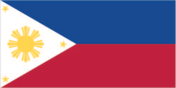
two equal horizontal bands of blue (top) and red with a white equilateral triangle based on the hoist side; in the center of the triangle is a yellow sun with eight primary rays (each containing three individual rays) and in each corner of the triangle is a small yellow five-pointed star
Government type
republic
Independence
4 July 1946 (from US)
International organization participation
APEC, AsDB, ASEAN, CCC, CP, ESCAP, FAO, G-24, G-77, IAEA, IBRD, ICAO, ICFTU, ICRM, IDA, IFAD, IFC, IFRCS, IHO, ILO, IMF, IMO, Inmarsat, Intelsat, Interpol, IOC, IOM, ISO, ITU, NAM, OPCW, UN, UNCTAD, UNESCO, UNHCR, UNIDO, UNU, UPU, WCL, WFTU, WHO, WIPO, WMO, WToO, WTrO Diplomatic representation in the US: chief of mission: Ambassador Raul Chaves RABE chancery: 1600 Massachusetts Avenue NW, Washington, DC 20036 consulate(s) general: Chicago, Honolulu, Los Angeles, New York, San Francisco, and Tamuning (Guam) consulate(s): San Diego and Susupe (Saipan) Diplomatic representation from the US: chief of mission: Ambassador Thomas C. HUBBARD embassy: 1201 Roxas Boulevard, Ermita Manila 1000 mailing address: FPO 96515
Judicial branch
Supreme Court, justices are appointed for four-year terms by the president on the recommendation of the Judicial and Bar Council Political parties and leaders: Laban Ng Masang Pilipino or LAMP Eduardo "Danding" COJUANGO, chairman, Edgardo ANGARA, party MACAPAGAL-ARROYO, secretary general, Jose DE VENECIA, party SALONGA, chairman, Florencio ABAD, secretary general]; People's
Legal system
based on Spanish and Anglo-American law; accepts compulsory ICJ jurisdiction, with reservations
Legislative branch
bicameral Congress or Kongreso consists of the Senate or Senado (24 seats--one-half elected every three years; members elected by popular vote to serve six-year terms) and the House of Representatives or Kapulungan Ng Mga Kinatawan (221 seats; members elected by popular vote to serve three-year terms; note--an additional 50 members may be appointed by the president) elections: Senate--last held 11 May 1998 (next to be held 11 May 2001); House of Representatives--elections last held 11 May 1998 (next to be held 11 May 2001) election results: Senate--percent of vote by party--NA; seats by party--LAMP 12, Lakas 5, PRP 2, LP 1, other 3; note--the Senate now has only 23 members with one seat vacated when Gloria MACAPAGAL-ARROYO became vice president; the seat can only be filled by election and is likely to remain open until the next regular election in 2001; House of Representatives--percent of vote by party--NA; seats by party--LAMP 135, Lakas 37, LP 13, Aksyon Demokratiko 1, other 35
National holiday
Independence Day, 12 June (1898) (from Spain)
Suffrage
18 years of age; universal
Economy
Agriculture--products
rice, coconuts, corn, sugarcane, bananas, pineapples, mangoes; pork, eggs, beef; fish
Budget
revenues: $14.5 billion expenditures: $12.6 billion (1998 est.)
Currency
1 Philippine peso (P) = 100 centavos
Debt--external
$46.4 billion (September 1998)
Economic aid--recipient
ODA, $1.1 billion (1998)
Economy--overview
In 1998 the Philippine economy?a mixture of agriculture, light industry, and supporting services--deteriorated as a result of spillover from the Asian financial crisis and poor weather conditions. Growth fell to about -0.5% in 1998 from 5% in 1997, but is expected to recover to more than 2% in 1999. The government has promised to continue its economic reforms to help the Philippines match the pace of development in the newly industrialized countries of East Asia. The strategy includes improving infrastructure, overhauling the tax system to bolster government revenues, and moving toward further deregulation and privatization of the economy.
Electricity--consumption
32.2 billion kWh (1996)
Electricity--exports
0 kWh (1996)
Electricity--imports
0 kWh (1996)
Electricity--production
32.2 billion kWh (1996)
Electricity--production by source
fossil fuel: 62.11% hydro: 20.19% nuclear: 0% other: 17.7% (1996)
Exchange rates
Philippine pesos (P) per US$1--38.404 (January 1999), 40.893 (1998), 29.471 (1997), 26.216 (1996), 25.714 (1995), 26.417 (1994)
Exports
$25 billion (f.o.b., 1998 est.)
Exports--commodities
electronics and telecommunications 51%, machinery and transport 10%, garments 9%, other 30%
Exports--partners
US 34%, Japan 17%, EU 17%, ASEAN 14%, Hong Kong 4%, Taiwan 4% (1997 est.)
Fiscal year
calendar year
GDP
purchasing power parity--$270.5 billion (1998 est.)
GDP--composition by sector
agriculture: 20% industry: 32% services: 48% (1997 est.)
GDP--per capita
purchasing power parity?$3,500 (1998 est.)
GDP--real growth rate
-0.5% (1998 est.)
Household income or consumption by percentage share
lowest 10%: 2.4% highest 10%: 33.5% (1994)
Imports
$29 billion (f.o.b., 1998 est.)
Imports--commodities
raw materials and intermediate goods 43%, capital goods 36%, consumer goods 9%, fuels 9%
Imports--partners
Japan 21%, US 20%, ASEAN 12%, EU 10%, Taiwan 5%, Hong Kong 4%, Saudi Arabia 4% (1997 est.)
Industrial production growth rate
-1.7% (1998 est.)
Industries
textiles, pharmaceuticals, chemicals, wood products, food processing, electronics assembly, petroleum refining, fishing
Inflation rate (consumer prices)
9.7% (1998)
Labor force
31.3 million (1998 est.)
Labor force--by occupation
agriculture 39.8%, government and social services 19.4%, services 17.7%, manufacturing 9.8%, construction 5.8%, other 7.5% (1998 est.)
Population below poverty line
32% (1997 est.)
Unemployment rate
9.6% (October 1998)
Communications
Radio broadcast stations
AM 261, FM 55, shortwave 0
Radios
9.03 million (1992 est.)
Telephone system
good international radiotelephone and submarine cable services; domestic and interisland service adequate domestic: domestic satellite system with 11 earth stations international: submarine cables to Hong Kong, Guam, Singapore, Taiwan, and Japan; satellite earth stations--3 Intelsat (1 Indian Ocean and 2 Pacific Ocean)
Telephones
1.9 million (1997)
Television broadcast stations
37 (includes six stations of the US Armed Forces Radio and TV Service) (1997)
Televisions
9.2 million (1998)
Transportation
Airports
260 (1998 est.) Airports--with paved runways: total: 75 over 3,047 m: 4 2,438 to 3,047 m: 5 1,524 to 2,437 m: 26 914 to 1,523 m: 30 under 914 m: 10 (1998 est.) Airports--with unpaved runways: total: 185 1,524 to 2,437 m: 3 914 to 1,523 m: 61 under 914 m: 121 (1998 est.)
Heliports
1 (1998 est.)
Highways
total: 161,313 km paved: 290 km unpaved: 161,023 km (1997)
Merchant marine
total: 513 ships (1,000 GRT or over) totaling 6,544,029 GRT/10,052,418 DWT ships by type: bulk 179, cargo 131, chemical tanker 6, combination bulk 13, container 9, liquefied gas tanker 12, livestock carrier 10, oil tanker 48, passenger 4, passenger-cargo 13, refrigerated cargo 19, roll-on/roll-off cargo 17, short-sea passenger 31, specialized tanker 1, vehicle carrier 20 note: a flag of convenience registry; Japan owns 19 ships, Hong Kong 5, Cyprus 1, Denmark 1, Greece 1, Netherlands 1, Singapore 1, and UK 1 (1998 est.)
Pipelines
petroleum products 357 km Ports and harbors: Batangas, Cagayan de Oro, Cebu, Davao, Guimaras Island, Iligan, Iloilo, Jolo, Legaspi, Manila, Masao, Puerto Princesa, San Fernando, Subic Bay, Zamboanga
Railways
total: 897 km of which 492 km in operation narrow gauge: 492 km 1.067-m gauge (1996)
Waterways
3,219 km; limited to shallow-draft (less than 1.5 m) vessels
Military and Security
Military branches
Army, Navy (includes Coast Guard and Marine Corps), Air Force
Military expenditures--dollar figure
$995 million (1998)
Military expenditures--percent of GDP
1.5% (1998)
Military manpower--availability
males age 15-49: 20,228,797 (1999 est.) Military manpower--fit for military service: males age 15-49: 14,261,514 (1999 est.)
Military manpower--military age
20 years of age
Military manpower--reaching military age annually
males: 818,006 (1999 est.)
Transnational Issues
Disputes--international
involved in a complex dispute over the Spratly Islands with China, Malaysia, Taiwan, Vietnam, and possibly Brunei; claim to Malaysia's Sabah State has not been fully revoked
Illicit drugs
exports locally produced marijuana and hashish to East Asia, the US, and other Western markets; serves as a transit point for heroin and crystal methamphetamine