1992 Edition
CIA World Factbook 1992 (Project Gutenberg)
Geography
Climate
tropical marine; northeast monsoon (November to April); southwest monsoon (May to October)
Coastline
36,289 km
Comparative area
slightly larger than Arizona
Continental shelf
to depth of exploitation
Disputes
involved in a complex dispute over the Spratly Islands with China, Malaysia, Taiwan, Vietnam, and possibly Brunei; claims Malaysian state of Sabah
Environment
astride typhoon belt, usually affected by 15 and struck by five to six cyclonic storms per year; subject to landslides, active volcanoes, destructive earthquakes, tsunami; deforestation; soil erosion; water pollution
Exclusive economic zone
200 nm
Land area
298,170 km2
Land boundaries
none
Land use
arable land 26%; permanent crops 11%; meadows and pastures 4%; forest and woodland 40%; other 19%; includes irrigated 5%
Maritime claims
(measured from claimed archipelagic baselines)
Natural resources
timber, crude oil, nickel, cobalt, silver, gold, salt, copper
Terrain
mostly mountains with narrow to extensive coastal lowlands
Territorial sea
irregular polygon extending up to 100 nm from coastline as defined by 1898 treaty; since late 1970s has also claimed polygonal-shaped area in South China Sea up to 285 nm in breadth
Total area
300,000 km2
People and Society
Birth rate
28 births/1,000 population (1992)
Death rate
7 deaths/1,000 population (1992)
Ethnic divisions
Christian Malay 91.5%, Muslim Malay 4%, Chinese 1.5%, other 3%
Infant mortality rate
53 deaths/1,000 live births (1992)
Labor force
24,120,000; agriculture 46%, industry and commerce 16%, services 18.5%, government 10%, other 9.5% (1989)
Languages
Pilipino (based on Tagalog) and English; both official
Life expectancy at birth
62 years male, 68 years female (1992)
Literacy
90% (male 90%, female 90%) age 15 and over can read and write (1990 est.)
Nationality
noun - Filipino(s); adjective - Philippine
Net migration rate
-1 migrant/1,000 population (1992)
Organized labor
3,945 registered unions; total membership 5.7 million (includes 2.8 million members of the National Congress of Farmers Organizations)
Population
67,114,060 (July 1992), growth rate 2.0% (1992)
Religions
Roman Catholic 83%, Protestant 9%, Muslim 5%, Buddhist and other 3%
Total fertility rate
3.5 children born/woman (1992)
Government
Administrative divisions
72 provinces and 61 chartered cities*; Abra, Agusan del Norte, Agusan del Sur, Aklan, Albay, Angeles*, Antique, Aurora, Bacolod*, Bago*, Baguio*, Bais*, Basilan, Basilan City*, Bataan, Batanes, Batangas, Batangas City*, Benguet, Bohol, Bukidnon, Bulacan, Butuan*, Cabanatuan*, Cadiz*, Cagayan, Cagayan de Oro*, Calbayog*, Caloocan*, Camarines Norte, Camarines Sur, Camiguin, Canlaon*, Capiz, Catanduanes, Cavite, Cavite City*, Cebu, Cebu City*, Cotabato*, Dagupan*, Danao*, Dapitan*, Davao City* Davao, Davao del Sur, Davao Oriental, Dipolog*, Dumaguete*, Eastern Samar, General Santos*, Gingoog*, Ifugao, Iligan*, Ilocos Norte, Ilocos Sur, Iloilo, Iloilo City*, Iriga*, Isabela, Kalinga-Apayao, La Carlota*, Laguna, Lanao del Norte, Lanao del Sur, Laoag*, Lapu-Lapu*, La Union, Legaspi*, Leyte, Lipa*, Lucena*, Maguindanao, Mandaue*, Manila*, Marawi*, Marinduque, Masbate, Mindoro Occidental, Mindoro Oriental, Misamis Occidental, Misamis Oriental, Mountain, Naga*, Negros Occidental, Negros Oriental, North Cotabato, Northern Samar, Nueva Ecija, Nueva Vizcaya, Olongapo*, Ormoc*, Oroquieta*, Ozamis*, Pagadian*, Palawan, Palayan*, Pampanga, Pangasinan, Pasay*, Puerto Princesa*, Quezon, Quezon City*, Quirino, Rizal, Romblon, Roxas*, Samar, San Carlos* (in Negros Occidental), San Carlos* (in Pangasinan), San Jose*, San Pablo*, Silay*, Siquijor, Sorsogon, South Cotabato, Southern Leyte, Sultan Kudarat, Sulu, Surigao*, Surigao del Norte, Surigao del Sur, Tacloban*, Tagaytay*, Tagbilaran*, Tangub*, Tarlac, Tawitawi, Toledo*, Trece Martires*, Zambales, Zamboanga*, Zamboanga del Norte, Zamboanga del Sur
Capital
Manila
Chief of State and Head of Government
President Corazon C. AQUINO (since 25 February 1986); Vice President Salvador H. LAUREL (since 25 February 1986)
Communists
the Communist Party of the Philippines (CPP) controls about 15,500-16,500 full-time insurgents and is not recognized as a legal party; a second Communist party, Philippine Communist Party (PKP), has quasi-legal status
Constitution
2 February 1987, effective 11 February 1987
Diplomatic representation
Ambassador Emmanuel PELAEZ; Chancery at 1617 Massachusetts Avenue NW, Washington, DC 20036; telephone (202) 483-1414; there are Philippine Consulates General in Agana (Guam), Chicago, Honolulu, Houston, Los Angeles, New York, San Francisco, and Seattle US: Ambassador Frank G. WISNER II; Embassy at 1201 Roxas Boulevard, Manila (mailing address is APO AP 96440); telephone [63] (2) 521-7116; FAX [63] (2) 522-4361; there is a US Consulate in Cebu
Executive branch
president, vice president, Cabinet
Flag
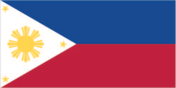
two equal horizontal bands of blue (top) and red with a white equilateral triangle based on the hoist side; in the center of the triangle is a yellow sun with eight primary rays (each containing three individual rays) and in each corner of the triangle is a small yellow five-pointed star
House of Representatives
last held 11 May 1992 (next election to be held NA May 1998); results - LDP 43.5%; Lakas-NUCD 25%, NPC 23.5%, Liberal 5%, KBL 3%;seats - (200 total) LDP 87, Lakas-NUCD 51, NPC 47, Liberal 10, KBL 5
Independence
4 July 1946 (from US)
Judicial branch
Supreme Court
Legal system
based on Spanish and Anglo-American law; accepts compulsory ICJ jurisdiction, with reservations
Legislative branch
bicameral Congress (Kongreso) consists of an upper house or Senate (Senado) and a lower house or House of Representatives (Kapulungan Ng Mga Kinatawan)
Long-form name
Republic of the Philippines
Member of
APEC, AsDB, ASEAN, CCC, CP, ESCAP, FAO, G-24, G-77, GATT, IAEA, IBRD, ICAO, ICFTU, IDA, IFAD, IFC, ILO, IMF, IMO, INMARSAT, INTELSAT, INTERPOL, IOC, IOM, ISO, ITU, LORCS, NAM (observer), UN, UNCTAD, UNESCO, UNIDO, UPU, WCL, WFTU, WHO, WIPO, WMO
National holiday
Independence Day (from Spain), 12 June (1898)
Political parties and leaders
Alliance of Philippine Democrats (LDP), Neptali GONZALES and Jose (Peping) COJUANGCO; Nationalist People's Coalition (NPC), Fidel Valdes RAMOS; Liberal Party, Jovito SALONGA; New Society Movement (KBL), Amelda MARCOS
President
last held 11 May 1992 (next election to be held NA May 1998);results - Fidel Valdes RAMOS won 23.6% of votes, a narrow plurality
Senate
last held 11 May 1992 (next election to be held NA May 1998); results - LDP 66%, NPC 20%, Lakas-NUCD 8%, Liberal 6%; seats - (24 total) LDP 24, NPC 5, Lakas-NUCD 2, Liberal 1
Suffrage
universal at age 15
Type
republic
Economy
Agriculture
accounts for about one-third of GNP and 45% of labor force; major crops - rice, coconut, corn, sugarcane, bananas, pineapple, mango; animal products - pork, eggs, beef; net exporter of farm products; fish catch of 2 million metric tons annually
Budget
$8.4 billion; expenditures $9.36 billion, including capital expenditures of $1.8 billion (1991 est.)
Currency
Philippine peso (plural - pesos); 1 Philippine peso (P) = 100 centavos
Economic aid
US commitments, including Ex-Im (FY70-89), $3.6 billion; Western (non-US) countries, ODA and OOF bilateral commitments (1970-88), $7.9 billion; OPEC bilateral aid (1979-89), $5 million; Communist countries (1975-89), $123 million
Electricity
7,500,000 kW capacity; 31,000 million kWh produced, 470 kWh per capita (1991)
Exchange rates
Philippine pesos (P) per US$1 - 25.810 (March 1992), 27.479 (1991), 24.311 (1990), 21.737 (1989), 21.095 (1988), 20.568 (1987)
Exports
$8.7 billion (f.o.b., 1991 est.) commodities: electrical equipment 19%, textiles 16%, minerals and ores 11%, farm products 10%, coconut 10%, chemicals 5%, fish 5%, forest products 4% partners: US 36%, EC 19%, Japan 18%, ESCAP 9%, ASEAN 7%
External debt
$28.9 billion (1991)
Fiscal year
calendar year
GNP
exchange rate conversion - $47 billion, per capita $720; real growth rate 0.1% (1991 est.)
Illicit drugs
illicit producer of cannabis for the international drug trade; growers are producing more and better quality cannabis despite government eradication efforts
Imports
$12.3 billion (c.i.f., 1991) commodities: raw materials 53%, capital goods 17%, petroleum products 17% partners: US 25%, Japan 17%, ESCAP 13%, EC 11%, ASEAN 10%, Middle East 10%
Industrial production
growth rate - 5% (1991 est.); accounts for 35% of GNP
Industries
textiles, pharmaceuticals, chemicals, wood products, food processing, electronics assembly, petroleum refining, fishing
Inflation rate (consumer prices)
17.6% (1991 est.)
Overview
Following the recession of 1984-85, the Philippine economy grew on the average of 5.0% per year during 1986-89. It slowed again during the period 1990-91. The agricultural sector together with forestry and fishing, plays an important role in the economy, employing about 45% of the work force and providing almost 30% of GDP. The Philippines is the world's largest exporter of coconuts and coconut products. Manufacturing contributes about 35% of GDP. Major industries include food processing, chemicals, and textiles.
Unemployment rate
10.0% (1991 est.)
Communications
Airports
278 total, 244 usable; 72 with permanent-surface runways; none with runways over 3,659 m; 9 with runways 2,440-3,659 m; 53 with runways 1,220-2,439 m
Civil air
53 major transport aircraft
Highways
156,000 km total (1984); 29,000 km paved; 77,000 km gravel, crushed-stone, or stabilized-soil surface; 50,000 km unimproved earth
Inland waterways
3,219 km; limited to shallow-draft (less than 1.5 m) vessels
Merchant marine
552 ships (1,000 GRT or over) totaling 8,150,425 GRT/13,624,527 DWT; includes 1 passenger, 11 short-sea passenger, 13 passenger-cargo, 155 cargo, 22 refrigerated cargo, 23 vehicle carrier, 8 livestock carrier, 13 roll-on/roll-off cargo, 8 container, 35 petroleum tanker, 1 chemical tanker, 6 liquefied gas, 2 combination ore/oil, 247 bulk, 7 combination bulk; note - many Philippine flag ships are foreign owned and are on the register for the purpose of long-term bare-boat charter back to their original owners who are principally in Japan and Germany
Pipelines
petroleum products 357 km
Ports
Cagayan de Oro, Cebu, Davao, Guimaras, Iloilo, Legaspi, Manila, Subic Bay
Railroads
378 km operable on Luzon, 34% government owned (1982)
Telecommunications
good international radio and submarine cable services; domestic and interisland service adequate; 872,900 telephones; broadcast stations - 267 AM (including 6 US), 55 FM, 33 TV (including 4 US); submarine cables extended to Hong Kong, Guam, Singapore, Taiwan, and Japan; satellite earth stations - 1 Indian Ocean INTELSAT, 2 Pacific Ocean INTELSAT, and 11 domestic
Military and Security
Branches
Army, Navy (including Coast Guard and Marine Corps), Air Force
Defense expenditures
exchange rate conversion - $915 million, 1.9% of GNP (1991)
Manpower availability
males 15-49, 16,719,421; 11,816,366 fit for military service; 698,683 reach military age (20) annually