1998 Edition
CIA World Factbook 1998 (Internet Archive)
Geography
Area
total: 1,285,220 sq km land: 1.28 million sq km water: 5,220 sq km
Area-comparative
slightly smaller than Alaska
Climate
varies from tropical in east to dry desert in west
Coastline
2,414 km
Elevation extremes
lowest point: Pacific Ocean 0 m highest point: Nevado Huascaran 6,768 m
Environment-current issues
deforestation; overgrazing of the slopes of the costa and sierra leading to soil erosion; desertification; air pollution in Lima; pollution of rivers and coastal waters from municipal and mining wastes
Environment-international agreements
party to: Antarctic-Environmental Protocol, Antarctic Treaty, Biodiversity, Climate Change, Desertification, Endangered Species, Hazardous Wastes, Nuclear Test Ban, Ozone Layer Protection, Ship Pollution, Tropical Timber 83, Tropical Timber 94, Wetlands signed, but not ratified: none of the selected agreements
Geographic coordinates
10 00 S, 76 00 W
Geography-note
shares control of Lago Titicaca, world's highest navigable lake, with Bolivia
Irrigated land
12,800 sq km (1993 est.)
Land boundaries
total: 6,940 km border countries: Bolivia 900 km, Brazil 1,560 km, Chile 160 km, Colombia 2,900 km, Ecuador 1,420 km
Land use
arable land: 3% permanent crops: 0% permanent pastures: 21% forests and woodland: 66% other: 10% (1993 est.)
Location
Western South America, bordering the South Pacific Ocean, between Chile and Ecuador
Map references
South America
Maritime claims
continental shelf: 200 nm territorial sea: 200 nm
Natural hazards
earthquakes, tsunamis, flooding, landslides, mild volcanic activity
Natural resources
copper, silver, gold, petroleum, timber, fish, iron ore, coal, phosphate, potash
Terrain
western coastal plain (costa), high and rugged Andes in center (sierra), eastern lowland jungle of Amazon Basin (selva)
People and Society
Age structure
0-14 years: 36% (male 4,745,363; female 4,589,017) 15-64 years: 60% (male 7,856,414; female 7,752,085) 65 years and over: 4% (male 535,566; female 632,665) (July 1998 est.)
Birth rate
26.69 births/1,000 population (1998 est.)
Death rate
5.81 deaths/1,000 population (1998 est.)
Ethnic groups
Amerindian 45%, mestizo (mixed Amerindian and white) 37%, white 15%, black, Japanese, Chinese, and other 3%
Infant mortality rate
43.42 deaths/1,000 live births (1998 est.)
Languages
Spanish (official), Quechua (official), Aymara
Life expectancy at birth
total population: 69.97 years male: 67.78 years female: 72.25 years (1998 est.)
Literacy
definition: age 15 and over can read and write total population: 88.7% male: 94.5% female: 83% (1995 est.)
Nationality
noun: Peruvian(s) adjective: Peruvian
Net migration rate
-1.15 migrant(s)/1,000 population (1998 est.)
Population
26,111,110 (July 1998 est.)
Population growth rate
1.97% (1998 est.)
Religions
Roman Catholic
Sex ratio
at birth: 1.05 male(s)/female under 15 years: 1.03 male(s)/female 15-64 years: 1.01 male(s)/female 65 years and over: 0.85 male(s)/female (1998 est.)
Total fertility rate
3.31 children born/woman (1998 est.)
Government
Administrative divisions
24 departments (departamentos, singular-departamento) and 1 constitutional province* (provincia constitucional); Amazonas, Ancash, Apurimac, Arequipa, Ayacucho, Cajamarca, Callao*, Cusco, Huancavelica, Huanuco, Ica, Junin, La Libertad, Lambayeque, Lima, Loreto, Madre de Dios, Moquegua, Pasco, Piura, Puno, San Martin, Tacna, Tumbes, Ucayali note: the 1979 constitution mandated the creation of regions (regiones, singular - region) to function eventually as autonomous economic and administrative entities; so far, 12 regions have been constituted from 23 of the 24 departments - Amazonas (from Loreto), Andres Avelino Caceres (from Huanuco, Pasco, Junin), Arequipa (from Arequipa), Chavin (from Ancash), Grau (from Tumbes, Piura), Inca (from Cusco, Madre de Dios, Apurimac), La Libertad (from La Libertad), Los Libertadores-Huari (from Ica, Ayacucho, Huancavelica), Mariategui (from Moquegua, Tacna, Puno), Nor Oriental del Maranon (from Lambayeque, Cajamarca, Amazonas), San Martin (from San Martin), Ucayali (from Ucayali); formation of another region has been delayed by the reluctance of the constitutional province of Callao to merge with the department of Lima; because of inadequate funding from the central government and organizational and political difficulties, the regions have yet to assume major responsibilities; the 1993 constitution retains the regions but limits their authority; the 1993 constitution also reaffirms the roles of departmental and municipal governments
Constitution
31 December 1993
Country name
conventional long form: Republic of Peru conventional short form: Peru local long form: Republica del Peru local short form: Peru
Data code
PE
Executive branch
chief of state: President Alberto Kenyo FUJIMORI Fujimori (since 28 July 1990); note - the president is both the chief of state and head of government head of government: President Alberto Kenyo FUJIMORI Fujimori (since 28 July 1990); note - the president is both the chief of state and head of government note: Prime Minister Alberto PANDOLFI Arbulu (since 3 April 1996) does not exercise executive power; this power is in the hands of the president cabinet: Council of Ministers appointed by the president elections: president elected by popular vote for a five-year term; election last held 9 April 1995 (next to be held NA 2000) election results: President FUJIMORI reelected; percent of vote-Alberto FUJIMORI 64.42%, Javier PEREZ de CUELLAR 21.80%, Mercedes CABANILLAS 4.11%, other 9.67%
FAX
- [1] (202) 659-8124 consulate(s) general: Agana (Guam), Chicago, Honolulu, Los Angeles, New York, San Francisco Diplomatic representation from the US: chief of mission: Ambassador Dennis C. JETT embassy: Avenida Encalada, Cuadra 17, Monterrico, Lima mailing address: P. O. Box 1995, Lima 1; American Embassy (Lima), APO AA 34031-5000 telephone: [51] (1) 434-3000
- [51] (1) 434-3037
Flag description
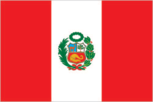
three equal, vertical bands of red (hoist side), white, and red with the coat of arms centered in the white band; the coat of arms features a shield bearing a llama, cinchona tree (the source of quinine), and a yellow cornucopia spilling out gold coins, all framed by a green wreath
Government type
republic
Independence
28 July 1821 (from Spain)
International organization participation
AG, CCC, ECLAC, FAO, G-11, G-15, G-19, G-24, G-77, IADB, IAEA, IBRD, ICAO, ICC, ICFTU, ICRM, IDA, IFAD, IFC, IFRCS, IHO, ILO, IMF, IMO, Inmarsat, Intelsat, Interpol, IOC, IOM, ISO (correspondent), ITU, LAES, LAIA, NAM, OAS, OPANAL, PCA, RG, UN, UNCTAD, UNESCO, UNIDO, UPU, WCL, WFTU, WHO, WIPO, WMO, WToO, WTrO Diplomatic representation in the US: chief of mission: Ambassador Ricardo V. LUNA MENDOZA chancery: 1700 Massachusetts Avenue NW, Washington, DC 20036 telephone: [1] (202) 833-9860 through 9869
Judicial branch
Supreme Court of Justice (Corte Suprema de Justicia), judges are appointed by the National Council of the Judiciary Political parties and leaders: Change 90-New Majority (C90/NM), Alberto FUJIMORI; Union for Peru (UPP), Javier PEREZ de CUELLAR; American Popular Revolutionary Alliance (APRA), Luis ALVA Castro; Independent Moralizing Front (FIM), Fernando OLIVERA Vega; Democratic Coordinator (CODE)-Pais Posible, Jose BARBA Caballero and Alejandro TOLEDO; Popular Action Party (AP), Juan DIAZ Leon; Popular Christian Party (PPC), Luis BEDOYA Reyes; Renovation Party, Rafael REY Rey; Civic Works Movement (OBRAS), Ricardo BELMONT; United Left (IU); Independent Agrarian Movement (MIA) Political pressure groups and leaders: leftist guerrilla groups include Shining Path, Abimael GUZMAN Reynoso (imprisoned), Oscar RAMIREZ Durand (top leader at large); Tupac Amaru Revolutionary Movement or MRTA, Victor POLAY (imprisoned), Hugo AVALLENEDA Valdez (top leader at large)
Legal system
based on civil law system; has not accepted compulsory ICJ jurisdiction
Legislative branch
unicameral Democratic Constituent Congress or Congresso Constituyente Democratico (120 seats; members are elected by popular vote to serve five-year terms) elections: last held 9 April 1995 (next to be held NA April 2000) election results: percent of vote by party-C90/NM 52.1%, UPP 14%, 11 other parties 33.9%; seats by party, when installed on 28 July 1995-C90/NM 67, UPP 17, APRA 8, FIM 6, (CODE)-Pais Posible 5, AP 4, PPC 3, Renovacion 3, IU 2, OBRAS 2, other parties 3
National capital
Lima
National holiday
Independence Day, 28 July (1821)
Suffrage
18 years of age; universal
Economy
Agriculture-products
coffee, cotton, sugarcane, rice, wheat, potatoes, plantains, coca; poultry, red meats, dairy products, wool; fish catch of 6.9 million metric tons (1990)
Budget
revenues: $8.5 billion expenditures: $9.3 billion, including capital expenditures of $2 billion (1996 est.)
Currency
1 nuevo sol (S/.) = 100 centimos
Debt-external
$25.7 billion (1996 est.)
Economic aid
recipient: ODA, $363 million (1993)
Economy-overview
The Peruvian economy has become increasingly market-oriented, with major privatizations completed since 1990 in the mining, electricity, and telecommunications industries. In the 1980s, the economy suffered from hyperinflation, declining per capita output, and mounting external debt. Peru was shut off from IMF and World Bank support in the mid-1980s because of its huge debt arrears. An austerity program implemented shortly after the FUJIMORI government took office in July 1990 contributed to a third consecutive yearly contraction of economic activity, but the slide came to a halt late that year, and in 1991 output rose 2.4%. After a burst of inflation as the austerity program eliminated government price subsidies, monthly price increases eased to the single-digit level and by December 1991 dropped to the lowest increase since mid-1987. Lima obtained a financial rescue package from multilateral lenders in September 1991, although it faced $14 billion in arrears on its external debt. By working with the IMF and World Bank on new financial conditions and arrangements, the government succeeded in ending its arrears by March 1993. In 1992, GDP fell by 2.8%, in part because a warmer-than-usual El Nino current resulted in a 30% drop in the fish catch, but the economy rebounded as strong foreign investment helped push growth to 7% in 1993, about 13% in 1994, and 6.8% in 1995. Growth slowed to about 2.8% in 1996 as the government adopted tight fiscal and monetary policy to reduce the current account deficit and meet its IMF targets. Growth then rebounded to 7.3% in 1997 even as inflation fell to its lowest level in 23 years. Capital inflows surged to record levels in early 1997 and have remained strong despite economic shocks stemming from the Asian financial crisis and the El Nino weather events.
Electricity-capacity
4.187 million kW (1995)
Electricity-consumption per capita
648 kWh (1995)
Electricity-production
15.6 billion kWh (1995)
Exchange rates
nuevo sol (S/.) per US$1-2.750 (January 1998), 2.664 (1997), 2.453 (1996), 2.253 (1995), 2.195 (1994), 1.988 (1993)
Exports
total value: $5.9 billion (f.o.b., 1996) commodities: copper, zinc, fishmeal, crude petroleum and byproducts, lead, refined silver, coffee, cotton partners: US 20%, Japan 7%, UK 7%, China 7%, Germany 5% (1996)
Fiscal year
calendar year Communications
GDP
purchasing power parity-$110.2 billion (1997 est.)
GDP-composition by sector
agriculture: 14% industry: 41% services: 45% (1996)
GDP-per capita
purchasing power parity-$4,420 (1997 est.)
GDP-real growth rate
7.3% (1997 est.)
Imports
total value: $9.2 billion (f.o.b., 1996) commodities: machinery, transport equipment, foodstuffs, petroleum, iron and steel, chemicals, pharmaceuticals partners: US 31%, Colombia 7%, Chile 6%, Venezuela 6%, UK 6% (1996)
Industrial production growth rate
1.2% (1996)
Industries
mining of metals, petroleum, fishing, textiles, clothing, food processing, cement, auto assembly, steel, shipbuilding, metal fabrication
Inflation rate-consumer price index
6.7% (1997 est.)
Labor force
total: 7.6 million (1996 est.) by occupation: agriculture, mining and quarrying, manufacturing, construction, transport, services
Radio broadcast stations
AM 273, FM 0, shortwave 144
Radios
5.7 million (1992 est.)
Telephone system
adequate for most requirements domestic: nationwide microwave radio relay system and a domestic satellite system with 12 earth stations international: satellite earth stations-2 Intelsat (Atlantic Ocean)
Telephones
779,306 (1990 est.)
Television broadcast stations
140
Televisions
2 million (1993 est.)
Unemployment rate
8.2%; extensive underemployment (1996)
Transportation
Airports
244 (1997 est.) Airports-with paved runways: total: 43 over 3,047 m: 6 2,438 to 3,047 m: 15 1,524 to 2,437 m: 12 914 to 1,523 m: 8 under 914 m: 2 (1997 est.) Airports-with unpaved runways: total: 201 over 3,047 m: 2 2,438 to 3,047 m: 2 1,524 to 2,437 m: 24 914 to 1,523 m: 73 under 914 m: 100 (1997 est.)
Highways
total: 72,800 km paved: 7,353 km unpaved: 65,447 km (1996 est.)
Merchant marine
total: 8 ships (1,000 GRT or over) totaling 68,752 GRT/100,213 DWT ships by type: bulk 1, cargo 7 (1997 est.)
Pipelines
crude oil 800 km; natural gas and natural gas liquids 64 km Ports and harbors: Callao, Chimbote, Ilo, Matarani, Paita, Puerto Maldonado, Salaverry, San Martin, Talara, Iquitos, Pucallpa, Yurimaguas note: Iquitos, Pucallpa, and Yurimaguas are all on the upper reaches of the Amazon and its tributaries
Railways
total: 2,041 km standard gauge: 1,726 km 1.435-m gauge narrow gauge: 315 km 0.914-m gauge (1994)
Waterways
8,600 km of navigable tributaries of Amazon system and 208 km of Lago Titicaca
Military and Security
Military branches
Army (Ejercito Peruano), Navy (Marina de Guerra del Peru; includes Naval Air, Marines, and Coast Guard), Air Force (Fuerza Aerea del Peru), National Police
Military expenditures-dollar figure
$998 million (1996); note-may not include off-budget purchases related to military modernization program
Military expenditures-percent of GDP
1.9% (1996)
Military manpower-availability
males age 15-49: 6,756,771 (1998 est.) Military manpower-fit for military service: males: 4,555,282 (1998 est.)
Military manpower-military age
20 years of age
Military manpower-reaching military age annually
males: 264,915 (1998 est.)
Transnational Issues
Disputes-international
three sections of the boundary with Ecuador are in dispute
Illicit drugs
until recently the world's largest coca leaf producer, Peru has reduced the area of coca under cultivation by 40%, from 115,300 hectares in 1995 to 68,800 hectares at the end of 1997; source of supply for most of the world's cocaine base; most of cocaine base is shipped to Colombian drug dealers for processing into cocaine for the international drug market, but exports of finished cocaine are increasing