1991 Edition
CIA World Factbook 1991 (Project Gutenberg)
Geography
Climate
varies from tropical in east to dry desert in west
Coastline
2,414 km
Comparative area
slightly smaller than Alaska
Disputes
two sections of the boundary with Ecuador are in dispute
Environment
subject to earthquakes, tsunamis, landslides, mild volcanic activity; deforestation; overgrazing; soil erosion; desertification; air pollution in Lima
Land boundaries
6,940 km total; Bolivia 900 km, Brazil 1,560 km, Chile 160 km, Colombia 2,900 km, Ecuador 1,420 km
Land use
arable land 3%; permanent crops NEGL%; meadows and pastures 21%; forest and woodland 55%; other 21%; includes irrigated 1%
Maritime claims
Territorial sea: 200 nm
Natural resources
copper, silver, gold, petroleum, timber, fish, iron ore, coal, phosphate, potash
Note
shares control of Lago Titicaca, world's highest navigable lake, with Bolivia
Terrain
western coastal plain (costa), high and rugged Andes in center (sierra), eastern lowland jungle of Amazon Basin (selva)
Total area
1,285,220 km2; land area: 1,280,000 km2
People and Society
Birth rate
28 births/1,000 population (1991)
Death rate
8 deaths/1,000 population (1991)
Ethnic divisions
Indian 45%; mestizo (mixed Indian and European ancestry) 37%; white 15%; black, Japanese, Chinese, and other 3%
Infant mortality rate
66 deaths/1,000 live births (1991)
Labor force
6,800,000 (1986); government and other services 44%, agriculture 37%, industry 19% (1988 est.)
Language
Spanish and Quechua (both official), Aymara
Life expectancy at birth
62 years male, 67 years female (1991)
Literacy
85% (male 92%, female 29%) age 15 and over can read and write (1990 est.)
Nationality
noun--Peruvian(s); adjective--Peruvian
Net migration rate
0 migrants/1,000 population (1991)
Organized labor
about 40% of salaried workers (1983 est.)
Population
22,361,785 (July 1991), growth rate 2.0% (1991)
Religion
predominantly Roman Catholic
Total fertility rate
3.5 children born/woman (1991)
Government
Administrative divisions
24 departments (departamentos, singular--departamento) and 1 constitutional province* (provincia constitucional); Amazonas, Ancash, Apurimac, Arequipa, Ayacucho, Cajamarca, Callao*, Cusco, Huancavelica, Huanuco, Ica, Junin, La Libertad, Lambayeque, Lima, Loreto, Madre de Dios, Moquegua, Pasco, Piura, Puno, San Martin, Tacna, Tumbes, Ucayali; note--the 1979 Constitution and legislation enacted from 1987 to 1990 mandate the creation of regions (regiones, singular--region) intended to function eventually as autonomous economic and administrative entities; so far, 12 regions have been constituted from 23 existing departments--Amazonas (from Loreto), Andres Avelino Caceres (from Huanuco, Pasco, Junin), Arequipa (from Arequipa), Chavin (from Ancash), Grau (from Tumbes, Piura), Inca (from Cusco, Madre de Dios, Apurimac), La Libertad (from La Libertad), Los Libertadores-Huari (from Ica, Ayacucho, Huancavelica), Mariategui (from Moquegua, Tacna, Puno), Nor Oriental del Maranon (from Lambayeque, Cajamarca, Amazonas), San Martin (from San Martin), Ucayali (from Ucayali); formation of another region has been delayed by the reluctance of the constitutional province of Callao to merge with the department of Lima; because of inadequate funding from the central government, the regions have yet to assume their reponsibilities and at the moment co-exist with the departmental structure
Capital
Lima
Communists
Peruvian Communist Party-Unity (PCP-U), pro-Soviet, 2,000; other minor Communist parties
Constitution
28 July 1980 (often referred to as the 1979 Constitution because the Constituent Assembly met in 1979, but the Constitution actually took effect the following year); reestablished civilian government with a popularly elected president and bicameral legislature
Diplomatic representation
Ambassador Roberto G. MACLEAN; Chancery at 1700 Massachusetts Avenue NW, Washington DC 20036; telephone (202) 833-9860 through 9869); Peruvian Consulates General are located in Chicago, Houston, Los Angeles, Miami, New York, Paterson (New Jersey), San Francisco, and San Juan (Puerto Rico); US--Ambassador Anthony C.E. QUAINTON; Embassy at the corner of Avenida Inca Garcilaso de la Vega and Avenida Espana, Lima (mailing address is P. O. Box 1995, Lima 100, or APO Miami 34031); telephone [51] (14) 338-000
Elections
President--last held on 10 June 1990 (next to be held April 1995); results--Alberto FUJIMORI 56.53%, Mario VARGAS Llosa 33.92%, other 9.55%; Senate--last held on 8 April 1990 (next to be held April 1995); results--percent of vote by party NA; seats--(60 total) FREDEMO 20, APRA 16, Change 90 14, IU 6, IS 3, FRENATRACA 1; Chamber of Deputies--last held 8 April 1990 (next to be held April 1995); results--percent of vote by party NA; seats--(180 total) FREDEMO 62, APRA 53, Change 90 32, IU 16, IS 4, FRENATRACA 3, other 10
Executive branch
president, two vice presidents, prime minister, Council of Ministers (cabinet)
Flag
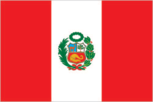
three equal, vertical bands of red (hoist side), white, and red with the coat of arms centered in the white band; the coat of arms features a shield bearing a llama, cinchona tree (the source of quinine), and a yellow cornucopia spilling out gold coins, all framed by a green wreath
Independence
28 July 1821 (from Spain)
Judicial branch
Supreme Court of Justice (Corte Suprema de Justicia)
Leaders
Chief of State--President Alberto FUJIMORI (since 28 July 1990); Vice President Maximo SAN ROMAN (since 28 July 1990); Vice President Carlos GARCIA (since 28 July 1990); Head of Government--Prime Minister Carlos TORRES Y TORRES Lara (since 15 February 1991)
Legal system
based on civil law system; has not accepted compulsory ICJ jurisdiction
Legislative branch
bicameral Congress (Congreso) consists of an upper chamber or Senate (Senado) and a lower chamber or Chamber of Deputies (Camara de Diputados)
Long-form name
Republic of Peru
Member of
AG, CCC, ECLAC, FAO, G-11, G-19, G-24, G-77, GATT, IADB, IAEA, IBRD, ICAO, ICFTU, IDA, IFAD, IFC, ILO, IMF, IMO, INMARSAT, INTELSAT, INTERPOL, IOC, IOM, ISO, ITU, LAES, LAIA, LORCS, NAM, OAS, OPANAL, PCA, RG, UN, UNCTAD, UNESCO, UNIDO, UNIIMOG, UPU, WCL, WFTU, WHO, WIPO, WMO, WTO
National holiday
Independence Day, 28 July (1821)
Other political or pressure groups
leftist guerrilla groups--Shining Path, leader Abimael GUZMAN; Tupac Amaru Revolutionary Movement, Nestor CERPA and Victor POLLAY
Political parties and leaders
Change 90 (Cambio 90), Alberto FUJIMORI; Democratic Front (FREDEMO), a loosely organized three-party coalition--Popular Christian Party (PPC), Luis BEDOYA Reyes; Popular Action Party (AP), Fernando BELAUNDE Terry; and Liberty Movement; American Popular Revolutionary Alliance (APRA), Luis ALVA Castro; National Front of Workers and Peasants (FRENATRACA), Roger CACERES; United Left (IU), run by committee; Socialist Left (IS), Enrique BERNALES
Suffrage
universal at age 18
Type
republic
Economy
Agriculture
accounts for 12% of GDP, 37% of labor force; commercial crops--coffee, cotton, sugarcane; other crops--rice, wheat, potatoes, plantains, coca; animal products--poultry, red meats, dairy, wool; not self-sufficient in grain or vegetable oil; fish catch of 4.6 million metric tons (1987), world's fifth-largest
Budget
revenues $1.3 billion; expenditures $2.1 billion, including capital expenditures of $NA (1990 est.)
Currency
inti (plural--intis); 1 inti (I/) = 1,000 soles
Economic aid
US commitments, including Ex-Im (FY70-89), $1.7 billion; Western (non-US) countries, ODA and OOF bilateral commitments (1970-88), $3.95 billion; Communist countries (1970-89), $577 million
Electricity
4,867,000 kW capacity; 15,540 million kWh produced, 710 kWh per capita (1990)
Exchange rates
intis (I/) per US$1--530,000 (January 1991), 187,886 (1990), 2,666 (1989), 128.83 (1988), 16.84 (1987), 13.95 (1986), 10.97 (1985)
Exports
$3.01 billion (f.o.b., 1990 est.); commodities--fishmeal, cotton, sugar, coffee, copper, iron ore, refined silver, lead, zinc, crude petroleum and byproducts; partners--EC 22%, US 20%, Japan 11%, Latin America 8%, USSR 4%
External debt
$20.0 billion (December 1990)
Fiscal year
calendar year
GDP
$19.3 billion, per capita $898; real growth rate - 3.9% (1990 est.)
Illicit drugs
world's largest coca leaf producer with about 121,000 hectares under cultivation; source of supply for most of the world's coca paste and cocaine base; about 85% of cultivation is for illicit production; most of cocaine base is shipped to Colombian drug dealers for processing into cocaine for the international drug market
Imports
$2.78 billion (f.o.b., 1990 est.); commodities--foodstuffs, machinery, transport equipment, iron and steel semimanufactures, chemicals, pharmaceuticals; partners--US 23%, Latin America 16%, EC 12%, Japan 7%, Switzerland 3%
Industrial production
growth rate - 21% (1989); accounts for almost 25% of GDP
Industries
mining of metals, petroleum, fishing, textiles, clothing, food processing, cement, auto assembly, steel, shipbuilding, metal fabrication
Inflation rate (consumer prices)
7,650% (1990)
Overview
The Peruvian economy is basically capitalistic, with a large dose of government welfare programs and government management of credit. In the 1980s the economy suffered from hyperinflation, declining per capita output, and mounting external debt. Peru was shut off from IMF and World Bank support in the mid-1980s because of its huge debt arrears. An austerity program implemented shortly after the Fujimori government took office in July 1990 contributed to a third consecutive yearly contraction of economic activity, but was able to generate a small recovery in the last quarter. After a burst of inflation as the program eliminated government price subsidies, monthly price increases eased to the single-digit level for the first time since mid-1988. Lima has restarted current payments to multilateral lenders and, although it faces $14 billion in arrears on its external debt, is working toward an accommodation with its creditors.
Unemployment rate
20.0%; underemployment estimated at 60% (1989)
Communications
Airports
222 total, 205 usable; 36 with permanent-surface runways; 2 with runways over 3,659 m; 24 with runways 2,440-3,659 m; 42 with runways 1,220-2,439 m
Civil air
27 major transport aircraft
Highways
56,645 km total; 6,030 km paved, 11,865 km gravel, 14,610 km improved earth, 24,140 km unimproved earth
Inland waterways
8,600 km of navigable tributaries of Amazon system and 208 km Lago Titicaca
Merchant marine
29 ships (1,000 GRT or over) totaling 321,541 GRT/516,859 DWT; includes 16 cargo, 1 refrigerated cargo, 1 roll-on/roll-off cargo, 3 petroleum, oils, and lubricants (POL) tanker, 8 bulk; note--in addition, 8 naval tankers and 1 naval cargo are sometimes used commercially
Pipelines
crude oil, 800 km; natural gas and natural gas liquids, 64 km
Ports
Callao, Ilo, Iquitos, Matarani, Talara
Railroads
1,884 km total; 1,584 km 1.435-meter standard gauge, 300 km 0.914-meter gauge
Telecommunications
fairly adequate for most requirements; nationwide radio relay system; 544,000 telephones; stations--273 AM, no FM, 140 TV, 144 shortwave; 2 Atlantic Ocean INTELSAT earth stations, 12 domestic antennas
Military and Security
Branches
Army (Ejercito Peruano), Navy (Marina de Guerra del Peru), Air Force (Fuerza Aerea del Peru), Peruvian National Police
Defense expenditures
$430 million, 2.4% of GDP (1991) _%_
Manpower availability
males 15-49, 5,704,684; 3,859,123 fit for military service; 241,792 reach military age (20) annually