1989 Edition
CIA World Factbook 1989 (Internet Archive)
Geography
Climate
varies from tropical in east to dry desert in west
Coastline
2,414 km
Comparative area
slightly smaller than Alaska
Disputes
two sections of the boundary with Ecuador are in dispute
Environment
subject to earthquakes, tsunamis, landslides, mild volcanic activity; deforestation; overgrazing; soil erosion; desertification; air pollution in Lima
Land boundaries
6,940 km total; Bolivia 900 km, Brazil 1,560 km, Chile 160 km, Colombia 2,900 km, Ecuador 1 ,420 km
Land use
3% arable land; NEGL% permanent crops; 21% meadows and pastures; 55% forest and woodland; 21% other; includes 1% irrigated
Natural resources
copper, silver, gold, petroleum, timber, fish, iron ore, coal, phosphate, potash
Note
shares control of Lago Titicaca, world's highest navigable lake, with Bolivia
Terrain
western coastal plain (costa), high and rugged Andes in center (sierra), eastern lowland jungle of Amazon Basin (selva)
Territorial sea
200 nm
Total area
1,285,220 km2; land area: 1,280,000km2
Total area
500km See region*! mip IV
People and Society
Birth rate
28 births/ 1 ,000 population (1990)
Death rate
8 deaths/ 1 ,000 population (1990)
Ethnic divisions
45% Indian; 37% mestizo (mixed Indian and European ancestry); 15% white; 3% black, Japanese, Chinese, and other
Infant mortality rate
67 deaths/ 1 ,000 live births (1990)
Labor force
6,800,000 (1986); 44% government and other services, 37% agriculture, 19% industry (1988 est.)
Language
Spanish and Quechua (official), Aymara
Life expectancy at birth
62 years male, 66 years female (1990)
Literacy
80% (est.)
Nationality
noun — Peruvian(s); adjective — Peruvian
Net migration rate
0 migrants/ 1,000 population (1990)
Organized labor
about 40% of salaried workers (198 3 est.)
Population
21,905,605 (July 1990), growth rate 2.1% (1990)
Religion
predominantly Roman Catholic
Total fertility rate
3.6 children born/ woman (1990)
Government
Administrative divisions
24 departments (departamentos, singular — departamento) and 1 constitutional province* (provincia constitucional); Amazonas, Ancash, Apurimac, Arequipa, Ayacucho, Cajamarca, Callao*, Cusco, Huancavelica, Huanuco, lea, Junin, La Libertad, Lambayeque, Lima, Loreto, Madre de Dios, Moquegua, Pasco, Piura, Puno, San Martin, Tacna, Tumbes, Ucayali
Capital
Lima
Communists
Peruvian Communist PartyUnity (PCP-U), pro-Soviet, 2,000; other minor Communist parties
Constitution
28 July 1980 (often referred to as the 1979 Constitution because constituent assembly met in 1979, but Constitution actually took effect the following year); reestablished civilian government with a popularly elected president and bicameral legislature
Diplomatic representation
Ambassador Cesar G. ATALA; Chancery at 1700 Massachusetts Avenue NW, Washington DC 20036; telephone (202) 833-9860 through 9869); Peruvian Consulates General are located in Chicago, Houston, Los Angeles, Miami, New York, Paterson (New Jersey), San Francisco, and San Juan (Puerto Rico); US — Ambassador Anthony QUAINTON; Embassy at the corner of Avenida Inca Garcilaso de la Vega and Avenida Espana, Lima (mailing address is P. O. Box 1995, Lima 1010, or APO Miami 34031); telephone [51] (14) 338-000
Elections
President — last held on 14 April 1985 (next to be held 8 April 1990); results— Alan Garcia Perez (APRA) 46%, Alfonso Barrantes Lingan (IU) 22%, others 32%; Senate — last held on 14 April 1985 (next to be held April 1 990); results — percent of vote by party NA; seats — (60 total) APRA 32, IU 15, AP 5, others 8; Chamber of Deputies — last held 14 April 1985 (next to be held April 1990); results — percent of vote by party NA; seats— (180 total) APRA 107, IU 48, AP 10, others 15
Executive branch
president, two vice presidents, prime minister. Council of Ministers (cabinet)
Flag
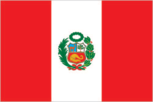
three equal, vertical bands of red (hoist side), white, and red with the coat of arms centered in the white band; the coat of arms features a shield bearing a llama, cinchona tree (the source of quinine), and a yellow cornucopia spilling out gold coins, all framed by a green wreath
Independence
28 July 1821 (from Spain)
Judicial branch
Supreme Court of Justice (Corte Suprema de Justicia)
Leaders
Chief of State — President Alan GARCIA Perez (since 28 July 1985); First Vice President Luis Alberto SANCHEZ Sanchez (since 28 July 1985); Second Vice President Luis Juan ALVA Castro (since 28 July 1985); Head of Government — Prime Minister Guillermo LARCO Cox (since 3 October 1989) Political parties and leaders: American Popular Revolutionary Alliance (APRA), Alan Garcia Perez; United Left (IU), run by committee; Democratic Front (FREDEMO), headed by Maria Vargas Llosa of the Liberty Movement (ML), coalition also includes the Popular Christian Party (PPC), Luis Bedoya Reyes and the Popular Action Party (AP), Fernando Belaunde Terry; Socialist Left (ISO), Alfonso Barrantes Lingan
Legal system
based on civil law system; has not accepted compulsory ICJ jurisdiction
Legislative branch
bicameral Congress (Congreso) consists of an upper chamber or Senate (Senado) and a lower chamber or Chamber of Deputies (Camara de Diputados)
Long-form name
Republic of Peru
Member of
Andean Pact, AIOEC, ASSIMER, CCC, CIPEC, FAO, G-77, GATT, Group of Eight, IADB, IAEA, IATP, IBRD, ICAO, ICO, IDA, IDB— InterAmerican Development Bank, IFAD, IFC, ILO, ILZSG, INTERPOL, IMF, IMO, INTELSAT, ISO, ITU, IWC — International Wheat Council, LAIA, NAM, OAS, PAHO, SELA, UN, UNESCO, UPU, WFTU, WHO, WMO, WSG, WTO
National holiday
Independence Day, 28 July (1821)
Other political or pressure groups
NA
Suffrage
universal at age 1 8
Type
republic