2018 Edition
CIA World Factbook 2018 Archive (Wayback Machine)
Introduction
Background
Explored and settled by the Spanish in the 16th century, Panama broke with Spain in 1821 and joined a union of Colombia, Ecuador, and Venezuela - named the Republic of Gran Colombia. When the latter dissolved in 1830, Panama remained part of Colombia. With US backing, Panama seceded from Colombia in 1903 and promptly signed a treaty with the US allowing for the construction of a canal and US sovereignty over a strip of land on either side of the structure (the Panama Canal Zone). The Panama Canal was built by the US Army Corps of Engineers between 1904 and 1914. In 1977, an agreement was signed for the complete transfer of the Canal from the US to Panama by the end of the century. Certain portions of the Zone and increasing responsibility over the Canal were turned over in the subsequent decades. With US help, dictator Manuel NORIEGA was deposed in 1989. The entire Panama Canal, the area supporting the Canal, and remaining US military bases were transferred to Panama by the end of 1999. An ambitious expansion project to more than double the Canal's capacity - by allowing for more Canal transits and larger ships - was carried out between 2007 and 2016.
Geography
Area
- land
- 74,340 sq km
- total
- 75,420 sq km
- water
- 1,080 sq km
Area Comparative
slightly smaller than South Carolina
Climate
tropical maritime; hot, humid, cloudy; prolonged rainy season (May to January), short dry season (January to May)
Coastline
2,490 km
Elevation
- elevation extremes
- 0 m lowest point: Pacific Ocean
- mean elevation
- 360 m
- note
- 3475 highest point: Volcan Baru
Environment Current Issues
water pollution from agricultural runoff threatens fishery resources; deforestation of tropical rain forest; land degradation and soil erosion threatens siltation of Panama Canal; air pollution in urban areas; mining threatens natural resources
Environment International Agreements
- party to
- Biodiversity, Climate Change, Climate Change-Kyoto Protocol, Desertification, Endangered Species, Environmental Modification, Hazardous Wastes, Law of the Sea, Marine Dumping, Ozone Layer Protection, Ship Pollution, Tropical Timber 83, Tropical Timber 94, Wetlands, Whaling
- signed, but not ratified
- Marine Life Conservation
Geographic Coordinates
9 00 N, 80 00 W
Geography Note
strategic location on eastern end of isthmus forming land bridge connecting North and South America; controls Panama Canal that links North Atlantic Ocean via Caribbean Sea with North Pacific Ocean
Irrigated Land
321 sq km (2012)
Land Boundaries
- border countries (2)
- Colombia 339 km, Costa Rica 348 km
- total
- 687 km
Land Use
- arable land: 7.3% (2011 est.) / permanent crops: 2.5% (2011 est.) / permanent pasture: 20.7% (2011 est.)
- agricultural land
- 30.5% (2011 est.)
- forest
- 43.6% (2011 est.)
- other
- 25.9% (2011 est.)
Location
Central America, bordering both the Caribbean Sea and the North Pacific Ocean, between Colombia and Costa Rica
Map References
Central America and the Caribbean
Maritime Claims
- contiguous zone
- 24 nm
- exclusive economic zone
- 200 nm or edge of continental margin
- territorial sea
- 12 nm
Natural Hazards
occasional severe storms and forest fires in the Darien area
Natural Resources
copper, mahogany forests, shrimp, hydropower
Population Distribution
population is concentrated towards the center of the country, particularly around the Canal, but a sizeable segment of the populace also lives in the far west around David; the eastern third of the country is sparsely inhabited
Terrain
interior mostly steep, rugged mountains with dissected, upland plains; coastal plains with rolling hills
People and Society
Age Structure
- 0-14 years
- 26.13% (male 506,953 /female 486,129)
- 15-24 years
- 16.84% (male 326,207 /female 313,894)
- 25-54 years
- 40.35% (male 776,395 /female 757,008)
- 55-64 years
- 8.11% (male 152,894 /female 155,353)
- 65 years and over
- 8.57% (male 149,415 /female 176,396) (2018 est.)
Birth Rate
17.6 births/1,000 population (2018 est.)
Children Under The Age Of 5 Years Underweight
3.9% (2008)
Contraceptive Prevalence Rate
62.8% (2013)
Death Rate
5 deaths/1,000 population (2018 est.)
Demographic Profile
Panama is a country of demographic and economic contrasts. It is in the midst of a demographic transition, characterized by steadily declining rates of fertility, mortality, and population growth, but disparities persist based on wealth, geography, and ethnicity. Panama has one of the fastest growing economies in Latin America and dedicates substantial funding to social programs, yet poverty and inequality remain prevalent. The indigenous population accounts for a growing share of Panama's poor and extreme poor, while the non-indigenous rural poor have been more successful at rising out of poverty through rural-to-urban labor migration. The government's large expenditures on untargeted, indirect subsidies for water, electricity, and fuel have been ineffective, but its conditional cash transfer program has shown some promise in helping to decrease extreme poverty among the indigenous population.Panama has expanded access to education and clean water, but the availability of sanitation and, to a lesser extent, electricity remains poor. The increase in secondary schooling - led by female enrollment - is spreading to rural and indigenous areas, which probably will help to alleviate poverty if educational quality and the availability of skilled jobs improve. Inadequate access to sanitation contributes to a high incidence of diarrhea in Panama's children, which is one of the main causes of Panama's elevated chronic malnutrition rate, especially among indigenous communities.
Dependency Ratios
- elderly dependency ratio
- 11.7 (2015 est.)
- potential support ratio
- 8.5 (2015 est.)
- total dependency ratio
- 54.8 (2015 est.)
- youth dependency ratio
- 43.1 (2015 est.)
Drinking Water Source
- improved: urban: 97.7% of population
- rural: 86.6% of population
- total: 94.7% of population
- unimproved: urban: 2.3% of population
- rural: 11.4% of population
- total: 5.3% of population (2015 est.)
Education Expenditures
3.2% of GDP (2011)
Ethnic Groups
mestizo (mixed Amerindian and white) 65%, Native American 12.3% (Ngabe 7.6%, Kuna 2.4%, Embera 0.9%, Bugle 0.8%, other 0.4%, unspecified 0.2%), black or African descent 9.2%, mulatto 6.8%, white 6.7% (2010 est.)
Health Expenditures
8% of GDP (2014)
Hiv Aids Adult Prevalence Rate
1% (2017 est.)
Hiv Aids Deaths
<1000 (2017 est.)
Hiv Aids People Living With Hiv Aids
25,000 (2017 est.)
Hospital Bed Density
2.3 beds/1,000 population (2013)
Infant Mortality Rate
- female
- 8.9 deaths/1,000 live births (2018 est.)
- male
- 10.3 deaths/1,000 live births (2018 est.)
- total
- 9.6 deaths/1,000 live births (2018 est.)
Languages
- Spanish (official), indigenous languages (including Ngabere (or Guaymi), Buglere, Kuna, Embera, Wounaan, Naso (or Teribe), and Bri Bri), Panamanian English Creole (similar to Jamaican English Creole; a mixture of English and Spanish with elements of Ngabere; also known as Guari Guari and Colon Creole), English, Chinese (Yue and Hakka), Arabic, French Creole, other (Yiddish, Hebrew, Korean, Japanese)
- note
- many Panamanians are bilingual
Life Expectancy At Birth
- female
- 81.9 years (2018 est.)
- male
- 76.1 years (2018 est.)
- total population
- 78.9 years (2018 est.)
Literacy
- definition
- age 15 and over can read and write (2015 est.)
- female
- 94.4% (2015 est.)
- male
- 95.7% (2015 est.)
- total population
- 95% (2015 est.)
Major Infectious Diseases
- degree of risk
- intermediate (2016)
- food or waterborne diseases
- bacterial diarrhea (2016)
- note
- active local transmission of Zika virus by Aedes species mosquitoes has been identified in this country (as of August 2016); it poses an important risk (a large number of cases possible) among US citizens if bitten by an infective mosquito; other less common ways to get Zika are through sex, via blood transfusion, or during pregnancy, in which the pregnant woman passes Zika virus to her fetus
- vectorborne diseases
- dengue fever (2016)
Major Urban Areas Population
1.783 million PANAMA CITY (capital) (2018)
Maternal Mortality Rate
94 deaths/100,000 live births (2015 est.)
Median Age
- female
- 29.9 years (2018 est.)
- male
- 29 years
- total
- 29.5 years
Nationality
- adjective
- Panamanian
- noun
- Panamanian(s)
Net Migration Rate
-0.2 migrant(s)/1,000 population (2017 est.)
Obesity Adult Prevalence Rate
22.7% (2016)
Physicians Density
1.59 physicians/1,000 population (2013)
Population
3,800,644 (July 2018 est.)
Population Growth Rate
1.24% (2018 est.)
Religions
Roman Catholic 85%, Protestant 15%
Sanitation Facility Access
- improved: urban: 83.5% of population (2015 est.)
- rural: 58% of population (2015 est.)
- total: 75% of population (2015 est.)
- unimproved: urban: 16.5% of population (2015 est.)
- rural: 42% of population (2015 est.)
- total: 25% of population (2015 est.)
School Life Expectancy Primary To Tertiary Education
- female
- 13 years (2013)
- male
- 12 years (2013)
- total
- 13 years (2013)
Sex Ratio
- 0-14 years
- 1.04 male(s)/female (2017 est.)
- 15-24 years
- 1.04 male(s)/female (2017 est.)
- 25-54 years
- 1.03 male(s)/female (2017 est.)
- 55-64 years
- 0.98 male(s)/female (2017 est.)
- 65 years and over
- 0.85 male(s)/female (2017 est.)
- at birth
- 1.04 male(s)/female (2017 est.)
- total population
- 1.01 male(s)/female (2017 est.)
Total Fertility Rate
2.28 children born/woman (2018 est.)
Unemployment Youth Ages 15 24
- female
- 16% (2016 est.)
- male
- 9% (2016 est.)
- total
- 11.5% (2016 est.)
Urbanization
- rate of urbanization
- 2.06% annual rate of change (2015-20 est.)
- urban population
- 67.7% of total population (2018)
Government
Administrative Divisions
10 provinces (provincias, singular - provincia) and 3 indigenous regions* (comarcas); Bocas del Toro, Chiriqui, Cocle, Colon, Darien, Embera-Wounaan*, Herrera, Guna Yala*, Los Santos, Ngobe-Bugle*, Panama, Panama Oeste, Veraguas
Capital
- geographic coordinates
- 8 58 N, 79 32 W
- name
- Panama City
- time difference
- UTC-5 (same time as Washington, DC, during Standard Time)
Citizenship
- citizenship by birth
- yes
- citizenship by descent only
- yes
- dual citizenship recognized
- no
- residency requirement for naturalization
- 5 years
Constitution
- amendments
- proposed by the National Assembly, by the Cabinet, or by the Supreme Court of Justice; passage requires approval by one of two procedures: 1) absolute majority vote of the Assembly membership in each of three readings and by absolute majority vote of the next elected Assembly in a single reading without text modifications; 2) absolute majority vote of the Assembly membership in each of three readings, followed by absolute majority vote of the next elected Assembly in each of three readings with text modifications, and approval in a referendum; amended several times, last in 2004; note - in May 2018, President VARELA began the process to amend the constitution (2018)
- history
- several previous; latest effective 11 October 1972 (2018)
Country Name
- conventional long form
- Republic of Panama
- conventional short form
- Panama
- etymology
- according to tradition, the name derives from a former indigenous fishing village and its nearby beach that were called "Panama" meaning "an abundance of fish"
- local long form
- Republica de Panama
- local short form
- Panama
Diplomatic Representation From The Us
- chief of mission
- Ambassador (vacant), Charge d'Affairs Roxanne CABRAL (since 9 March 2018)
- embassy
- Edificio 783, Avenida Demetrio Basilio Lakas Panama, Apartado Postal 0816-02561, Zona 5, Panama City
- FAX
- [507] 317-5445 (2018)
- mailing address
- American Embassy Panama, Unit 0945, APO AA 34002; American Embassy Panama, 9100 Panama City PL, Washington, DC 20521-9100
- telephone
- [507] 317-5000
Diplomatic Representation In The Us
- chancery
- 2862 McGill Terrace NW, Washington, DC 20007
- chief of mission
- Ambassador Emanuel Arturo GONZALEZ-REVILLA Lince (since 18 September 2014)
- consulate(s) general
- Houston, Miami, Long Beach (CA), New Orleans, New York, Philadelphia, Tampa, Washington DC
- FAX
- [1] (202) 483-8413
- telephone
- [1] (202) 483-1407
Executive Branch
- cabinet
- Cabinet appointed by the president
- chief of state
- President Juan Carlos VARELA (since 1 July 2014); Vice President Isabel de SAINT MALO de Alvarado (since 1 July 2014); note - the president is both chief of state and head of government
- election results
- Juan Carlos VARELA elected president; percent of vote - Juan Carlos VARELA (PP) 39.1%, Jose Domingo ARIAS (CD) 31.4%, Juan Carlos NAVARRO (PRD) 28.2%, other 1.3%
- elections/appointments
- president and vice president directly elected on the same ballot by simple majority popular vote for a 5-year term; president eligible for a single non-consecutive term); election last held on 4 May 2014 (next to be held in 2019)
- head of government
- President Juan Carlos VARELA (since 1 July 2014); Vice President Isabel de SAINT MALO de Alvarado (since 1 July 2014)
Flag Description
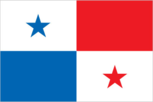
divided into four, equal rectangles; the top quadrants are white (hoist side) with a blue five-pointed star in the center and plain red; the bottom quadrants are plain blue (hoist side) and white with a red five-pointed star in the center; the blue and red colors are those of the main political parties (Conservatives and Liberals respectively) and the white denotes peace between them; the blue star stands for the civic virtues of purity and honesty, the red star signifies authority and law
Government Type
presidential republic
Independence
3 November 1903 (from Colombia; became independent from Spain on 28 November 1821)
International Law Organization Participation
accepts compulsory ICJ jurisdiction with reservations; accepts ICCt jurisdiction
International Organization Participation
BCIE, CAN (observer), CD, CELAC, FAO, G-77, IADB, IAEA, IBRD, ICAO, ICC (national committees), ICCt, ICRM, IDA, IFAD, IFC, IFRCS, ILO, IMF, IMO, IMSO, Interpol, IOC, IOM, IPU, ISO, ITSO, ITU, ITUC (NGOs), LAES, LAIA, MIGA, NAM, OAS, OPANAL, OPCW, Pacific Alliance (observer), PCA, SICA, UN, UNASUR (observer), UNCTAD, UNESCO, UNIDO, Union Latina, UNWTO, UPU, WCO, WFTU (NGOs), WHO, WIPO, WMO, WTO
Judicial Branch
- highest courts
- Supreme Court of Justice or Corte Suprema de Justicia (consists of 9 magistrates and 9 alternates and divided into civil, criminal, administrative, and general business chambers)
- judge selection and term of office
- magistrates appointed by the president for staggered 10-year terms
- subordinate courts
- appellate courts or Tribunal Superior; Labor Supreme Courts; Court of Audit; circuit courts or Tribunal Circuital (2 each in 9 of the 10 provinces); municipal courts; electoral, family, maritime, and adolescent courts
Legal System
civil law system; judicial review of legislative acts in the Supreme Court of Justice
Legislative Branch
- description
- unicameral National Assembly or Asamblea Nacional (71 seats; 45 members directly elected in multi-seat constituencies - populous towns and cities - by proportional representation vote and 26 directly elected in single-seat constituencies - outlying rural districts - by plurality vote; members serve 5-year terms)
- election results
- percent of vote by party - CD 33.7%, PRD 31.5%, Panamenista Party 20%, MOLIRENA 7.2%, PP 3.3%, other 1%, independent 3%; seats by party - PRD 30, CD 25, Panamenista 12, MOLIRENA 2, PP 1, independent 1
- elections
- last held on 4 May 2014 (next to be held in May 2019)
- note
- an alliance between the Panamenista Party and Democratic Revolutionary Party (PRD) fractured after the 2014 election, but a loose coalition composed of Panamenista and moderate PRD and CD legislators generally work together to support the president’s agenda
National Anthem
- lyrics/music
- Jeronimo DE LA OSSA/Santos A. JORGE
- name
- "Himno Istmeno" (Isthmus Hymn)
- note
- adopted 1925
National Holiday
Independence Day (Separation Day), 3 November (1903)
National Symbol S
harpy eagle; national colors: blue, white, red
Political Parties And Leaders
Democratic Change or CD [Romulo ROUX]Democratic Revolutionary Party or PRD [Benicio ROBINSON]Nationalist Republican Liberal Movement or MOLIRENA [Francisco "Pancho" ALEMAN]Panamenista Party [Jose Luis "Popi" VARELA Rodriguez] (formerly the Arnulfista Party)Popular Party or PP [Juan Carlos ARANGO Reese] (formerly Christian Democratic Party or PDC)
Suffrage
18 years of age; universal
Economy
Agriculture Products
bananas, rice, corn, coffee, sugarcane, vegetables; livestock; shrimp
Budget
- expenditures
- 13.44 billion (2017 est.)
- revenues
- 12.43 billion (2017 est.)
Budget Surplus Or Deficit
-1.6% (of GDP) (2017 est.)
Commercial Bank Prime Lending Rate
- 7.52% (31 December 2017 est.)
- 7.53% (31 December 2016 est.)
Current Account Balance
- -$3.036 billion (2017 est.)
- -$3.16 billion (2016 est.)
Debt External
- $91.53 billion (31 December 2017 est.)
- $83.81 billion (31 December 2016 est.)
Distribution Of Family Income Gini Index
- 50.7 (2014 est.)
- 56.1 (2003)
Economy Overview
Panama's dollar-based economy rests primarily on a well-developed services sector that accounts for more than three-quarters of GDP. Services include operating the Panama Canal, logistics, banking, the Colon Free Trade Zone, insurance, container ports, flagship registry, and tourism and Panama is a center for offshore banking. Panama's transportation and logistics services sectors, along with infrastructure development projects, have boosted economic growth; however, public debt surpassed $37 billion in 2016 because of excessive government spending and public works projects. The US-Panama Trade Promotion Agreement was approved by Congress and signed into law in October 2011, and entered into force in October 2012.Future growth will be bolstered by the Panama Canal expansion project that began in 2007 and was completed in 2016 at a cost of $5.3 billion - about 10-15% of current GDP. The expansion project more than doubled the Canal's capacity, enabling it to accommodate high-capacity vessels such as tankers and neopanamax vessels that are too large to traverse the existing canal. The US and China are the top users of the Canal.Strong economic performance has not translated into broadly shared prosperity, as Panama has the second worst income distribution in Latin America. About one-fourth of the population lives in poverty; however, from 2006 to 2012 poverty was reduced by 10 percentage points.
Exchange Rates
- balboas (PAB) per US dollar -
- 1 (2017 est.)
- 1 (2016 est.)
- 1 (2015 est.)
- 1 (2014 est.)
- 1 (2013 est.)
Exports
- $15.5 billion (2017 est.)
- $14.7 billion (2016 est.)
- note
- includes the Colon Free Zone
Exports Commodities
fruit and nuts, fish, iron and steel waste, wood
Exports Partners
US 18.9%, Netherlands 16.6%, China 6.5%, Costa Rica 5.4%, India 5.1%, Vietnam 5% (2017)
Fiscal Year
calendar year
Gdp Composition By End Use
- exports of goods and services
- 41.9% (2017 est.)
- government consumption
- 10.7% (2017 est.)
- household consumption
- 45.6% (2017 est.)
- imports of goods and services
- -44.2% (2017 est.)
- investment in fixed capital
- 42.9% (2017 est.)
- investment in inventories
- 3% (2017 est.)
Gdp Composition By Sector Of Origin
- agriculture
- 2.4% (2017 est.)
- industry
- 15.7% (2017 est.)
- services
- 82% (2017 est.)
Gdp Official Exchange Rate
$61.84 billion (2017 est.) (2017 est.)
Gdp Per Capita Ppp
- $25,400 (2017 est.)
- $24,500 (2016 est.)
- $23,700 (2015 est.)
- note
- data are in 2017 dollars
Gdp Purchasing Power Parity
- $104.1 billion (2017 est.)
- $98.82 billion (2016 est.)
- $94.12 billion (2015 est.)
- note
- data are in 2017 dollars
Gdp Real Growth Rate
- 5.4% (2017 est.)
- 5% (2016 est.)
- 5.8% (2015 est.)
Gross National Saving
- 38.9% of GDP (2017 est.)
- 39.2% of GDP (2016 est.)
- 36.8% of GDP (2015 est.)
Household Income Or Consumption By Percentage Share
- highest 10%
- 38.9% (2014 est.)
- lowest 10%
- 38.9% (2014 est.)
Imports
- $21.91 billion (2017 est.)
- $20.51 billion (2016 est.)
- note
- includes the Colon Free Zone
Imports Commodities
fuels, machinery, vehicles, iron and steel rods, pharmaceuticals
Imports Partners
US 24.4%, China 9.8%, Mexico 4.9% (2017)
Industrial Production Growth Rate
6.3% (2017 est.)
Industries
construction, brewing, cement and other construction materials, sugar milling
Inflation Rate Consumer Prices
- 0.9% (2017 est.)
- 0.7% (2016 est.)
Labor Force
- 1.633 million (2017 est.)
- note
- shortage of skilled labor, but an oversupply of unskilled labor
Labor Force By Occupation
- agriculture
- 17%
- industry
- 18.6%
- services
- 64.4% (2009 est.)
Market Value Of Publicly Traded Shares
- $12.54 billion (31 December 2012 est.)
- $10.68 billion (31 December 2011 est.)
- $8.348 billion (31 December 2010 est.)
Population Below Poverty Line
23% (2015 est.)
Public Debt
- 37.8% of GDP (2017 est.)
- 37.4% of GDP (2016 est.)
Reserves Of Foreign Exchange And Gold
- $2.703 billion (31 December 2017 est.)
- $3.878 billion (31 December 2016 est.)
Stock Of Broad Money
- $8.347 billion (31 December 2017 est.)
- $8.249 billion (31 December 2016 est.)
Stock Of Direct Foreign Investment Abroad
- $11.38 billion (31 December 2017 est.)
- $10.71 billion (31 December 2016 est.)
Stock Of Direct Foreign Investment At Home
- $56.7 billion (31 December 2017 est.)
- $50.62 billion (31 December 2016 est.)
Stock Of Domestic Credit
- $51.05 billion (31 December 2017 est.)
- $46.41 billion (31 December 2016 est.)
Stock Of Narrow Money
- $8.347 billion (31 December 2017 est.)
- $8.249 billion (31 December 2016 est.)
Taxes And Other Revenues
20.1% (of GDP) (2017 est.)
Unemployment Rate
- 6% (2017 est.)
- 5.5% (2016 est.)
Energy
Carbon Dioxide Emissions From Consumption Of Energy
26.08 million Mt (2017 est.)
Crude Oil Exports
0 bbl/day (2015 est.)
Crude Oil Imports
0 bbl/day (2015 est.)
Crude Oil Production
0 bbl/day (2017 est.)
Crude Oil Proved Reserves
0 bbl (1 January 2018)
Electricity Access
- electrification - rural areas
- 80% (2013)
- electrification - total population
- 91% (2013)
- electrification - urban areas
- 94% (2013)
- population without electricity
- 300,000 (2013)
Electricity Consumption
8.708 billion kWh (2016 est.)
Electricity Exports
139 million kWh (2015 est.)
Electricity From Fossil Fuels
36% of total installed capacity (2016 est.)
Electricity From Hydroelectric Plants
51% of total installed capacity (2017 est.)
Electricity From Nuclear Fuels
0% of total installed capacity (2017 est.)
Electricity From Other Renewable Sources
13% of total installed capacity (2017 est.)
Electricity Imports
30 million kWh (2016 est.)
Electricity Installed Generating Capacity
3.4 million kW (2016 est.)
Electricity Production
10.6 billion kWh (2016 est.)
Natural Gas Consumption
0 cu m (2017 est.)
Natural Gas Exports
0 cu m (2017 est.)
Natural Gas Imports
0 cu m (2017 est.)
Natural Gas Production
0 cu m (2017 est.)
Natural Gas Proved Reserves
0 cu m (1 January 2014 est.)
Refined Petroleum Products Consumption
146,000 bbl/day (2016 est.)
Refined Petroleum Products Exports
66 bbl/day (2015 est.)
Refined Petroleum Products Imports
129,200 bbl/day (2015 est.)
Refined Petroleum Products Production
0 bbl/day (2015 est.)
Communications
Broadband Fixed Subscriptions
- subscriptions per 100 inhabitants
- 12 (2017 est.)
- total
- 446,076 (2017 est.)
Broadcast Media
multiple privately owned TV networks and a government-owned educational TV station; multi-channel cable and satellite TV subscription services are available; more than 100 commercial radio stations (2007)
Internet Country Code
.pa
Internet Users
- percent of population
- 54% (July 2016 est.)
- total
- 2,000,833 (July 2016 est.)
Telephone System
- domestic
- mobile-cellular telephone subscribership has increased rapidly (2015)
- general assessment
- domestic and international facilities well-developed (2015)
- international
- country code - 507; landing point for the Americas Region Caribbean Ring System (ARCOS-1), the MAYA-1, and PAN-AM submarine cable systems that together provide links to the US and parts of the Caribbean, Central America, and South America; satellite earth stations - 2 Intelsat (Atlantic Ocean); connected to the Central American Microwave System (2015)
Telephones Fixed Lines
- subscriptions per 100 inhabitants
- 16 (2017 est.)
- total subscriptions
- 603,638 (2017 est.)
Telephones Mobile Cellular
- subscriptions per 100 inhabitants
- 159 (2017 est.)
- total subscriptions
- 5,977,641 (2017 est.)
Transportation
Airports
117 (2013)
Airports With Paved Runways
- 1,524 to 2,437 m
- 3 (2017)
- 2,438 to 3,047 m
- 3 (2017)
- 914 to 1,523 m
- 20 (2017)
- over 3,047 m
- 1 (2017)
- total
- 57 (2017)
- under 914 m
- 30 (2017)
Airports With Unpaved Runways
- 1,524 to 2,437 m
- 1 (2013)
- 914 to 1,523 m
- 8 (2013)
- total
- 60 (2013)
- under 914 m
- 51 (2013)
Civil Aircraft Registration Country Code Prefix
HP (2016)
Heliports
3 (2013)
Merchant Marine
- by type
- bulk carrier 2665, container ship 617, general cargo 1293, oil tanker 809, other 2668 (2017)
- total
- 8,052 (2017)
National Air Transport System
- annual freight traffic on registered air carriers
- 121,567,075 mt-km (2015)
- annual passenger traffic on registered air carriers
- 12,018,103 (2015)
- inventory of registered aircraft operated by air carriers
- 103 (2015)
- number of registered air carriers
- 4 (2015)
Pipelines
128 km oil (2013)
Ports And Terminals
- container port(s) (TEUs)
- Balboa (2,831,893), Colon (3,258,381) (2016)
- major seaport(s)
- Balboa, Colon, Cristobal
Railways
- standard gauge
- 77 km 1.435-m gauge (2014)
- total
- 77 km (2014)
Roadways
- paved
- 6,351 km (2010)
- total
- 15,137 km (2010)
- unpaved
- 8,786 km (2010)
Waterways
800 km (includes the 82-km Panama Canal that is being widened) (2011)
Military and Security
Military Branches
no regular military forces; Panamanian Public Security Forces (subordinate to the Ministry of Public Security), comprising the National Police (PNP), National Air-Naval Service (SENAN), National Border Service (SENAFRONT) (2013)
Military Note
on 10 February 1990, the government of then President Guillermo ENDARA abolished Panama's military and reformed the security apparatus by creating the Panamanian Public Forces; in October 1994, Panama's National Assembly approved a constitutional amendment prohibiting the creation of a standing military force but allowing the temporary establishment of special police units to counter acts of "external aggression"
Transnational Issues
Disputes International
organized illegal narcotics operations in Colombia operate within the remote border region with Panama
Illicit Drugs
major cocaine transshipment point and primary money-laundering center for narcotics revenue; money-laundering activity is especially heavy in the Colon Free Zone; offshore financial center; negligible signs of coca cultivation; monitoring of financial transactions is improving; official corruption remains a major problem
Refugees And Internally Displaced Persons
- refugees (country of origin)
- 15,614 (Colombia) (2016), 60,699 (Venezuela) (economic and political crisis; includes Venezuelans who have claimed asylum or have received alternative legal stay) (2018)