2008 Edition
CIA World Factbook 2008 (Project Gutenberg)
Introduction
Background
Explored and settled by the Spanish in the 16th century, Panama broke with Spain in 1821 and joined a union of Colombia, Ecuador, and Venezuela - named the Republic of Gran Colombia. When the latter dissolved in 1830, Panama remained part of Colombia. With US backing, Panama seceded from Colombia in 1903 and promptly signed a treaty with the US allowing for the construction of a canal and US sovereignty over a strip of land on either side of the structure (the Panama Canal Zone). The Panama Canal was built by the US Army Corps of Engineers between 1904 and 1914. In 1977, an agreement was signed for the complete transfer of the Canal from the US to Panama by the end of the century. Certain portions of the Zone and increasing responsibility over the Canal were turned over in the subsequent decades. With US help, dictator Manuel NORIEGA was deposed in 1989. The entire Panama Canal, the area supporting the Canal, and remaining US military bases were transferred to Panama by the end of 1999. In October 2006, Panamanians approved an ambitious plan to expand the Canal. The project, which began in 2007 and could double the Canal's capacity, is expected to be completed in 2014-15.
Geography
Area
total: 78,200 sq km land: 75,990 sq km water: 2,210 sq km
Area - comparative
slightly smaller than South Carolina
Climate
tropical maritime; hot, humid, cloudy; prolonged rainy season (May to January), short dry season (January to May)
Coastline
2,490 km
Elevation extremes
lowest point: Pacific Ocean 0 m highest point: Volcan Baru 3,475 m
Environment - current issues
water pollution from agricultural runoff threatens fishery resources; deforestation of tropical rain forest; land degradation and soil erosion threatens siltation of Panama Canal; air pollution in urban areas; mining threatens natural resources
Environment - international agreements
party to: Biodiversity, Climate Change, Climate Change-Kyoto Protocol, Desertification, Endangered Species, Hazardous Wastes, Law of the Sea, Marine Dumping, Ozone Layer Protection, Ship Pollution, Tropical Timber 83, Tropical Timber 94, Wetlands, Whaling signed, but not ratified: Marine Life Conservation
Freshwater withdrawal (domestic/industrial/agricultural)
total: 0.82 cu km/yr (67%/5%/28%) per capita: 254 cu m/yr (2000)
Geographic coordinates
9 00 N, 80 00 W
Geography - note
strategic location on eastern end of isthmus forming land bridge connecting North and South America; controls Panama Canal that links North Atlantic Ocean via Caribbean Sea with North Pacific Ocean
Irrigated land
430 sq km (2003)
Land boundaries
total: 555 km border countries: Colombia 225 km, Costa Rica 330 km
Land use
arable land: 7.26% permanent crops: 1.95% other: 90.79% (2005)
Location
Central America, bordering both the Caribbean Sea and the North Pacific Ocean, between Colombia and Costa Rica
Map references
Central America and the Caribbean
Maritime claims
territorial sea: 12 nm contiguous zone: 24 nm exclusive economic zone: 200 nm or edge of continental margin
Natural hazards
occasional severe storms and forest fires in the Darien area
Natural resources
copper, mahogany forests, shrimp, hydropower
Terrain
interior mostly steep, rugged mountains and dissected, upland plains; coastal areas largely plains and rolling hills
Total renewable water resources
148 cu km (2000)
People and Society
Age structure
0-14 years: 29.6% (male 499,254/female 479,242) 15-64 years: 63.8% (male 1,066,915/female 1,043,499) 65 years and over: 6.7% (male 102,937/female 117,832) (2008 est.)
Birth rate
20.68 births/1,000 population (2008 est.)
Death rate
4.71 deaths/1,000 population (2008 est.)
Education expenditures
3.8% of GDP (2004)
Ethnic groups
mestizo (mixed Amerindian and white) 70%, Amerindian and mixed (West Indian) 14%, white 10%, Amerindian 6%
HIV/AIDS - adult prevalence rate
0.9% (2003 est.)
HIV/AIDS - deaths
fewer than 500 (2003 est.)
HIV/AIDS - people living with HIV/AIDS
16,000 (2003 est.)
Infant mortality rate
total: 13.4 deaths/1,000 live births male: 14.35 deaths/1,000 live births female: 12.42 deaths/1,000 live births (2008 est.)
Languages
Spanish (official), English 14%; note - many Panamanians bilingual
Life expectancy at birth
total population: 76.88 years male: 74.08 years female: 79.81 years (2008 est.)
Literacy
definition: age 15 and over can read and write total population: 91.9% male: 92.5% female: 91.2% (2000 census)
Major infectious diseases
degree of risk: intermediate food or waterborne diseases: bacterial diarrhea and hepatitis A vectorborne disease: dengue fever and malaria water contact disease: leptospirosis (2008)
Median age
total: 26.7 years male: 26.3 years female: 27.1 years (2008 est.)
Nationality
noun: Panamanian(s) adjective: Panamanian
Net migration rate
-0.53 migrant(s)/1,000 population (2008 est.)
Population
3,309,679 (July 2008 est.)
Population growth rate
1.544% (2008 est.)
Religions
Roman Catholic 85%, Protestant 15%
School life expectancy (primary to tertiary education)
total: 13 years male: 13 years female: 14 years (2006)
Sex ratio
at birth: 1.04 male(s)/female under 15 years: 1.04 male(s)/female 15-64 years: 1.02 male(s)/female 65 years and over: 0.87 male(s)/female total population: 1.02 male(s)/female (2008 est.)
Total fertility rate
2.57 children born/woman (2008 est.)
Government
Administrative divisions
11 provinces (provincias, singular - provincia) and 1 territory* (comarca); Bocas del Toro, Comarca Kuna Yala, Comarca Ngobe-Bugle, Chiriqui, Cocle, Colon, Darien, Herrera, Los Santos, Panama, San Blas*(Kuna Yala), and Veraguas
Capital
name: Panama geographic coordinates: 8 58 N, 79 32 W time difference: UTC-5 (same time as Washington, DC during Standard Time)
Constitution
11 October 1972; major reforms adopted 1978, 1983, 1994, and 2004
Country name
conventional long form: Republic of Panama conventional short form: Panama local long form: Republica de Panama local short form: Panama
Diplomatic representation from the US
chief of mission: Ambassador William A. EATON embassy: Edificio 783, Avenida Demetrio Basilio Lakas Panama, Apartado Postal 0816-02561, Zona 5, Panama City mailing address: American Embassy Panama, Unit 0945, APO AA 34002 telephone: [507] 207-7000
Diplomatic representation in the US
chief of mission: Ambassador Federico HUMBERT Arias chancery: 2862 McGill Terrace NW, Washington, DC 20008 telephone: [1] (202) 483-1407
Executive branch
chief of state: President Martin TORRIJOS Espino (since 1 September 2004); First Vice President Samuel LEWIS Navarro (since 1 September 2004); Second Vice President Ruben AROSEMENA Valdes (since 1 September 2004); note - the president is both the chief of state and head of government head of government: President Martin TORRIJOS Espino (since 1 September 2004); First Vice President Samuel LEWIS Navarro (since 1 September 2004); Second Vice President Ruben AROSEMENA Valdes (since 1 September 2004) cabinet: Cabinet appointed by the president elections: president and vice presidents elected on the same ticket by popular vote for five-year terms (not eligible for immediate reelection; president and vice presidents must sit out two additional terms (10 years) before becoming eligible for reelection); election last held 2 May 2004 (next to be held on 3 May 2009); note - beginning in 2009, Panama will have only one vice president election results: Martin TORRIJOS Espino elected president; percent of vote - Martin TORRIJOS Espino 47.5%, Guillermo ENDARA Galimany 30.6%, Jose Miguel ALEMAN 17%, Ricardo MARTINELLI 4.9% note: government coalition - PRD (Democratic Revolutionary Party), PP (Popular Party)
FAX
- [1] (202) 483-8416 consulate(s) general: Atlanta, Honolulu, Houston, Miami, New Orleans, New York, Philadelphia, San Diego, San Francisco, San Juan (Puerto Rico), Tampa
- [507] 317-5568
Flag description
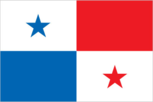
divided into four, equal rectangles; the top quadrants are white (hoist side) with a blue five-pointed star in the center and plain red; the bottom quadrants are plain blue (hoist side) and white with a red five-pointed star in the center
Government type
constitutional democracy
Independence
3 November 1903 (from Colombia; became independent from Spain 28 November 1821)
International organization participation
BCIE, CAN (observer), CSN (observer), FAO, G-77, IADB, IAEA, IBRD, ICAO, ICC, ICCt, ICRM, IDA, IFAD, IFC, IFRCS, ILO, IMF, IMO, IMSO, Interpol, IOC, IOM, IPU, ISO, ITSO, ITU, ITUC, LAES, LAIA (observer), MIGA, NAM, OAS, OPANAL, OPCW, PCA, RG, UN, UN Security Council (temporary), UNCTAD, UNESCO, UNIDO, Union Latina, UNWTO, UPU, WCL, WCO, WFTU, WHO, WIPO, WMO, WTO
Judicial branch
Supreme Court of Justice or Corte Suprema de Justicia (nine judges appointed for 10-year terms); five superior courts; three courts of appeal
Legal system
based on civil law system; judicial review of legislative acts in the Supreme Court of Justice; accepts compulsory ICJ jurisdiction with reservations
Legislative branch
unicameral National Assembly or Asamblea Nacional (78 seats; members are elected by popular vote to serve five-year terms); note - in 2009, the number of seats will change to 71 elections: last held 2 May 2004 (next to be held 3 May 2009) election results: percent of vote by party - NA; seats by party - PRD 41, PA 17, PS 9, MOLIRENA 4, CD 3, PLN 3, PP 1 note: legislators from outlying rural districts are chosen on a plurality basis while districts located in more populous towns and cities elect multiple legislators by means of a proportion-based formula
National holiday
Independence Day, 3 November (1903)
Political parties and leaders
Democratic Change or CD [Ricardo MARTINELLI]; Democratic Revolutionary Party or PRD [Hugo GUIRAUD]; Nationalist Republican Liberal Movement or MOLIRENA [Gisela CHUNG]; Panamenista Party or PA [Juan Carlos VARELA] (formerly the Arnulfista Party); Patriotic Union Party or PU (combination of the Liberal National Party or PLN and the Solidarity Party or PS)[Jose Raul MULINO and Anibal GALINDO]; Popular Party or PP [Rene ORILLAC] (formerly Christian Democratic Party or PDC)
Political pressure groups and leaders
Chamber of Commerce; National Civic Crusade; National Council of Organized Workers or CONATO; National Council of Private Enterprise or CONEP; National Union of Construction and Similar Workers (SUNTRACS); Panamanian Association of Business Executives or APEDE; Panamanian Industrialists Society or SIP; Workers Confederation of the Republic of Panama or CTRP
Suffrage
18 years of age; universal and compulsory
Economy
Agriculture - products
bananas, rice, corn, coffee, sugarcane, vegetables; livestock; shrimp
Budget
revenues: $5.505 billion expenditures: $4.822 billion (2007 est.)
Commercial bank prime lending rate
8.25% (31 December 2007)
Currency (code)
balboa (PAB); US dollar (USD)
Currency code
PAB; USD
Current account balance
-$1.577 billion (2007 est.)
Debt - external
$10.45 billion (31 December 2007 est.)
Distribution of family income - Gini index
56.1 (2003)
Economic aid - recipient
$19.54 million (2005)
Economy - overview
Panama's dollarized economy rests primarily on a well-developed services sector that accounts for two-thirds of GDP. Services include operating the Panama Canal, banking, the Colon Free Zone, insurance, container ports, flagship registry, and tourism. Economic growth will be bolstered by the Panama Canal expansion project that began in 2007 and should be completed by 2014 at a cost of $5.3 billion (about 30% of current GDP). The expansion project will more than double the Canal's capacity, enabling it to accommodate ships that are now too large to transverse the transoceanic crossway and should help to reduce the high unemployment rate. The government has implemented tax reforms, as well as social security reforms, and backs regional trade agreements and development of tourism. Not a CAFTA signatory, Panama in December 2006 independently negotiated a free trade agreement with the US, which, when implemented, will help promote the country's economic growth.
Electricity - consumption
4.768 billion kWh (2006 est.)
Electricity - exports
124.9 million kWh (2007 est.)
Electricity - imports
8.74 million kWh (2007 est.)
Electricity - production
5.805 billion kWh (2006 est.)
Electricity - production by source
fossil fuel: 37% hydro: 61.3% nuclear: 0% other: 1.7% (2001)
Exchange rates
balboas (PAB) per US dollar - 1 (2007), 1 (2006), 1 (2005), 1 (2004), 1 (2003)
Exports
$9.312 billion f.o.b.; note - includes the Colon Free Zone (2007 est.)
Exports - commodities
bananas, shrimp, sugar, coffee, clothing
Exports - partners
US 35.6%, Netherlands 10.2%, China 6%, Sweden 5.5%, UK 5.4%, Costa Rica 5.1%, Spain 5% (2007)
Fiscal year
calendar year
GDP - composition by sector
agriculture: 6.6% industry: 16.4% services: 77% (2007 est.)
GDP - per capita (PPP)
$10,700 (2007 est.)
GDP - real growth rate
11.2% (2007 est.)
GDP (official exchange rate)
$19.74 billion (2007 est.)
GDP (purchasing power parity)
$34.81 billion (2007 est.)
Household income or consumption by percentage share
lowest 10%: 0.7% highest 10%: 43% (2003)
Imports
$12.62 billion f.o.b. note: includes the Colon Free Zone (2007 est.)
Imports - commodities
capital goods, foodstuffs, consumer goods, chemicals
Imports - partners
US 32.8%, Netherlands Antilles 7.6%, China 5.6%, Japan 5.1%, Costa Rica 5.1%, South Korea 4.1% (2007)
Industrial production growth rate
10.5% (2007 est.)
Industries
construction, brewing, cement and other construction materials, sugar milling
Inflation rate (consumer prices)
4.2% (2007 est.)
Investment (gross fixed)
20.2% of GDP (2007 est.)
Labor force
1.362 million note: shortage of skilled labor, but an oversupply of unskilled labor (2007 est.)
Labor force - by occupation
agriculture: 15% industry: 18% services: 67% (2006)
Market value of publicly traded shares
$5.074 billion (2005)
Natural gas - consumption
0 cu m (2007 est.)
Natural gas - exports
0 cu m (2007 est.)
Natural gas - imports
0 cu m (2007 est.)
Natural gas - production
0 cu m (2007 est.)
Natural gas - proved reserves
0 cu m (1 January 2006 est.)
Oil - consumption
92,790 bbl/day (2006 est.)
Oil - exports
4,447 bbl/day (2005)
Oil - imports
88,790 bbl/day (2005)
Oil - production
0 bbl/day (2007 est.)
Oil - proved reserves
0 bbl (1 January 2006 est.)
Population below poverty line
37% (1999 est.)
Public debt
53% of GDP (2007 est.)
Reserves of foreign exchange and gold
$1.935 billion (31 December 2007 est.)
Stock of direct foreign investment - abroad
$NA
Stock of direct foreign investment - at home
$NA
Stock of domestic credit
$17.4 billion (31 December 2007)
Stock of money
$3.054 billion (31 December 2007)
Stock of quasi money
$14.26 billion (31 December 2007)
Unemployment rate
6.4% (2007 est.)
Communications
Internet country code
.pa
Internet hosts
7,858 (2008)
Internet Service Providers (ISPs)
6 (2000)
Internet users
525,200 (2007)
Radio broadcast stations
AM 101, FM 134, shortwave 0 (1998)
Radios
815,000 (1997)
Telephone system
general assessment: domestic and international facilities well developed domestic: combined fixed-line and mobile-cellular teledensity is approaching 90 per 100 persons international: country code - 507; landing point for the Americas Region Caribbean Ring System (ARCOS-1), the MAYA-1, and PAN-AM submarine cable systems that together provide links to the US and parts of the Caribbean, Central America, and South America; satellite earth stations - 2 Intelsat (Atlantic Ocean); connected to the Central American Microwave System (2007)
Telephones - main lines in use
491,900 (2007)
Telephones - mobile cellular
2.392 million (2007)
Television broadcast stations
38 (including repeaters) (1998)
Televisions
510,000 (1997)
Transportation
Airports
116 (2007)
Airports - with paved runways
total: 54 over 3,047 m: 1 2,438 to 3,047 m: 1 1,524 to 2,437 m: 5 914 to 1,523 m: 18 under 914 m: 29 (2007)
Airports - with unpaved runways
total: 62 1,524 to 2,437 m: 1 914 to 1,523 m: 11 under 914 m: 50 (2007)
Heliports
2 (2007)
Merchant marine
total: 6,323 by type: barge carrier 2, bulk carrier 2,143, cargo 1,208, carrier 13, chemical tanker 565, combination ore/oil 6, container 790, liquefied gas 189, passenger 44, passenger/cargo 71, petroleum tanker 557, refrigerated cargo 265, roll on/roll off 128, specialized tanker 29, vehicle carrier 313 foreign-owned: 5,394 (Albania 2, Argentina 8, Australia 4, Azerbaijan 1, Bahamas 9, Bangladesh 2, Belgium 2, British Virgin Islands 1, Bulgaria 3, Burma 1, Canada 18, Chile 12, China 532, Colombia 4, Croatia 3, Cuba 10, Cyprus 19, Denmark 40, Dominican Republic 1, Ecuador 4, Egypt 17, Estonia 5, Finland 2, France 5, Gabon 1, Germany 44, Gibraltar 1, Greece 510, Hong Kong 130, India 27, Indonesia 31, Iran 7, Israel 3, Italy 28, Japan 2,335, Jordan 13, North Korea 1, South Korea 303, Kuwait 2, Latvia 8, Lebanon 5, Lithuania 7, Malaysia 12, Maldives 1, Malta 3, Mexico 2, Monaco 16, Netherlands 14, Nigeria 10, Norway 89, Oman 2, Pakistan 9, Peru 16, Philippines 7, Poland 11, Portugal 9, Qatar 1, Romania 7, Russia 18, Saudi Arabia 16, Singapore 100, Spain 50, Sri Lanka 1, Sweden 6, Switzerland 25, Syria 32, Taiwan 320, Thailand 10, Tunisia 1, Turkey 94, Turks and Caicos Islands 1, Ukraine 10, UAE 109, UK 59, US 126, Venezuela 10, Vietnam 30, Yemen 6) registered in other countries: 3 (Marshall Islands 1, Sierra Leone 1, Venezuela 1) (2008)
Ports and terminals
Balboa, Colon, Cristobal
Railways
total: 355 km standard gauge: 77 km 1.435-m gauge narrow gauge: 278 km 0.914-m gauge (2006)
Roadways
total: 11,978 km paved: 4,300 km unpaved: 7,343 km (2002)
Waterways
800 km (includes 82 km Panama Canal) (2007)
Military and Security
Manpower available for military service
males age 16-49: 851,044 (2008 est.)
Manpower fit for military service
males age 16-49: 673,103 (2008 est.)
Manpower reaching militarily significant age annually
male: 31,042 female: 29,969 (2008 est.)
Military - note
on 10 February 1990, the government of then President ENDARA abolished Panama's military and reformed the security apparatus by creating the Panamanian Public Forces; in October 1994, Panama's Legislative Assembly approved a constitutional amendment prohibiting the creation of a standing military force but allowing the temporary establishment of special police units to counter acts of "external aggression"
Military branches
no regular military forces; Panamanian Public Forces or PPF includes the Panamanian National Police (PNP), National Maritime Service (NMS), and National Air Service (NAS) (2008)
Military expenditures
1% of GDP (2006)
Transnational Issues
Disputes - international
organized illegal narcotics operations in Colombia operate within the remote border region with Panama
Illicit drugs
major cocaine transshipment point and primary money-laundering center for narcotics revenue; money-laundering activity is especially heavy in the Colon Free Zone; offshore financial center; negligible signs of coca cultivation; monitoring of financial transactions is improving; official corruption remains a major problem This page was last updated on 18 December, 2008
Trafficking in persons
current situation: Panama is a source, transit, and destination country for women and children trafficked for the purpose of commercial sexual exploitation; the majority of victims are Panamanian women and children trafficked within the country into the sex trade; rural children in Panama may be trafficked internally to urban areas for labor exploitation tier rating: Tier 2 Watch List - Panama is on the Tier 2 Watch List for failing to show evidence of increasing efforts to combat human trafficking, particularly with respect to prosecuting, convicting, and sentencing human traffickers for their crimes, and for failing to provide adequate victim assistance (2008)