1995 Edition
CIA World Factbook 1995 (Project Gutenberg)
Geography
Area
total area: 78,200 sq km land area: 75,990 sq km comparative area: slightly smaller than South Carolina
Climate
tropical; hot, humid, cloudy; prolonged rainy season (May to January), short dry season (January to May)
Coastline
2,490 km
Environment
current issues: water pollution from agricultural runoff threatens fishery resources; deforestation of tropical rain forest; land degradation natural hazards: NA international agreements: party to - Biodiversity, Endangered Species, Hazardous Wastes, Marine Dumping, Nuclear Test Ban, Ozone Layer Protection, Ship Pollution, Tropical Timber 83, Wetlands; signed, but not ratified - Climate Change, Law of the Sea, Marine Life Conservation, Tropical Timber 94
International disputes
none
Irrigated land
320 sq km (1989 est.)
Land boundaries
total 555 km, Colombia 225 km, Costa Rica 330 km
Land use
arable land: 6% permanent crops: 2% meadows and pastures: 15% forest and woodland: 54% other: 23%
Location
Middle America, bordering both the Caribbean Sea and the North Pacific Ocean, between Colombia and Costa Rica
Map references
Central America and the Caribbean
Maritime claims
territorial sea: 200 nm
Natural resources
copper, mahogany forests, shrimp
Note
strategic location on eastern end of isthmus forming land bridge connecting North and South America; controls Panama Canal that links North Atlantic Ocean via Caribbean Sea with North Pacific Ocean
Terrain
interior mostly steep, rugged mountains and dissected, upland plains; coastal areas largely plains and rolling hills
People and Society
Age structure
0-14 years: 34% (female 439,491; male 458,817) 15-64 years: 61% (female 812,876; male 823,124) 65 years and over: 5% (female 74,672; male 71,923) (July 1995 est.)
Birth rate
24.12 births/1,000 population (1995 est.)
Death rate
4.79 deaths/1,000 population (1995 est.)
Ethnic divisions
mestizo (mixed Indian and European ancestry) 70%, West Indian 14%, white 10%, Indian 6%
Infant mortality rate
15.8 deaths/1,000 live births (1995 est.)
Labor force
979,000 (1994 est.) by occupation: government and community services 31.8%, agriculture, hunting, and fishing 26.8%, commerce, restaurants, and hotels 16.4%, manufacturing and mining 9.4%, construction 3.2%, transportation and communications 6.2%, finance, insurance, and real estate 4.3% note: shortage of skilled labor, but an oversupply of unskilled labor
Languages
Spanish (official), English 14% note: many Panamanians bilingual
Life expectancy at birth
total population: 75.2 years male: 72.57 years female: 77.97 years (1995 est.)
Literacy
age 15 and over can read and write (1990) total population: 89% male: 89% female: 88%
Nationality
noun: Panamanian(s) adjective: Panamanian
Net migration rate
-0.36 migrant(s)/1,000 population (1995 est.)
Population
2,680,903 (July 1995 est.)
Population growth rate
1.9% (1995 est.)
Religions
Roman Catholic 85%, Protestant 15%
Total fertility rate
2.8 children born/woman (1995 est.)
Government
Administrative divisions
9 provinces (provincias, singular - provincia) and 1 territory* (comarca); Bocas del Toro, Chiriqui, Cocle, Colon, Darien, Herrera, Los Santos, Panama, San Blas*, Veraguas
Capital
Panama
Constitution
11 October 1972; major reforms adopted April 1983
Digraph
PM
Diplomatic representation in US
chief of mission: Ambassador Ricardo Alberto ARIAS chancery: 2862 McGill Terrace NW, Washington, DC 20008 telephone: [1] (202) 483-1407 consulate(s) general: Atlanta, Houston, Miami, New Orleans, New York, San Francisco, San Juan (Puerto Rico), Tampa
Executive branch
chief of state and head of government: President Ernesto PEREZ BALLADARES Gonzalez Revilla (since 1 September 1994, elected 8 May 1994); First Vice President Tomas Gabriel ALTAMIRANO DUQUE (since 1 September 1994); Second Vice President Felipe Alejandro VIRZI Lopez (since 1 September 1994 election last held 8 May 1994 (next to be held 9 May 1999); results - Ernesto PEREZ BALLADARES (PRD) 33%, Mireya MOSCOSO DE GRUBER (PA) 29%, Ruben BLADES (MPE) 17%, Ruben Dario CARLES (MOLIRENA) 16% cabinet: Cabinet; appointed by the president
FAX
[507] 27-1964
Flag
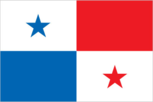
divided into four, equal rectangles; the top quadrants are white (hoist side) with a blue five-pointed star in the center and plain red, the bottom quadrants are plain blue (hoist side) and white with a red five-pointed star in the center
Independence
3 November 1903 (from Colombia; became independent from Spain 28 November 1821)
Judicial branch
Supreme Court of Justice (Corte Suprema de Justicia), 5 superior courts, 3 courts of appeal
Legal system
based on civil law system; judicial review of legislative acts in the Supreme Court of Justice; accepts compulsory ICJ jurisdiction, with reservations
Legislative Assembly (Asamblea Legislativa)
legislators from outlying rural districts are chosen on a plurality basis while districts located in more populous towns and cities elect multiple legislators by means of a proportion-based formula; elections last held 8 May 1994 (next to be held 9 May 1999); results - percent of vote by party NA ; seats - (72 total) PRD 32, PS 4, PALA 1, PA 14, MPE 6, MOLIRENA 4, PLA 3, PRC 3, PL 2, PDC 1, UDI 1, MORENA 1
Legislative branch
unicameral
Member of
AG (associate), CG, ECLAC, FAO, G-77, IADB, IAEA, IBRD, ICAO, ICFTU, ICRM, IDA, IFAD, IFC, IFRCS, ILO, IMF, IMO, INMARSAT, INTELSAT, INTERPOL, IOC, IOM, ITU, LAES, LAIA (observer), NAM, OAS, OPANAL, PCA, UN, UNCTAD, UNESCO, UNIDO, UPU, WCL, WFTU, WHO, WIPO, WMO, WTO
Names
conventional long form: Republic of Panama conventional short form: Panama local long form: Republica de Panama local short form: Panama
National holiday
Independence Day, 3 November (1903)
Other political or pressure groups
National Council of Organized Workers (CONATO); National Council of Private Enterprise (CONEP); Panamanian Association of Business Executives (APEDE); National Civic Crusade; Chamber of Commerce; Panamanian Industrialists Society (SIP); Workers Confederation of the Republic of Panama (CTRP)
Political parties and leaders
governing coalition: Democratic Revolutionary Party (PRD), Gerardo GONZALEZ; Solidarity Party (PS), Samuel LEWIS GALINDO; Liberal Republican Party (PLR), Rodolfo CHIARI; Labor Party (PALA), Carlos Lopez GUEVARA other parties: Nationalist Republican Liberal Movement (MOLIRENA), Alfredo RAMIREZ; Authentic Liberal Party (PLA), Arnulfo ESCALONA; Arnulfista Party (PA), Mireya MOSCOSO DE GRUBER; Christian Democratic Party (PDC), Raul OSSA; Liberal Party (PL), Roberto ALEMAN Zubieta; Papa Egoro Movement (MPE), Ruben BLADES; Civic Renewal Party (PRC), Tomas HERRERA; National Unity Mission Party (MUN), Jose Manuel PAREDES; Independent Democratic Union (UDI), Jacinto CARDENAS; National Renovation Movement (MORENA), Pedro VALLERINO
Suffrage
18 years of age; universal and compulsory
Type
constitutional republic
US diplomatic representation
chief of mission: (vacant); Charge d'Affaires Oliver P. GARZA embassy: Avenida Balboa and Calle 38, Apartado 6959, Panama City 5 mailing address: American Embassy Panama, Unit 0945; APO AA 34002 telephone: [507] 27-1777
Economy
Agriculture
accounts for 10% of GDP (1992 est.); crops - bananas, rice, corn, coffee, sugarcane; livestock; fishing; importer of food grain, vegetables
Budget
revenues: $1.93 billion expenditures: $1.93 billion, including capital expenditures of $NA (1994)
Currency
1 balboa (B) = 100 centesimos
Economic aid
recipient: US commitments, including Ex-Im (FY70-89), $516 million; Western (non-US) countries, ODA and OOF bilateral commitments (1970-89), $582 million; Communist countries (1970-89), $4 million
Electricity
capacity: 960,000 kW production: 2.8 billion kWh consumption per capita: 1,047 kWh (1993)
Exchange rates
balboas (B) per US$1 - 1.000 (fixed rate)
Exports
$520 million (f.o.b., 1994 est.) commodities: bananas 43%, shrimp 11%, sugar 4%, clothing 5%, coffee 2% partners: US 45%, EU, Central America and Caribbean
External debt
$6.7 billion (yearend 1993 est.)
Fiscal year
calendar year
Illicit drugs
major cocaine transshipment point and drug money laundering center
Imports
$2.205 billion (c.i.f., 1994 est.) commodities: capital goods 21%, crude oil 11%, foodstuffs 9%, consumer goods, chemicals partners: US 40%, EU, Central America and Caribbean, Japan
Industrial production
growth rate 1.8% (1994 est.); accounts for about 9% of GDP
Industries
manufacturing and construction, petroleum refining, brewing, cement and other construction materials, sugar milling
Inflation rate (consumer prices)
1.8% (1994 est.)
National product
GDP - purchasing power parity - $12.3 billion (1994 est.)
National product per capita
$4,670 (1994 est.)
National product real growth rate
3.6% (1994 est.)
Overview
Because of its key geographic location, Panama's economy is service-based, heavily weighted toward banking, commerce, and tourism. Trade and financial ties with the US are especially close. GDP grew at 3.6% in 1994, a respectable rate, yet below the 7.1% average of the early 1990s. Banking and financial services and trade through the Colon Free Zone continued to expand rapidly, with the industrial and agricultural sectors experiencing little growth. The new administration, inaugurated 1 September 1994, has launched an economic plan designed to reverse rising unemployment, attract foreign investment, cut back the size of government, and modernize the economy. The success of the plan in meeting its goals for 1995 and beyond depends largely on the success of the administration in reforming the labor code and instituting the reforms necessary to join the GATT.
Unemployment rate
12.9% (1994 est.)
Communications
Radio
broadcast stations: AM 91, FM 0, shortwave 0 radios: NA
Telephone system
220,000 telephones; domestic and international facilities well developed local: NA intercity: NA international: 1 coaxial submarine cable; 2 INTELSAT (Atlantic Ocean) earth stations; connected to the Central American Microwave System
Television
broadcast stations: 23 televisions: NA
Transportation
Airports
total: 115 with paved runways over 3,047 m: 1 with paved runways 2,438 to 3,047 m: 1 with paved runways 1,524 to 2,437 m: 5 with paved runways 914 to 1,523 m: 14 with paved runways under 914 m: 74 with unpaved runways 914 to 1,523 m: 20
Highways
total: 8,530 km paved: 2,745 km unpaved: gravel, crushed stone 3,270 km; improved, unimproved earth 2,515 km
Inland waterways
800 km navigable by shallow draft vessels; 82 km Panama Canal
Merchant marine
total: 3,526 ships (1,000 GRT or over) totaling 60,748,525 GRT/95,102,552 DWT ships by type: barge carrier 1, bulk 787, cargo 1,070, chemical tanker 175, combination bulk 33, combination ore/oil 25, container 259, liquefied gas tanker 125, livestock carrier 8, multifunction large-load carrier 6, oil tanker 465, passenger 24, passenger-cargo 3, refrigerated cargo 284, roll-on/roll-off cargo 81, short-sea passenger 34, specialized tanker 9, vehicle carrier 137 note: a flag of convenience registry; includes 93 countries; the 10 major fleet flags are: Japan 1,171 ships, Greece 323, Hong Kong 276, US 212, Taiwan 184, Singapore 181, South Korea 172, China 145 ships, UK 102, and Norway 70
Pipelines
crude oil 130 km
Ports
Bahia de las Minas, Balboa, Colon, Cristobal, Panama
Railroads
total: 238 km broad gauge: 78 km 1.524-m gauge narrow gauge: 160 km 0.914-m gauge
Military and Security
Branches
Panamanian Public Forces (PPF; includes the National Police or PNP, Maritime Service, National Air Service, and Institutional Protective Service); Judicial Branch Technical Police
Defense expenditures
expenditures for the Panamanian security forces amounted to $105 million, 1.0% of GDP (1993 est.) ________________________________________________________________________ PAPUA NEW GUINEA
Manpower availability
males age 15-49 701,691; males fit for military service 481,927 (1995 est.)