1990 Edition
CIA World Factbook 1990 (Project Gutenberg)
Geography
Climate
tropical; hot, humid, cloudy; prolonged rainy season (May to January), short dry season (January to May)
Coastline
2,490 km
Comparative area
slightly smaller than South Carolina
Environment
dense tropical forest in east and northwest
Land boundaries
555 km total; Colombia 225 km, Costa Rica 330 km
Land use
6% arable land; 2% permanent crops; 15% meadows and pastures; 54% forest and woodland; 23% other; includes NEGL% irrigated
Natural resources
copper, mahogany forests, shrimp
Note
strategic location on eastern end of isthmus forming land bridge connecting North and South America; controls Panama Canal that links North Atlantic Ocean via Caribbean Sea with North Pacific Ocean
Terrain
interior mostly steep, rugged mountains and dissected, upland plains; coastal areas largely plains and rolling hills
Territorial sea
200 nm
Total area
78,200 km2; land area: 75,990 km2
People and Society
Birth rate
26 births/1,000 population (1990)
Death rate
5 deaths/1,000 population (1990)
Ethnic divisions
70% mestizo (mixed Indian and European ancestry), 14% West Indian, 10% white, 6% Indian
Infant mortality rate
22 deaths/1,000 live births (1990)
Labor force
770,472 (1987); 27.9% government and community services; 26.2% agriculture, hunting, and fishing; 16% commerce, restaurants, and hotels; 10.5% manufacturing and mining; 5.3% construction; 5.3% transportation and communications; 4.2% finance, insurance, and real estate; 2.4% Canal Zone; shortage of skilled labor, but an oversupply of unskilled labor
Language
Spanish (official); 14% speak English as native tongue; many Panamanians bilingual
Life expectancy at birth
72 years male, 76 years female (1990)
Literacy
90%
Nationality
noun--Panamanian(s); adjective--Panamanian
Net migration rate
NEGL migrants/1,000 population (1990)
Organized labor
17% of labor force (1986)
Population
2,425,400 (July 1990), growth rate 2.1% (1990)
Religion
over 93% Roman Catholic, 6% Protestant
Total fertility rate
3.1 children born/woman (1990)
Government
Administrative divisions
9 provinces (provincias, singular--provincia) and 1 territory* (comarca); Bocas del Toro, Chiriqui, Cocle, Colon, Darien, Herrera, Los Santos, Panama, San Blas*, Veraguas
Capital
Panama
Communists
People's Party (PdP), pro-Noriega regime mainline Communist party, did not obtain the necessary 3% of the total vote in the 1984 election to retain its legal status; about 3,000 members
Constitution
11 October 1972; major reforms adopted April 1983
Diplomatic representation
Ambassador Eduardo VALLARINO; Chancery at 2862 McGill Terrace NW, Washington DC 20008; telephone (202) 483-1407; the status of the Consulates General and Consulates has not yet been determined; US--Ambassador Deane R. HINTON; Embassy at Avenida Balboa and Calle 38, Apartado 6959, Panama City 5 (mailing address is Box E, APO Miami 34002); telephone [507] 27-1777
Elections
President--last held on 7 May 1989, annulled but later upheld (next to be held May 1994); results--anti-Noriega coalition believed to have won about 75% of the total votes cast; Legislative Assembly--last held on 7 May 1989, annulled but later upheld; in process of reorganization (next to be held May 1994); results--percent of vote by party NA; seats--(67 total) the Electoral Tribunal has confirmed 58 of the 67 seats--PDC 27, MOLIRENA 15, PLA 6, Noriegist PRD 7, PPA 3; legitimate holders of the other 9 seats cannot be determined and a special election will be held
Executive branch
president, two vice presidents, Cabinet
Flag
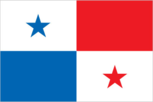
divided into four, equal rectangles; the top quadrants are white with a blue five-pointed star in the center (hoist side) and plain red, the bottom quadrants are plain blue (hoist side) and white with a red five-pointed star in the center
Independence
3 November 1903 (from Colombia; became independent from Spain 28 November 1821)
Judicial branch
Supreme Court of Justice (Corte Suprema de Justica) currently being reorganized
Leaders
Chief of State and Head of Government--President Guillermo ENDARA (since 20 December 1989, elected 7 May 1989); First Vice President Ricardo Arias CALDERON (since 20 December 1989, elected 7 May 1989); Second Vice President Guillermo FORD (since 20 December 1989, elected 7 May 1989)
Legal system
based on civil law system; judicial review of legislative acts in the Supreme Court of Justice; accepts compulsory ICJ jurisdiction, with reservations
Legislative branch
unicameral Legislative Assembly (Asamblea Legislativa)
Long-form name
Republic of Panama
Member of
FAO, G-77, IADB, IAEA, IBRD, ICAO, ICO, IDA, IFAD, IDB--Inter-American Development Bank, IFC, ILO, IMF, IMO, INTELSAT, INTERPOL, IRC, ITU, IWC--International Whaling Commission, IWC--International Wheat Council, NAM, OAS, PAHO, SELA, UN, UNESCO, UPEB, UPU, WFTU, WHO, WMO, WTO
National holiday
Independence Day, 3 November (1903)
Other political or pressure groups
National Council of Organized Workers (CONATO); National Council of Private Enterprise (CONEP); Panamanian Association of Business Executives (APEDE)
Political parties and leaders
Government alliance--Authentic Liberal Party (PLA); faction of Authentic Panamenista Party (PPA), Guillermo Endara; Christian Democrat Party (PDC), Ricardo Arias Calderon; Nationalist Republican Liberal Movement (MOLIRENA), Alfredo Ramirez; former Noriegist parties--Democratic Revolutionary Party (PRD, ex-official government party), Carlos Duque; Labor Party (PALA), Ramon Sieiro Murgas; People's Party (PdP, Soviet-oriented Communist party), Ruben Dario Sousa Batista; Democratic Workers Party; National Action Party (PAN); other opposition parties--Popular Nationalist Party (PNP), Olimpo A. Saez Maruci; factions of the former Liberal and Republican parties; Popular Action Party (PAP), Carlos Ivan Zuniga; Socialist Workers Party (PST, leftist), Jose Cambra; Revolutionary Workers Party (PRT, leftist), Graciela Dixon
Suffrage
universal and compulsory at age 18
Type
centralized republic
Economy
Agriculture
accounts for 10% of GDP (1989 est.), 26% of labor force (1987); crops--bananas, rice, corn, coffee, sugarcane; livestock; fishing; importer of food grain, vegetables, milk products
Aid
US commitments, including Ex-Im (FY70-88), $515 million; Western (non-US) countries, ODA and OOF bilateral commitments (1970-87), $568 million; Communist countries (1970-88), $4 million
Budget
revenues $598 million; expenditures $750 million, including capital expenditures of $NA (1989 est.)
Currency
balboa (plural--balboas); 1 balboa (B) = 100 centesimos
Electricity
1,113,000 kW capacity; 3,270 million kWh produced, 1,380 kWh per capita (1989)
Exchange rates
balboas (B) per US$1--1.000 (fixed rate)
Exports
$220 million (f.o.b., 1989 est.); commodities--bananas 40%, shrimp 27%, coffee 4%, sugar, petroleum products; partners--US 90%, Central America and Caribbean, EC (1989 est.)
External debt
$5.2 billion (November 1989 est.)
Fiscal year
calendar year
GDP
$3.9 billion, per capita $1,648; real growth rate - 7.5%
Imports
$830 million (f.o.b., 1989 est.); commodities--foodstuffs 16%, capital goods 9%, crude oil 16%, consumer goods, chemicals; partners--US 35%, Central America and Caribbean, EC, Mexico, Venezuela (1989 est.)
Industrial production
growth rate - 4.1% (1989 est.)
Industries
manufacturing and construction activities, petroleum refining, brewing, cement and other construction material, sugar mills, paper products
Inflation rate (consumer prices)
- 0.1% (1989 est.)
Overview
The GDP contracted an estimated 7.5% in 1989, following a drop of 20% in 1988. Political instability, lack of credit, and the erosion of business confidence prompted declines of 20-70% in the financial, agricultural, commercial, manufacturing, and construction sectors between 1987 and 1989. Transits through the Panama Canal were off slightly, as were toll revenues. Unemployment remained about 23% during 1989. Imports of foodstuffs and crude oil increased during 1989, but capital goods imports continued their slide. Exports were widely promoted by Noriega trade delegations, but sales abroad remained stagnant.
Unemployment rate
23% (1989 est.)
Communications
Airports
123 total, 112 usable; 42 with permanent-surface runways; none with runways over 3,659 m; 2 with runways 2,440-3,659 m; 15 with runways 1,220-2,439 m
Civil air
16 major transport aircraft
Highways
8,530 km total; 2,745 km paved, 3,270 km gravel or crushed stone, 2,515 km improved and unimproved earth
Inland waterways
800 km navigable by shallow draft vessels; 82 km Panama Canal
Merchant marine
3,187 ships (1,000 GRT or over) totaling 46,502,092 GRT/72,961,250 DWT; includes 34 passenger, 22 short-sea passenger, 3 passenger-cargo, 1,087 cargo, 179 refrigerated cargo, 186 container, 71 roll-on/roll-off cargo, 136 vehicle carrier, 7 livestock carrier, 9 multifunction large-load carrier, 315 petroleum, oils, and lubricants (POL) tanker, 184 chemical tanker, 30 combination ore/oil, 91 liquefied gas, 8 specialized tanker, 767 bulk, 58 combination bulk; note--all but 5 are foreign owned and operated; the top 4 foreign owners are Japan 41%, Greece 9%, Hong Kong 9%, and the US 7% (China owns at least 144 ships, Yugoslavia 12, Cuba 6, and Vietnam 9)
Pipelines
crude oil, 130 km
Ports
Cristobal, Balboa, Puerto de La Bahia de Las Minas
Railroads
238 km total; 78 km 1.524-meter gauge, 160 km 0.914-meter gauge
Telecommunications
domestic and international facilities well developed; connection into Central American Microwave System; 2 Atlantic Ocean satellite antennas; 220,000 telephones; stations--91 AM, no FM, 23 TV; 1 coaxial submarine cable
Military and Security
Branches
the Panamanian Defense Forces (PDF) ceased to exist as a military institution shortly after the United States invaded Panama on 20 December 1989; President Endara is attempting to restructure the forces, with more civilian control, under the new name of Panamanian Public Forces (PPF)
Defense expenditures
2.0% of GDP (1987)
Military manpower
males 15-49, 628,327; 433,352 fit for military service; no conscription