2010 Edition
CIA World Factbook 2010 (Project Gutenberg)
Introduction
Background
The Indus Valley civilization, one of the oldest in the world and dating back at least 5,000 years, spread over much of what is presently Pakistan. During the second millennium B.C., remnants of this culture fused with the migrating Indo-Aryan peoples. The area underwent successive invasions in subsequent centuries from the Persians, Greeks, Scythians, Arabs (who brought Islam), Afghans, and Turks. The Mughal Empire flourished in the 16th and 17th centuries; the British came to dominate the region in the 18th century. The separation in 1947 of British India into the Muslim state of Pakistan (with West and East sections) and largely Hindu India was never satisfactorily resolved, and India and Pakistan fought two wars - in 1947-48 and 1965 - over the disputed Kashmir territory. A third war between these countries in 1971 - in which India capitalized on Islamabad's marginalization of Bengalis in Pakistani politics - resulted in East Pakistan becoming the separate nation of Bangladesh. In response to Indian nuclear weapons testing, Pakistan conducted its own tests in 1998. India-Pakistan relations have been rocky since the November 2008 Mumbai attacks, but both countries are taking small steps to put relations back on track. In February 2008, Pakistan held parliamentary elections and in September 2008, after the resignation of former President MUSHARRAF, elected Asif Ali ZARDARI to the presidency. Pakistani government and military leaders are struggling to control domestic insurgents, many of whom are located in the tribal areas adjacent to the border with Afghanistan.
Geography
Area
- land
- 770,875 sq km
- total
- 796,095 sq km
- water
- 25,220 sq km
Area - comparative
slightly less than twice the size of California
Climate
mostly hot, dry desert; temperate in northwest; arctic in north
Coastline
1,046 km
Elevation extremes
- highest point
- K2 (Mt. Godwin-Austen) 8,611 m
- lowest point
- Indian Ocean 0 m
Environment - current issues
water pollution from raw sewage, industrial wastes, and agricultural runoff; limited natural fresh water resources; most of the population does not have access to potable water; deforestation; soil erosion; desertification
Environment - international agreements
- party to
- Biodiversity, Climate Change, Climate Change-Kyoto Protocol, Desertification, Endangered Species, Environmental Modification, Hazardous Wastes, Law of the Sea, Marine Dumping, Ozone Layer Protection, Ship Pollution, Wetlands signed, but not ratified: Marine Life Conservation
Freshwater withdrawal (domestic/industrial/agricultural)
- per capita
- 1,072 cu m/yr (2000)
- total
- 169.39 cu km/yr (2%/2%/96%)
Geographic coordinates
30 00 N, 70 00 E
Geography - note
controls Khyber Pass and Bolan Pass, traditional invasion routes between Central Asia and the Indian Subcontinent
Irrigated land
182,300 sq km (2003)
Land boundaries
- border countries
- Afghanistan 2,430 km, China 523 km, India 2,912 km, Iran 909 km
- total
- 6,774 km
Land use
- arable land
- 24.44%
- other
- 74.72% (2005)
- permanent crops
- 0.84%
Location
Southern Asia, bordering the Arabian Sea, between India on the east and Iran and Afghanistan on the west and China in the north
Map references
Asia
Maritime claims
- contiguous zone
- 24 nm
- continental shelf
- 200 nm or to the edge of the continental margin
- exclusive economic zone
- 200 nm
- territorial sea
- 12 nm
Natural hazards
frequent earthquakes, occasionally severe especially in north and west; flooding along the Indus after heavy rains (July and August)
Natural resources
land, extensive natural gas reserves, limited petroleum, poor quality coal, iron ore, copper, salt, limestone
Terrain
flat Indus plain in east; mountains in north and northwest; Balochistan plateau in west
Total renewable water resources
233.8 cu km (2003)
People and Society
Age structure
0-14 years: 36.7% (male 33,037,943/female 31,092,572) 15-64 years: 59.1% (male 53,658,173/female 49,500,786) 65 years and over: 4.2% (male 3,495,350/female 3,793,734) (2010 est.)
Birth rate
25.3 births/1,000 population (2010 est.)
Death rate
7.06 deaths/1,000 population (July 2010 est.)
Education expenditures
2.9% of GDP (2008)
Ethnic groups
Punjabi 44.68%, Pashtun (Pathan) 15.42%, Sindhi 14.1%, Sariaki 8.38%, Muhajirs 7.57%, Balochi 3.57%, other 6.28%
HIV/AIDS - adult prevalence rate
0.1% (2007 est.)
HIV/AIDS - deaths
5,100 (2007 est.)
HIV/AIDS - people living with HIV/AIDS
96,000 (2007 est.)
Infant mortality rate
- female
- 61.89 deaths/1,000 live births (2010 est.)
- male
- 68.59 deaths/1,000 live births
- total
- 65.32 deaths/1,000 live births
Languages
Punjabi 48%, Sindhi 12%, Siraiki (a Punjabi variant) 10%, Pashtu 8%, Urdu (official) 8%, Balochi 3%, Hindko 2%, Brahui 1%, English (official; lingua franca of Pakistani elite and most government ministries), Burushaski, and other 8%
Life expectancy at birth
- female
- 67.5 years (2010 est.)
- male
- 63.84 years
- total population
- 65.63 years
Literacy
- definition: age 15 and over can read and write
- female
- 36% (2005 est.)
- male
- 63%
- total population
- 49.9%
Major infectious diseases
- animal contact disease
- rabies note: highly pathogenic H5N1 avian influenza has been identified in this country; it poses a negligible risk with extremely rare cases possible among US citizens who have close contact with birds (2009)
- degree of risk
- high
- food or waterborne diseases
- bacterial diarrhea, hepatitis A and E, and typhoid fever
- vectorborne diseases
- dengue fever and malaria
Median age
- female
- 21.2 years (2010 est.)
- male
- 21.2 years
- total
- 21.2 years
Nationality
- adjective
- Pakistani
- noun
- Pakistani(s)
Net migration rate
-2.36 migrant(s)/1,000 population (2010 est.)
Population
184,404,791 (July 2010 est.)
Population growth rate
1.589% (2010 est.)
Religions
Muslim 95% (Sunni 75%, Shia 20%), other (includes Christian and Hindu) 5%
School life expectancy (primary to tertiary education)
- female
- 6 years (2008)
- male
- 8 years
- total
- 7 years
Sex ratio
- at birth
- 1.05 male(s)/female under 15 years: 1.06 male(s)/female 15-64 years: 1.09 male(s)/female 65 years and over: 0.92 male(s)/female
- total population
- 1.07 male(s)/female (2010 est.)
Total fertility rate
3.28 children born/woman (2010 est.)
Urbanization
- rate of urbanization
- 3% annual rate of change (2005-10 est.)
- urban population
- 36% of total population (2008)
Government
Administrative divisions
- 4 provinces, 1 territory*, and 1 capital territory**; Balochistan, Federally Administered Tribal Areas*, Islamabad Capital Territory**, Khyber Pakhtunkhwa (formerly North-West Frontier Province), Punjab, Sindh note: the Pakistani-administered portion of the disputed Jammu and
- Kashmir region consists of two administrative entities
- Azad Kashmir and Gilgit-Baltistan
Capital
- geographic coordinates
- 33 42 N, 73 10 E
- name
- Islamabad
- time difference
- UTC+5 (10 hours ahead of Washington, DC during Standard Time)
Constitution
12 April 1973; suspended 5 July 1977, restored 30 December 1985; suspended 15 October 1999, restored in stages in 2002; amended 31 December 2003; suspended 3 November 2007; restored on 15 December 2007; amended 19 April 2010
Country name
- conventional long form
- Islamic Republic of Pakistan
- conventional short form
- Pakistan
- former
- West Pakistan
- local long form
- Jamhuryat Islami Pakistan
- local short form
- Pakistan
Diplomatic representation from the US
- chief of mission
- Ambassador Cameron MUNTER
- consulate(s)
- Lahore, Peshawar
- consulate(s) general
- Karachi
- embassy
- Diplomatic Enclave, Ramna 5, Islamabad
- FAX
- [92] (51) 2276427
- mailing address
- P. O. Box 1048, Unit 62200, APO AE 09812-2200
- telephone
- [92] (51) 208-0000
Diplomatic representation in the US
- chancery
- 3517 International Court, Washington, DC 20008
- chief of mission
- Ambassador Husain HAQQANI
- consulate(s)
- Chicago, Houston
- consulate(s) general
- Boston (Honorary Consulate General), Chicago, Houston, Los Angeles, New York
- FAX
- [1] (202) 686-1544
- telephone
- [1] (202) 243-6500
Executive branch
- cabinet
- Cabinet appointed by the president upon the advice of the prime minister (For more information visit the World Leaders website )
- chief of state
- President Asif Ali ZARDARI (since 9 September 2008)
- election results
- Asif Ali ZARDARI elected president; ZARDARI 481 votes, SIDDIQUE 153 votes, SYED 44 votes; Syed Yousuf Raza GILANI elected prime minister; GILANI 264 votes, Pervaiz ELAHI 42 votes; several abstentions
- elections
- the president elected by secret ballot through an Electoral College comprising the members of the Senate, National Assembly, and the provincial assemblies for a five-year term; election last held on 6 September 2008 (next to be held not later than 2013); note - any person who is a Muslim and not less than 45 years of age and is qualified to be elected as a member of the National Assembly can contest the presidential election; the prime minister selected by the National Assembly; election last held on 24 March 2008
- head of government
- Prime Minister Syed Yousuf Raza GILANI (since 25 March 2008)
Flag description
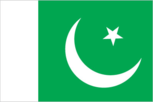
green with a vertical white band (symbolizing the role of religious minorities) on the hoist side; a large white crescent and star are centered in the green field; the crescent, star, and color green are traditional symbols of Islam
Government type
federal republic
Independence
14 August 1947 (from British India)
International organization participation
ADB, ARF, ASEAN (dialogue partner), C, CICA, CP, D-8, ECO, FAO, G-11, G-24, G-77, IAEA, IBRD, ICAO, ICC, ICRM, IDA, IDB, IFAD, IFC, IFRCS, IHO, ILO, IMF, IMO, IMSO, Interpol, IOC, IOM, IPU, ISO, ITSO, ITU, ITUC, MIGA, MINURSO, MONUSCO, NAM, OAS (observer), OIC, OPCW, PCA, SAARC, SACEP, SCO (observer), UN, UNAMID, UNCTAD, UNESCO, UNHCR, UNIDO, UNMIL, UNMIS, UNMIT, UNOCI, UNWTO, UPU, WCO, WFTU, WHO, WIPO, WMO, WTO
Judicial branch
Supreme Court (justices appointed by the president); Federal Islamic or Sharia Court
Legal system
based on English common law with provisions to accommodate Pakistan's status as an Islamic state; accepts compulsory ICJ jurisdiction with reservations
Legislative branch
- bicameral parliament or Majlis-e-Shoora consists of the Senate (100 seats; members indirectly elected by provincial assemblies and the territories' representatives in the National Assembly to serve six-year terms; one half are elected every three years) and the National Assembly (342 seats; 272 members elected by popular vote; 60 seats reserved for women; 10 seats reserved for non-Muslims; members serve five-year terms)
- election results
- Senate - percent of vote by party - NA; seats by party - PPPP 27, PML-Q 21, MMA 9, PML-N 7, ANP 6, MQM 6, JUI-F 4, BNP-A 2, JWP 1, NPP 1, PKMAP 1, PML-F 1, PPP 1, independents 13; National Assembly - percent of votes by party - NA; seats by party as of October 2010 - PPPP 127, PML-N 90, PML 51, MQM 25, ANP 13, JUI-F 8, PML-F 5, BNP-A 1, NPP 1, PPP-S 1, independents 18, unfilled seats - 2
- elections
- Senate - last held on 3 March 2009 (next to be held in March 2012); National Assembly - last held on 18 February 2008 with by-elections on 26 June 2008 (next to be held in 2013)
National anthem
- lyrics/music
- Abu-Al-Asar Hafeez JULLANDHURI/Ahmed Ghulamali CHAGLA note: adopted 1954; the anthem is also known as "Pak sarzamin shad bad" (Blessed Be the Sacred Land)
- name
- "Qaumi Tarana" (National Anthem)
National holiday
Republic Day, 23 March (1956)
Political parties and leaders
Awami National Party or ANP [Asfandyar Wali KHAN]; Balochistan National Party-Awami or BNP-A [Moheem Khan BALOCH]; Balochistan National Party-Hayee Group or BNP-H [Dr. Hayee BALOCH]; Balochistan National Party-Mengal or BNP-M [Sardar Ataullah MENGAL]; Jamaat-i Islami or JI [Syed Munawar HASAN]; Jamhoori Watan Party or JWP; Jamiat Ahle Hadith or JAH [Sajid MIR]; Jamiat Ulema-i Islam Fazl-ur Rehman or JUI-F [Fazl-ur REHMAN]; Jamiat Ulema-i Islam Sami-ul HAQ or JUI-S [Sami ul-HAQ]; Jamiat Ulema-i Pakistan or JUP [Shah Faridul HAQ]; Muttahida Majlis-e Amal or MMA [Qazi Hussain AHMED]; Muttahida Qaumi Movement or MQM [Altaf HUSSAIN]; National Alliance or NA [Ghulam Mustapha JATOI] (merged with PML); National Peoples Party or NPP; Pakhtun Khwa Milli Awami Party or PKMAP [Mahmood Khan ACHAKZAI]; Pakistan Awami Tehrik or PAT [Tahir ul QADRI]; Pakistan Muslim League or PML [Chaudhry Shujaat HUSSAIN]; Pakistan Muslim League-Functional or PML-F [Pir PAGARO]; Pakistan Muslim League-Nawaz or PML-N [Nawaz SHARIF]; Pakistan Peoples Party Parliamentarians or PPPP [Bilawal Bhutto ZARDARI, chairman; Asif Ali ZARDARI, co-chairman]; Pakistan Peoples Party-SHERPAO or PPP-S [Aftab Ahmed Khan SHERPAO]; Pakistan Tehrik-e Insaaf or PTI [Imran KHAN]; Tehrik-i Islami [Allama Sajid NAQVI] note: political alliances in Pakistan can shift frequently
Political pressure groups and leaders
- other
- military (most important political force); ulema (clergy); landowners; industrialists; small merchants
Suffrage
18 years of age; universal; joint electorates and reserved parliamentary seats for women and non-Muslims
Economy
Agriculture - products
cotton, wheat, rice, sugarcane, fruits, vegetables; milk, beef, mutton, eggs
Central bank discount rate
12.5% (31 December 2009) 15% (31 December 2008)
Commercial bank prime lending rate
NA%
Current account balance
-$2.641 billion (2010 est.) -$3.583 billion (2009 est.)
Debt - external
$57.21 billion (31 December 2010 est.) $53.62 billion (31 December 2009 est.)
Distribution of family income - Gini index
30.6 (FY07/08) 41 (FY98/99)
Economy - overview
Pakistan, an impoverished and underdeveloped country, has suffered from decades of internal political disputes and low levels of foreign investment. Between 2001-07, however, poverty levels decreased by 10%, as Islamabad steadily raised development spending. Between 2004-07, GDP growth in the 5-8% range was spurred by gains in the industrial and service sectors - despite severe electricity shortfalls - but growth slowed in 2008-09 and unemployment rose. Inflation remains the top concern among the public, climbing from 7.7% in 2007 to more than 13% in 2010. In addition, the Pakistani rupee has depreciated since 2007 as a result of political and economic instability. The government agreed to an International Monetary Fund Standby Arrangement in November 2008 in response to a balance of payments crisis, but during 2009-10 its current account strengthened and foreign exchange reserves stabilized - largely because of lower oil prices and record remittances from workers abroad. Record floods in July-August 2010 lowered agricultural output and contributed to a jump in inflation, and reconstruction costs will strain the limited resources of the government. Textiles account for most of Pakistan's export earnings, but Pakistan's failure to expand a viable export base for other manufactures has left the country vulnerable to shifts in world demand. Other long term challenges include expanding investment in education, healthcare, and electricity production, and reducing dependence on foreign donors.
Electricity - consumption
72.2 billion kWh (2007 est.)
Electricity - exports
0 kWh (2008 est.)
Electricity - imports
0 kWh (2008 est.)
Electricity - production
90.8 billion kWh (2007 est.)
Exchange rates
Pakistani rupees (PKR) per US dollar - 85.27 (2010), 81.7129 (2009), 70.64 (2008), 60.6295 (2007), 60.35 (2006)
Exports
$20.29 billion (2010 est.) $18.33 billion (2009 est.)
Exports - commodities
textiles (garments, bed linen, cotton cloth, yarn), rice, leather goods, sports goods, chemicals, manufactures, carpets and rugs
Exports - partners
US 15.87%, UAE 12.35%, Afghanistan 8.48%, UK 4.7%, China 4.44% (2009)
GDP - composition by sector
- agriculture
- 21.8%
- industry
- 23.6%
- services
- 54.6% (2010 est.)
GDP - per capita (PPP)
$2,400 (2010 est.) $2,400 (2009 est.) $2,400 (2008 est.) note: data are in 2010 US dollars
GDP - real growth rate
2.7% (2010 est.) 4.3% (2009 est.) 3.6% (2008 est.)
GDP (official exchange rate)
$174.8 billion (2010 est.)
GDP (purchasing power parity)
$451.2 billion (2010 est.) $439.4 billion (2009 est.) $421.2 billion (2008 est.) note: data are in 2010 US dollars
Household income or consumption by percentage share
lowest 10%: 3.9% highest 10%: 26.5% (2005)
Imports
$32.71 billion (2010 est.) $28.53 billion (2009 est.)
Imports - commodities
petroleum, petroleum products, machinery, plastics, transportation equipment, edible oils, paper and paperboard, iron and steel, tea
Imports - partners
China 15.35%, Saudi Arabia 10.54%, UAE 9.8%, US 4.81%, Kuwait 4.73%, Malaysia 4.43%, India 4.02% (2009)
Industrial production growth rate
4.9% (2010 est.)
Industries
textiles and apparel, food processing, pharmaceuticals, construction materials, paper products, fertilizer, shrimp
Inflation rate (consumer prices)
13.4% (2010 est.) 13.6% (2009 est.)
Investment (gross fixed)
15% of GDP (2010 est.)
Labor force
55.77 million note: extensive export of labor, mostly to the Middle East, and use of child labor (2010 est.)
Labor force - by occupation
- agriculture
- 43%
- industry
- 20.3%
- services
- 36.6% (2005 est.)
Market value of publicly traded shares
$33.24 billion (31 December 2009) $23.49 billion (31 December 2008) $70.26 billion (31 December 2007)
Natural gas - consumption
37.5 billion cu m (2008 est.)
Natural gas - exports
0 cu m (2008 est.)
Natural gas - imports
0 cu m (2008 est.)
Natural gas - production
37.5 billion cu m (2008 est.)
Natural gas - proved reserves
840.2 billion cu m (1 January 2010 est.)
Oil - consumption
373,000 bbl/day (2009 est.)
Oil - exports
30,090 bbl/day (2007 est.)
Oil - imports
319,500 bbl/day (2007 est.)
Oil - production
59,140 bbl/day (2009 est.)
Oil - proved reserves
436.2 million bbl (1 January 2010 est.)
Population below poverty line
24% (FY05/06 est.)
Public debt
49.9% of GDP (2010 est.) 49.3% of GDP (2009 est.)
Reserves of foreign exchange and gold
$16.1 billion (31 December 2010 est.) $13.77 billion (31 December 2009 est.)
Stock of broad money
$85.22 billion (31 December 2010 est.) $65.13 billion (31 December 2009 est.)
Stock of direct foreign investment - abroad
$1.047 billion (31 December 2010 est.) $1.017 billion (31 December 2009 est.)
Stock of direct foreign investment - at home
$30.09 billion (31 December 2010 est.) $28.09 billion (31 December 2009 est.)
Stock of domestic credit
$71.45 billion (31 December 2010 est.) $63.1 billion (31 December 2009 est.)
Stock of narrow money
$59.75 billion (31 December 2010 est) $47.23 billion (31 December 2009 est)
Unemployment rate
15% (2010 est.) 14% (2009 est.) note: substantial underemployment exists
Communications
Broadcast media
media is government regulated; 1 dominant state-owned TV broadcaster, Pakistan Television Corporation (PTV), operates a network consisting of 6 channels; private TV broadcasters are permitted and some foreign satellite channels are carried by cable TV operators; the state-owned radio network operates more than 40 stations; privately-owned radio stations mostly limit programming to music and talk shows (2007)
Internet country code
.pk
Internet hosts
330,466 (2010)
Internet users
20.431 million (2009)
Telephone system
- domestic
- mobile-cellular subscribership has skyrocketed, exceeding 100 million in 2009, up from only about 300,000 in 2000; approximately 90 percent of Pakistanis live within areas that have cell phone coverage and more than half of all Pakistanis have access to a cell phone; fiber systems are being constructed throughout the country to aid in network growth; fixed line availability has risen only marginally over the same period and there are still difficulties getting fixed-line service to rural areas
- general assessment
- the telecommunications infrastructure is improving dramatically with foreign and domestic investments in fixed-line and mobile-cellular networks; system consists of microwave radio relay, coaxial cable, fiber-optic cable, cellular, and satellite networks;
- international
- country code - 92; landing point for the SEA-ME-WE-3 and SEA-ME-WE-4 submarine cable systems that provide links to Asia, the Middle East, and Europe; satellite earth stations - 3 Intelsat (1 Atlantic Ocean and 2 Indian Ocean); 3 operational international gateway exchanges (1 at Karachi and 2 at Islamabad); microwave radio relay to neighboring countries (2009)
Telephones - main lines in use
4.058 million (2009)
Telephones - mobile cellular
103 million (2009)
Transportation
Airports
148 (2010)
Airports - with paved runways
- total
- 101 over 3,047 m: 15 2,438 to 3,047 m: 20 1,524 to 2,437 m: 39 914 to 1,523 m: 18 under 914 m: 9 (2010)
Airports - with unpaved runways
- total
- 47 1,524 to 2,437 m: 11 914 to 1,523 m: 11 under 914 m: 25 (2010)
Heliports
20 (2010)
Merchant marine
- by type
- bulk carrier 1, cargo 4, petroleum tanker 5
- registered in other countries
- 14 (Comoros 3, Georgia 1, Marshall Islands 1, Panama 5, Saint Kitts and Nevis 3, Saint Vincent and the Grenadines 1) (2010)
- total
- 10
Pipelines
gas 10,402 km; oil 2,011 km; refined products 787 km (2009)
Ports and terminals
Karachi, Port Muhammad Bin Qasim
Railways
- broad gauge
- 7,479 km 1.676-m gauge (293 km electrified)
- narrow gauge
- 312 km 1.000-m gauge (2007)
- total
- 7,791 km
Roadways
- paved
- 172,827 km (includes 711 km of expressways)
- total
- 259,197 km
- unpaved
- 86,370 km (2007)
Military and Security
Manpower available for military service
males age 16-49: 45,829,360 females age 16-49: 41,716,682 (2010 est.)
Manpower fit for military service
males age 16-49: 35,774,936 females age 16-49: 34,572,451 (2010 est.)
Manpower reaching militarily significant age annually
- female
- 2,000,479 (2010 est.)
- male
- 2,144,574
Military branches
Army (includes National Guard), Navy (includes Marines and Maritime Security Agency), Pakistan Air Force (Pakistan Fiza'ya) (2010)
Military expenditures
3% of GDP (2007 est.)
Military service age and obligation
17-23 years of age for voluntary military service; soldiers cannot be deployed for combat until age 18; the Pakistani Air Force and Pakistani Navy have inducted their first female pilots and sailors (2009)
Transnational Issues
Disputes - international
various talks and confidence-building measures cautiously have begun to defuse tensions over Kashmir, particularly since the October 2005 earthquake in the region; Kashmir nevertheless remains the site of the world's largest and most militarized territorial dispute with portions under the de facto administration of China (Aksai Chin), India (Jammu and Kashmir), and Pakistan (Azad Kashmir and Northern Areas); UN Military Observer Group in India and Pakistan (UNMOGIP) has maintained a small group of peacekeepers since 1949; India does not recognize Pakistan's ceding historic Kashmir lands to China in 1964; India and Pakistan have maintained their 2004 cease fire in Kashmir and initiated discussions on defusing the armed stand-off in the Siachen glacier region; Pakistan protests India's fencing the highly militarized Line of Control and construction of the Baglihar Dam on the Chenab River in Jammu and Kashmir, which is part of the larger dispute on water sharing of the Indus River and its tributaries; to defuse tensions and prepare for discussions on a maritime boundary, India and Pakistan seek technical resolution of the disputed boundary in Sir Creek estuary at the mouth of the Rann of Kutch in the Arabian Sea; Pakistani maps continue to show the Junagadh claim in India's Gujarat State; by 2005, Pakistan, with UN assistance, repatriated 2.3 million Afghan refugees leaving slightly more than a million, many of whom remain at their own choosing; Pakistan has proposed and Afghanistan protests construction of a fence and laying of mines along portions of their porous border; Pakistan has sent troops into remote tribal areas to monitor and control the border with Afghanistan and to stem terrorist or other illegal activities
Illicit drugs
significant transit area for Afghan drugs, including heroin, opium, morphine, and hashish, bound for Iran, Western markets, the Gulf States, Africa, and Asia; financial crimes related to drug trafficking, terrorism, corruption, and smuggling remain problems; opium poppy cultivation estimated to be 2,300 hectares in 2007 with 600 of those hectares eradicated; federal and provincial authorities continue to conduct anti-poppy campaigns that utilizes forced eradication, fines, and arrests page last updated on January 20, 2011 ======================================================================
Refugees and internally displaced persons
- IDPs
- undetermined (government strikes on Islamic militants in South Waziristan); 34,000 (October 2005 earthquake; most of those displaced returned to their home villages in the spring of 2006) (2007)
- refugees (country of origin)
- 1,043,984 (Afghanistan)