2017 Edition
CIA World Factbook 2017 Archive (HTML)
Introduction
Background
Two centuries of Viking raids into Europe tapered off following the adoption of Christianity by King Olav TRYGGVASON in 994; conversion of the Norwegian kingdom occurred over the next several decades. In 1397, Norway was absorbed into a union with Denmark that lasted more than four centuries. In 1814, Norwegians resisted the cession of their country to Sweden and adopted a new constitution. Sweden then invaded Norway but agreed to let Norway keep its constitution in return for accepting the union under a Swedish king. Rising nationalism throughout the 19th century led to a 1905 referendum granting Norway independence. Although Norway remained neutral in World War I, it suffered heavy losses to its shipping. Norway proclaimed its neutrality at the outset of World War II, but was nonetheless occupied for five years by Nazi Germany (1940-45). In 1949, Norway abandoned neutrality and became a member of NATO. Discovery of oil and gas in adjacent waters in the late 1960s boosted Norway's economic fortunes. In referenda held in 1972 and 1994, Norway rejected joining the EU. Key domestic issues include immigration and integration of ethnic minorities, maintaining the country's extensive social safety net with an aging population, and preserving economic competitiveness.
Geography
Area
- 323,802 sq km 304,282 sq km 19,520 sq km
- land
- 304,282 sq km
- total
- 323,802 sq km
- water
- 19,520 sq km
Area - comparative
slightly larger than twice the size of Georgia; slightly larger than New Mexico
Climate
temperate along coast, modified by North Atlantic Current; colder interior with increased precipitation and colder summers; rainy year-round on west coast
Coastline
25,148 km (includes mainland 2,650 km, as well as long fjords, numerous small islands, and minor indentations 22,498 km; length of island coastlines 58,133 km)
Elevation
- 460 m lowest point: Norwegian Sea 0 m highest point: Galdhopiggen 2,469 m
- elevation extremes
- lowest point: Norwegian Sea 0 m
- highest point
- Galdhopiggen 2,469 m
- mean elevation
- 460 m
Environment - current issues
water pollution; acid rain damaging forests and adversely affecting lakes, threatening fish stocks; air pollution from vehicle emissions
Environment - international agreements
- Air Pollution, Air Pollution-Nitrogen Oxides, Air Pollution-Persistent Organic Pollutants, Air Pollution-Sulfur 85, Air Pollution-Sulfur 94, Air Pollution-Volatile Organic Compounds, Antarctic-Environmental Protocol, Antarctic-Marine Living Resources, Antarctic Seals, Antarctic Treaty, Biodiversity, Climate Change, Climate Change-Kyoto Protocol, Desertification, Endangered Species, Environmental Modification, Hazardous Wastes, Law of the Sea, Marine Dumping, Ozone Layer Protection, Ship Pollution, Tropical Timber 83, Tropical Timber 94, Wetlands, Whaling none of the selected agreements
- party to
- Air Pollution, Air Pollution-Nitrogen Oxides, Air Pollution-Persistent Organic Pollutants, Air Pollution-Sulfur 85, Air Pollution-Sulfur 94, Air Pollution-Volatile Organic Compounds, Antarctic-Environmental Protocol, Antarctic-Marine Living Resources, Antarctic Seals, Antarctic Treaty, Biodiversity, Climate Change, Climate Change-Kyoto Protocol, Desertification, Endangered Species, Environmental Modification, Hazardous Wastes, Law of the Sea, Marine Dumping, Ozone Layer Protection, Ship Pollution, Tropical Timber 83, Tropical Timber 94, Wetlands, Whaling
- signed, but not ratified
- none of the selected agreements
Geographic coordinates
62 00 N, 10 00 E
Geography - note
about two-thirds mountains; some 50,000 islands off its much-indented coastline; strategic location adjacent to sea lanes and air routes in North Atlantic; one of the most rugged and longest coastlines in the world
Irrigated land
900 sq km (2012)
Land boundaries
- 2,566 km Finland 709 km, Sweden 1,666 km, Russia 191 km
- border countries (3)
- Finland 709 km, Sweden 1,666 km, Russia 191 km
- total
- 2,566 km
Land use
- 2.7% arable land 2.2%; permanent crops 0%; permanent pasture 0.5% 27.8% 69.5% (2011 est.)
- agricultural land
- 2.7%
- forest
- 27.8%
- other
- 69.5% (2011 est.)
Location
Northern Europe, bordering the North Sea and the North Atlantic Ocean, west of Sweden
Map references
Europe
Maritime claims
- 12 nm 10 nm 200 nm 200 nm
- contiguous zone
- 10 nm
- continental shelf
- 200 nm
- exclusive economic zone
- 200 nm
- territorial sea
- 12 nm
Natural hazards
- rockslides, avalanches Beerenberg (2,227 m) on Jan Mayen Island in the Norwegian Sea is the country's only active volcano
- volcanism
- Beerenberg (2,227 m) on Jan Mayen Island in the Norwegian Sea is the country's only active volcano
Natural resources
petroleum, natural gas, iron ore, copper, lead, zinc, titanium, pyrites, nickel, fish, timber, hydropower
Population - distribution
most Norwegians live in the south where the climate is milder and there is better connectivity to mainland Europe; population clusters are found all along the North Sea coast in the southwest, and Skaggerak in the southeast; the interior areas of the north remain sparsely populated
Terrain
glaciated; mostly high plateaus and rugged mountains broken by fertile valleys; small, scattered plains; coastline deeply indented by fjords; arctic tundra in north
People and Society
Age structure
- 18% (male 490,915/female 466,515) 12.58% (male 343,103/female 326,053) 41.01% (male 1,125,334/female 1,056,330) 11.71% (male 315,223/female 307,639) 16.71% (male 409,057/female 479,876) (2017 est.)
- 0-14 years
- 18% (male 490,915/female 466,515)
- 15-24 years
- 12.58% (male 343,103/female 326,053)
- 25-54 years
- 41.01% (male 1,125,334/female 1,056,330)
- 55-64 years
- 11.71% (male 315,223/female 307,639)
- 65 years and over
- 16.71% (male 409,057/female 479,876) (2017 est.)
Birth rate
12.2 births/1,000 population (2017 est.)
Death rate
8.1 deaths/1,000 population (2017 est.)
Dependency ratios
- 52.1 27.3 24.8 data include Svalbard and Jan Mayen Islands (2015 est.)
- elderly dependency ratio
- 24.8
- note
- data include Svalbard and Jan Mayen Islands (2015 est.)
- potential support ratio
- 4
- total dependency ratio
- 52.1
- youth dependency ratio
- 27.3
Drinking water source
- urban: 100% of population rural: 100% of population total: 100% of population urban: 0% of population rural: 0% of population total: 0% of population (2015 est.)
- rural
- 0% of population
- total
- 0% of population (2015 est.)
- urban
- 0% of population
Education expenditures
7.4% of GDP (2013)
Ethnic groups
Norwegian 83.2% (includes about 60,000 Sami), other European 8.3%, other 8.5% (2017 est.)
Health expenditures
9.7% of GDP (2014)
HIV/AIDS - adult prevalence rate
NA
HIV/AIDS - deaths
NA
HIV/AIDS - people living with HIV/AIDS
NA
Hospital bed density
3.85 beds/1,000 population (2014)
Infant mortality rate
- 2.5 deaths/1,000 live births 2.8 deaths/1,000 live births 2.2 deaths/1,000 live births (2017 est.)
- female
- 2.2 deaths/1,000 live births (2017 est.)
- male
- 2.8 deaths/1,000 live births
- total
- 2.5 deaths/1,000 live births
Languages
- Bokmal Norwegian (official), Nynorsk Norwegian (official), small Sami- and Finnish-speaking minorities Sami is an official language in nine municipalities
- note
- Sami is an official language in nine municipalities
Life expectancy at birth
- 81.9 years 79.8 years 84 years (2017 est.)
- female
- 84 years (2017 est.)
- male
- 79.8 years
- total population
- 81.9 years
Major urban areas - population
OSLO (capital) 986,000 (2015)
Maternal mortality ratio
5 deaths/100,000 live births (2015 est.)
Median age
- 39.2 years 38.4 years 40 years (2017 est.)
- female
- 40 years (2017 est.)
- male
- 38.4 years
- total
- 39.2 years
Mother's mean age at first birth
- 28.9 years data is calculated based on actual age at first births (2015 est.)
- note
- data is calculated based on actual age at first births (2015 est.)
Nationality
- Norwegian(s) Norwegian
- adjective
- Norwegian
- noun
- Norwegian(s)
Net migration rate
5.9 migrant(s)/1,000 population (2017 est.)
Obesity - adult prevalence rate
23.1% (2016)
Physicians density
4.42 physicians/1,000 population (2014)
Population
5,320,045 (July 2017 est.)
Population distribution
most Norweigans live in the south where the climate is milder and there is better connectivity to mainland Europe; population clusters are found all along the North Sea coast in the southwest, and Skaggerak in the southeast; the interior areas of the north remain sparsely populated
Population growth rate
1.01% (2017 est.)
Religions
Church of Norway (Evangelical Lutheran - official) 71.5%, Roman Catholic 2.8%, other Christian 3.9%, Muslim 2.8%, other 2%, unspecified 7.5% (2016 est.)
Sanitation facility access
- urban: 98% of population rural: 98.3% of population total: 98.1% of population urban: 2% of population rural: 1.7% of population total: 1.9% of population (2015 est.)
- rural
- 1.7% of population
- total
- 1.9% of population (2015 est.)
- urban
- 2% of population
School life expectancy (primary to tertiary education)
- 18 years 17 years 18 years (2015)
- female
- 18 years (2015)
- male
- 17 years
- total
- 18 years
Sex ratio
- 1.06 male(s)/female 1.05 male(s)/female 1.05 male(s)/female 1.06 male(s)/female 1.02 male(s)/female 0.84 male(s)/female 1.02 male(s)/female (2016 est.)
- 0-14 years
- 1.05 male(s)/female
- 15-24 years
- 1.05 male(s)/female
- 25-54 years
- 1.06 male(s)/female
- 55-64 years
- 1.02 male(s)/female
- 65 years and over
- 0.84 male(s)/female
- at birth
- 1.06 male(s)/female
- total population
- 1.02 male(s)/female (2016 est.)
Total fertility rate
1.85 children born/woman (2017 est.)
Unemployment, youth ages 15-24
- 11.1% 13% 9.3% (2016 est.)
- female
- 9.3% (2016 est.)
- male
- 13%
- total
- 11.1%
Urbanization
- 81% of total population (2017) 1.31% annual rate of change (2015-20 est.) data include Svalbard and Jan Mayen Islands
- note
- data include Svalbard and Jan Mayen Islands
- rate of urbanization
- 1.31% annual rate of change (2015-20 est.)
- urban population
- 81% of total population (2017)
Government
Administrative divisions
19 counties (fylker, singular - fylke); Akershus, Aust-Agder, Buskerud, Finnmark, Hedmark, Hordaland, More og Romsdal, Nordland, Nord-Trondelag, Oppland, Oslo, Ostfold, Rogaland, Sogn og Fjordane, Sor-Trondelag, Telemark, Troms, Vest-Agder, Vestfold
Capital
- Oslo 59 55 N, 10 45 E UTC+1 (6 hours ahead of Washington, DC, during Standard Time) +1hr, begins last Sunday in March; ends last Sunday in October
- daylight saving time
- +1hr, begins last Sunday in March; ends last Sunday in October
- geographic coordinates
- 59 55 N, 10 45 E
- name
- Oslo
- time difference
- UTC+1 (6 hours ahead of Washington, DC, during Standard Time)
Citizenship
- no at least one parent must be a citizen of Norway no 7 years
- citizenship by birth
- no
- citizenship by descent only
- at least one parent must be a citizen of Norway
- dual citizenship recognized
- no
- residency requirement for naturalization
- 7 years
Constitution
- drafted spring 1814, adopted 16 May 1814, signed by Constituent Assembly 17 May 1814 proposals submitted by members of Parliament or by the government within the first three years of Parliament's four-year term; passage requires two-thirds majority vote of a two-thirds quorum in the next elected Parliament; amended over 400 times, last in 2015 (2016)
- amendments
- proposals submitted by members of Parliament or by the government within the first three years of Parliament's four-year term; passage requires two-thirds majority vote of a two-thirds quorum in the next elected Parliament; amended over 400 times, last in 2015 (2016)
- history
- drafted spring 1814, adopted 16 May 1814, signed by Constituent Assembly 17 May 1814
Country name
- Kingdom of Norway Norway Kongeriket Norge Norge derives from the Old Norse words "nordr" and "vegr" meaning "northern way" and refers to the long coastline of western Norway
- conventional long form
- Kingdom of Norway
- conventional short form
- Norway
- etymology
- derives from the Old Norse words "nordr" and "vegr" meaning "northern way" and refers to the long coastline of western Norway
- local long form
- Kongeriket Norge
- local short form
- Norge
Dependent areas
Bouvet Island, Jan Mayen, Svalbard
Diplomatic representation from the US
- Ambassador (vacant); Charge d'Affaires James P. DEHART (since 12 January 2017) Morgedalsvegen 36, 0378 Oslo; PSC 69, Box 1000, APO AE 09707 [47] 21-30-85-40 [47] 22-44-33-63, 22-56-27-51
- chief of mission
- Ambassador (vacant); Charge d'Affaires James P. DEHART (since 12 January 2017)
- embassy
- Morgedalsvegen 36, 0378 Oslo;
- FAX
- [47] 22-44-33-63, 22-56-27-51
- mailing address
- PSC 69, Box 1000, APO AE 09707
- telephone
- [47] 21-30-85-40
Diplomatic representation in the US
- Ambassador Kare Reidar AAS (since 17 September 2013) 2720 34th Street NW, Washington, DC 20008 [1] (202) 333-6000 [1] (202) 459-3990 Houston, New York, San Francisco
- chancery
- 2720 34th Street NW, Washington, DC 20008
- chief of mission
- Ambassador Kare Reidar AAS (since 17 September 2013)
- consulate(s) general
- Houston, New York, San Francisco
- FAX
- [1] (202) 459-3990
- telephone
- [1] (202) 333-6000
Executive branch
- King HARALD V (since 17 January 1991); Heir Apparent Crown Prince HAAKON MAGNUS, son of the monarch (born 20 July 1973) Prime Minister Erna SOLBERG (since 16 October 2013) State Council appointed by the monarch, approved by Parliament the monarchy is hereditary; following parliamentary elections, the leader of the majority party or majority coalition usually appointed prime minister by the monarch with the approval of the parliament
- cabinet
- State Council appointed by the monarch, approved by Parliament
- chief of state
- King HARALD V (since 17 January 1991); Heir Apparent Crown Prince HAAKON MAGNUS, son of the monarch (born 20 July 1973)
- elections/appointments
- the monarchy is hereditary; following parliamentary elections, the leader of the majority party or majority coalition usually appointed prime minister by the monarch with the approval of the parliament
- head of government
- Prime Minister Erna SOLBERG (since 16 October 2013)
Flag description
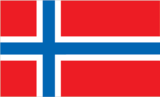
red with a blue cross outlined in white that extends to the edges of the flag; the vertical part of the cross is shifted to the hoist side in the style of the Dannebrog (Danish flag); the colors recall Norway's past political unions with Denmark (red and white) and Sweden (blue)
Government type
parliamentary constitutional monarchy
Independence
7 June 1905 (declared the union with Sweden dissolved); 26 October 1905 (Sweden agreed to the repeal of the union)
International law organization participation
accepts compulsory ICJ jurisdiction with reservations; accepts ICCt jurisdiction
International organization participation
ADB (nonregional member), AfDB (nonregional member), Arctic Council, Australia Group, BIS, CBSS, CD, CE, CERN, EAPC, EBRD, EFTA, EITI (implementing country), ESA, FAO, FATF, IADB, IAEA, IBRD, ICAO, ICC (national committees), ICCt, ICRM, IDA, IEA, IFAD, IFC, IFRCS, IGAD (partners), IHO, ILO, IMF, IMO, IMSO, Interpol, IOC, IOM, IPU, ISO, ITSO, ITU, ITUC (NGOs), MIGA, MINUSMA, NATO, NC, NEA, NIB, NSG, OAS (observer), OECD, OPCW, OSCE, Paris Club, PCA, Schengen Convention, UN, UNCTAD, UNESCO, UNHCR, UNIDO, UNITAR, UNMISS, UNRWA, UNTSO, UNWTO, UPU, WCO, WHO, WIPO, WMO, WTO, ZC
Judicial branch
- Supreme Court or Hoyesterett (consists of the chief justice and 18 associate justices) justices appointed by the monarch (King in Council) upon the recommendation of the Judicial Appointments Board; justice retirement mandatory at age 70 Courts of Appeal or Lagmensrett; regional and district courts; Conciliation Boards; ordinary and special courts; note - in addition to professionally trained judges, elected lay judges sit on the bench with professional judges in the Courts of Appeal and district courts
- highest court(s)
- Supreme Court or Hoyesterett (consists of the chief justice and 18 associate justices)
- judge selection and term of office
- justices appointed by the monarch (King in Council) upon the recommendation of the Judicial Appointments Board; justice retirement mandatory at age 70
- subordinate courts
- Courts of Appeal or Lagmensrett; regional and district courts; Conciliation Boards; ordinary and special courts; note - in addition to professionally trained judges, elected lay judges sit on the bench with professional judges in the Courts of Appeal and district courts
Legal system
mixed legal system of civil, common, and customary law; Supreme Court can advise on legislative acts
Legislative branch
- unicameral Parliament or Storting (169 seats; members directly elected in multi-seat constituencies by proportional representation vote; members serve 4-year terms) last held on 11 September 2017 (next to be held in September 2021) percent of vote by party - Ap 27.4%, H 25%, FrP 15.2%, SP 10.3%, SV 6%, V 4.4%, KrF 4.2%, MDG 3.2%, R 2.4%, other/invalid 1.9%; seats by party - Ap 49, H 45, FrP 27, SP 19, SV 11, V 8, KrF 8, MDG 1, R 1
- description
- unicameral Parliament or Storting (169 seats; members directly elected in multi-seat constituencies by proportional representation vote; members serve 4-year terms)
- election results
- percent of vote by party - Ap 27.4%, H 25%, FrP 15.2%, SP 10.3%, SV 6%, V 4.4%, KrF 4.2%, MDG 3.2%, R 2.4%, other/invalid 1.9%; seats by party - Ap 49, H 45, FrP 27, SP 19, SV 11, V 8, KrF 8, MDG 1, R 1
- elections
- last held on 11 September 2017 (next to be held in September 2021)
National anthem
- "Ja, vi elsker dette landet" (Yes, We Love This Country) lyrics/music: Bjornstjerne BJORNSON/Rikard NORDRAAK adopted 1864; in addition to the national anthem, "Kongesangen" (Song of the King), which uses the tune of "God Save the Queen," serves as the royal anthem
- lyrics/music
- lyrics/music: Bjornstjerne BJORNSON/Rikard NORDRAAK
- name
- "Ja, vi elsker dette landet" (Yes, We Love This Country)
- note
- adopted 1864; in addition to the national anthem, "Kongesangen" (Song of the King), which uses the tune of "God Save the Queen," serves as the royal anthem
National holiday
Constitution Day, 17 May (1814)
National symbol(s)
- lion; national colors: red, white, blue
- lion; national colors
- red, white, blue
Political parties and leaders
Center Party or Sp [Trygve Slagsvold VEDUM] Christian Democratic Party or KrF [Knut Arild HAREIDE] Conservative Party or H [Erna SOLBERG] Green Party or MDG [Rasmus HANSSON and Une Aina BASTHOLM] Labor Party or Ap [Jonas Gahr STORE] Liberal Party or V [Trine SKEI GRANDE] Progress Party or FrP [Siv JENSEN] Socialist Left Party or SV [Audun LYSBAKKEN]
Political pressure groups and leaders
- Confederation of Norwegian Enterprise or NHO [Tore ULSTEIN, Kristin SKOGEN LUND] Norwegian Confederation of Trade Unions or LO [Hans-Christian GABRIELSEN] environmental groups; media; digital privacy movements
- other
- environmental groups; media; digital privacy movements
Suffrage
18 years of age; universal
Economy
Agriculture - products
barley, wheat, potatoes; pork, beef, veal, milk; fish
Budget
- $200.6 billion $189.4 billion (2016 est.)
- expenditures
- $189.4 billion (2016 est.)
- revenues
- $200.6 billion
Budget surplus (+) or deficit (-)
3% of GDP (2016 est.)
Central bank discount rate
6.25% (31 December 2010) 1.75% (31 December 2009)
Commercial bank prime lending rate
1.5% (31 December 2016 est.) 1.75% (31 December 2015 est.)
Current account balance
$18.43 billion (2016 est.) $33.75 billion (2015 est.)
Debt - external
- $642.3 billion (31 March 2016 est.) $640.1 billion (31 March 2015 est.) Norway is a net external creditor
- note
- Norway is a net external creditor
Distribution of family income - Gini index
26.8 (2010) 25.8 (1995)
Economy - overview
Norway has a stable economy with a vibrant private sector, a large state sector, and an extensive social safety net. Norway opted out of the EU during a referendum in November 1994; nonetheless, as a member of the European Economic Area, it contributes sizably to the EU budget. The country is richly endowed with natural resources in addition to oil and gas, including hydropower, fish, forests, and minerals. Norway is a leading producer and the world’s second largest exporter of seafood, after China. The government manages the country’s petroleum resources through extensive regulation. The petroleum sector provides about 9% of jobs, 12% of GDP, 13% of the state’s revenue, and 37% of exports, according to official national estimates. Norway is one of the world's leading petroleum exporters, though oil production in 2016 was close to 50% below its peak in 2000; annual gas production, conversely, more than doubled over the same time period. After a continual decline from 2001 to 2013, oil production rose in 2016 for the third year running, due to the higher production of existing oil fields and to new fields coming on stream. In anticipation of eventual declines in oil and gas production, Norway saves state revenue from petroleum sector activities in the world's largest sovereign wealth fund, valued at almost $900 billion as of early 2017. To help balance the federal budget each year, the government follows a “fiscal rule,” which states that spending of revenues from petroleum and fund investments shall correspond to the expected real rate of return on the fund, an amount it estimates is sustainable over time. In February 2017, the government revised the expected rate of return for the fund downward from 4% to 3%. After solid GDP growth in the 2004-07 period, the economy slowed in 2008, and contracted in 2009, before returning to modest, positive growth from 2010 to 2016. Lower oil prices in 2015 and 2016 caused growth to slow, increased unemployment, and weakened the Norwegian krone. The latter trend has mitigated the negative impact of lower oil and gas prices by making Norwegian exports cheaper for foreign buyers. The government has expressed willingness to increase public spending from the sovereign wealth fund to help prevent a recession.
Exchange rates
Norwegian kroner (NOK) per US dollar - 8.3978 (2016 est.) 8.3978 (2015 est.) 8.0646 (2014 est.) 6.3021 (2013 est.) 5.82 (2012 est.)
Exports
$88.88 billion (2016 est.) $103.4 billion (2015 est.)
Exports - commodities
petroleum and petroleum products, machinery and equipment, metals, chemicals, ships, fish
Exports - partners
UK 21%, Germany 14.4%, Netherlands 10.7%, France 6.9%, Sweden 6.5%, Belgium 4.4%, US 4.3%, Denmark 4% (2016)
Fiscal year
calendar year
GDP - composition, by end use
- 45.2% 24.5% 24% 5.3% 34% -33% (2016 est.)
- exports of goods and services
- 34%
- government consumption
- 24.5%
- household consumption
- 45.2%
- imports of goods and services
- -33% (2016 est.)
- investment in fixed capital
- 24%
- investment in inventories
- 5.3%
GDP - composition, by sector of origin
- 2.5% 31.7% 65.8% (2016 est.)
- agriculture
- 2.5%
- industry
- 31.7%
- services
- 65.8% (2016 est.)
GDP - per capita (PPP)
- $69,400 (2016 est.) $69,300 (2015 est.) $68,800 (2014 est.) data are in 2016 dollars
- note
- data are in 2016 dollars
GDP - real growth rate
1.1% (2016 est.) 1.6% (2015 est.) 1.9% (2014 est.)
GDP (official exchange rate)
$370.6 billion (2016 est.)
GDP (purchasing power parity)
- $364.5 billion (2016 est.) $356.1 billion (2015 est.) $346.7 billion (2014 est.) data are in 2016 dollars
- note
- data are in 2016 dollars
Gross national saving
34.1% of GDP (2016 est.) 36.9% of GDP (2015 est.) 39.2% of GDP (2014 est.)
Household income or consumption by percentage share
- 3.8% 21.2% (2014)
- highest 10%
- 21.2% (2014)
- lowest 10%
- 3.8%
Imports
$73.62 billion (2016 est.) $75.41 billion (2015 est.)
Imports - commodities
machinery and equipment, chemicals, metals, foodstuffs
Imports - partners
Germany 12.2%, Sweden 12.2%, China 11.2%, US 6.6%, Denmark 5.7%, UK 5.2%, Netherlands 4.1% (2016)
Industrial production growth rate
0.4% (2016 est.)
Industries
petroleum and gas, shipping, fishing, aquaculture, food processing, shipbuilding, pulp and paper products, metals, chemicals, timber, mining, textiles
Inflation rate (consumer prices)
3.6% (2016 est.) 2.2% (2015 est.)
Labor force
2.78 million (2016 est.)
Labor force - by occupation
- 2.1% 19.3% 78.6% (2016 est.)
- agriculture
- 2.1%
- industry
- 19.3%
- services
- 78.6% (2016 est.)
Market value of publicly traded shares
$193.9 billion (31 December 2015 est.) $219.4 billion (31 December 2014 est.) $265.4 billion (31 December 2013 est.)
Population below poverty line
NA%
Public debt
- 35.7% of GDP (2016 est.) 32% of GDP (2015 est.) data cover general government debt, and includes debt instruments issued (or owned) by government entities other than the treasury; the data exclude treasury debt held by foreign entities; the data exclude debt issued by subnational entities, as well as intra-governmental debt; intra-governmental debt consists of treasury borrowings from surpluses in the social funds, such as for retirement, medical care, and unemployment; debt instruments for the social funds are not sold at public auctions
- note
- data cover general government debt, and includes debt instruments issued (or owned) by government entities other than the treasury; the data exclude treasury debt held by foreign entities; the data exclude debt issued by subnational entities, as well as intra-governmental debt; intra-governmental debt consists of treasury borrowings from surpluses in the social funds, such as for retirement, medical care, and unemployment; debt instruments for the social funds are not sold at public auctions
Reserves of foreign exchange and gold
$60.45 billion (31 December 2016 est.) $57.46 billion (31 December 2015 est.)
Stock of broad money
$323.9 billion (31 December 2014 est.) $310 billion (31 December 2013 est.)
Stock of direct foreign investment - abroad
$191.7 billion (31 December 2016 est.) $203 billion (31 December 2015 est.)
Stock of direct foreign investment - at home
$219.1 billion (31 December 2016 est.) $210.6 billion (31 December 2015 est.)
Stock of domestic credit
$571.7 billion (31 December 2016 est.) $527.8 billion (31 December 2015 est.)
Stock of narrow money
$214 billion (31 December 2016 est.) $199.6 billion (31 December 2015 est.)
Taxes and other revenues
54.2% of GDP (2016 est.)
Unemployment rate
4.7% (2016 est.) 4.4% (2015 est.)
Energy
Carbon dioxide emissions from consumption of energy
53.9 million Mt (2015 est.)
Crude oil - exports
1.395 million bbl/day (2016 est.)
Crude oil - imports
10,630 bbl/day (2016 est.)
Crude oil - production
1.648 million bbl/day (2016 est.)
Crude oil - proved reserves
6.611 billion bbl (1 January 2017)
Electricity - consumption
133.1 billion kWh (2016 est.)
Electricity - exports
15.53 billion kWh (2016 est.)
Electricity - from fossil fuels
4.1% of total installed capacity (2015 est.)
Electricity - from hydroelectric plants
88.4% of total installed capacity (2015 est.)
Electricity - from nuclear fuels
0% of total installed capacity (2015 est.)
Electricity - from other renewable sources
3.3% of total installed capacity (2015 est.)
Electricity - imports
5.7 billion kWh (2016 est.)
Electricity - installed generating capacity
33.85 million kW (2015 est.)
Electricity - production
149.5 billion kWh (2016 est.)
Electricity access
- 100% (2016)
- electrification - total population
- 100% (2016)
Natural gas - consumption
5.23 billion cu m (2015 est.)
Natural gas - exports
112 billion cu m (2015 est.)
Natural gas - imports
0 cu m (2014 est.)
Natural gas - production
117.2 billion cu m (2015 est.)
Natural gas - proved reserves
1.856 trillion cu m (1 January 2017 es)
Refined petroleum products - consumption
227,700 bbl/day (2016 est.)
Refined petroleum products - exports
353,100 bbl/day (2016 est.)
Refined petroleum products - imports
124,500 bbl/day (2016 est.)
Refined petroleum products - production
282,400 bbl/day (2016 est.)
Communications
Broadcast media
state-owned public radio-TV broadcaster operates 3 nationwide TV stations, 3 nationwide radio stations, and 16 regional radio stations; roughly a dozen privately owned TV stations broadcast nationally and roughly another 25 local TV stations broadcasting; nearly 75% of households have access to multi-channel cable or satellite TV; 2 privately owned radio stations broadcast nationwide and another 240 stations operate locally; Norway is the first country in the world to phase out FM radio in favor of Digital Audio Broadcasting (DAB), a process scheduled for completion in late 2017 (2017)
Internet country code
.no
Internet users
- 5,122,904 97.3% (July 2016 est.)
- percent of population
- 97.3% (July 2016 est.)
- total
- 5,122,904
Telephone system
- modern in all respects; one of the most advanced telecommunications networks in Europe Norway has a domestic satellite system; the prevalence of rural areas encourages the wide use of mobile-cellular systems country code - 47; 2 buried coaxial cable systems; submarine cables provide links to other Nordic countries and Europe; satellite earth stations - NA Eutelsat, NA Intelsat (Atlantic Ocean), and 1 Inmarsat (Atlantic and Indian Ocean regions); note - Norway shares the Inmarsat earth station with the other Nordic countries (Denmark, Finland, Iceland, and Sweden) (2016)
- domestic
- Norway has a domestic satellite system; the prevalence of rural areas encourages the wide use of mobile-cellular systems
- general assessment
- modern in all respects; one of the most advanced telecommunications networks in Europe
- international
- country code - 47; 2 buried coaxial cable systems; submarine cables provide links to other Nordic countries and Europe; satellite earth stations - NA Eutelsat, NA Intelsat (Atlantic Ocean), and 1 Inmarsat (Atlantic and Indian Ocean regions); note - Norway shares the Inmarsat earth station with the other Nordic countries (Denmark, Finland, Iceland, and Sweden) (2016)
Telephones - fixed lines
- 863,855 16 (July 2016 est.)
- subscriptions per 100 inhabitants
- 16 (July 2016 est.)
- total subscriptions
- 863,855
Telephones - mobile cellular
- 5,718,740 109 (July 2016 est.)
- subscriptions per 100 inhabitants
- 109 (July 2016 est.)
- total
- 5,718,740
Transportation
Airports
95 (2013)
Airports - with paved runways
- 21 (2017)
- 1,524 to 2,437 m
- 10
- 2,438 to 3,047 m
- 14
- 914 to 1,523 m
- 22
- total
- 67
- under 914 m
- 21 (2017)
Airports - with unpaved runways
- 22 (2013)
- 914 to 1,523 m
- 6
- total
- 28
- under 914 m
- 22 (2013)
Civil aircraft registration country code prefix
LN (2016)
Heliports
1 (2013)
Merchant marine
- 1,585 bulk carrier 99, general cargo 240, oil tanker 80, other 1,166 (2017)
- by type
- bulk carrier 99, general cargo 240, oil tanker 80, other 1,166 (2017)
- total
- 1,585
National air transport system
- 12,277,220 0 mt-km (2015)
- annual freight traffic on registered air carriers
- 0 mt-km (2015)
- annual passenger traffic on registered air carriers
- 12,277,220
- inventory of registered aircraft operated by air carriers
- 106
- number of registered air carriers
- 3
Pipelines
gas 8,520 km; oil/condensate 1,304 km (2017)
Ports and terminals
- Bergen, Haugesund, Maaloy, Mongstad, Narvik, Sture Kamoy, Kollsnes, Melkoya Island Fredrikstad, Mosjoen
- LNG terminal(s) (export)
- Kamoy, Kollsnes, Melkoya Island
- LNG terminal(s) (import)
- Fredrikstad, Mosjoen
- major seaport(s)
- Bergen, Haugesund, Maaloy, Mongstad, Narvik, Sture
Railways
- 4,250 km 4,250 km 1.435-m gauge (2,518 km electrified) (2014)
- standard gauge
- 4,250 km 1.435-m gauge (2,518 km electrified) (2014)
- total
- 4,250 km
Roadways
- 93,870 km (includes 393 km of expressways) 75,754 km 18,116 km (2013)
- paved
- 75,754 km
- total
- 93,870 km (includes 393 km of expressways)
- unpaved
- 18,116 km (2013)
Waterways
1,577 km (2010)
Military and Security
Military branches
Norwegian Army (Haeren), Royal Norwegian Navy (Kongelige Norske Sjoeforsvaret; includes Coastal Rangers and Coast Guard (Kystvakt)), Royal Norwegian Air Force (Kongelige Norske Luftforsvaret), Home Guard (Heimevernet, HV) (2017)
Military expenditures
1.62% of GDP (2016) 1.5% of GDP (2015) 1.47% of GDP (2014) 1.41% of GDP (2013) 1.4% of GDP (2012)
Military service age and obligation
19-35 years of age for male and female compulsory military service; 16 years of age in wartime; 17 years of age for male volunteers; 18 years of age for women; 19-month service obligation (2017)
Transnational Issues
Disputes - international
Norway asserts a territorial claim in Antarctica (Queen Maud Land and its continental shelf); Denmark (Greenland) and Norway have made submissions to the Commission on the Limits of the Continental Shelf (CLCS) and Russia is collecting additional data to augment its 2001 CLCS submission; Norway and Russia signed a comprehensive maritime boundary agreement in 2010
Refugees and internally displaced persons
- 15,062 (Eritrea); 11,537 (Syria); 8,379 (Somalia); 6,568 (Afghanistan) (2016) 3,251 (2016)
- refugees (country of origin)
- 15,062 (Eritrea); 11,537 (Syria); 8,379 (Somalia); 6,568 (Afghanistan) (2016)
- stateless persons
- 3,251 (2016)