2003 Edition
CIA World Factbook 2003 (Project Gutenberg)
Introduction
Administrative divisions
19 provinces (fylker, singular - fylke); Akershus, Aust-Agder, Buskerud, Finnmark, Hedmark, Hordaland, More og Romsdal, Nordland, Nord-Trondelag, Oppland, Oslo, Ostfold, Rogaland, Sogn og Fjordane, Sor-Trondelag, Telemark, Troms, Vest-Agder, Vestfold
Age structure
0-14 years: 19.9% (male 465,320; female 439,095) 15-64 years: 65.2% (male 1,501,608; female 1,462,590) 65 years and over: 14.9% (male 281,554; female 395,956) (2003 est.)
Agriculture - products
barley, wheat, potatoes; pork, beef, veal, milk; fish
Airports
102 (2002)
Airports - with paved runways
- total
- 66 2,438 to 3,047 m: 13 1,524 to 2,437 m: 13 914 to 1,523 m: 14
- under 914 m
- 26 (2002)
Airports - with unpaved runways
- total
- 36 914 to 1,523 m: 7
- under 914 m
- 29 (2002) Military Norway
Area
- land
- 307,860 sq km
- total
- 324,220 sq km
- water
- 16,360 sq km
Area - comparative
slightly larger than New Mexico
Background
Two centuries of Viking raids into Europe tapered off following the adoption of Christianity by King Olav TRYGGVASON in 994. Conversion of the Norwegian kingdom occurred over the next several decades. In 1397, Norway was absorbed into a union with Denmark that was to last for more than four centuries. In 1814, Norwegians resisted the cession of their country to Sweden and adopted a new constitution. Sweden then invaded Norway but agreed to let Norway keep its constitution in return for accepting the union under a Swedish king. Rising nationalism throughout the 19th century led to a 1905 referendum granting Norway independence. Norway remained neutral in World War I and proclaimed its neutrality at the outset of World War II. Nevertheless, it was not able to avoid a five-year occupation by Nazi Germany (1940-1945). In 1949, neutrality was abandoned and Norway became a member of NATO. Discovery of oil and gas in adjacent waters in the late 1960s boosted Norway's economic fortunes. The current focus is on containing spending on the extensive welfare system and planning for the time when petroleum reserves are depleted. In referenda held in 1972 and 1994, Norway rejected joining the EU. Geography Norway
Birth rate
12.17 births/1,000 population (2003 est.)
Budget
- expenditures
- $57.6 billion, including capital expenditures of $NA (2000 est.)
- revenues
- $71.7 billion
Capital
Oslo
Climate
temperate along coast, modified by North Atlantic Current; colder interior with increased precipitation and colder summers; rainy year-round on west coast
Coastline
21,925 km (includes mainland 3,419 km, large islands 2,413 km, long fjords, numerous small islands, and minor indentations 16,093 km)
Constitution
17 May 1814, modified in 1884
Country name
- conventional long form
- Kingdom of Norway
- conventional short form
- Norway
- local long form
- Kongeriket Norge
- local short form
- Norge
Currency
Norwegian krone (NOK)
Currency code
NOK
Death rate
9.72 deaths/1,000 population (2003 est.)
Debt - external
$0 (Norway is a net external creditor)
Dependent areas
Bouvet Island, Jan Mayen, Svalbard
Diplomatic representation from the US
- chief of mission
- Ambassador John D. ONG
- embassy
- Drammensveien 18, 0244 Oslo
- mailing address
- PSC 69, Box 1000, APO AE 09707
- telephone
- [47] (22) 44 85 50
Diplomatic representation in the US
- chancery
- 2720 34th Street NW, Washington, DC 20008
- chief of mission
- Ambassador Knut VOLLEBAEK
- consulate(s) general
- Houston, Miami, Minneapolis, New York, and San Francisco
Disputes - international
Norway asserts a territorial claim in Antarctica (Queen Maud Land and its continental shelf); despite recent discussions, Russia and Norway continue to dispute their maritime limits in the Barents Sea and Russia's fishing rights beyond Svalbard's territorial limits within the Svalbard Treaty zone This page was last updated on 18 December, 2003
Distribution of family income - Gini index
25.8 (1995)
Economic aid - donor
ODA, $1.4 billion (1998)
Economy - overview
The Norwegian economy is a prosperous bastion of welfare capitalism, featuring a combination of free market activity and government intervention. The government controls key areas, such as the vital petroleum sector (through large-scale state enterprises). The country is richly endowed with natural resources - petroleum, hydropower, fish, forests, and minerals - and is highly dependent on its oil production and international oil prices; in 1999, oil and gas accounted for 35% of exports. Only Saudi Arabia and Russia export more oil than Norway. Norway opted to stay out of the EU during a referendum in November 1994. The government has moved ahead with privatization. With arguably the highest quality of life worldwide, Norwegians still worry about that time in the next two decades when the oil and gas begin to run out. Accordingly, Norway has been saving its oil-boosted budget surpluses in a Government Petroleum Fund, which is invested abroad and now is valued at more than $43 billion. GDP growth was a lackluster 1% in 2002 and 2003 against the background of a faltering European economy.
Electricity - consumption
115.3 billion kWh (2001)
Electricity - exports
7.162 billion kWh (2001)
Electricity - imports
10.76 billion kWh (2001)
Electricity - production
120.1 billion kWh (2001)
Electricity - production by source
- fossil fuel
- 0.4%
- hydro
- 99.3%
- nuclear
- 0%
- other
- 0.4% (2001)
Elevation extremes
- highest point
- Galdhopiggen 2,469 m
- lowest point
- Norwegian Sea 0 m
Environment - current issues
water pollution; acid rain damaging forests and adversely affecting lakes, threatening fish stocks; air pollution from vehicle emissions
Environment - international agreements
- party to
- Air Pollution, Air Pollution-Nitrogen Oxides, Air Pollution-Persistent Organic Pollutants, Air Pollution-Sulphur 85, Air Pollution-Sulphur 94, Air Pollution-Volatile Organic Compounds, Antarctic-Environmental Protocol, Antarctic-Marine Living Resources, Antarctic Seals, Antarctic Treaty, Biodiversity, Climate Change, Desertification, Endangered Species, Environmental Modification, Hazardous Wastes, Law of the Sea, Marine Dumping, Nuclear Test Ban, Ozone Layer Protection, Ship Pollution, Tropical Timber 83, Tropical Timber 94, Wetlands, Whaling
- signed, but not ratified
- Climate Change-Kyoto Protocol
Ethnic groups
Norwegian, Sami 20,000
Exchange rates
Norwegian kroner per US dollar - 7.98 (2002), 8.99 (2001), 8.8 (2000), 7.8 (1999), 7.55 (1998)
Executive branch
- cabinet
- State Council appointed by the monarch with the approval of Parliament
- chief of state
- King HARALD V (since 17 January 1991); Heir Apparent Crown Prince HAAKON MAGNUS, son of the monarch (born 20 July 1973)
- elections
- none; the monarch is hereditary; following parliamentary elections, the leader of the majority party or the leader of the majority coalition is usually appointed prime minister by the monarch with the approval of the Parliament
- head of government
- Prime Minister Kjell Magne BONDEVIK (since 19 October 2001)
Exports
$68.2 billion f.o.b. (2002 est.)
Exports - commodities
petroleum and petroleum products, machinery and equipment, metals, chemicals, ships, fish
Exports - partners
UK 18.1%, Germany 13.8%, France 11%, US 9.2%, Netherlands 8.2%, Sweden 8% (2002)
FAX
- [1] (202) 337-0870
- [47] (22) 44 33 63
- telephone
- [1] (202) 333-6000
Fiscal year
calendar year Communications Norway
Flag description
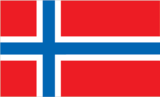
red with a blue cross outlined in white that extends to the edges of the flag; the vertical part of the cross is shifted to the hoist side in the style of the Dannebrog (Danish flag) Economy Norway
GDP
purchasing power parity - $149.1 billion (2002 est.)
GDP - composition by sector
- agriculture
- 1.9%
- industry
- 30.8%
- services
- 67.3% (2000)
GDP - per capita
purchasing power parity - $33,000 (2002 est.)
GDP - real growth rate
1% (2002 est.)
Geographic coordinates
62 00 N, 10 00 E
Geography - note
about two-thirds mountains; some 50,000 islands off its much indented coastline; strategic location adjacent to sea lanes and air routes in North Atlantic; one of most rugged and longest coastlines in world People Norway
Government type
constitutional monarchy
Highways
- paved
- 69,505 km (including 143 km of expressways)
- total
- 91,454 km
- unpaved
- 21,949 km (2000)
HIV/AIDS - adult prevalence rate
0.1% (2001 est.)
HIV/AIDS - deaths
less than 100 (2001 est.)
HIV/AIDS - people living with HIV/AIDS
1,800 (2001 est.)
Household income or consumption by percentage share
- highest 10%
- 21.8% (1995)
- lowest 10%
- 4.1%
Imports
$37.3 billion f.o.b. (2002 est.)
Imports - commodities
machinery and equipment, chemicals, metals, foodstuffs
Imports - partners
Sweden 17.7%, Germany 13.4%, UK 7.8%, Denmark 7.7%, US 5.7%, Netherlands 5.3%, France 4.2%, Italy 4% (2002)
Independence
7 June 1905 Norway declared the union with Sweden dissolved; 26 October 1905 Sweden agreed to the repeal of the union
Industrial production growth rate
1.2% (2002 est.)
Industries
petroleum and gas, food processing, shipbuilding, pulp and paper products, metals, chemicals, timber, mining, textiles, fishing
Infant mortality rate
- female
- 3.38 deaths/1,000 live births (2003 est.)
- male
- 4.32 deaths/1,000 live births
- total
- 3.87 deaths/1,000 live births
Inflation rate (consumer prices)
1.3% (2001 est.)
International organization participation
AfDB, AsDB, Australia Group, BIS, CBSS, CE, CERN, EAPC, EBRD, ECE, EFTA, ESA, FAO, IADB, IAEA, IBRD, ICAO, ICC, ICCt, ICFTU, ICRM, IDA, IEA, IFAD, IFC, IFRCS, IHO, ILO, IMF, IMO, Interpol, IOC, IOM, ISO, ITU, NAM (guest), NATO, NC, NEA, NIB, NSG, OAS (observer), OECD, OPCW, OSCE, PCA, UN, UNCTAD, UNESCO, UNHCR, UNIDO, UNMEE, UNMIBH, UNMIK, UNMISET, UNMOP, UNTSO, UPU, WCO, WEU (associate), WHO, WIPO, WMO, WTrO, ZC
Internet country code
.no
Internet Service Providers (ISPs)
13 (2000)
Internet users
2.68 million (2002) Transportation Norway
Irrigated land
1,270 sq km (1998 est.)
Judicial branch
Supreme Court or Hoyesterett (justices appointed by the monarch)
Labor force
2.4 million (2000 est.)
Labor force - by occupation
services 74%, industry 22%, agriculture, forestry, and fishing 4% (1995)
Land boundaries
- border countries
- Finland 729 km, Sweden 1,619 km, Russia 196 km
- total
- 2,544 km
Land use
- arable land
- 2.94%
- other
- 97.06% (1998 est.)
- permanent crops
- 0%
Languages
- Norwegian (official)
- note
- small Sami- and Finnish-speaking minorities
Legal system
mixture of customary law, civil law system, and common law traditions; Supreme Court renders advisory opinions to legislature when asked; accepts compulsory ICJ jurisdiction, with reservations
Legislative branch
- modified unicameral Parliament or Storting (165 seats; members are elected by popular vote by proportional representation to serve four-year terms)
- election results
- percent of vote by party - Labor Party 24.3%, Conservative Party 21.2%, Progress Party 14.6%, Socialist Left Party 12.5%, Christian People's Party 12.4%, Center Party 5.6%, Liberal Party 3.9%, Coastal Party 1.7%, other 3.8%; seats by party - Labor Party 43, Conservative Party 38, Progress Party 26, Socialist Left Party 23, Christian People's Party 22, Center Party 10, Liberal Party 2, Coastal Party 1
- elections
- last held 10 September 2001 (next to be held NA September 2005)
- note
- for certain purposes, the Parliament divides itself into two chambers and elects one-fourth of its membership to an upper house or Lagting
Life expectancy at birth
- female
- 82.22 years (2003 est.)
- male
- 76.15 years
- total population
- 79.09 years
Literacy
- definition
- age 15 and over can read and write
- female
- NA% Government Norway
- male
- NA%
- total population
- 100%
Location
Northern Europe, bordering the North Sea and the North Atlantic Ocean, west of Sweden
Map references
Europe
Maritime claims
- contiguous zone
- 10 NM
- continental shelf
- 200 NM
- exclusive economic zone
- 200 NM
- territorial sea
- 4 NM
Median age
- female
- 38.7 years (2002)
- male
- 36.7 years
- total
- 37.7 years
Merchant marine
- convenience
- Australia 1, Denmark 14, Germany 11, Greece 10, Hong Kong 7, Iceland 2, Japan 11, Lithuania 1, Monaco 42, Poland 1, Saudi Arabia 3, Singapore 10, Sweden 42, Switzerland 2, UK 4, US 5 (2002 est.)
- note
- includes some foreign-owned ships registered here as a flag of
- ships by type
- bulk 68, cargo 136, chemical tanker 125, combination bulk 5, combination ore/oil 32, container 19, liquefied gas 86, multi-function large load carrier 1, passenger 6, petroleum tanker 127, refrigerated cargo 6, roll on/roll off 44, short-sea passenger 20, specialized tanker 5, vehicle carrier 34
- total
- 714 ships (1,000 GRT or over) 20,247,207 GRT/30,860,236 DWT
Military branches
Norwegian Army, Royal Norwegian Navy (including Coast Artillery and Coast Guard), Royal Norwegian Air Force, Home Guard
Military expenditures - dollar figure
$3.113 billion (FY98/99)
Military expenditures - percent of GDP
2.13% (2002) Transnational Issues Norway
Military manpower - availability
- males age 15-49
- 1,099,314 (2003 est.)
Military manpower - fit for military service
- males age 15-49
- 910,628 (2003 est.)
Military manpower - military age
20 years of age (2003 est.)
Military manpower - reaching military age annually
- males
- 27,249 (2003 est.)
National holiday
Constitution Day, 17 May (1814); note - on 14 January 1814 Denmark ceded Norway to Sweden; resisting Swedish domination, Norwegians adopted a new constitution four months later; on 14 August 1814 Norway was proclaimed independent but in union with Sweden; on 7 June 1905 Norway declared the union with Sweden dissolved
Nationality
- adjective
- Norwegian
- noun
- Norwegian(s)
Natural gas - consumption
4.1 billion cu m (2001 est.)
Natural gas - exports
50.5 billion cu m (2001 est.)
Natural gas - imports
0 cu m (2001 est.)
Natural gas - production
54.6 billion cu m (2001 est.)
Natural gas - proved reserves
1.716 trillion cu m (37257)
Natural hazards
rockslides, avalanches
Natural resources
petroleum, copper, natural gas, pyrites, nickel, iron ore, zinc, lead, fish, timber, hydropower
Net migration rate
2.09 migrant(s)/1,000 population (2003 est.)
Oil - consumption
171,100 bbl/day (2001 est.)
Oil - exports
3.466 million bbl/day (2001)
Oil - imports
88,870 bbl/day (2001)
Oil - production
3.408 million bbl/day (2001 est.)
Oil - proved reserves
9.859 billion bbl (37257)
Pipelines
condensate 411 km; gas 6,199 km; oil 2,213 km; oil/gas/water 746 km; unknown (oil/water) 38 km; water 96 km (2003)
Political parties and leaders
Center Party [Aslaug Marie HAGA]; Christian People's Party [Valgerd Svarstad HAUGLAND]; Coastal Party [Steinar BASTESEN]; Conservative Party [Jan PETERSEN]; Labor Party [Jens STOLTENBERG]; Liberal Party [Lars SPONHEIM]; Progress Party [Carl I. HAGEN]; Socialist Left Party [Kristin HALVORSEN]
Political pressure groups and leaders
NA
Population
4,546,123 (July 2003 est.)
Population below poverty line
NA%
Population growth rate
0.46% (2003 est.)
Ports and harbors
Bergen, Drammen, Floro, Hammerfest, Harstad, Haugesund, Kristiansand, Larvik, Narvik, Oslo, Porsgrunn, Stavanger, Tromso, Trondheim
Radio broadcast stations
AM 5, FM at least 650, shortwave 1 (1998)
Radios
4.03 million (1997)
Railways
- standard gauge
- 4,178 km 1.435-m gauge (2,518 km electrified) (2002)
- total
- 4,178 km
Religions
Evangelical Lutheran 86% (state church), other Protestant and Roman Catholic 3%, other 1%, none and unknown 10% (1997)
Sex ratio
- at birth
- 1.07 male(s)/female
- total population
- 0.98 male(s)/female (2003 est.)
- under 15 years
- 1.06 male(s)/female 15-64 years: 1.03 male(s)/female 65 years and over: 0.71 male(s)/female
Suffrage
18 years of age; universal
Telephone system
- domestic
- Norway has a domestic satellite system; moreover, the prevalence of rural areas encourages the wide use of cellular mobile systems instead of fixed-wire systems
- general assessment
- modern in all respects; one of the most advanced telecommunications networks in Europe
- international
- 2 buried coaxial cable systems; 4 coaxial submarine cables; satellite earth stations - NA Eutelsat, NA Intelsat (Atlantic Ocean), and 1 Inmarsat (Atlantic and Indian Ocean regions); note - Norway shares the Inmarsat earth station with the other Nordic countries (Denmark, Finland, Iceland, and Sweden) (1999)
Telephones - main lines in use
2.735 million (1998)
Telephones - mobile cellular
2,080,408 (1998)
Television broadcast stations
360 (plus 2,729 repeaters) (1995)
Televisions
2.03 million (1997)
Terrain
glaciated; mostly high plateaus and rugged mountains broken by fertile valleys; small, scattered plains; coastline deeply indented by fjords; arctic tundra in north
Total fertility rate
1.8 children born/woman (2003 est.)
Unemployment rate
3.9% (2002 est.)
Waterways
- 1,577 km (along west coast)
- note
- navigable by 2.4 m maximum draft vessels