1998 Edition
CIA World Factbook 1998 (Internet Archive)
Geography
Area
total: 324,220 sq km land: 307,860 sq km water: 16,360 sq km
Area-comparative
slightly larger than New Mexico
Climate
temperate along coast, modified by North Atlantic Current; colder interior; rainy year-round on west coast
Coastline
21,925 km (includes mainland 3,419 km, large islands 2,413 km, long fjords, numerous small islands, and minor indentations 16,093 km)
Elevation extremes
lowest point: Norwegian Sea 0 m highest point: Glittertinden 2,472 m
Environment-current issues
water pollution; acid rain damaging forests and adversely affecting lakes, threatening fish stocks; air pollution from vehicle emissions
Environment-international agreements
party to: Air Pollution, Air Pollution-Nitrogen Oxides, Air Pollution-Sulphur 85, Air Pollution-Sulphur 94, Air Pollution-Volatile Organic Compounds, Antarctic-Environmental Protocol, Antarctic Treaty, Biodiversity, Climate Change, Desertification, Endangered Species, Environmental Modification, Hazardous Wastes, Law of the Sea, Marine Dumping, Nuclear Test Ban, Ozone Layer Protection, Ship Pollution, Tropical Timber 83, Tropical Timber 94, Wetlands, Whaling signed, but not ratified: none of the selected agreements
Geographic coordinates
62 00 N, 10 00 E
Geography-note
about two-thirds mountains; some 50,000 islands off its much indented coastline; strategic location adjacent to sea lanes and air routes in North Atlantic; one of most rugged and longest coastlines in world; Norway only NATO member having a land boundary with Russia
Irrigated land
970 sq km (1993 est.)
Land boundaries
total: 2,515 km border countries: Finland 729 km, Sweden 1,619 km, Russia 167 km
Land use
arable land: 3% permanent crops: NA% permanent pastures: 0% forests and woodland: 27% other: 70% (1993 est.)
Location
Northern Europe, bordering the North Sea and the North Atlantic Ocean, west of Sweden
Map references
Europe
Maritime claims
contiguous zone: 10 nm continental shelf: 200 nm exclusive economic zone: 200 nm territorial sea: 4 nm
Natural hazards
NA
Natural resources
petroleum, copper, natural gas, pyrites, nickel, iron ore, zinc, lead, fish, timber, hydropower
Terrain
glaciated; mostly high plateaus and rugged mountains broken by fertile valleys; small, scattered plains; coastline deeply indented by fjords; arctic tundra in north
People and Society
Age structure
0-14 years: 20% (male 444,373; female 420,940) 15-64 years: 65% (male 1,454,733; female 1,407,395) 65 years and over: 15% (male 288,056; female 404,458) (July 1998 est.)
Birth rate
12.9 births/1,000 population (1998 est.)
Death rate
10.17 deaths/1,000 population (1998 est.)
Ethnic groups
Germanic (Nordic, Alpine, Baltic), Lapps (Sami) 20,000
Infant mortality rate
5.01 deaths/1,000 live births (1998 est.)
Languages
Norwegian (official) note: small Lappand Finnish-speaking minorities
Life expectancy at birth
total population: 78.23 years male: 75.42 years female: 81.21 years (1998 est.)
Literacy
definition: age 15 and over can read and write total population: 99% (1976 est.) male: NA% female: NA%
Nationality
noun: Norwegian(s) adjective: Norwegian
Net migration rate
1.64 migrant(s)/1,000 population (1998 est.)
Population
4,419,955 (July 1998 est.)
Population growth rate
0.44% (1998 est.)
Religions
Evangelical Lutheran 87.8% (state church), other Protestant and Roman Catholic 3.8%, none 3.2%, unknown 5.2% (1980)
Sex ratio
at birth: 1.06 male(s)/female under 15 years: 1.06 male(s)/female 15-64 years: 1.03 male(s)/female 65 years and over: 0.71 male(s)/female (1998 est.)
Total fertility rate
1.8 children born/woman (1998 est.)
Government
Administrative divisions
19 provinces (fylker, singular-fylke); Akershus, Aust-Agder, Buskerud, Finnmark, Hedmark, Hordaland, More og Romsdal, Nordland, Nord-Trondelag, Oppland, Oslo, Ostfold, Rogaland, Sogn og Fjordane, Sor-Trondelag, Telemark, Troms, Vest-Agder, Vestfold
Constitution
17 May 1814, modified in 1884
Country name
conventional long form: Kingdom of Norway conventional short form: Norway local long form: Kongeriket Norge local short form: Norge
Data code
NO
Dependent areas
Bouvet Island, Jan Mayen, Svalbard
Executive branch
chief of state: King HARALD V (since 17 January 1991); Heir Apparent Crown Prince HAAKON MAGNUS (born 20 July 1973) head of government: Prime Minister Kjell Magne BONDEVIK (since 15 October 1997) cabinet: State Council appointed by the king with the approval of the Parliament elections: none; the king is a hereditary monarch; following parliamentary elections, the leader of the majority party or leader of a majority coalition is usually appointed prime minister by the king with the approval of the Parliament
FAX
- [1] (202) 337-0870 consulate(s) general: Houston, Miami, Minneapolis, New York, and San Francisco Diplomatic representation from the US: chief of mission: Ambassador David HERMELIN embassy: Drammensveien 18, 0244 Oslo mailing address: PSC 69, Box 1000, APO AE 09707 telephone: [47] 22 44 85 50
- [47] 22 44 33 63
Flag description
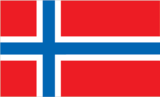
red with a blue cross outlined in white that extends to the edges of the flag; the vertical part of the cross is shifted to the hoist side in the style of the Dannebrog (Danish flag)
Government type
constitutional monarchy
Independence
26 October 1905 (from Sweden)
International organization participation
AfDB,AsDB, Australia Group, BIS, CBSS, CCC,CE, CERN, EAPC, EBRD, ECE, EFTA, ESA, FAO, IADB, IAEA, IBRD, ICAO, ICC, ICFTU, ICRM, IEA, IFAD, IFC, IFRCS, IHO, ILO, IMF, IMO, Inmarsat, Intelsat, Interpol, IOC, IOM, ISO, ITU, MONUA, MTCR, NAM (guest), NATO, NC, NEA, NIB, NSG, OECD, OSCE, PCA, UN, UNCRO, UNCTAD, UNESCO, UNHCR, UNIDO, UNIFIL, UNMIBH, UNMOP, UNPREDEP, UNTSO, UPU, WEU (associate), WHO, WIPO, WMO, WTrO, ZC Diplomatic representation in the US: chief of mission: Ambassador Tom-Erik VRAALSON chancery: 2720 34th Street NW, Washington, DC 20008 telephone: [1] (202) 333-6000
Judicial branch
Supreme Court or Hoyesterett, justices appointed by the king Political parties and leaders: Labor Party [Thorbjorn JAGLAND]; Conservative Party [Jan PETERSEN]; Center Party [Anne ENGER LAHNSTEIN]; Christian People's Party [Valgerd HAUGLAND]; Socialist Left [Kjellbjoerg LUNDE]; Norwegian Communist [Kare Andre NILSEN]; Progress Party [Carl I. HAGEN]; Liberal [Odd Einar DORUM]; Left Party; Red Electoral Alliance [Erling FOLKVORD]
Legal system
mixture of customary law, civil law system, and common law traditions; Supreme Court renders advisory opinions to legislature when asked; accepts compulsory ICJ jurisdiction, with reservations
Legislative branch
modified unicameral Parliament or Storting which, for certain purposes, divides itself into two chambers (165 seats; members are elected by popular vote by proportional representation to serve four-year terms) elections: last held 15 September 1997 (next to be held NA September 2001) election results: percent of vote by party-Labor 35%, Center Party 7.9%, Conservatives 14.3%, Christian People's 13.7%, Socialist Left 6%, Progress 15.3%, Liberal Party 4.4%, other parties 1.6%; seats by party-Labor 65, Center Party 11, Conservatives 23, Christian People's 25, Socialist Left 9, Progress 25, Liberal Party 6, other parties 1 note: for certain purposes, the Parliament divides itself into two chambers and elects one-fourth of its membership to an upper house or Lagting; the 39-member Saami assembly has advisory functions on regional control of natural resources and decision-making capacity on matters relating to the preservation of the Saami culture
National capital
Oslo
National holiday
Constitution Day, 17 May (1814)
Suffrage
18 years of age; universal
Economy
Agriculture-products
oats, other grains; beef, milk; livestock output exceeds value of crops; among world's top 10 fishing nations; fish catch of 2.33 million metric tons in 1994
Budget
revenues: $48.6 billion expenditures: $53 billion, including capital expenditures of $NA (1994 est.)
Currency
1 Norwegian krone (NKr) = 100 oere
Debt-external
$NA
Economic aid
donor: ODA, $1.014 billion (1993)
Economy-overview
Norway is a prosperous bastion of welfare capitalism. The economy consists of a combination of free market activity and government intervention. The government controls key areas, such as the vital petroleum sector (through large-scale state enterprises), and extensively subsidizes agriculture, fishing, and areas with sparse resources. Norway maintains an extensive welfare system that helps propel public sector expenditures to more than 50% of GDP and results in one of the highest average tax levels in the world. A small country with a high dependence on international trade, Norway is basically an exporter of raw materials and semiprocessed goods, with an abundance of smalland medium-sized firms, and is ranked among the major shipping nations. The country is richly endowed with natural resources-petroleum, hydropower, fish, forests, and minerals-and is highly dependent on its oil sector. Only Saudi Arabia exports more oil than Norway. Norway imports more than half its food needs. Oslo opted to stay out of the EU during a referendum in November 1994. Economic growth in 1998 should be about the same as in 1997. Inflation probably will move up toward 3% because of tightness in labor markets. Despite their high per capita income-outstripped among major nations only by the US-and their generous welfare benefits, Norwegians worry about that time in the 21st century when the oil and gas run out.
Electricity-capacity
26.431 million kW (1995)
Electricity-consumption per capita
26,547 kWh (1995)
Electricity-production
121.375 billion kWh (1995)
Exchange rates
Norwegian kroner (NKr) per US$1-7.4875 (January 1998), 7.0734 (1997), 6.4498 (1996), 6.3352 (1995), 7.0576 (1994), 7.0941 (1993)
Exports
total value: $49.3 billion (f.o.b., 1996) commodities: petroleum and petroleum products 43%, metals and products 11%, foodstuffs (mostly fish) 9%, chemicals and raw materials 25%, natural gas 6.0%, ships 5.4% partners: EU 77.2% (UK 19.8%, Germany 12.7%, Netherlands 9.1%, France 7.8%, Sweden 9.8%), US 6.0% (1995)
Fiscal year
calendar year Communications
GDP
purchasing power parity-$120.5 billion (1997 est.)
GDP-composition by sector
agriculture: 2.9% industry: 34.7% services: 62.4% (1991)
GDP-per capita
purchasing power parity-$27,400 (1997 est.)
GDP-real growth rate
3.5% (1997 est.)
Imports
total value: $35.1 billion (c.i.f., 1996) commodities: machinery and equipment and manufactured consumer goods 54%, chemicals and other industrial inputs 39%, foodstuffs 6% partners: EU 71.0% (Sweden 15.4%, Germany 13.8%, UK 9.7%, Denmark 7.5%, Netherlands 4.4%), US 6.6% (1995)
Industrial production growth rate
3% (1996 est.)
Industries
petroleum and gas, food processing, shipbuilding, pulp and paper products, metals, chemicals, timber, mining, textiles, fishing
Inflation rate-consumer price index
2% (1997 est.)
Labor force
total: 2.13 million by occupation: services 71%, industry 23%, agriculture, forestry, and fishing 6% (1993)
Radio broadcast stations
AM 46, FM 493 (350 private and 143 government), shortwave 0
Radios
3.3 million (1993 est.)
Telephone system
high-quality domestic and international telephone, telegraph, and telex services domestic: NA domestic satellite earth stations international: 2 buried coaxial cable systems; 4 coaxial submarine cables; satellite earth stations-NA Eutelsat, NA Intelsat (Atlantic Ocean), and 1 Inmarsat (Atlantic and Indian Ocean regions); note-Norway shares the Inmarsat earth station with the other Nordic countries (Denmark, Finland, Iceland, and Sweden)
Telephones
2.39 million (1994 est.); 470,000 mobile phones in use in 1994
Television broadcast stations
54 (repeaters 2,100)
Televisions
1.5 million (1993 est.)
Unemployment rate
2.6% (yearend 1997)
Transportation
Airports
102 (1997 est.) Airports-with paved runways: total: 65 over 3,047 m: 1 2,438 to 3,047 m: 11 1,524 to 2,437 m: 14 914 to 1,523 m: 11 under 914 m: 28 (1997 est.) Airports-with unpaved runways: total: 37 914 to 1,523 m: 5 under 914 m: 32 (1997 est.)
Heliports
1 (1997 est.)
Highways
total: 91,323 km paved: 65,753 km (including 106 km of expressways) unpaved: 25,570 km (1996 est.)
Merchant marine
total: 762 ships (1,000 GRT or over) totaling 21,042,709 GRT/33,839,476 DWT ships by type: bulk 102, cargo 128, chemical tanker 91, combination bulk 9, combination ore/oil 38, container 18, liquefied gas tanker 91, multi-function large load carrier 1, oil tanker 145, passenger 13, passenger-cargo 1, refrigerated cargo 13, roll-on/roll-off cargo 52, short-sea passenger 23, vehicle carrier 37 note: the government has created an internal register, the Norwegian International Ship register (NIS), as a subset of the Norwegian register; ships on the NIS enjoy many benefits of flags of convenience and do not have to be crewed by Norwegians (1997 est.)
Pipelines
refined products 53 km Ports and harbors: Bergen, Drammen, Floro, Hammerfest, Harstad, Haugesund, Kristiansand, Larvik, Narvik, Oslo, Porsgrunn, Stavanger, Tromso, Trondheim
Railways
total: 4,023 km standard gauge: 4,023 km 1.435-m gauge (2,422 km electrified; 96 km double track) (1996)
Waterways
1,577 km along west coast; 2.4 m draft vessels maximum
Military and Security
Military branches
Norwegian Army, Royal Norwegian Navy (includes Coast Artillery and Coast Guard), Royal Norwegian Air Force, Home Guard
Military expenditures-dollar figure
$3.7 billion (1995)
Military expenditures-percent of GDP
2.9% (1995)
Military manpower-availability
males age 15-49: 1,107,727 (1998 est.) Military manpower-fit for military service: males: 921,368 (1998 est.)
Military manpower-military age
20 years of age
Military manpower-reaching military age annually
males: 27,406 (1998 est.)
Transnational Issues
Disputes-international
territorial claim in Antarctica (Queen Maud Land); Svalbard is the focus of a maritime boundary dispute in the Barents Sea between Norway and Russia
Illicit drugs
minor transshipment point for drugs shipped via the CIS and Baltic states for the European market; increasing domestic consumption of cannabis and amphetamines