1991 Edition
CIA World Factbook 1991 (Project Gutenberg)
Geography
Climate
temperate along coast, modified by North Atlantic Current; colder interior; rainy year-round on west coast
Coastline
21,925 km (3,419 km mainland; 2,413 km large islands; 16,093 km long fjords, numerous small islands, and minor indentations)
Comparative area
slightly larger than New Mexico
Disputes
maritime boundary dispute with USSR; territorial claim in Antarctica (Queen Maud Land); Denmark has challenged Norway's maritime claims beween Greenland and Jan Mayen
Environment
air and water pollution; acid rain
Land boundaries
2,544 km total; Finland 729 km, Sweden 1,619 km, USSR 196 km
Land use
arable land 3%; permanent crops 0%; meadows and pastures NEGL%; forest and woodland 27%; other 70%; includes irrigated NEGL%
Maritime claims
Contiguous zone: 10 nm; Continental shelf: to depth of exploitation; Exclusive economic zone: 200 nm; Territorial sea: 4 nm
Natural resources
crude oil, copper, natural gas, pyrites, nickel, iron ore, zinc, lead, fish, timber, hydropower
Note
strategic location adjacent to sea lanes and air routes in North Atlantic; one of most rugged and longest coastlines in world; Norway and Turkey only NATO members having a land boundary with the USSR
Terrain
glaciated; mostly high plateaus and rugged mountains broken by fertile valleys; small, scattered plains; coastline deeply indented by fjords; arctic tundra in north
Total area
324,220 km2; land area: 307,860 km2
People and Society
Birth rate
14 births/1,000 population (1991)
Death rate
11 deaths/1,000 population (1991)
Ethnic divisions
Germanic (Nordic, Alpine, Baltic) and racial-cultural minority of 20,000 Lapps
Infant mortality rate
7 deaths/1,000 live births (1991)
Labor force
2,167,000 (September 1990); services 34.7%, commerce 18%, mining and manufacturing 16.6%, banking and financial services 7.5%, transportation and communications 7.2%, construction 7.2%, agriculture, forestry, and fishing 6.4% (1989)
Language
Norwegian (official); small Lapp- and Finnish-speaking minorities
Life expectancy at birth
74 years male, 81 years female (1991)
Literacy
99% (male NA%, female NA%) age 15 and over can read and write (1976 est.)
Nationality
noun--Norwegian(s); adjective--Norwegian
Net migration rate
2 migrants/1,000 population (1991)
Organized labor
66% of labor force (1985)
Population
4,273,442 (July 1991), growth rate 0.5% (1991)
Religion
Evangelical Lutheran (state church) 87.8%, other Protestant and Roman Catholic 3.8%, none 3.2%, unknown 5.2% (1980)
Total fertility rate
1.8 children born/woman (1991)
Government
Administrative divisions
19 provinces (fylker, singular--fylke); Akershus, Aust-Agder, Buskerud, Finnmark, Hedmark, Hordaland, More og Romsdal, Nordland, Nord-Trondelag, Oppland, Oslo, Ostfold, Rogaland, Sogn og Fjordane, Sor-Trondelag, Telemark, Troms, Vest-Agder, Vestfold
Capital
Oslo
Communists
15,500 est.; 5,500 Norwegian Communist Party (NKP); 10,000 Workers Communist Party Marxist-Leninist (AKP-ML, pro-Chinese)
Constitution
17 May 1814, modified in 1884
Dependent areas
Bouvet Island, Jan Mayen, Svalbard
Diplomatic representation
Ambassador Kjeld VIBE; Chancery at 2720 34th Street NW, Washington DC 20008; telephone (202) 333-6000; there are Norwegian Consulates General in Houston, Los Angeles, Minneapolis, New York, and San Francisco, and Consulates in Miami and New Orleans; US--Ambassador Loret Miller RUPPE; Embassy at Drammensveien 18, 0244 Oslo 2 (mailing address is APO New York 09085); telephone [47] (2) 44-85-50
Elections
Storting--last held on 11 September 1989 (next to be held 6 September 1993); results--Labor 34.3%, Conservative 22.2%, Progress 13.0%, Socialist Left 10.1%, Christian People's 8.5%, Center Party 6.6%, Finnmark List 0.3%, other 5%; seats--(165 total) Labor 63, Conservative 37, Progress 22, Socialist Left 17, Christian People's 14, Center Party 11, Finnmark List 1
Executive branch
monarch, prime minister, State Council (cabinet)
Flag
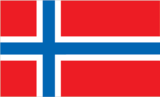
red with a blue cross outlined in white that extends to the edges of the flag; the vertical part of the cross is shifted to the hoist side in the style of the Dannebrog (Danish flag)
Independence
26 October 1905 (from Sweden)
Judicial branch
Supreme Court (Hoiesterett)
Leaders
Chief of State--King HARALD V (since 17 January 1991); Heir Apparent Crown Prince HAAKON MAGNUS (born 20 July 1973); Head of Government--Prime Minister Gro Harlem BRUNDTLAND (since 3 November 1990)
Legal system
mixture of customary law, civil law system, and common law traditions; Supreme Court renders advisory opinions to legislature when asked; accepts compulsory ICJ jurisdiction, with reservations
Legislative branch
unicameral Parliament (Stortinget) with an Upper Chamber (Lagting) and a Lower Chamber (Odelsting)
Long-form name
Kingdom of Norway
Member of
AfDB, AsDB, BIS, CCC, CE, CERN, COCOM, CSCE, EBRD, ECE, EFTA, ESA, FAO, GATT, IADB, IAEA, IBRD, ICAO, ICC, ICFTU, IDA, IEA, IFAD, IFC, ILO, IMF, IMO, INMARSAT, INTELSAT, INTERPOL, IOC, IOM, ISO, ITU, LORCS, NATO, NC, NEA, NIB, OECD, PCA, UN, UNAVEM, UNCTAD, UNESCO, UNHCR, UNIDO, UNIFIL, UNIIMOG, UNMOGIP, UNTSO, UPU, WHO, WIPO, WMO
National holiday
Constitution Day, 17 May (1814)
Political parties and leaders
Labor, Gro Harlem BRUNDTLAND; Conservative, Kaci Kullmann FIVE; Center Party, Anne Enger LAHNSTEIN; Christian People's, Kjell Magne BONDEVIK; Socialist Left, Eric SOLHEIM; Norwegian Communist, Kare Andre NILSEN; Progress, Carl I. HAGEN; Liberal, Arne FJORTOFT; Finnmark List, leader NA
Suffrage
universal at age 18
Type
constitutional monarchy
Economy
Agriculture
accounts for 2.8% of GNP and 6.4% of labor force; among world's top 10 fishing nations; livestock output exceeds value of crops; over half of food needs imported; fish catch of 1.76 million metric tons in 1989
Budget
revenues $47.9 billion; expenditures $48.7 billion, including capital expenditures of $NA (1990)
Currency
Norwegian krone (plural--kroner); 1 Norwegian krone (NKr) = 100 ore
Economic aid
donor--ODA and OOF commitments (1970-89), $4.4 billion
Electricity
26,735,000 kW capacity; 121,685 million kWh produced, 28,950 kWh per capita (1989)
Exchange rates
Norwegian kroner (NKr) per US$1--5.9060 (January 1991), 6.2597 (1990), 6.9045 (1989), 6.5170 (1988), 6.7375 (1987), 7.3947 (1986), 8.5972 (1985)
Exports
$33.8 billion (f.o.b., 1990); commodities--petroleum and petroleum products 25%, natural gas 11%, fish 7%, aluminum 6%, ships 3.5%, pulp and paper; partners--EC 64.9%, Nordic countries 19.5%, developing countries 6.9%, US 6.2%, Japan 1.7% (1990)
External debt
$15 billion (December 1990)
Fiscal year
calendar year
GDP
$74.2 billion, per capita $17,400; real growth rate 3.1% (1990)
Imports
$26.8 billion (c.i.f., 1990); commodities--machinery, fuels and lubricants, transportation equipment, chemicals, foodstuffs, clothing, ships; partners--EC 46.3%, Nordic countries 25.7%, developing countries 14.3%, US 8.1%, Japan 4.7% (1990)
Industrial production
growth rate 3.6% (1990)
Industries
petroleum and gas, food processing, shipbuilding, pulp and paper products, metals, chemicals, timber, mining, textiles, fishing
Inflation rate (consumer prices)
4.1% (1990)
Overview
Norway is a prosperous capitalist nation with the resources to finance extensive welfare measures. Since 1975 exploitation of large crude oil and natural gas reserves has helped maintain high growth; for the past five years growth has averaged 4.1%, the fourth-highest among OECD countries. Growth slackened in 1987-88 partially because of the sharp drop in world oil prices, but picked up again in 1989. The Brundtland government plans to push hard on environmental issues, as well as cutting unemployment, improving child care, upgrading major industries, and negotiating an EC - European Free Trade Association (EFTA) agreement on an Economic European Area.
Unemployment rate
5.2% (1990, excluding people in job-training programs)
Communications
Airports
104 total, 103 usable; 64 with permanent-surface runways; none with runways over 3,659 m; 12 with runways 2,440-3,659 m; 16 with runways 1,220-2,439 m
Civil air
76 major transport aircraft
Highways
79,540 km total; 18,600 km concrete, bituminous, stone block; 19,980 km bituminous treated; 40,960 km gravel, crushed stone, and earth
Inland waterways
1,577 km along west coast; 1.5-2.4 m draft vessels maximum
Merchant marine
867 ships (1,000 GRT or over) totaling 23,270,845 GRT/41,199,182 DWT; includes 11 passenger, 23 short-sea passenger, 121 cargo, 3 passenger-cargo, 24 refrigerated cargo, 14 container, 50 roll-on/roll-off cargo, 18 vehicle carrier, 1 railcar carrier, 186 petroleum, oils, and lubricants (POL) tanker, 98 chemical tanker, 69 liquefied gas, 1 specialized tanker, 35 combination ore/oil, 204 bulk, 9 combination bulk; note--the government has created a captive register, the Norwegian International Ship Register (NIS), as a subset of the Norwegian register; ships on the NIS enjoy many benefits of flags of convenience and do not have to be crewed by Norwegians; the majority of ships (777) under the Norwegian flag are now registered with the NIS
Pipelines
refined products, 53 km
Ports
Oslo, Bergen, Fredrikstad, Kristiansand, Stavanger, Trondheim
Railroads
4,223 km 1.435-meter standard gauge; Norwegian State Railways (NSB) operates 4,219 km (2,450 km electrified and 96 km double track); 4 km other
Telecommunications
high-quality domestic and international telephone, telegraph, and telex services; 3,102,000 telephones; stations--8 AM, 46 (1,400 relays) FM, 55 (2,100 relays) TV; 4 coaxial submarine cables; communications satellite earth stations operating in the EUTELSAT, INTELSAT (1 Atlantic Ocean), MARISAT, and domestic systems
Military and Security
Branches
Norwegian Army, Royal Norwegian Navy, Royal Norwegian Air Force, Home Guard
Defense expenditures
$3.3 billion, 3.3% of GDP (1990) _%_
Manpower availability
males 15-49, 1,124,201; 942,158 fit for military service; 31,813 reach military age (20) annually