2015 Edition
CIA World Factbook 2015 Archive (Wayback Machine ZIP)
Introduction
Background
Under US administration as part of the UN Trust Territory of the Pacific, the people of the Northern Mariana Islands decided in the 1970s not to seek independence but instead to forge closer links with the US. Negotiations for territorial status began in 1972. A covenant to establish a commonwealth in political union with the US was approved in 1975, and came into force on 24 March 1976. A new government and constitution went into effect in 1978.
Geography
Area
- land
- 464 sq km
- note
- consists of 14 islands including Saipan, Rota, and Tinian
- total
- 464 sq km
- water
- 0 sq km
Area - comparative
2.5 times the size of Washington, DC
Climate
tropical marine; moderated by northeast trade winds, little seasonal temperature variation; dry season December to June, rainy season July to October
Coastline
1,482 km
Elevation extremes
- highest point
- unnamed elevation on Agrihan 965 m
- lowest point
- Pacific Ocean 0 m
Environment - current issues
contamination of groundwater on Saipan may contribute to disease; clean-up of landfill; protection of endangered species conflicts with development
Geographic coordinates
15 12 N, 145 45 E
Geography - note
strategic location in the North Pacific Ocean
Irrigated land
1 sq km (2011)
Land boundaries
0 km
Land use
- arable land 2.2%; permanent crops 2.2%; permanent pasture 2.2%
- agricultural land
- 6.6%
- forest
- 65.5%
- other
- 27.9% (2011 est.)
Location
Oceania, islands in the North Pacific Ocean, about three-quarters of the way from Hawaii to the Philippines
Map references
Oceania
Maritime claims
- exclusive economic zone
- 200 nm
- territorial sea
- 12 nm
Natural hazards
active volcanoes on Pagan and Agrihan; typhoons (especially August to November)
Natural resources
arable land, fish
Terrain
southern islands are limestone with flat terraces and fringing coral reefs; northern islands are volcanic
People and Society
Age structure
- 0-14 years
- 25.6% (male 6,917/female 6,483)
- 15-24 years
- 14.39% (male 4,216/female 3,317)
- 25-54 years
- 44.3% (male 9,802/female 13,385)
- 55-64 years
- 10.76% (male 3,031/female 2,602)
- 65 years and over
- 4.95% (male 1,240/female 1,351) (2015 est.)
Birth rate
18.32 births/1,000 population (2015 est.)
Death rate
3.71 deaths/1,000 population (2015 est.)
Drinking water source
- urban: 97.5% of population
- rural: 97.5% of population
- total: 97.5% of population
- urban: 2.5% of population
- rural: 2.5% of population
- total: 2.5% of population (2015 est.)
Ethnic groups
Asian 50% (includes Filipino 35.3%, Chinese 6.8%, Korean 4.2%, and other Asian 3.7%), Native Hawaiian or other Pacific Islander 34.9% (includes Chamorro 23.9%, Carolinian 4.6%, and other Native Hawaiian or Pacific Islander 6.4%), other 2.5%, two or more ethnicities or races 12.7% (2010 est.)
HIV/AIDS - adult prevalence rate
NA
HIV/AIDS - deaths
NA
HIV/AIDS - people living with HIV/AIDS
NA
Infant mortality rate
- female
- 5 deaths/1,000 live births (2015 est.)
- male
- 5.78 deaths/1,000 live births
- total
- 5.4 deaths/1,000 live births
Languages
Philippine languages 32.8%, Chamorro (official) 24.1%, English (official) 17%, other Pacific island languages 10.1%, Chinese 6.8%, other Asian languages 7.3%, other 1.9% (2010 est.)
Life expectancy at birth
- female
- 80.65 years (2015 est.)
- male
- 75.15 years
- total population
- 77.82 years
Major urban areas - population
SAIPAN (capital) 49,000 (2014)
Median age
- female
- 33 years (2015 est.)
- male
- 29.6 years
- total
- 32.1 years
Nationality
- adjective
- NA
- noun
- NA (US citizens)
Net migration rate
7.16 migrant(s)/1,000 population (2015 est.)
Population
52,344 (July 2015 est.)
Population growth rate
2.18% (2015 est.)
Religions
Christian (Roman Catholic majority, although traditional beliefs and taboos may still be found)
Sanitation facility access
- urban: 79.7% of population
- rural: 79.7% of population
- total: 79.7% of population
- urban: 20.3% of population
- rural: 20.3% of population
- total: 20.3% of population (2015 est.)
Sex ratio
- 0-14 years
- 1.07 male(s)/female
- 15-24 years
- 1.27 male(s)/female
- 25-54 years
- 0.73 male(s)/female
- 55-64 years
- 1.17 male(s)/female
- 65 years and over
- 0.92 male(s)/female
- at birth
- 1.06 male(s)/female
- total population
- 0.93 male(s)/female (2015 est.)
Total fertility rate
1.98 children born/woman (2015 est.)
Urbanization
- rate of urbanization
- 0.39% annual rate of change (2010-15 est.)
- urban population
- 89.2% of total population (2015)
Government
Administrative divisions
none (commonwealth in political union with the US); there are no first-order administrative divisions as defined by the US Government, but there are 4 municipalities at the second order: Northern Islands, Rota, Saipan, Tinian
Capital
- geographic coordinates
- 15 12 N, 145 45 E
- name
- Saipan
- time difference
- UTC+10 (15 hours ahead of Washington, DC, during Standard Time)
Citizenship
see United States
Constitution
partially effective 9 January 1978 (Constitution of the Commonwealth of the Northern Mariana Islands); fully effective 4 November 1986 (Covenant Agreement); amended several times, last in 2012 (2015)
Country name
- abbreviation
- CNMI
- conventional long form
- Commonwealth of the Northern Mariana Islands
- conventional short form
- Northern Mariana Islands
- former
- Trust Territory of the Pacific Islands, Mariana Islands District
Dependency status
commonwealth in political union with the US; federal funds to the Commonwealth administered by the US Department of the Interior, Office of Insular Affairs
Executive branch
- cabinet
- Cabinet appointed by the governor with the advice and consent of the Senate
- chief of state
- President Barack H. OBAMA (since 20 January 2009); Vice President Joseph R. BIDEN (since 20 January 2009)
- election results
- Eloy S. INOS reelected governor; percent of vote in runoff - Eloy S. INOS (Republican) 57%, Heinz HOFSCHNEIDER (Republican) 43%; Ralph TORRES reelected lieutenant governor
- elections/appointments
- president and vice president indirectly elected on the same ballot by an Electoral College of 'electors' chosen from each state; president and vice president serve a 4-year term (eligible for a second term); under the US Constitution, residents of the Northern Mariana Islands do not vote in elections for US president and vice president; however, they may vote in Democratic and Republican party presidential primary elections; governor directly elected by absolute majority vote in 2 rounds if needed; election last held on 4 November 2014 with a runoff on 21 November 2014 (next to be held in 2018)
- head of government
- Governor Eloy S. INOS (since 20 February 2013); Lieutenant Governor Ralph TORRES (since 20 February 2013)
- note
- Benigno R. FITIAL was impeached by House of Representatives on 11-12 February 2013 and resigned on 20 February 2013; Eloy INOS (Republican) sworn in as governor the same day
Flag description
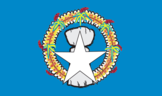
blue with a white, five-pointed star superimposed on a gray latte stone (the traditional foundation stone used in building) in the center, surrounded by a wreath; blue symbolizes the Pacific Ocean, the star represents the Commonwealth; the latte stone and the floral head wreath display elements of the native Chamorro culture
Government type
commonwealth; self-governing with locally elected governor, lieutenant governor, and legislature
Independence
none (commonwealth in political union with the US)
International organization participation
PIF (observer), SPC, UPU
Judicial branch
- highest court(s)
- Supreme Court of the Commonwealth of the Northern Marianna Islands or CNMI (consists of the chief justice and 2 associate justices); US Federal District Court (consists of 1 judge); note - US Federal District Court jurisdiction limited to US federal laws; appeals beyond the Northern Mariannas Islands Supreme Court are referred to the US Supreme Court
- judge selection and term of office
- judges of the Supreme Court of the CNMI appointed by the governor and confirmed by the CNMI Senate; judges appointed for 8-year terms and can serve another term if approved through voter election; US Federal District Court judges appointed by the US president and confirmed by the US Senate; judges appointed for renewable 10-year terms
- subordinate courts
- Superior Court
Legal system
US system applies, except for customs, wages, immigration laws, and taxation
Legislative branch
- description
- bicameral Northern Mariana Commonwealth Legislature consists of the Senate (9 seats; members directly elected in single-seat constituencies by simple majority vote to serve 4-year terms) and the House of Representatives (20 seats; members directly elected in single-seat constituencies by simple majority vote to serve 2-year terms)
- election results
- Senate - percent of vote by party - NA; seats by party - Covenant Party 3, Republican Party 3, Democratic Party 1, independent 2; House of Representatives - percent of vote by party - NA; seats by party - independents 13, Republican Party 7
- elections
- Senate - last held on 4 November 2014 (next to be held on 8 November 2016); House of Representatives - last held on 4 November 2014 (next to be held on 8 November 2016)
- note
- the Northern Mariana Islands directly elects 1 member by simple majority vote to serve a 2-year term as a delegate to the US House of Representatives; the delegate can vote when serving on a committee and when the House meets as the Committee of the Whole House, but not when legislation is submitted for a “full floor” House vote; election of delegate last held on 4 November 2014 (next to be held on 8 November 2016)
National anthem
- lyrics/music
- Jose S. PANGELINAN [Chamoru], David PETER [Carolinian]/Wilhelm GANZHORN
- name
- "Gi Talo Gi Halom Tasi" (In the Middle of the Sea)
- note
- adopted 1996; the Carolinian version of the song is known as "Satil Matawal Pacifico;" as a commonwealth of the United States, in addition to the local anthem, "The Star-Spangled Banner" is official (see United States)
National holiday
Commonwealth Day, 8 January (1978)
National symbol(s)
latte stone; national colors: blue, white
Political parties and leaders
- Covenant Party [Benigno R. FITIAL]
- Democratic Party [Dr. Carlos S. CAMACHO]
- Republican Party [Juan S. REYES]
Political pressure groups and leaders
NA
Suffrage
18 years of age; universal; note - indigenous inhabitants are US citizens but do not vote in US presidential elections
Economy
Agriculture - products
vegetables and melons, fruits and nuts; ornamental plants; livestock, poultry, eggs; fish and aquaculture products
Budget
- expenditures
- $249.8 million (2013 est.)
- revenues
- $246.4 million
Budget surplus (+) or deficit (-)
-0.3% of GDP (2013 est.)
Debt - external
$NA
Economy - overview
The Northern Mariana Islands' economy benefits substantially from financial assistance from the US. In fiscal year 2013, federal grants accounted for 35.4% of the Commonwealth’s total revenues. A small agriculture sector is made up of cattle ranches and small farms producing coconuts, breadfruit, tomatoes, and melons. The Commonwealth’s economy continued to recover in 2013. Real GDP increased 4.4%, following a 2.1% gain in 2012. Economic growth in 2013 reflected increases in consumer spending and exports of services, mainly spending by foreign tourists. Tourism continued to grow in 2013, after posting double-digit growth in 2012. The tourist industry employs approximately a quarter of the work force and accounts for roughly one-fourth of GDP. The Commonwealth is making a concerted effort to broaden its tourism by extending casino gambling from the small Islands of Tinian and Rota to the main Island of Saipan, it’s political and commercial center.
Exchange rates
the US dollar is used
Exports
- $288 million (2013)
- $268 million (2012)
Exports - commodities
garments
Fiscal year
1 October - 30 September
GDP - composition, by end use
- exports of goods and services
- 42.2%
- government consumption
- 51.5%
- household consumption
- 91.3%
- imports of goods and services
- 42.2% (2013)
- investment in fixed assets
- 3.8%
GDP - composition, by sector of origin
- agriculture
- 1.7%
- industry
- 2.9%
- services
- 95.4% (2010)
GDP - per capita (PPP)
- $13,300 (2013 est.)
- $12,900 (2012)
- $12,400 (2011)
GDP - real growth rate
- 4.5% (2013)
- 2.1% (2012)
- -6.8% (2011)
GDP (official exchange rate)
$1.232 billion (2013 est.)
GDP (purchasing power parity)
- $682 million (2013 est.)
- $665 million (2012)
- $649 million (2011)
- note
- GDP estimate includes US subsidy
Household income or consumption by percentage share
- highest 10%
- NA%
- lowest 10%
- NA%
Imports
- $606 million (2013)
- $531 million (2012)
Imports - commodities
food, construction equipment and materials, petroleum products
Industrial production growth rate
NA%
Industries
tourism, banking, construction, fishing, handicrafts, other services
Inflation rate (consumer prices)
- -2.5% (2013 est.)
- 1.1% (2012)
Labor force
- 27,970
- note
- includes foreign workers (2010 est.)
Labor force - by occupation
- agriculture
- 1.9%
- industry
- 10%
- services
- 88.1% (2010 est.)
Population below poverty line
NA%
Taxes and other revenues
20% of GDP (2013 est.)
Unemployment rate
- 11.2% (2010 est.)
- 8% (2005 est.)
Energy
Electricity - consumption
48,300 kWh (January 2009)
Electricity - exports
0 kWh (January 2009 est.)
Electricity - imports
0 kWh (January 2009 est.)
Electricity - production
60,600 kWh (January 2009)
Communications
Broadcast media
1 TV broadcast station on Saipan; multi-channel cable TV services are available on Saipan; 9 licensed radio broadcast stations (2009)
Internet country code
.mp
Radio broadcast stations
AM 1, FM 6, shortwave 1 (2005)
Telephone system
- international
- country code - 1-670; satellite earth stations - 2 Intelsat (Pacific Ocean)
Television broadcast stations
1 (on Saipan; in addition, 2 cable services on Saipan provide varied programming from satellite networks) (2006)
Transportation
Airports
5 (2013)
Airports - with paved runways
- 1,524 to 2,437 m
- 1 (2013)
- 2,438 to 3,047 m
- 2
- total
- 3
Airports - with unpaved runways
- 1 (2013)
- 2,438 to 3,047 m
- 1
- total
- 2
Heliports
1 (2013)
Ports and terminals
- major seaport(s)
- Saipan, Tinian, Rota
Roadways
- total
- 536 km (2008)
Military and Security
Manpower fit for military service
- females age 16-49
- 11,569 (2010 est.)
- males age 16-49
- 8,793
Manpower reaching militarily significant age annually
- female
- 306 (2010 est.)
- male
- 410
Military - note
defense is the responsibility of the US
Transnational Issues
Disputes - international
none