1998 Edition
CIA World Factbook 1998 (Internet Archive)
Geography
Area
total: 477 sq km land: 477 sq km water: 0 sq km note: includes 14 islands including Saipan, Rota, and Tinian
Area-comparative
2.5 times the size of Washington, DC
Climate
tropical marine; moderated by northeast trade winds, little seasonal temperature variation; dry season December to June, rainy season July to October
Coastline
1,482 km
Elevation extremes
lowest point: Pacific Ocean 0 m highest point: unnamed location on Agrihan 965 m
Environment-current issues
contamination of groundwater on Saipan may contribute to disease; clean-up of landfill; protection of endangered species conflicts with development
Environment-international agreements
party to: NA signed, but not ratified: NA
Geographic coordinates
15 12 N, 145 45 E
Geography-note
strategic location in the North Pacific Ocean
Irrigated land
NA sq km
Land boundaries
0 km
Land use
arable land: 21% permanent crops: NA% permanent pastures: 19% forests and woodland: NA% other: NA%
Location
Oceania, islands in the North Pacific Ocean, about three-quarters of the way from Hawaii to the Philippines
Map references
Oceania
Maritime claims
exclusive economic zone: 200 nm territorial sea: 12 nm
Natural hazards
active volcanoes on Pagan and Agrihan; typhoons (especially August to November)
Natural resources
arable land, fish
Terrain
southern islands are limestone with level terraces and fringing coral reefs; northern islands are volcanic
People and Society
Age structure
0-14 years: 24% (male 8,110; female 7,869) 15-64 years: 74% (male 23,847; female 25,659) 65 years and over: 2% (male 518; female 558) (July 1998 est.)
Birth rate
22.81 births/1,000 population (1998 est.)
Death rate
2.28 deaths/1,000 population (1998 est.)
Ethnic groups
Chamorro, Carolinians and other Micronesians, Caucasian, Japanese, Chinese, Korean
Infant mortality rate
6.53 deaths/1,000 live births (1998 est.)
Languages
English, Chamorro, Carolinian note: 86% of population speaks a language other than English at home
Life expectancy at birth
total population: 75.82 years male: 72.76 years female: 79.08 years (1998 est.)
Literacy
definition: age 15 and over can read and write total population: 97% male: 97% female: 96% (1980 est.)
Nationality
noun: NA adjective: NA
Net migration rate
21.42 migrant(s)/1,000 population (1998 est.)
Population
66,561 (July 1998 est.)
Population growth rate
4.2% (1998 est.)
Religions
Christian (Roman Catholic majority, although traditional beliefs and taboos may still be found)
Sex ratio
at birth: 1.06 male(s)/female under 15 years: 1.03 male(s)/female 15-64 years: 0.92 male(s)/female 65 years and over: 0.93 male(s)/female (1998 est.)
Total fertility rate
1.89 children born/woman (1998 est.)
Government
Administrative divisions
none
Constitution
Covenant Agreement effective 4 November 1986 and the Constitution of the Commonwealth of the Northern Mariana Islands
Country name
conventional long form: Commonwealth of the Northern Mariana Islands conventional short form: Northern Mariana Islands
Data code
CQ
Dependency status
commonwealth in political union with the US; federal funds to the Commonwealth administered by the US Department of the Interior, Office of Insular Affairs
Executive branch
chief of state: President of the US William Jefferson CLINTON (since 20 January 1993); Vice President Albert GORE, Jr. (since 20 January 1993) head of government: Governor Pedro P. TENORIO (since NA January 1998) and Lieutenant Governor Jesus R. SABLAN (since NA January 1998) cabinet: NA elections: governor and lieutenant governor elected on the same ticket by popular vote for four-year terms; election last held in NA November 1997 (next to be held NA November 2001) election results: Pedro P. TENORIO elected governor of Northern Mariana Islands in three-way race; percent of vote-Pedro P. TENORIO (Republican) 47%
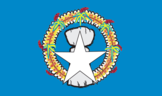
Flag description
blue with a white five-pointed star superimposed on the gray silhouette of a latte stone (a traditional foundation stone used in building) in the center, surrounded by a wreath
Government type
commonwealth; self-governing with locally elected governor, lieutenant governor, and legislature
Independence
none (commonwealth in political union with the US)
International organization participation
ESCAP (associate), SPC
Judicial branch
Commonwealth Supreme Court; Superior Court; Federal District Court Political parties and leaders: Republican Party, Benigno R. FITIAL, leader; Democratic Party, chairman (currently vacant)
Legal system
based on US system except for customs, wages, immigration laws, and taxation
Legislative branch
bicameral Legislature consists of the Senate (9 seats; members are elected by popular vote to serve four-year staggered terms) and the House of Representatives (18 seats; members are elected by popular vote to serve two-year terms) elections: Senate-last held NA November 1997 (next to be held NA November 1999); House of Representatives-last held NA November 1997 (next to be held NA November 1999) election results: Senate-percent of vote by party-NA; seats by party-NA (Republicans retained a majority of the seats); House of Representatives-percent of vote by party-NA; seats by party-NA (Republicans retained a majority of the seats) note: the Commonwealth does not have a nonvoting delegate in Congress; instead, it has an elected official or "resident representative" located in Washington, DC; seats by party-Republican 1 (Juan N. BABAUTA)
National capital
Saipan
National holiday
Commonwealth Day, 8 January (1978)
Suffrage
18 years of age; universal; indigenous inhabitants are US citizens but do not vote in US presidential elections
Economy
Agriculture-products
coconuts, fruits, vegetables; cattle
Budget
revenues: $190.4 million expenditures: $190.4 million, including capital expenditures of $19.1 million (FY94/95)
Currency
1 United States dollar (US$) = 100 cents
Debt-external
$NA
Economic aid
none
Economy-overview
The economy benefits substantially from financial assistance from the US. The rate of funding has declined as locally generated government revenues have grown. An agreement for the years 1986 to 1992 entitled the islands to $228 million for capital development, government operations, and special programs. Since 1992, funding has been extended one year at a time. The commonwealth received $27.7 million from FY93/94 through FY95/96. For FY96/97 through FY02/03, funding of $11 million will be provided for infrastructure, with an equal local match. A rapidly growing chief source of income is the tourist industry, which now employs about 50% of the work force. Japanese tourists predominate. The agricultural sector is of minor importance and is made up of cattle ranches and small farms producing coconuts, breadfruit, tomatoes, and melons. Garment production is the fastest growing industry with employment of 12,000 mostly Chinese workers and shipments of $800 million to the US in 1997 under duty and quota exemptions.
Electricity-capacity
NA kW
Electricity-consumption per capita
NA kWh
Electricity-production
NA kWh
Exchange rates
US currency is used
Exports
NA commodities: garments partners: NA
Fiscal year
1 October-30 September Communications
GDP
purchasing power parity-$524 million (1994 est.) note: GDP numbers reflect US spending
GDP-composition by sector
agriculture: NA% industry: NA% services: NA%
GDP-per capita
purchasing power parity-$10,500 (1994 est.)
GDP-real growth rate
NA%
Imports
NA commodities: food, construction equipment and materials, petroleum products partners: US, Japan
Industrial production growth rate
NA%
Industries
tourism, construction, garments, handicrafts
Inflation rate-consumer price index
6.5% (1994 est.)
Labor force
total: 7,476 total indigenous labor force; 2,699 unemployed; 22,560 foreign workers (1995) by occupation: NA
Radio broadcast stations
AM 2, FM 3
Radios
15,460 (1995 est.)
Telephone system
domestic: NA international: satellite earth stations-2 Intelsat (Pacific Ocean)
Telephones
13,618 (1993 est.)
Television broadcast stations
1 note: there is 1 cable TV station
Televisions
15,460 (1995 est.)
Unemployment rate
14% (residents)
Transportation
Airports
5 (1997 est.) Airports-with paved runways: total: 3 2,438 to 3,047 m: 1 1,524 to 2,437 m: 2 (1997 est.) Airports-with unpaved runways: total: 2 2,438 to 3,047 m: 1 under 914 m: 1 (1997 est.)
Heliports
1 (1997 est.)
Highways
total: 362 km (1991 est.) paved: NA km unpaved: NA km
Merchant marine
none
Railways
0 km
Waterways
none Ports and harbors: Saipan, Tinian
Military and Security
Military-note
defense is the responsibility of the US
Transnational Issues
Disputes-international
none