2016 Edition
CIA World Factbook 2016 Archive (HTML)
Introduction
Background
Macedonia gained its independence peacefully from Yugoslavia in 1991. Greek objection to Macedonia’s name, insisting it implies territorial pretensions to the northern Greek province of the same name, have stalled the country’s movement toward Euro-Atlantic integration. Immediately after Macedonia declared independence, Greece sought to block Macedonian efforts to gain UN membership if the name “Macedonia” was used. Macedonia was eventually admitted to the UN in 1993 as “The Former Yugoslav Republic of Macedonia,” and at the same time it agreed to UN-sponsored negotiations on the name dispute. In 1995, Greece lifted a 20-month trade embargo and the two countries agreed to normalize relations, but the issue of the name remained unresolved and negotiations for a solution are ongoing. Since 2004, the US and over 130 other nations have recognized Macedonia by its constitutional name, Republic of Macedonia. Ethnic Albanian grievances over perceived political and economic inequities escalated into an insurgency in 2001 that eventually led to the internationally brokered Ohrid Framework Agreement, which ended the fighting and established guidelines for constitutional amendments and the creation of new laws that enhanced the rights of minorities. Relations between Macedonians and ethnic Albanians remain fragile, however. Although Macedonia became an EU candidate in 2005, the country still faces challenges, including overcoming the ongoing political crisis that began in 2015 when opposition party SDSM began releasing wiretap content that it alleged showed widespread government corruption, the ongoing migration crisis, fully implementing the Framework Agreement, resolving the outstanding name dispute with Greece, improving relations with Bulgaria, halting democratic backsliding, and stimulating economic growth and development. Macedonia's membership in NATO was blocked by Greece at the Alliance's Summit of Bucharest in 2008.
Geography
Area
- 25,713 sq km 25,433 sq km 280 sq km
- land
- 25,433 sq km
- total
- 25,713 sq km
- water
- 280 sq km
Area - comparative
slightly larger than Vermont
Climate
warm, dry summers and autumns; relatively cold winters with heavy snowfall
Coastline
0 km (landlocked)
Elevation
- 741 m lowest point: Vardar River 50 m highest point: Golem Korab (Maja e Korabit) 2,764 m
- elevation extremes
- lowest point: Vardar River 50 m
- highest point
- Golem Korab (Maja e Korabit) 2,764 m
- mean elevation
- 741 m
Environment - current issues
air pollution from metallurgical plants
Environment - international agreements
- Air Pollution, Biodiversity, Climate Change, Climate Change-Kyoto Protocol, Desertification, Endangered Species, Hazardous Wastes, Law of the Sea, Ozone Layer Protection, Wetlands none of the selected agreements
- party to
- Air Pollution, Biodiversity, Climate Change, Climate Change-Kyoto Protocol, Desertification, Endangered Species, Hazardous Wastes, Law of the Sea, Ozone Layer Protection, Wetlands
- signed, but not ratified
- none of the selected agreements
Geographic coordinates
41 50 N, 22 00 E
Geography - note
landlocked; major transportation corridor from Western and Central Europe to Aegean Sea and Southern Europe to Western Europe
Irrigated land
1,280 sq km (2012)
Land boundaries
- 838 km Albania 181 km, Bulgaria 162 km, Greece 234 km, Kosovo 160 km, Serbia 101 km
- border countries (5)
- Albania 181 km, Bulgaria 162 km, Greece 234 km, Kosovo 160 km, Serbia 101 km
- total
- 838 km
Land use
- 44.3% arable land 16.4%; permanent crops 1.4%; permanent pasture 26.5% 39.8% 15.9% (2011 est.)
- agricultural land
- 44.3%
- forest
- 39.8%
- other
- 15.9% (2011 est.)
Location
Southeastern Europe, north of Greece
Map references
Europe
Maritime claims
none (landlocked)
Natural hazards
high seismic risks
Natural resources
low-grade iron ore, copper, lead, zinc, chromite, manganese, nickel, tungsten, gold, silver, asbestos, gypsum, timber, arable land
Population - distribution
a fairly even distribution throughout most of the country, with urban areas attracting larger and denser populations
Terrain
mountainous with deep basins and valleys; three large lakes, each divided by a frontier line; country bisected by the Vardar River
People and Society
Age structure
- 17.27% (male 187,752/female 174,935) 13.69% (male 148,340/female 139,195) 43.65% (male 465,622/female 451,028) 12.3% (male 126,548/female 131,749) 13.09% (male 117,787/female 157,069) (2016 est.)
- 0-14 years
- 17.27% (male 187,752/female 174,935)
- 15-24 years
- 13.69% (male 148,340/female 139,195)
- 25-54 years
- 43.65% (male 465,622/female 451,028)
- 55-64 years
- 12.3% (male 126,548/female 131,749)
- 65 years and over
- 13.09% (male 117,787/female 157,069) (2016 est.)
Birth rate
11.5 births/1,000 population (2016 est.)
Child labor - children ages 5-14
- 16,782 6% (2005 est.)
- percentage
- 6% (2005 est.)
- total number
- 16,782
Children under the age of 5 years underweight
1.3% (2011)
Contraceptive prevalence rate
40.2% (2011)
Death rate
9.1 deaths/1,000 population (2016 est.)
Dependency ratios
- 41.4% 24% 17.4% 5.7% (2015 est.)
- elderly dependency ratio
- 17.4%
- potential support ratio
- 5.7% (2015 est.)
- total dependency ratio
- 41.4%
- youth dependency ratio
- 24%
Drinking water source
- urban: 99.8% of population rural: 98.9% of population total: 99.4% of population urban: 0.2% of population rural: 1.1% of population total: 0.6% of population (2015 est.)
- rural
- 1.1% of population
- total
- 0.6% of population (2015 est.)
- urban
- 0.2% of population
Ethnic groups
Macedonian 64.2%, Albanian 25.2%, Turkish 3.9%, Roma (Gypsy) 2.7%, Serb 1.8%, other 2.2% (2002 est.)
Health expenditures
6.5% of GDP (2014)
HIV/AIDS - adult prevalence rate
0.01% (2013 est.)
HIV/AIDS - deaths
fewer than 100 (2013 est.)
HIV/AIDS - people living with HIV/AIDS
200 (2013 est.)
Hospital bed density
4.5 beds/1,000 population (2011)
Infant mortality rate
- 7.5 deaths/1,000 live births 7.8 deaths/1,000 live births 7.2 deaths/1,000 live births (2016 est.)
- female
- 7.2 deaths/1,000 live births (2016 est.)
- male
- 7.8 deaths/1,000 live births
- total
- 7.5 deaths/1,000 live births
Languages
Macedonian (official) 66.5%, Albanian (official) 25.1%, Turkish 3.5%, Roma 1.9%, Serbian 1.2%, other 1.8% (2002 est.)
Life expectancy at birth
- 76.2 years 73.6 years 79 years (2016 est.)
- female
- 79 years (2016 est.)
- male
- 73.6 years
- total population
- 76.2 years
Literacy
- age 15 and over can read and write 97.8% 98.8% 96.8% (2015 est.)
- definition
- age 15 and over can read and write
- female
- 96.8% (2015 est.)
- male
- 98.8%
- total population
- 97.8%
Major urban areas - population
SKOPJE (capital) 503,000 (2015)
Maternal mortality rate
8 deaths/100,000 live births (2015 est.)
Median age
- 37.5 years 36.4 years 38.6 years (2016 est.)
- female
- 38.6 years (2016 est.)
- male
- 36.4 years
- total
- 37.5 years
Mother's mean age at first birth
26.6 (2013 est.)
Nationality
- Macedonian(s) Macedonian
- adjective
- Macedonian
- noun
- Macedonian(s)
Net migration rate
-0.5 migrant(s)/1,000 population (2016 est.)
Obesity - adult prevalence rate
20.8% (2014)
Physicians density
2.62 physicians/1,000 population (2009)
Population
2,100,025 (July 2016 est.)
Population distribution
a fairly even distribution throughout most of the country, with urban areas attracting larger and denser populations
Population growth rate
0.18% (2016 est.)
Religions
Macedonian Orthodox 64.8%, Muslim 33.3%, other Christian 0.4%, other and unspecified 1.5% (2002 est.)
Sanitation facility access
- urban: 97.2% of population rural: 82.6% of population total: 90.9% of population urban: 2.8% of population rural: 17.4% of population total: 9.1% of population (2015 est.)
- rural
- 17.4% of population
- total
- 9.1% of population (2015 est.)
- urban
- 2.8% of population
School life expectancy (primary to tertiary education)
- 13 years 13 years 13 years (2012)
- female
- 13 years (2012)
- male
- 13 years
- total
- 13 years
Sex ratio
- 1.08 male(s)/female 1.07 male(s)/female 1.07 male(s)/female 1.03 male(s)/female 0.96 male(s)/female 0.75 male(s)/female 0.99 male(s)/female (2016 est.)
- 0-14 years
- 1.07 male(s)/female
- 15-24 years
- 1.07 male(s)/female
- 25-54 years
- 1.03 male(s)/female
- 55-64 years
- 0.96 male(s)/female
- 65 years and over
- 0.75 male(s)/female
- at birth
- 1.08 male(s)/female
- total population
- 0.99 male(s)/female (2016 est.)
Total fertility rate
1.6 children born/woman (2016 est.)
Unemployment, youth ages 15-24
- 53.1% 52% 55% (2014 est.)
- female
- 55% (2014 est.)
- male
- 52%
- total
- 53.1%
Urbanization
- 57.1% of total population (2015) 0.11% annual rate of change (2010-15 est.)
- rate of urbanization
- 0.11% annual rate of change (2010-15 est.)
- urban population
- 57.1% of total population (2015)
Government
Administrative divisions
70 municipalities (opstini, singular - opstina) and 1 city* (grad); Aracinovo, Berovo, Bitola, Bogdanci, Bogovinje, Bosilovo, Brvenica, Caska, Centar Zupa, Cesinovo-Oblesevo, Cucer Sandevo, Debar, Debarca, Delcevo, Demir Hisar, Demir Kapija, Dojran, Dolneni, Gevgelija, Gostivar, Gradsko, Ilinden, Jegunovce, Karbinci, Kavadarci, Kicevo, Kocani, Konce, Kratovo, Kriva Palanka, Krivogastani, Krusevo, Kumanovo, Lipkovo, Lozovo, Makedonska Kamenica, Makedonski Brod, Mavrovo i Rostusa, Mogila, Negotino, Novaci, Novo Selo, Ohrid, Pehcevo, Petrovec, Plasnica, Prilep, Probistip, Radovis, Rankovce, Resen, Rosoman, Skopje*, Sopiste, Staro Nagoricane, Stip, Struga, Strumica, Studenicani, Sveti Nikole, Tearce, Tetovo, Valandovo, Vasilevo, Veles, Vevcani, Vinica, Vrapciste, Zelenikovo, Zelino, Zrnovci
Capital
- Skopje 42 00 N, 21 26 E UTC+1 (6 hours ahead of Washington, DC, during Standard Time) +1hr, begins last Sunday in March; ends last Sunday in October
- daylight saving time
- +1hr, begins last Sunday in March; ends last Sunday in October
- geographic coordinates
- 42 00 N, 21 26 E
- name
- Skopje
- time difference
- UTC+1 (6 hours ahead of Washington, DC, during Standard Time)
Citizenship
- no at least one parent must be a citizen of Macedonia no 8 years
- citizenship by birth
- no
- citizenship by descent only
- at least one parent must be a citizen of Macedonia
- dual citizenship recognized
- no
- residency requirement for naturalization
- 8 years
Constitution
several previous; latest adopted 17 November 1991, effective 20 November 1991; amended several times, last in 2015 (2016)
Country name
- Republic of Macedonia Macedonia Republika Makedonija Makedonija the provisional designation used by the UN, EU, and NATO is the "former Yugoslav Republic of Macedonia" (FYROM) People's Republic of Macedonia, Socialist Republic of Macedonia the country name derives from the ancient kingdom of Macedon (7th to 2nd centuries B.C.)
- conventional long form
- Republic of Macedonia
- conventional short form
- Macedonia
- etymology
- the country name derives from the ancient kingdom of Macedon (7th to 2nd centuries B.C.)
- former
- People's Republic of Macedonia, Socialist Republic of Macedonia
- local long form
- Republika Makedonija
- local short form
- Makedonija
- note
- the provisional designation used by the UN, EU, and NATO is the "former Yugoslav Republic of Macedonia" (FYROM)
Diplomatic representation from the US
- Ambassador Jess L. BAILY (since 12 February 2015) Str. Samolilova, Nr. 21, 1000 Skopje American Embassy Skopje, US Department of State, 7120 Skopje Place, Washington, DC 20521-7120 (pouch) [389] (2) 310-2000 [389] (2) 310-2499
- chief of mission
- Ambassador Jess L. BAILY (since 12 February 2015)
- embassy
- Str. Samolilova, Nr. 21, 1000 Skopje
- FAX
- [389] (2) 310-2499
- mailing address
- American Embassy Skopje, US Department of State, 7120 Skopje Place, Washington, DC 20521-7120 (pouch)
- telephone
- [389] (2) 310-2000
Diplomatic representation in the US
- Ambassador Vasko NAUMOVSKI (since 18 November 2014) 2129 Wyoming Avenue NW, Washington, DC 20008 [1] (202) 667-0501 [1] (202) 667-2131 Chicago, Detroit, New York
- chancery
- 2129 Wyoming Avenue NW, Washington, DC 20008
- chief of mission
- Ambassador Vasko NAUMOVSKI (since 18 November 2014)
- consulate(s) general
- Chicago, Detroit, New York
- FAX
- [1] (202) 667-2131
- telephone
- [1] (202) 667-0501
Executive branch
- President Gjorge IVANOV (since 12 May 2009) Interim Prime Minister Emil DIMITRIEV (since 18 January 2016); Prime Minister Nikola GRUEVSKI (since 26 August 2006) resigned on 15 January 2016 Council of Ministers elected by the Assembly by simple majority vote; note - the 2014 cabinet formed by the government coalition parties VMRO-DPMNE, DUI, and several small parties; as a result of an agreement reached in July 2015 between the largest parties to resolve a 16-month opposition boycott of the Assembly, several minister and deputy minister positions were also given to the opposition SDSM president directly elected by absolute majority popular vote in 2 rounds if needed for a 5-year term (eligible for a second term); election last held on 13 and 27 April 2014 (next to be held in 2019); following legislative elections, the leader of the majority party or majority coalition usually elected prime minister by the Assembly Gjorge IVANOV reelected president in second round; percent of vote - Gjorge IVANOV (independent) 55.3%, Stevo PENDAROVSKI (SDSM) 41.1%, other 3.6%
- cabinet
- Council of Ministers elected by the Assembly by simple majority vote; note - the 2014 cabinet formed by the government coalition parties VMRO-DPMNE, DUI, and several small parties; as a result of an agreement reached in July 2015 between the largest parties to resolve a 16-month opposition boycott of the Assembly, several minister and deputy minister positions were also given to the opposition SDSM
- chief of state
- President Gjorge IVANOV (since 12 May 2009)
- election results
- Gjorge IVANOV reelected president in second round; percent of vote - Gjorge IVANOV (independent) 55.3%, Stevo PENDAROVSKI (SDSM) 41.1%, other 3.6%
- elections/appointments
- president directly elected by absolute majority popular vote in 2 rounds if needed for a 5-year term (eligible for a second term); election last held on 13 and 27 April 2014 (next to be held in 2019); following legislative elections, the leader of the majority party or majority coalition usually elected prime minister by the Assembly
- head of government
- Interim Prime Minister Emil DIMITRIEV (since 18 January 2016); Prime Minister Nikola GRUEVSKI (since 26 August 2006) resigned on 15 January 2016
Flag description
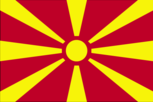
a yellow sun (the Sun of Liberty) with eight broadening rays extending to the edges of the red field; the red and yellow colors have long been associated with Macedonia
Government type
parliamentary republic
Independence
8 September 1991 (referendum by registered voters endorsed independence from Yugoslavia)
International law organization participation
has not submitted an ICJ jurisdiction declaration; accepts ICCt jurisdiction
International organization participation
BIS, CD, CE, CEI, EAPC, EBRD, EU (candidate country), FAO, IAEA, IBRD, ICAO, ICC (NGOs), ICCt, ICRM, IDA, IFAD, IFC, IFRCS, ILO, IMF, IMO, Interpol, IOC, IOM, IPU, ISO, ITU, ITUC (NGOs), MIGA, OAS (observer), OIF, OPCW, OSCE, PCA, PFP, SELEC, UN, UNCTAD, UNESCO, UNHCR, UNIDO, UNIFIL, UNWTO, UPU, WCO, WHO, WIPO, WMO, WTO
Judicial branch
- Supreme Court (consist of NA judges); Constitutional Court (consists of 9 judges) Supreme Court judges nominated by the Judicial Council, a 7-member body of legal professionals, and appointed by the Assembly; judge tenure NA; Constitutional Court judges appointed by the Assembly for nonrenewable, 9-year terms Courts of Appeal; Basic Courts
- highest court(s)
- Supreme Court (consist of NA judges); Constitutional Court (consists of 9 judges)
- judge selection and term of office
- Supreme Court judges nominated by the Judicial Council, a 7-member body of legal professionals, and appointed by the Assembly; judge tenure NA; Constitutional Court judges appointed by the Assembly for nonrenewable, 9-year terms
- subordinate courts
- Courts of Appeal; Basic Courts
Legal system
civil law system; judicial review of legislative acts
Legislative branch
- unicameral Assembly or Sobranie (123 seats; 120 members directly elected in multi-seat constituencies by proportional representation vote and 3 directly elected in diaspora constituencies worldwide by simple majority vote; members serve 4-year terms) last held on 27 April 2014 (the election scheduled for 5 June 2016 has been postponed until 11 December 2016) percent of vote by party - VMRO-DPMNE 43.0%, SDSM 25.3%, BDI 13.7%, PDSh 5.9%, GROM 2.8%, RDK 1.6%, other 4.3%, invalid 3.4%; seats by party - VMRO-DPMNE 61, SDSM 34, BDI 19, PDSh 7, GROM 1, RDK 1
- description
- unicameral Assembly or Sobranie (123 seats; 120 members directly elected in multi-seat constituencies by proportional representation vote and 3 directly elected in diaspora constituencies worldwide by simple majority vote; members serve 4-year terms)
- election results
- percent of vote by party - VMRO-DPMNE 43.0%, SDSM 25.3%, BDI 13.7%, PDSh 5.9%, GROM 2.8%, RDK 1.6%, other 4.3%, invalid 3.4%; seats by party - VMRO-DPMNE 61, SDSM 34, BDI 19, PDSh 7, GROM 1, RDK 1
- elections
- last held on 27 April 2014 (the election scheduled for 5 June 2016 has been postponed until 11 December 2016)
National anthem
- "Denes nad Makedonija" (Today Over Macedonia) Vlado MALESKI/Todor SKALOVSKI written in 1943 and adopted in 1991 , the song previously served as the anthem of the Socialist Republic of Macedonia while part of Yugoslavia
- lyrics/music
- Vlado MALESKI/Todor SKALOVSKI
- name
- "Denes nad Makedonija" (Today Over Macedonia)
- note
- written in 1943 and adopted in 1991 , the song previously served as the anthem of the Socialist Republic of Macedonia while part of Yugoslavia
National holiday
Independence Day, 8 September (1991); also known as National Day
National symbol(s)
- eight-rayed sun; national colors: red, yellow
- eight-rayed sun; national colors
- red, yellow
Political parties and leaders
- Citizens Option for Macedonia or GROM [Stevco JAKIMOVSKI] Democratic Party of Albanians or PDSh [Menduh THACI] Democratic Union for Integration or BDI [Ali AHMETI] Internal Macedonian Revolutionary Organization - Democratic Party for Macedonian National Unity or VMRO-DPMNE [Nikola GRUEVSKI] National Democratic Revival or RDK [Vesel MEMEDI] Social Democratic Union of Macedonia or SDSM [Zoran ZAEV] during the 2014 parliamentary elections VMRO-DPMNE, SDSM, and GROM each led coalitions
- note
- during the 2014 parliamentary elections VMRO-DPMNE, SDSM, and GROM each led coalitions
Political pressure groups and leaders
Federation of Free Trade Unions [Mirjana ANDREVSKA] Federation of Trade Unions [Zivko MITREVSKI] Trade Union of Education, Science and Culture or SONK [Jakim NEDELKOV] Student Plenum Eco Guerilla [Arianit XHAFERI]
Suffrage
18 years of age; universal
Economy
Agriculture - products
grapes, tobacco, vegetables, fruits; milk, eggs
Budget
- $2.903 billion $3.252 billion (2015 est.)
- expenditures
- $3.252 billion (2015 est.)
- revenues
- $2.903 billion
Budget surplus (+) or deficit (-)
-3.5% of GDP (2015 est.)
Central bank discount rate
- 3.25% (31 December 2014) 3.25% (31 December 2013) series discontinued in January 2010; the discount rate has been replaced by a referent rate for calculating the penalty rate
- note
- series discontinued in January 2010; the discount rate has been replaced by a referent rate for calculating the penalty rate
Commercial bank prime lending rate
7.08% (31 December 2015 est.) 7.46% (31 December 2014 est.)
Current account balance
-$141 million (2015 est.) -$91 million (2014 est.)
Debt - external
$7.029 billion (31 December 2015 est.) $7.241 billion (31 December 2014 est.)
Distribution of family income - Gini index
43.6 (2013) 39.2 (2011)
Economy - overview
Since its independence in 1991, Macedonia has made progress in liberalizing its economy and improving its business environment, but has lagged the Balkan region in attracting foreign investment. Corruption and weak rule of law remain significant problems. Some businesses complain of opaque regulations and unequal enforcement of the law. Macedonia’s economy is closely linked to Europe as a customer for exports and source of investment, and has suffered as a result of prolonged weakness in the euro zone. Unemployment has remained consistently high at about 30% since 2008, but may be overstated based on the existence of an extensive gray market, estimated to be between 20% and 45% of GDP, which is not captured by official statistics. Macedonia maintained macroeconomic stability through the global financial crisis by conducting prudent monetary policy, which keeps the domestic currency pegged against the euro, and by limiting fiscal deficits. The government has been loosening fiscal policy, however, and the budget deficit was 4.2% of GDP in both 2013 and 2014, gradually falling to 3.7% in 2015. By yearend 2015, public debt was 40.3%, which although low by regional comparison, is significant for a small economy.
Exchange rates
Macedonian denars (MKD) per US dollar - 55.537 (2015 est.) 46.437 (2014 est.) 46.437 (31 December 2013 est.) 47.89 (2012 est.) 44.231 (2011 est.)
Exports
$3.372 billion (2015 est.) $3.682 billion (2014 est.)
Exports - commodities
foodstuffs, beverages, tobacco; textiles, miscellaneous manufactures, iron, steel; automotive parts
Exports - partners
Germany 33.2%, Kosovo 11.5%, Bulgaria 5.1%, Greece 4.5% (2015)
Fiscal year
calendar year
GDP - composition, by end use
- 67.7% 16.7% 18.2% 13.7% 48.5% -64.8% (2015 est.)
- exports of goods and services
- 48.5%
- government consumption
- 16.7%
- household consumption
- 67.7%
- imports of goods and services
- -64.8% (2015 est.)
- investment in fixed capital
- 18.2%
- investment in inventories
- 13.7%
GDP - composition, by sector of origin
- 11.2% 26.1% 62.7% (2015 est.)
- agriculture
- 11.2%
- industry
- 26.1%
- services
- 62.7% (2015 est.)
GDP - per capita (PPP)
- $14,000 (2015 est.) $13,500 (2014 est.) $13,100 (2013 est.) data are in 2015 US dollars
- note
- data are in 2015 US dollars
GDP - real growth rate
3.7% (2015 est.) 3.5% (2014 est.) 2.9% (2013 est.)
GDP (official exchange rate)
$9.922 billion (2015 est.)
GDP (purchasing power parity)
- $29.04 billion (2015 est.) $28.01 billion (2014 est.) $27.05 billion (2013 est.) data are in 2015 US dollars; Macedonia has a large informal sector that may not be reflected in these data
- note
- data are in 2015 US dollars; Macedonia has a large informal sector that may not be reflected in these data
Gross national saving
22.5% of GDP (2015 est.) 21.2% of GDP (2014 est.) 22.1% of GDP (2013 est.)
Household income or consumption by percentage share
- 2.2% 34.5% (2009 est.)
- highest 10%
- 34.5% (2009 est.)
- lowest 10%
- 2.2%
Imports
$5.393 billion (2015 est.) $6.15 billion (2014 est.)
Imports - commodities
machinery and equipment, automobiles, chemicals, fuels, food products
Imports - partners
Germany 15.9%, UK 13.6%, Greece 10.9%, Serbia 8.7%, Bulgaria 6.7%, Turkey 5.5%, Italy 4.7% (2015)
Industrial production growth rate
7.8% (2015 est.)
Industries
food processing, beverages, textiles, chemicals, iron, steel, cement, energy, pharmaceuticals, automotive parts
Inflation rate (consumer prices)
-0.2% (2015 est.) -0.1% (2014 est.)
Labor force
954,900 (2015 est.)
Labor force - by occupation
- 18.3% 29.1% 52.6% (2014 est.)
- agriculture
- 18.3%
- industry
- 29.1%
- services
- 52.6% (2014 est.)
Market value of publicly traded shares
$2.084 billion (31 December 2014) $2.302 billion (31 December 2013) $2.423 billion (31 December 2012)
Population below poverty line
30.4% (2011 est.)
Public debt
- 46.5% of GDP (2015 est.) 46% of GDP (2014 est.) official data from Ministry of Finance; data cover central government debt; this data exclude debt instruments issued (or owned) by government entities other than the treasury; include treasury debt held by foreign entitites; exclude debt issued by sub-national entities, as well as intra-governmental debt; there are no debt instruments sold for social funds
- note
- official data from Ministry of Finance; data cover central government debt; this data exclude debt instruments issued (or owned) by government entities other than the treasury; include treasury debt held by foreign entitites; exclude debt issued by sub-national entities, as well as intra-governmental debt; there are no debt instruments sold for social funds
Reserves of foreign exchange and gold
$2.471 billion (31 December 2015 est.) $2.963 billion (31 December 2014 est.)
Stock of broad money
$6.129 billion (31 December 2014 est.) $6.282 billion (31 December 2013 est.)
Stock of direct foreign investment - abroad
$599.6 million (31 December 2015 est.) $600.3 million (31 December 2014 est.)
Stock of direct foreign investment - at home
$6.123 billion (31 December 2015 est.) $5.93 billion (31 December 2014 est.)
Stock of domestic credit
$5.308 billion (31 December 2015 est.) $5.111 billion (31 December 2014 est.)
Stock of narrow money
$1.797 billion (31 December 2015 est.) $1.692 billion (31 December 2014 est.)
Taxes and other revenues
29.3% of GDP (2015 est.)
Unemployment rate
26.1% (2015 est.) 28% (2014 est.)
Energy
Carbon dioxide emissions from consumption of energy
7.9 million Mt (2013 est.)
Crude oil - exports
0 bbl/day (2013 est.)
Crude oil - imports
146 bbl/day (2014 est.)
Crude oil - production
0 bbl/day (2015 est.)
Crude oil - proved reserves
0 bbl (1 January 2016 es)
Electricity - consumption
6.96 billion kWh (2014 est.)
Electricity - exports
112.9 million kWh (2014 est.)
Electricity - from fossil fuels
64.5% of total installed capacity (2014 est.)
Electricity - from hydroelectric plants
33% of total installed capacity (2014 est.)
Electricity - from nuclear fuels
0% of total installed capacity (2014 est.)
Electricity - from other renewable sources
2.6% of total installed capacity (2014 est.)
Electricity - imports
3.073 billion kWh (2014 est.)
Electricity - installed generating capacity
2.011 million kW (2014 est.)
Electricity - production
4.569 billion kWh (2014 est.)
Electricity access
- 100% (2016)
- electrification - total population
- 100% (2016)
Natural gas - consumption
134.7 million cu m (2014 est.)
Natural gas - exports
0 cu m (2014)
Natural gas - imports
134.7 million cu m (2014 est.)
Natural gas - production
0 cu m (2014)
Natural gas - proved reserves
0 cu m (31 December 2014 )
Refined petroleum products - consumption
20,000 bbl/day (2014 est.)
Refined petroleum products - exports
2,616 bbl/day (2014 est.)
Refined petroleum products - imports
17,950 bbl/day (2014 est.)
Refined petroleum products - production
1,719 bbl/day (2013 est.)
Communications
Broadcast media
public TV broadcaster operates 3 national channels and a satellite network; 5 privately owned TV channels broadcast nationally using terrestrial transmitters and about 15 broadcast on national level via satellite; roughly 75 local commercial TV stations; large number of cable operators offering domestic and international programming; public radio broadcaster operates over multiple stations; 3 privately owned radio stations broadcast nationally; about 70 local commercial radio stations (2012)
Internet country code
.mk
Internet users
1.475 million 70.4% (July 2015 est.)
Telephone system
- competition from the mobile-cellular segment of the telecommunications market has led to a drop in fixed-line telephone subscriptions combined fixed-line and mobile-cellular telephone subscribership about 120 per 100 persons country code - 389 (2015)
- domestic
- combined fixed-line and mobile-cellular telephone subscribership about 120 per 100 persons
- general assessment
- competition from the mobile-cellular segment of the telecommunications market has led to a drop in fixed-line telephone subscriptions
- international
- country code - 389 (2015)
Telephones - fixed lines
- 372,557 18 (July 2015 est.)
- subscriptions per 100 inhabitants
- 18 (July 2015 est.)
- total subscriptions
- 372,557
Telephones - mobile cellular
- 2.223 million 106 (July 2015 est.)
- subscriptions per 100 inhabitants
- 106 (July 2015 est.)
- total
- 2.223 million
Transportation
Airports
10 (2013)
Airports - with paved runways
- 6 (2013)
- 2,438 to 3,047 m
- 2
- total
- 8
- under 914 m
- 6 (2013)
Airports - with unpaved runways
- 1 (2013)
- 914 to 1,523 m
- 1
- total
- 2
- under 914 m
- 1 (2013)
Civil aircraft registration country code prefix
Z3 (2016)
Pipelines
gas 268 km; oil 120 km (2013)
Railways
- 699 km 699 km 1.435-m gauge (223 km electrified) (2014)
- standard gauge
- 699 km 1.435-m gauge (223 km electrified) (2014)
- total
- 699 km
Roadways
- 14,182 km (includes 242 km of expressways) 9,633 km 4,549 km (2014)
- paved
- 9,633 km
- total
- 14,182 km (includes 242 km of expressways)
- unpaved
- 4,549 km (2014)
Military and Security
Military branches
Army of the Republic of Macedonia (ARM; includes General Staff and subordinate Joint Operational Command, Training and Doctrine Command, Special Operations Regiment) (2012)
Military expenditures
1.08% of GDP (2015) 1.17% of GDP (2014) 1.14% of GDP (2013) 1.2% of GDP (2012) 1.3% of GDP (2011)
Military service age and obligation
18 years of age for voluntary military service; conscription abolished in 2008 (2013)
Transnational Issues
Disputes - international
Kosovo and Macedonia completed demarcation of their boundary in September 2008; Greece continues to reject the use of the name Macedonia or Republic of Macedonia
Illicit drugs
major transshipment point for Southwest Asian heroin and hashish; minor transit point for South American cocaine destined for Europe; although not a financial center and most criminal activity is thought to be domestic, money laundering is a problem due to a mostly cash-based economy and weak enforcement
Refugees and internally displaced persons
- 667 (2015) 478,003 refugee and migrant arrivals (2015 - November 2016 est.)
- note
- 478,003 refugee and migrant arrivals (2015 - November 2016 est.)
- stateless persons
- 667 (2015)