1999 Edition
CIA World Factbook 1999 (Internet Archive)
Geography
Area
total: 25,333 sq km land: 24,856 sq km water: 477 sq km
Area--comparative
slightly larger than Vermont
Climate
warm, dry summers and autumns and relatively cold winters with heavy snowfall
Coastline
0 km (landlocked)
Elevation extremes
lowest point: Vardar River 50 m highest point: Golem Korab (Majae Korabit) 2,753 m
Environment--current issues
air pollution from metallurgical plants
Environment--international agreements
party to: Air Pollution, Biodiversity, Climate Change, Hazardous Wastes, Law of the Sea, Ozone Layer Protection signed, but not ratified: none of the selected agreements
Geographic coordinates
41 50 N, 22 00 E
Geography--note
landlocked; major transportation corridor from Western and Central Europe to Aegean Sea and Southern Europe to Western Europe
Irrigated land
830 sq km (1993 est.)
Land boundaries
total: 748 km border countries: Albania 151 km, Bulgaria 148 km, Greece 228 km, Serbia and Montenegro 221 km (all with Serbia)
Land use
arable land: 24% permanent crops: 2% permanent pastures: 25% forests and woodland: 39% other: 10% (1993 est.)
Location
Southeastern Europe, north of Greece
Map references
Europe
Maritime claims
none (landlocked)
Natural hazards
high seismic risks
Natural resources
chromium, lead, zinc, manganese, tungsten, nickel, low-grade iron ore, asbestos, sulfur, timber
Terrain
mountainous territory covered with deep basins and valleys; three large lakes, each divided by a frontier line; country bisected by the Vardar River
People and Society
Age structure
0-14 years: 23% (male 243,190; female 228,491) 15-64 years: 67% (male 680,692; female 673,923) 65 years and over: 10% (male 88,116; female 108,192) (1999 est.)
Birth rate
15.21 births/1,000 population (1999 est.)
Death rate
8.03 deaths/1,000 population (1999 est.)
Ethnic groups
Macedonian 66%, Albanian 23%, Turkish 4%, Serb 2%, Gypsies 3%, other 2%
Infant mortality rate
18.68 deaths/1,000 live births (1999 est.)
Languages
Macedonian 70%, Albanian 21%, Turkish 3%, Serbo-Croatian 3%, other 3%
Life expectancy at birth
total population: 73.05 years male: 70.93 years female: 75.34 years (1999 est.)
Literacy
NA
Nationality
noun: Macedonian(s) adjective: Macedonian
Net migration rate
-0.83 migrant(s)/1,000 population (1999 est.)
Population
2,022,604 (July 1999 est.) note: the Macedonian Government census of July 1994 put the population at 1.94 million, but ethnic allocations were likely undercounted
Population growth rate
0.64% (1999 est.)
Religions
Eastern Orthodox 67%, Muslim 30%, other 3%
Sex ratio
at birth: 1.08 male(s)/female under 15 years: 1.06 male(s)/female 15-64 years: 1.01 male(s)/female 65 years and over: 0.81 male(s)/female total population: 1 male(s)/female (1999 est.)
Total fertility rate
2 children born/woman (1999 est.)
Government
Administrative divisions
34 counties (opstinas, singular--opstina) Berovo, Bitola, Brod, Debar, Delcevo, Gevgelija, Gostivar, Kavadarci, Kicevo, Kocani, Kratovo, Kriva Palanka, Krusevo, Kumanovo, Murgasevo, Negotino, Ohrid, Prilep, Probistip, Radovis, Resen, Skopje-Centar, Skopje-Cair, Skopje-Karpos, Skopje-Kisela Voda, Skopje-Gazi Baba, Stip, Struga, Strumica, Sveti Nikole, Tetovo, Titov Veles, Valandovo, Vinica note: in September 1996, the Macedonian Assembly passed legislation changing the territorial division of the country; names of the 123 new municipalities are not yet available
Capital
Skopje
Constitution
adopted 17 November 1991, effective 20 November 1991
Country name
conventional long form: The Former Yugoslav Republic of Macedonia conventional short form: none local long form: Republika Makedonija local short form: Makedonija abbreviation: FYROM
Data code
MK
Executive branch
chief of state: President Kiro GLIGOROV (since 27 January 1991) head of government: Prime Minister Ljubco GEORGIEVSKI (since 30 November 1998) cabinet: Council of Ministers elected by the majority vote of all the deputies in the Assembly; note--cabinet formed by the government coalition parties VMRO-DPMNE, DA, and DPA elections: president elected by popular vote for a five-year term; election last held 16 October 1994 (next to be held NA October 1999) election results: Kiro GLIGOROV elected president; percent of vote--Kiro GLIGOROV 78.4%
Flag description
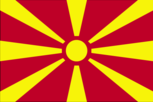
a rising yellow sun with eight rays extending to the edges of the red field
Government type
emerging democracy
Independence
17 September 1991 (from Yugoslavia)
International organization participation
BIS (pending member), CCC, CE, CEI, EAPC, EBRD, ECE, FAO, IAEA, IBRD, ICAO, ICRM, IDA, IFAD, IFC, IFRCS, ILO, IMF, IMO, Intelsat (nonsignatory user), Interpol, IOC, ISO, ITU, OSCE, PFP, UN, UNCTAD, UNESCO, UNIDO, UPU, WHO, WIPO, WMO, WToO, WTrO (applicant) Diplomatic representation in the US: chief of mission: Ambassador Ljubica Z. ACEVSKA chancery: 3050 K Street, NW, Suite 210, Washington, DC 20007 consulate(s) general: New York Diplomatic representation from the US: chief of mission: Ambassador Christopher Robert HILL embassy: Bul. Ilindenska bb, 91000 Skopje mailing address: American Embassy Skopje, Department of State, Washington, DC 20521-7120 (pouch)
Judicial branch
Constitutional Court, judges are elected by the Judicial Council; Judicial Court of the Republic, judges are elected by the Judicial Council Political parties and leaders: Social-Democratic Alliance of president]; Internal Macedonian Revolutionary Organization--Democratic Party for Macedonian National Unity or
Legal system
based on civil law system; judicial review of legislative acts
Legislative branch
unicameral Assembly or Sobranje (120 seats--85 members are elected by popular vote; 35 members come from lists of candidates submitted by parties based on the percentage that parties gain from the overall vote; all serve four-year terms) elections: last held 18 October and 1 November 1998 (next to be held NA 2002) election results: percent of vote by party--NA; seats by party--VMRO 49, SDSM 27, PDP 14, DA 13, DPA 11, LDP 4, Socialists 1, Roma Party 1
National holiday
8 September
Suffrage
18 years of age; universal
Economy
Agriculture--products
rice, tobacco, wheat, corn, millet, cotton, sesame, mulberry leaves, citrus, vegetables; beef, pork, poultry, mutton
Budget
revenues: $1.06 billion expenditures: $1 billion, including capital expenditures of $107 million (1996 est.)
Currency
1 Macedonian denar (MKD) = 100 deni
Debt--external
$1.06 billion (June 1997)
Economic aid--recipient
ODA, $100 million (1996 est.)
Economy--overview
The breakup of Yugoslavia in 1991 deprived Macedonia, its poorest republic, of key protected markets and large transfer payments from the center. Worker remittances and foreign aid have softened the subsequent volatile recovery period. Continued recovery depends on Macedonia's ability to attract investment, to redevelop trade ties with Greece and Serbia and Montenegro, and to maintain its commitment to economic liberalization. The economy can meet its basic food needs but depends on outside sources for all of its oil and gas and most of its modern machinery and parts.
Electricity--consumption
6.06 billion kWh (1996)
Electricity--exports
0 kWh (1996)
Electricity--imports
0 kWh (1996)
Electricity--production
6.06 billion kWh (1996)
Electricity--production by source
fossil fuel: 80.2% hydro: 19.8% nuclear: 0% other: 0% (1996)
Exchange rates
denars per US$1--52.156 (January 1999), 54.462 (1998), 50.004 (1997), 39.981 (1996), 37.882 (1995), 43.263 (1994)
Exports
$1.2 billion (f.o.b., 1997)
Exports--commodities
food, beverages, tobacco 17.0%, machinery and transport equipment 13.3%, other manufactured goods 58%
Exports--partners
Bulgaria, other former Yugoslav republics, Germany, Italy
Fiscal year
calendar year
GDP
purchasing power parity--$2.1 billion (1998 est.)
GDP--composition by sector
agriculture: 20.4% industry: 38.6% services: 41% (1995 est.)
GDP--per capita
purchasing power parity?$1,050 (1998 est.)
GDP--real growth rate
4.5% (1998 est.)
Household income or consumption by percentage share
lowest 10%: NA% highest 10%: NA%
Imports
$1.6 billion (c.i.f., 1997)
Imports--commodities
machinery and equipment 19%, chemicals 14%, fuels 12%
Imports--partners
other former Yugoslav republics, Germany, Bulgaria, Italy, Austria
Industrial production growth rate
3.4% (1997 est.)
Industries
coal, metallic chromium, lead, zinc, ferronickel, textiles, wood products, tobacco
Inflation rate (consumer prices)
3% (1998 est.)
Labor force
591,773 (June 1994)
Labor force--by occupation
manufacturing and mining 40% (1992)
Population below poverty line
NA%
Unemployment rate
30% (1998 est.); note--many employed workers are, in fact, furloughees
Communications
Radio broadcast stations
AM 6, FM 2, shortwave 0
Radios
350,000 (1992 est.)
Telephone system
domestic: NA international: NA
Telephones
125,000
Television broadcast stations
136 (of which 22 are main stations and 114 are low-power stations) (1997)
Televisions
327,011 (1992 est.)
Transportation
Airports
16 (1998 est.) Airports--with paved runways: total: 10 2,438 to 3,047 m: 2 under 914 m: 8 (1998 est.) Airports--with unpaved runways: total: 6 914 to 1,523 m: 2 under 914 m: 4 (1998 est.)
Highways
total: 10,591 km paved: 5,500 km (including 133 km of expressways) unpaved: 5,091 km (1997 est.)
Pipelines
0 km Ports and harbors: none
Railways
total: 922 km standard gauge: 922 km 1.435-m gauge (232 km electrified) (1997)
Waterways
none, lake transport only
Military and Security
Military branches
Army, Navy, Air and Air Defense Forces, Police Force
Military expenditures--dollar figure
$71 million (1998)
Military expenditures--percent of GDP
2.2% (1998)
Military manpower--availability
males age 15-49: 539,329 (1999 est.) Military manpower--fit for military service: males age 15-49: 434,468 (1999 est.)
Military manpower--military age
19 years of age
Military manpower--reaching military age annually
males: 17,291 (1999 est.)
Transnational Issues
Disputes--international
dispute with Greece over name; in September 1995, Skopje and Athens signed an interim accord resolving their dispute over symbols and certain constitutional provisions; Athens also lifted its economic embargo on The Former Yugoslav Republic of Macedonia; the border commission formed by The Former Yugoslav Republic of Macedonia and Serbia and Montenegro in April 1996 to resolve differences in delineation of their mutual border has made no progress so far; Albanians in Macedonia claim discrimination in education, access to public-sector jobs and representation in government; Party for Democratic Action (DPA), which is now a member party of the government, calls for a rewrite of the constitution to declare ethnic Albanians a national group and allow for regional autonomy
Illicit drugs
increasing transshipment point for Southwest Asian heroin and hashish; minor transit point for South American cocaine destined for Europe