2024 Edition
CIA World Factbook 2024 (factbook.json @ b8538d78e87c)
Introduction
Background
The first recorded kingdom (Choson) on the Korean Peninsula dates from approximately 2300 B.C. Over the subsequent centuries, three main kingdoms -- Kogoryo, Paekche, and Silla -- were established on the Peninsula. By the 5th century A.D., Kogoryo emerged as the most powerful, with control over much of the Peninsula and part of Manchuria (modern-day northeast China). However, Silla allied with the Chinese to create the first unified Korean state in 688. Following the collapse of Silla in the 9th century, Korea was unified under the Koryo (Goryeo; 918-1392) and the Chosen (Joseon; 1392-1910) dynasties. Korea became the object of intense imperialistic rivalry among the Chinese (its traditional benefactor), Japanese, and Russian empires in the latter half of the 19th and early 20th centuries. After the Sino-Japanese War (1894-95) and the Russo-Japanese War (1904-05), Korea was occupied by Imperial Japan. In 1910, Japan formally annexed the entire peninsula. After World War II, the northern half came under Soviet-sponsored communist control. In 1948, North Korea (formally known as the Democratic People's Republic of Korea or DPRK) was founded under President KIM Il Sung, who consolidated power and cemented autocratic one-party rule under the Korean Worker's Party (KWP). North Korea failed to conquer UN-backed South Korea (formally the Republic of Korea or ROK) during the Korean War (1950-53), after which a demilitarized zone separated the two Koreas. KIM's authoritarian rule included tight control over North Korean citizens and the demonization of the US as the central threat to North Korea's political and social system. In addition, he molded the country's economic, military, and political policies around the core objective of unifying Korea under Pyongyang's control. North Korea also declared a central ideology of juche ("self-reliance") as a check against outside influence, while continuing to rely heavily on China and the Soviet Union for economic support. KIM Il Sung's son, KIM Jong Il, was officially designated as his father's successor in 1980, and he assumed a growing political and managerial role until the elder KIM's death in 1994. Under KIM Jong Il's reign, North Korea continued developing nuclear weapons and ballistic missiles. KIM Jong Un was publicly unveiled as his father's successor in 2010. Following KIM Jong Il's death in 2011, KIM Jong Un quickly assumed power and has since occupied the regime's highest political and military posts. After the end of Soviet aid in 1991, North Korea faced serious economic setbacks that exacerbated decades of economic mismanagement and resource misallocation. Since the mid-1990s, North Korea has faced chronic food shortages and economic stagnation. In recent years, the North's domestic agricultural production has improved but still falls far short of producing sufficient food for its population. Starting in 2002, North Korea began to tolerate semi-private markets but has made few other efforts to meet its goal of improving the overall standard of living. New economic development plans in the 2010s failed to meet government-mandated goals for key industrial sectors, food production, or overall economic performance. At the onset of the COVID-19 pandemic in 2020, North Korea instituted a nationwide lockdown that severely restricted its economy and international engagement. Since then, KIM has repeatedly expressed concerns with the regime's economic failures and food problems, but in 2021, he vowed to continue "self-reliant" policies and has reinvigorated his pursuit of greater regime control of the economy. As of 2024, despite slowly renewing cross-border trade with China, North Korea remained one of the world's most isolated countries and one of Asia's poorest. In 2024, Pyongyang announced it was ending all economic cooperation with South Korea. The move followed earlier proclamations that it was scrapping a 2018 military pact with South Korea to de-escalate tensions along their militarized border, abandoning the country’s decades-long pursuit of peaceful unification with South Korea, and designating the South as North Korea’s “principal enemy.”
Geography
Area
- land
- 120,408 sq km
- total
- 120,538 sq km
- water
- 130 sq km
Area - comparative
slightly larger than Virginia; slightly smaller than Mississippi
Climate
temperate, with rainfall concentrated in summer; long, bitter winters
Coastline
2,495 km
Elevation
- highest point
- Paektu-san 2,744 m
- lowest point
- Sea of Japan 0 m
- mean elevation
- 600 m
Geographic coordinates
40 00 N, 127 00 E
Geography - note
strategic location bordering China, South Korea, and Russia; mountainous interior is isolated and sparsely populated
Irrigated land
14,600 sq km (2012)
Land boundaries
- border countries
- China 1,352 km; South Korea 237 km; Russia 18 km
- total
- 1,607 km
Land use
- agricultural land
- 21.8% (2018 est.)
- agricultural land: arable land
- arable land: 19.5% (2018 est.)
- agricultural land: permanent crops
- permanent crops: 1.9% (2018 est.)
- agricultural land: permanent pasture
- permanent pasture: 0.4% (2018 est.)
- forest
- 46% (2018 est.)
- other
- 32.2% (2018 est.)
Location
Eastern Asia, northern half of the Korean Peninsula bordering the Korea Bay and the Sea of Japan, between China and South Korea
Map references
Asia
Maritime claims
- exclusive economic zone
- 200 nm
- note
- note: military boundary line 50 nm in the Sea of Japan and the exclusive economic zone limit in the Yellow Sea where all foreign vessels and aircraft without permission are banned
- territorial sea
- 12 nm
Natural hazards
late spring droughts often followed by severe flooding; occasional typhoons during the early fall volcanism: P'aektu-san (2,744 m) (also known as Baitoushan, Baegdu, or Changbaishan), on the Chinese border, is considered historically active
Natural resources
coal, iron ore, limestone, magnesite, graphite, copper, zinc, lead, precious metals, hydropower
Population distribution
population concentrated in the plains and lowlands; least populated regions are the mountainous provinces adjacent to the Chinese border; largest concentrations are in the western provinces, particularly the municipal district of Pyongyang, and around Hungnam and Wonsan in the east
Terrain
mostly hills and mountains separated by deep, narrow valleys; wide coastal plains in west, discontinuous in east
People and Society
Age structure
- 0-14 years
- 19.9% (male 2,673,822/female 2,548,775)
- 15-64 years
- 68.9% (male 9,054,771/female 9,066,447)
- 65 years and over
- 11.2% (2024 est.) (male 1,099,676/female 1,855,175)
Alcohol consumption per capita
- beer
- 0.12 liters of pure alcohol (2019 est.)
- other alcohols
- 0 liters of pure alcohol (2019 est.)
- spirits
- 3.48 liters of pure alcohol (2019 est.)
- total
- 3.61 liters of pure alcohol (2019 est.)
- wine
- 0 liters of pure alcohol (2019 est.)
Birth rate
13.2 births/1,000 population (2024 est.)
Child marriage
- women married by age 18
- 0.1% (2017 est.)
Children under the age of 5 years underweight
9.3% (2017)
Contraceptive prevalence rate
70.2% (2017)
Current health expenditure
NA
Currently married women (ages 15-49)
69.7% (2023 est.)
Death rate
9.2 deaths/1,000 population (2024 est.)
Dependency ratios
- elderly dependency ratio
- 16.3
- potential support ratio
- 6.1 (2021 est.)
- total dependency ratio
- 43.5
- youth dependency ratio
- 27.2
Drinking water source
- improved: rural
- rural: 89.1% of population
- improved: total
- total: 94.5% of population
- improved: urban
- urban: 97.8% of population
- unimproved: rural
- rural: 10.9% of population
- unimproved: total
- total: 5.5% of population (2020 est.)
- unimproved: urban
- urban: 2.2% of population
Education expenditures
NA
Ethnic groups
racially homogeneous; there is a small Chinese community and a few ethnic Japanese
Gross reproduction rate
0.88 (2024 est.)
Infant mortality rate
- female
- 13.8 deaths/1,000 live births
- male
- 16.9 deaths/1,000 live births
- total
- 15.4 deaths/1,000 live births (2024 est.)
Languages
- Languages
- Korean
- major-language sample(s)
- 월드 팩트북, 필수적인 기본 정보 제공처 (Korean)The World Factbook, the indispensable source for basic information.
Life expectancy at birth
- female
- 77 years
- male
- 70.2 years
- total population
- 73.5 years (2024 est.)
Literacy
- definition
- age 15 and over can read and write
- female
- 100% (2015)
- male
- 100%
- total population
- 100%
Major urban areas - population
3.158 million PYONGYANG (capital) (2023)
Maternal mortality ratio
107 deaths/100,000 live births (2020 est.)
Median age
- female
- 37.4 years
- male
- 34.5 years
- total
- 35.9 years (2024 est.)
Nationality
- adjective
- Korean
- noun
- Korean(s)
Net migration rate
0 migrant(s)/1,000 population (2024 est.)
Obesity - adult prevalence rate
6.8% (2016)
Physician density
3.68 physicians/1,000 population (2017)
Population
- female
- 13,470,397 (2024 est.)
- male
- 12,828,269
- total
- 26,298,666
Population distribution
population concentrated in the plains and lowlands; least populated regions are the mountainous provinces adjacent to the Chinese border; largest concentrations are in the western provinces, particularly the municipal district of Pyongyang, and around Hungnam and Wonsan in the east
Population growth rate
0.4% (2024 est.)
Religions
- traditionally Buddhist and Confucian, some Christian and syncretic Chondogyo (Religion of the Heavenly Way)
- note
- note: autonomous religious activities now almost nonexistent; government-sponsored religious groups exist to provide illusion of religious freedom
Sanitation facility access
- improved: rural
- rural: 73.1% of population
- improved: total
- total: 85.3% of population
- improved: urban
- urban: 92.7% of population
- unimproved: rural
- rural: 26.9% of population
- unimproved: total
- total: 14.7% of population (2020 est.)
- unimproved: urban
- urban: 7.3% of population
School life expectancy (primary to tertiary education)
- female
- 11 years (2015)
- male
- 11 years
- total
- 11 years
Sex ratio
- 0-14 years
- 1.05 male(s)/female
- 15-64 years
- 1 male(s)/female
- 65 years and over
- 0.59 male(s)/female
- at birth
- 1.06 male(s)/female
- total population
- 0.95 male(s)/female (2024 est.)
Tobacco use
- female
- 0% (2020 est.)
- male
- 34.8% (2020 est.)
- total
- 17.4% (2020 est.)
Total fertility rate
1.81 children born/woman (2024 est.)
Urbanization
- rate of urbanization
- 0.85% annual rate of change (2020-25 est.)
- urban population
- 63.2% of total population (2023)
Government
Administrative divisions
- 9 provinces (do, singular and plural) and 4 special administration cities (si, singular and plural) provinces: Chagang, Hambuk (North Hamgyong), Hamnam (South Hamgyong), Hwangbuk (North Hwanghae), Hwangnam (South Hwanghae), Kangwon, P'yongbuk (North Pyongan), P'yongnam (South Pyongan), Ryanggang special administration cities: Kaesong, Nampo, P'yongyang, Rason
- note
- note: P'yongyang is identified as a directly controlled city, while Kaesong, Nampo, and Rason are designated as special cities
Capital
- etymology
- the name translates as "flat land" in Korean
- geographic coordinates
- 39 01 N, 125 45 E
- name
- Pyongyang
- time difference
- UTC+9 (14 hours ahead of Washington, DC, during Standard Time)
- time zone note
- on 5 May 2018, North Korea reverted to UTC+9, the same time zone as South Korea
Citizenship
- citizenship by birth
- no
- citizenship by descent only
- at least one parent must be a citizen of North Korea
- dual citizenship recognized
- no
- residency requirement for naturalization
- unknown
Constitution
- amendments
- proposed by the Supreme People’s Assembly (SPA); passage requires more than two-thirds majority vote of the total SPA membership; revised several times, last in 2023
- history
- previous 1948, 1972; latest adopted 1998 (during KIM Jong-il era)
Country name
- abbreviation
- DPRK
- conventional long form
- Democratic People's Republic of Korea
- conventional short form
- North Korea
- etymology
- derived from the Chinese name for Goryeo, which was the Korean dynasty that united the peninsula in the 10th century A.D.; the North Korean name "Choson" means "[Land of the] Morning Calm"
- local long form
- Choson-minjujuui-inmin-konghwaguk
- local short form
- Choson
Diplomatic representation from the US
- embassy
- none; the Swedish Embassy in Pyongyang represents the US as consular protecting power
Diplomatic representation in the US
noneNote: North Korea has a Permanent Mission to the UN in New York
Executive branch
- cabinet
- Cabinet or Naegak members appointed by the Supreme People's Assembly except the Minister of People's Armed Forces
- chief of state
- State Affairs Commission President KIM Jong Un (since 17 December 2011)
- election results
- 2019: KIM Jong Un reelected unopposed
- elections/appointments
- chief of state and premier indirectly elected by the Supreme People's Assembly; election last held on 10 March 2019 (next to be held in March 2024)
- head of government
- Supreme People's Assembly President CHOE Ryong Hae (since 11 April 2019)
- note
- note 1: KIM Jong Un's titles include general secretary of the Workers' Party of Korea (KWP), chairman of the KWP Central Military Commission, president of the State Affairs Commission, and supreme commander of the Korean People's Armynote 2: within the North Korean system, KIM Jong Un's role as chief of state is secondary to his role as general secretary of the Korean Workers' Party; chief of state is used to engage with non-communist countries such as the US; North Korea revised its constitution in 2019 to define "the Chairman of the State Affairs Commission" as "the supreme leader who represents the state"; functions as the commander-in-chief and chief executive; the specific titles associated with this office have changed multiple times under KIM's tenure, however, KIM Jong Un has been supreme leader since his father's death in 2011note 3: the head of government functions as the technical head of state and performs related duties, such as receiving ambassadors' credentials
Flag description
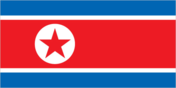
three horizontal bands of blue (top), red (triple width), and blue; the red band is edged in white; on the hoist side of the red band is a white disk with a red five-pointed star; the broad red band symbolizes revolutionary traditions; the narrow white bands stand for purity, strength, and dignity; the blue bands signify sovereignty, peace, and friendship; the red star represents socialism
Government type
dictatorship, single-party communist state
Independence
15 August 1945 (from Japan)
International law organization participation
has not submitted an ICJ jurisdiction declaration; non-party state to the ICCt
International organization participation
ARF, FAO, G-77, ICAO, ICRM, IFAD, IFRCS, IHO, IMO, IMSO, IOC, IPU, ISO, ITSO, ITU, NAM, UN, UNCTAD, UNESCO, UNIDO, UNWTO, UPU, WFTU (NGOs), WHO, WIPO, WMO
Judicial branch
- highest court(s)
- Supreme Court or Central Court (consists of one judge and 2 "People's Assessors" or, for some cases, 3 judges)
- judge selection and term of office
- judges elected by the Supreme People's Assembly for 5-year terms
- subordinate courts
- lower provincial courts as determined by the Supreme People's Assembly
Legal system
civil law system based on the Prussian model; system influenced by Japanese traditions and Communist legal theory
Legislative branch
- description
- unicameral Supreme People's Assembly (SPA) or Ch'oego Inmin Hoeui (687 seats; members directly elected by majority vote in 2 rounds if needed to serve 5-year terms)
- election results
- percent of vote by party - NA; seats by party - KWP 607, KSDP 50, Chondoist Chongu Party 22, General Association of Korean Residents in Japan (Chongryon) 5, religious associations 3; ruling party approves a list of candidates who are elected without opposition; composition as of February 2024 - men 566, women 121, percentage women 17.6%
- elections
- last held on 10 March 2019 (next to be held in 2024)
- note
- note: the SPA functions as a rubberstamp legislature; the Korean Workers' Party selects all candidates
National anthem
- lyrics/music
- PAK Se Yong/KIM Won Gyun
- name
- "Aegukka" (Patriotic Song)
- note
- note: adopted 1947; both North Korea's and South Korea's anthems share the same name and have a vaguely similar melody but have different lyrics; the North Korean anthem is also known as "Ach'imun pinnara" (Let Morning Shine)
National heritage
- selected World Heritage Site locales
- Koguryo Tombs Complex; Historic Monuments and Sites in Kaesong
- total World Heritage Sites
- 2 (both cultural)
National holiday
Founding of the Democratic People's Republic of Korea (DPRK), 9 September (1948)
National symbol(s)
red star, chollima (winged horse); national colors: red, white, blue
Political parties
major parties:Korean Workers' Party or KWP (formally known as Workers' Party of Korea) General Association of Korean Residents in Japan (Chongryon; under KWP control) minor parties: Chondoist Chongu Party (under KWP control)Social Democratic Party or KSDP (under KWP control)
Suffrage
17 years of age; universal and compulsory
Economy
Agricultural products
- maize, rice, vegetables, apples, cabbages, fruits, sweet potatoes, potatoes, beans, soybeans (2022)
- note
- note: top ten agricultural products based on tonnage
Economic overview
one of the last centrally planned economies; hard hit by COVID-19, crop failures, international sanctions, and isolationist policies; declining growth and trade, and heavily reliant on China; poor exchange rate stability; economic data integrity issues
Exchange rates
- Currency
- North Korean won (KPW) per US dollar (average market rate)
- Exchange rates 2015
- 130 (2015 est.)
- Exchange rates 2016
- 130 (2016 est.)
- Exchange rates 2017
- 135 (2017 est.)
Exports
- Exports 2015
- $2.908 billion (2015 est.)
- Exports 2017
- $4.582 billion (2017 est.)
- Exports 2018
- $222 million (2018)
Exports - commodities
- tungsten ore, refined petroleum, iron alloys, electricity, molybdenum ore (2022)
- note
- note: top five export commodities based on value in dollars
Exports - partners
- China 53%, Senegal 11%, Nigeria 6%, Poland 4%, Netherlands 3% (2022)
- note
- note: top five export partners based on percentage share of exports
GDP - composition, by end use
- exports of goods and services
- 5.9% (2016 est.)
- imports of goods and services
- -11.1% (2016 est.)
GDP - composition, by sector of origin
- agriculture
- 22.5% (2017 est.)
- industry
- 47.6% (2017 est.)
- services
- 29.9% (2017 est.)
GDP (official exchange rate)
$28 billion (2013 est.)
Imports
- Imports 2016
- $3.86 billion (2016 est.)
- Imports 2018
- $2.32 billion (2018 est.)
Imports - commodities
- plastic products, tobacco, soybean oil, rubber tires, packaged medicine (2022)
- note
- note: top five import commodities based on value in dollars
Imports - partners
- China 98%, Zimbabwe 0%, Netherlands 0%, India 0%, Colombia 0% (2022)
- note
- note: top five import partners based on percentage share of imports
Industrial production growth rate
- 4.3% (2014 est.)
- note
- note: annual % change in industrial value added based on constant local currency
Industries
military products; machine building, electric power, chemicals; mining (coal, iron ore, limestone, magnesite, graphite, copper, zinc, lead, and precious metals), metallurgy; textiles, food processing; tourism
Labor force
- 15.837 million (2023 est.)
- note
- note: number of people ages 15 or older who are employed or seeking work
Real GDP (purchasing power parity)
- note
- note: data are in 2015 dollarsNorth Korea does not publish reliable National Income Accounts data; the data shown are derived from purchasing power parity (PPP) GDP estimates that were made by Angus MADDISON in a study conducted for the OECD; his figure for 1999 was extrapolated to 2015 using estimated real growth rates for North Korea's GDP and an inflation factor based on the US GDP deflator; the results were rounded to the nearest $10 billion.
- Real GDP (purchasing power parity) 2015
- $40 billion (2015 est.)
Real GDP growth rate
- Real GDP growth rate 2014
- 1% (2014 est.)
- Real GDP growth rate 2015
- -1.1% (2015 est.)
Real GDP per capita
- note
- note: data are in 2015 US dollars
- Real GDP per capita 2014
- $1,800 (2014 est.)
- Real GDP per capita 2015
- $1,700 (2015 est.)
Unemployment rate
- note
- note: % of labor force seeking employment
- Unemployment rate 2021
- 3.13% (2021 est.)
- Unemployment rate 2022
- 2.97% (2022 est.)
- Unemployment rate 2023
- 3% (2023 est.)
Youth unemployment rate (ages 15-24)
- female
- 7.8% (2023 est.)
- male
- 6.3% (2023 est.)
- note
- note: % of labor force ages 15-24 seeking employment
- total
- 7.1% (2023 est.)
Energy
Carbon dioxide emissions
- from coal and metallurgical coke
- 58.987 million metric tonnes of CO2 (2022 est.)
- from petroleum and other liquids
- 2.617 million metric tonnes of CO2 (2022 est.)
- total emissions
- 61.605 million metric tonnes of CO2 (2022 est.)
Coal
- consumption
- 21.747 million metric tons (2022 est.)
- production
- 21.747 million metric tons (2022 est.)
- proven reserves
- 10.6 billion metric tons (2022 est.)
Electricity
- consumption
- 18.24 billion kWh (2022 est.)
- installed generating capacity
- 8.277 million kW (2022 est.)
- transmission/distribution losses
- 4.033 billion kWh (2022 est.)
Electricity access
- electrification - total population
- 54.7% (2022 est.)
Electricity generation sources
- fossil fuels
- 42.1% of total installed capacity (2022 est.)
- hydroelectricity
- 57.6% of total installed capacity (2022 est.)
- solar
- 0.3% of total installed capacity (2022 est.)
Energy consumption per capita
- Total energy consumption per capita 2022
- 25.876 million Btu/person (2022 est.)
Petroleum
- refined petroleum consumption
- 17,000 bbl/day (2022 est.)
Communications
Broadcast media
no independent media; radios and TVs are pre-tuned to government stations; 4 government-owned TV stations; the Korean Workers' Party owns and operates the Korean Central Broadcasting Station, and the state-run Voice of Korea operates an external broadcast service; the government prohibits listening to and jams foreign broadcasts (2019)
Internet country code
.kp
Telecommunication systems
- domestic
- fixed-lines are approximately 5 per 100 and mobile-cellular 23 per 100 persons (2021)
- general assessment
- despite years of isolationism, economic under-achievement, and international sanctions, North Korea has improved its telecommunications infrastructure in the last decade; Inconsistent electric power supply and likely difficulties procuring new hardware, however, present enduring obstacles to building reliable high-speed telecom networks; mobile phone use is estimated to have increased to nearly 25% of the polulation as of 2018, yet the high cost of ownership makes mobile communications inaccessible to North Koreans of lower socioeconomic status; strict regime censorship and monitoring of telecom systems in North Korea restricts users from legally contacting anyone outside the country or accessing the global Internet; for those citizens living close to China, it has been possible to illegally obtain Chinese handsets and SIM cards, and to connect to towers located just across the border; while this offers access to the outside world and at much lower prices than the state-controlled offerings, the risks are high including steep fines and the possibility of jail time; North Korea has been effective in building an IT sector and a nascent digital economy on the back of a concerted effort to grow a sizeable, well-trained IT workforce; but even here, its capabilities have been directed more towards nefarious activities such as cyber crime and hacking into foreign countries’ computer and financial systems; North Korea’s determination to maintain ideological control of its populace by isolating itself from the rest of the world will probably lead to tighter controls on communications inside and outside of the country (2023)
- international
- country code - 850; satellite earth stations - 2 (1 Intelsat - Indian Ocean, 1 Russian - Indian Ocean region); other international connections through Moscow and Beijing
Telephones - fixed lines
- subscriptions per 100 inhabitants
- 5 (2021 est.)
- total subscriptions
- 1.18 million (2021 est.)
Telephones - mobile cellular
- subscriptions per 100 inhabitants
- 23 (2021 est.)
- total subscriptions
- 6 million (2021 est.)
Transportation
Airports
83 (2024)
Civil aircraft registration country code prefix
P
Heliports
8 (2024)
Merchant marine
- by type
- bulk carrier 10, container ship 5, general cargo 191, oil tanker 29, other 29
- total
- 264 (2023)
National air transport system
- annual freight traffic on registered air carriers
- 250,000 (2018) mt-km
- annual passenger traffic on registered air carriers
- 103,560 (2018)
- inventory of registered aircraft operated by air carriers
- 4
- number of registered air carriers
- 1 (2020)
Pipelines
6 km oil (2013)
Ports
- key ports
- Ch'ongjin, Haeju Hang, Hungnam, Najin, Nampo, Senbong, Wonsan
- small
- 7
- total ports
- 10 (2024)
- very small
- 3
Railways
- note
- note: figures are approximate; some narrow-gauge railway also exists
- standard gauge
- 7,435 km (2014) 1.435-m gauge (5,400 km electrified)
- total
- 7,435 km (2014)
Roadways
- paved
- 724 km
- total
- 25,554 km
- unpaved
- 24,830 km (2006)
Waterways
2,250 km (2011) (most navigable only by small craft)
Military and Security
Military - note
North Korea is one of the most militarized countries in the World, and the Korean People's Army (KPA) is one of the World’s largest military forces; founded in 1948, the KPA’s primary responsibilities are national defense and protection of the Kim regime; it also provides considerable support to domestic economic projects such as agriculture production and infrastructure construction; North Korea views the US as its primary external security threat in addition to the invasion of South Korea and the subsequent Korean War (1950-53), North Korea from the 1960s to the 1980s launched a considerable number of limited military and subversive actions against South Korea using special forces and terrorist tactics; including aggressive skirmishes along the DMZ, overt attempts to assassinate South Korean leaders, kidnappings, the bombing of an airliner, and a failed effort in 1968 to foment an insurrection and conduct a guerrilla war in the South with more than 100 seaborne commandos; from the 1990s until 2010, the North lost two submarines and a semi-submersible boat attempting to insert infiltrators into the South (1996, 1998) and provoked several engagements in the Northwest Islands area along the disputed Northern Limit Line (NLL), including naval skirmishes between patrol boats in 1999 and 2002, the torpedoing and sinking of a South Korean Navy corvette in 2010, and the bombardment of a South Korean military installation on Yeonpyeong Island, also in 2010; since 2010, further minor incidents continue to occur periodically along the DMZ, where both the KPA and the South Korean military maintain large numbers of troops; in late 2023 and early 2024, the Kim regime abandoned decades of official policy and declared that South Korea was not inhabited by “fellow countrymen” but a separate and “hostile” state that the North would “subjugate” if war broke out North Korea also has a history of provocative regional military actions and posturing that are of major concern to the international community, including: proliferation of military-related items; ballistic and cruise missile development and testing; weapons of mass destruction (WMD) programs including tests of nuclear devices in 2006, 2009, 2013, 2016, and 2017; and large conventional armed forces; despite high-level efforts to ease tensions during the 2018-19 timeframe, including summits with the leaders of China, South Korea, and the US, North Korea has continued developing its WMD programs and, in recent years, issued statements condemning the US and vowing to further strengthen its military capabilities, including long range missiles and nuclear weapons (2024)
Military and security forces
- Korean People's Army (KPA): KPA Ground Forces, KPA Navy, KPA Air Force and Air Defense Forces, KPA Strategic Forces (missile forces), KPA Special Forces (special operations forces); Security Guard Command (aka Bodyguard Command); Military Security CommandMinistry of Social Security (formerly Ministry of Public Security): Border Guard General Bureau, civil security forces; Ministry of State Security: internal security, investigations (2024)
- note
- note 1: North Korea employs a systematic and intentional overlap of powers and responsibilities among its multiple internal security organizations to prevent any potential subordinate consolidation of power and assure that each unit provided a check and balance on the othernote 2: Kim Jong Un is the KPA supreme commander, while operational control of the armed forces resides in the General Staff Department (GSD), which reports directly to Kim; the GSD maintains overall control of all military forces and is charged with turning Kim’s directives into operational military orders; the Ministry of National Defense (MND) is responsible for administrative control of the military and external relations with foreign militariesnote 3: the Security Guard Command protects the Kim family, other senior leadership figures, and government facilitiesnote 4: the North also has a large paramilitary/militia force organized into the Worker Peasant Red Guard and Red Youth Guard; these organizations are present at all levels of government (province, county, ward) and are under the control of the Korean Workers' Party in peacetime, but revert to KPA control in crisis or war; they are often mobilized for domestic projects, such as road building and agricultural support
Military and security service personnel strengths
information varies; estimated 1-1.2 million active-duty troops; estimated 200,000 internal security forces (2023)
Military deployments
approximately 10,000 Russia (2024)
Military equipment inventories and acquisitions
- the KPA is equipped with older weapon systems originally acquired from the former Soviet Union, Russia, and China, and some domestically produced equipment; North Korea produces a diverse array of military hardware, including small arms, munitions, light armored vehicles, tanks, naval vessels and submarines, and some advanced weapons systems, such as cruise and ballistic missiles; most are copies or upgrades of older foreign supplied equipment (2024)
- note
- note: since 2006, the UN Security Council has passed nearly a dozen resolutions sanctioning North Korea for developing nuclear weapons and related activities, starting with Resolution 1718, which condemned the North's first nuclear test and placed sanctions on the supply of heavy weaponry (including tanks, armored combat vehicles, large caliber artillery, combat aircraft, attack helicopters, warships, and missiles and missile launchers), missile technology and material, and select luxury goods; additional resolutions have expanded to include all arms, including small arms and light weapons; the US and other countries have also imposed unilateral sanctions
Military expenditures
defense spending is a regime priority; between 2010 and 2020, military expenditures accounted for an estimated 20-30% of North Korea's GDP annually; spending estimates ranged from $7 billion to $11 billion annually; in 2023, North Korea announced that it would spend nearly 16% of state expenditures on defense; North Korea in the 2010s and 2020s has increasingly relied on illicit activities — including cybercrime — to generate revenue for its weapons of mass destruction and ballistic missile programs to evade US and UN sanctions
Military service age and obligation
- 17 years of age for compulsory military service for men and women; service obligation varies from 5-13 years; reportedly up to 10 years (7 for women) for those serving in combat units and 13 years (7 for women) for specialized combat units, such as missile forces (2024)
- note
- note: the bulk of the KPA is made up of conscripts; as many as 20% of North Korean males between the ages of 16 and 54 are in the military at a given time and possibly up to 30 percent of males between the ages of 18 and 27, not counting the reserves or paramilitary units; women comprise about 20% of the military by some estimates
Transnational Issues
Illicit drugs
at present there is insufficient information to determine the current level of involvement of government officials in the production or trafficking of illicit drugs, but for years, from the 1970s into the 2000s, citizens of North Korea , many of them diplomatic employees of the government, were apprehended abroad while trafficking in narcotics; police investigations in Taiwan, Japan and Australia during that period have linked North Korea to large illicit shipments of heroin and methamphetamine
Refugees and internally displaced persons
- IDPs
- undetermined (2021)
Trafficking in persons
- tier rating
- Tier 3 — the government of North Korea does not fully meet the minimum standards for the elimination of trafficking and is not making significant efforts to do so, therefore, North Korea remained on Tier 3; for more details, go to: https://www.state.gov/reports/2024-trafficking-in-persons-report/north-korea/
Space
Space agency/agencies
National Aerospace Development Administration (NADA; established 2013); predecessor organization, Korean Committee of Space Technology (KCST; established 1980s); State Space Development Bureau; Academy of Defense Science; Ministry of People’s Armed Forces (2024)
Space launch site(s)
Sohae Satellite Launching Station (aka Tongch'ang-dong Space Launch Center; North Pyongan province); Tonghae Satellite Launching Ground (North Hamgyong province) (2024)
Space program overview
- North Korea’s leader has emphasized the development of space capabilities, particularly space launch vehicles (SLVs) and remote sensing (RS) satellites; manufactures small satellites; manufactures and launches rockets/SLVs; note – the SLV program is closely related to North Korea’s development of intercontinental ballistic missiles (2024)
- note
- note: further details about the key activities, programs, and milestones of the country’s space program, as well as government spending estimates on the space sector, appear in the Space Programs reference guide
Environment
Air pollutants
- carbon dioxide emissions
- 28.28 megatons (2016 est.)
- methane emissions
- 18.68 megatons (2020 est.)
- particulate matter emissions
- 41.46 micrograms per cubic meter (2019 est.)
Climate
temperate, with rainfall concentrated in summer; long, bitter winters
Environment - current issues
water pollution; inadequate supplies of potable water; waterborne disease; deforestation; soil erosion and degradation
Environment - international agreements
- party to
- Antarctic Treaty, Biodiversity, Climate Change, Climate Change-Kyoto Protocol, Climate Change-Paris Agreement, Desertification, Environmental Modification, Hazardous Wastes, Ozone Layer Protection, Ship Pollution, Wetlands
- signed, but not ratified
- Antarctic-Environmental Protection, Law of the Sea
Food insecurity
- widespread lack of access
- due to low food consumption levels, poor dietary diversity, and economic downturn -the food security situation is expected to remain fragile, given persisting economic constraints aggravated by a below-average 2022 agricultural output (2023)
Land use
- agricultural land
- 21.8% (2018 est.)
- agricultural land: arable land
- arable land: 19.5% (2018 est.)
- agricultural land: permanent crops
- permanent crops: 1.9% (2018 est.)
- agricultural land: permanent pasture
- permanent pasture: 0.4% (2018 est.)
- forest
- 46% (2018 est.)
- other
- 32.2% (2018 est.)
Total renewable water resources
77.15 billion cubic meters (2020 est.)
Total water withdrawal
- agricultural
- 6.61 billion cubic meters (2020 est.)
- industrial
- 1.15 billion cubic meters (2020 est.)
- municipal
- 900 million cubic meters (2020 est.)
Urbanization
- rate of urbanization
- 0.85% annual rate of change (2020-25 est.)
- urban population
- 63.2% of total population (2023)