2020 Edition
factbook.json (GitHub)
Introduction
Background
The first recorded kingdom (Choson) on the Korean Peninsula dates from approximately 2300 B.C. Over the subsequent centuries, three main kingdoms -- Kogoryo, Paekche, and Silla -- were established on the Peninsula. By the 5th century A.D., Kogoryo emerged as the most powerful, with control over much of the Peninsula and part of Manchuria (modern-day northeast China). However, Silla allied with the Chinese to create the first unified Korean state in 688. Following the collapse of Silla in the 9th century, Korea was unified under the Koryo (Goryeo; 918-1392) and the Chosen (Joseon; 1392-1910) dynasties. Korea became the object of intense imperialistic rivalry among the Chinese (its traditional benefactor), Japanese, and Russian empires in the latter half of the 19th and early 20th centuries. After the Sino-Japanese War (1894-95) and the Russo-Japanese War (1904-05), Korea was occupied by Imperial Japan. In 1910, Japan formally annexed the entire peninsula. After World War II, the northern half came under Soviet-sponsored communist control. In 1948, North Korea (formally known as the Democratic People's Republic of Korea or DPRK) was founded under President KIM Il Sung, who consolidated power and cemented autocratic one-party rule under the Korean Worker's Party (KWP). North Korea failed to conquer UN-backed South Korea (formally the Republic of Korea or ROK) during the Korean War (1950-53), after which a demilitarized zone separated the two Koreas. KIM's authoritarian rule included tight control over North Korean citizens and the demonization of the US as the central threat to North Korea's political and social system. In addition, he molded the country's economic, military, and political policies around the core objective of unifying Korea under Pyongyang's control. North Korea also declared a central ideology of juche ("self-reliance") as a check against outside influence, while continuing to rely heavily on China and the Soviet Union for economic support. KIM Il Sung's son, KIM Jong Il, was officially designated as his father's successor in 1980, and he assumed a growing political and managerial role until the elder KIM's death in 1994. Under KIM Jong Il's reign, North Korea continued developing nuclear weapons and ballistic missiles. KIM Jong Un was publicly unveiled as his father's successor in 2010. Following KIM Jong Il's death in 2011, KIM Jong Un quickly assumed power and has since occupied the regime's highest political and military posts. After the end of Soviet aid in 1991, North Korea faced serious economic setbacks that exacerbated decades of economic mismanagement and resource misallocation. Since the mid-1990s, North Korea has faced chronic food shortages and economic stagnation. In recent years, the North's domestic agricultural production has improved but still falls far short of producing sufficient food for its population. Starting in 2002, North Korea began to tolerate semi-private markets but has made few other efforts to meet its goal of improving the overall standard of living. New economic development plans in the 2010s failed to meet government-mandated goals for key industrial sectors, food production, or overall economic performance. At the onset of the COVID-19 pandemic in 2020, North Korea instituted a nationwide lockdown that severely restricted its economy and international engagement. Since then, KIM has repeatedly expressed concerns with the regime's economic failures and food problems, but in 2021, he vowed to continue "self-reliant" policies and has reinvigorated his pursuit of greater regime control of the economy. As of 2024, despite slowly renewing cross-border trade with China, North Korea remained one of the world's most isolated countries and one of Asia's poorest. In 2024, Pyongyang announced it was ending all economic cooperation with South Korea. The move followed earlier proclamations that it was scrapping a 2018 military pact with South Korea to de-escalate tensions along their militarized border, abandoning the country’s decades-long pursuit of peaceful unification with South Korea, and designating the South as North Korea’s “principal enemy.”
Geography
Area
- land
- 120,408 sq km
- total
- 120,538 sq km
- water
- 130 sq km
Area - comparative
slightly larger than Virginia; slightly smaller than Mississippi
Climate
temperate, with rainfall concentrated in summer; long, bitter winters
Coastline
2,495 km
Elevation
- highest point
- Paektu-san 2,744 m
- lowest point
- Sea of Japan 0 m
- mean elevation
- 600 m
Geographic coordinates
40 00 N, 127 00 E
Geography - note
strategic location bordering China, South Korea, and Russia; mountainous interior is isolated and sparsely populated
Irrigated land
14,600 sq km (2012)
Land boundaries
- border countries
- China 1,352 km; South Korea 237 km; Russia 18 km
- total
- 1,607 km
Land use
- agricultural land
- 21.6% (2023 est.)
- agricultural land: arable land
- arable land: 19.1% (2023 est.)
- agricultural land: permanent crops
- permanent crops: 2.1% (2023 est.)
- agricultural land: permanent pasture
- permanent pasture: 0.4% (2023 est.)
- forest
- 64% (2023 est.)
- other
- 14.5% (2023 est.)
Location
Eastern Asia, northern half of the Korean Peninsula bordering the Korea Bay and the Sea of Japan, between China and South Korea
Map references
Asia
Maritime claims
- exclusive economic zone
- 200 nm
- territorial sea
- 12 nm
Natural hazards
late spring droughts often followed by severe flooding; occasional typhoons during the early fall volcanism: P'aektu-san (2,744 m) (also known as Baitoushan, Baegdu, or Changbaishan), on the Chinese border, is considered historically active
Natural resources
coal, iron ore, limestone, magnesite, graphite, copper, zinc, lead, precious metals, hydropower
Population distribution
population concentrated in the plains and lowlands; least-populated regions are the mountainous provinces adjacent to the Chinese border; largest concentrations are in the western provinces, particularly the municipal district of Pyongyang, and around Hungnam and Wonsan in the east
Terrain
mostly hills and mountains separated by deep, narrow valleys; wide coastal plains in west, discontinuous in east
People and Society
Age structure
- 0-14 years
- 19.9% (male 2,673,822/female 2,548,775)
- 15-64 years
- 68.9% (male 9,054,771/female 9,066,447)
- 65 years and over
- 11.2% (2024 est.) (male 1,099,676/female 1,855,175)
Alcohol consumption per capita
- beer
- 0.12 liters of pure alcohol (2019 est.)
- other alcohols
- 0 liters of pure alcohol (2019 est.)
- spirits
- 3.48 liters of pure alcohol (2019 est.)
- total
- 3.61 liters of pure alcohol (2019 est.)
- wine
- 0 liters of pure alcohol (2019 est.)
Birth rate
12.99 births/1,000 population (2025 est.)
Child marriage
- men married by age 18
- 0% (2017)
- women married by age 15
- 0% (2017)
- women married by age 18
- 0.1% (2017)
Children under the age of 5 years underweight
9.3% (2017 est.)
Currently married women (ages 15-49)
68.2% (2017 est.)
Death rate
9.01 deaths/1,000 population (2025 est.)
Dependency ratios
- elderly dependency ratio
- 16.8 (2025 est.)
- potential support ratio
- 6 (2025 est.)
- total dependency ratio
- 45.6 (2025 est.)
- youth dependency ratio
- 28.8 (2025 est.)
Drinking water source
- improved: rural
- rural: 88.8% of population (2022 est.)
- improved: total
- total: 93.9% of population (2022 est.)
- improved: urban
- urban: 96.9% of population (2022 est.)
- unimproved: rural
- rural: 11.2% of population (2022 est.)
- unimproved: total
- total: 6.1% of population (2022 est.)
- unimproved: urban
- urban: 3.1% of population (2022 est.)
Education expenditure
14.6% national budget (2025 est.)
Ethnic groups
racially homogeneous; there is a small Chinese community and a few ethnic Japanese
Gross reproduction rate
0.87 (2025 est.)
Infant mortality rate
- female
- 13.8 deaths/1,000 live births
- male
- 16.9 deaths/1,000 live births
- total
- 14.7 deaths/1,000 live births (2025 est.)
Languages
- Languages
- Korean
- major-language sample(s)
- 월드 팩트북, 필수적인 기본 정보 제공처 (Korean) The World Factbook, the indispensable source for basic information.
Life expectancy at birth
- female
- 77 years
- male
- 70.2 years
- total population
- 73.5 years (2024 est.)
Major urban areas - population
3.158 million PYONGYANG (capital) (2023)
Maternal mortality ratio
67 deaths/100,000 live births (2023 est.)
Median age
- female
- 37.4 years
- male
- 34.5 years
- total
- 36.2 years (2025 est.)
Nationality
- adjective
- Korean
- noun
- Korean(s)
Net migration rate
-0.04 migrant(s)/1,000 population (2025 est.)
Obesity - adult prevalence rate
6.8% (2016)
Physician density
3.63 physicians/1,000 population (2017)
Population
- female
- 13,518,572
- male
- 12,884,269
- total
- 26,402,841 (2025 est.)
Population growth rate
0.4% (2025 est.)
Religions
traditionally Buddhist and Confucian, some Christian and syncretic Chondogyo (Religion of the Heavenly Way)
Sanitation facility access
- improved: rural
- rural: 73.1% of population (2022 est.)
- improved: total
- total: 85.4% of population (2022 est.)
- improved: urban
- urban: 92.7% of population (2022 est.)
- unimproved: rural
- rural: 26.9% of population (2022 est.)
- unimproved: total
- total: 14.6% of population (2022 est.)
- unimproved: urban
- urban: 7.3% of population (2022 est.)
School life expectancy (primary to tertiary education)
- female
- 12 years (2018 est.)
- male
- 12 years (2018 est.)
- total
- 12 years (2018 est.)
Sex ratio
- 0-14 years
- 1.05 male(s)/female
- 15-64 years
- 1 male(s)/female
- 65 years and over
- 0.59 male(s)/female
- at birth
- 1.06 male(s)/female
- total population
- 0.95 male(s)/female (2024 est.)
Tobacco use
- female
- 0% (2025 est.)
- male
- 32.6% (2025 est.)
- total
- 16% (2025 est.)
Total fertility rate
1.8 children born/woman (2025 est.)
Urbanization
- rate of urbanization
- 0.85% annual rate of change (2020-25 est.)
- urban population
- 63.2% of total population (2023)
Government
Administrative divisions
9 provinces (do, singular and plural) and 4 special administration cities (si, singular and plural) provinces: Chagang, Hambuk (North Hamgyong), Hamnam (South Hamgyong), Hwangbuk (North Hwanghae), Hwangnam (South Hwanghae), Kangwon, P'yongbuk (North Pyongan), P'yongnam (South Pyongan), Ryanggang special administration cities: Kaesong, Nampo, P'yongyang, Rason
Capital
- etymology
- the name translates as "flat land" in Korean
- geographic coordinates
- 39 01 N, 125 45 E
- name
- Pyongyang
- time difference
- UTC+9 (14 hours ahead of Washington, DC, during Standard Time)
- time zone note
- on 5 May 2018, North Korea reverted to UTC+9, the same time zone as South Korea
Citizenship
- citizenship by birth
- no
- citizenship by descent only
- at least one parent must be a citizen of North Korea
- dual citizenship recognized
- no
- residency requirement for naturalization
- unknown
Constitution
- amendment process
- proposed by the Supreme People’s Assembly (SPA); passage requires more than two-thirds majority vote of the total SPA membership
- history
- previous 1948, 1972; latest adopted 1998
Country name
- abbreviation
- DPRK
- conventional long form
- Democratic People's Republic of Korea
- conventional short form
- North Korea
- etymology
- derived from the Chinese name for Goryeo, which was the Korean dynasty that united the peninsula in the 10th century A.D.; the North Korean name "Choson" means "[Land of the] Morning Calm"
- local long form
- Choson-minjujuui-inmin-konghwaguk
- local short form
- Choson
Diplomatic representation from the US
- embassy
- none; the Swedish Embassy in Pyongyang represents the US as consular protecting power
Diplomatic representation in the US
none note: North Korea has a Permanent Mission to the UN in New York
Executive branch
- cabinet
- Cabinet or Naegak members appointed by the Supreme People's Assembly, except the Minister of People's Armed Forces
- chief of state
- State Affairs Commission President KIM Jong Un (since 17 December 2011)
- election results
- 2019: KIM Jong Un reelected unopposed
- election/appointment process
- chief of state and premier indirectly elected by the Supreme People's Assembly
- expected date of next election
- March 2024
- head of government
- Supreme People's Assembly President CHOE Ryong Hae (since 11 April 2019)
- most recent election date
- 11 April 2019
Flag
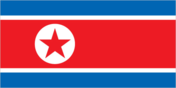
description: three horizontal bands of blue (top), red (triple-width), and blue; the red band is edged in white; on the left side of the red band is a white disk with a red five-pointed star meaning: the red band stands for revolutionary traditions, the white for purity, strength, and dignity; blue for sovereignty, peace, and friendship; the red star represents socialism
Government type
dictatorship, single-party communist state
Independence
15 August 1945 (from Japan)
International law organization participation
has not submitted an ICJ jurisdiction declaration; non-party state to the ICCt
International organization participation
ARF, FAO, G-77, ICAO, ICRM, IFAD, IFRCS, IHO, IMO, IMSO, IOC, IPU, ISO, ITSO, ITU, NAM, UN, UNCTAD, UNESCO, UNIDO, UNWTO, UPU, WFTU (NGOs), WHO, WIPO, WMO
Judicial branch
- highest court(s)
- Supreme Court or Central Court (consists of one judge and 2 "People's Assessors" or, for some cases, 3 judges)
- judge selection and term of office
- judges elected by the Supreme People's Assembly for 5-year terms
- subordinate courts
- lower provincial courts as determined by the Supreme People's Assembly
Legal system
civil law system based on the Prussian model; influenced by Japanese traditions and Communist legal theory
Legislative branch
- electoral system
- plurality/majority
- expected date of next election
- December 2025
- legislative structure
- unicameral
- legislature name
- Supreme People's Assembly (Choe Go In Min Hoe Ui)
- most recent election date
- 3/10/2019
- number of seats
- 687 (all directly elected)
- percentage of women in chamber
- 17.6%
- scope of elections
- full renewal
- term in office
- 5 years
National anthem(s)
- history
- adopted 1947; North Korea's and South Korea's anthems have the same name and a similar melody, but different lyrics; the North Korean anthem is also known as "Ach'imun pinnara" (Let Morning Shine)
- lyrics/music
- PAK Se Yong/KIM Won Gyun
- title
- "Aegukka" (Patriotic Song)
National color(s)
red, white, blue
National heritage
- selected World Heritage Site locales
- Koguryo Tombs Complex; Historic Monuments and Sites in Kaesong; Mount Kumgang – Diamond Mountain from the Sea (m)
- total World Heritage Sites
- 2 (both cultural, one mixed)
National holiday
Founding of the Democratic People's Republic of Korea (DPRK), 9 September (1948)
National symbol(s)
red star, chollima (winged horse)
Political parties
major parties: Korean Workers' Party or KWP (formally known as Workers' Party of Korea) General Association of Korean Residents in Japan (Chongryon; under KWP control) minor parties: Chondoist Chongu Party (under KWP control) Social Democratic Party or KSDP (under KWP control)
Suffrage
17 years of age; universal and compulsory
Economy
Agricultural products
maize, vegetables, rice, apples, cabbages, fruits, sweet potatoes, potatoes, beans, soybeans (2023)
Economic overview
one of the last centrally planned economies; hard hit by COVID-19, crop failures, international sanctions, and isolationist policies; declining growth and trade, and heavily reliant on China; poor exchange rate stability; economic data integrity issues
Exchange rates
- Currency
- North Korean won (KPW) per US dollar (average market rate)
- Exchange rates 2015
- 130 (2015 est.)
- Exchange rates 2016
- 130 (2016 est.)
- Exchange rates 2017
- 135 (2017 est.)
Exports - commodities
fake hair, iron alloys, tungsten ore, electricity, cars (2023)
Exports - partners
China 74%, Poland 3%, Senegal 3%, Angola 3%, Austria 3% (2023)
GDP (official exchange rate)
$16.447 billion (2023 est.)
Imports - commodities
processed hair, plastic products, garments, fabric, soybean oil (2023)
Imports - partners
China 97%, Togo 1%, Peru 1%, Gabon 1%, India 0% (2023)
Industries
military products; machine building, electric power, chemicals; mining (coal, iron ore, limestone, magnesite, graphite, copper, zinc, lead, and precious metals), metallurgy; textiles, food processing; tourism
Labor force
17.637 million (2024 est.)
Real GDP (purchasing power parity)
- Real GDP (purchasing power parity) 2021
- $14.982 billion (2021 est.)
- Real GDP (purchasing power parity) 2022
- $14.959 billion (2022 est.)
- Real GDP (purchasing power parity) 2023
- $15.416 billion (2023 est.)
Real GDP per capita
- Real GDP per capita 2021
- $600 (2021 est.)
- Real GDP per capita 2022
- $600 (2022 est.)
- Real GDP per capita 2023
- $600 (2023 est.)
Unemployment rate
- Unemployment rate 2022
- 2.9% (2022 est.)
- Unemployment rate 2023
- 2.9% (2023 est.)
- Unemployment rate 2024
- 2.9% (2024 est.)
Youth unemployment rate (ages 15-24)
- female
- 7.4% (2024 est.)
- male
- 6.1% (2024 est.)
- total
- 6.8% (2024 est.)
Energy
Coal
- consumption
- 22.105 million metric tons (2023 est.)
- production
- 21.928 million metric tons (2023 est.)
- proven reserves
- 10.6 billion metric tons (2023 est.)
Electricity
- consumption
- 22.448 billion kWh (2023 est.)
- installed generating capacity
- 8.357 million kW (2023 est.)
- transmission/distribution losses
- 4.101 billion kWh (2023 est.)
Electricity access
- electrification - total population
- 54.7% (2022 est.)
Electricity generation sources
- fossil fuels
- 36.9% of total installed capacity (2023 est.)
- hydroelectricity
- 62.5% of total installed capacity (2023 est.)
- solar
- 0.6% of total installed capacity (2023 est.)
Energy consumption per capita
- Total energy consumption per capita 2023
- 23.83 million Btu/person (2023 est.)
Petroleum
- refined petroleum consumption
- 18,000 bbl/day (2023 est.)
Communications
Broadcast media
no independent media; radios and TVs are pre-tuned to government stations; 4 state-owned TV stations; the Korean Workers' Party owns and operates the Korean Central Broadcasting Station, and the state-run Voice of Korea operates an external broadcast service; the government prohibits listening to and jams foreign broadcasts (2019)
Internet country code
.kp
Telephones - fixed lines
- subscriptions per 100 inhabitants
- 4 (2022 est.)
- total subscriptions
- 1.18 million (2021 est.)
Telephones - mobile cellular
- subscriptions per 100 inhabitants
- 24 (2022 est.)
- total subscriptions
- 6.35 million (2022 est.)
Transportation
Airports
81 (2025)
Civil aircraft registration country code prefix
P
Heliports
8 (2025)
Merchant marine
- by type
- bulk carrier 10, container ship 5, general cargo 191, oil tanker 29, other 29
- total
- 264 (2023)
Ports
- key ports
- Ch'ongjin, Haeju Hang, Hungnam, Najin, Nampo, Senbong, Wonsan
- large
- 0
- medium
- 0
- ports with oil terminals
- 0
- small
- 7
- total ports
- 10 (2024)
- very small
- 3
Railways
- standard gauge
- 7,435 km (2014) 1.435-m gauge (5,400 km electrified)
- total
- 7,435 km (2014)
Military and Security
Military - note
the Korean People's Army (KPA) is one of the World’s largest military forces; founded in 1948, the KPA’s primary responsibilities are national defense and protection of the Kim regime; it also provides support to domestic economic projects such as agriculture production and infrastructure construction; North Korea views South Korea and the US as its primary external threats and Russia as its closest security partner in addition to the invasion of South Korea and the subsequent Korean War (1950-53), North Korea from the 1960s to the 1980s launched a number of military and subversive actions against South Korea; including skirmishes along the DMZ, overt attempts to assassinate South Korean leaders, kidnappings, the bombing of an airliner, and a failed effort in 1968 to foment an insurrection and conduct a guerrilla war in the South with more than 100 seaborne commandos; from the 1990s until 2010, the North lost two submarines and a semi-submersible boat attempting to insert infiltrators into the South (1996, 1998) and provoked several engagements in the Northwest Islands area along the disputed Northern Limit Line (NLL), including naval skirmishes between patrol boats in 1999 and 2002, the torpedoing and sinking of a South Korean Navy corvette in 2010, and the bombardment of a South Korean military installation on Yeonpyeong Island, also in 2010; since 2010, further minor incidents continue to occur periodically along the DMZ, where both the KPA and the South Korean military maintain large numbers of troops North Korea also has a history of provocative regional military actions and posturing that are of major concern to the international community, including: proliferation of military-related items; ballistic and cruise missile development and testing; weapons of mass destruction (WMD) programs including tests of nuclear devices in 2006, 2009, 2013, 2016, and 2017; and large conventional armed forces (2025)
Military and security forces
Korean People's Army (KPA): KPA Ground Forces, KPA Navy, KPA Air Force and Air Defense Forces, KPA Strategic Forces (missile forces), KPA Special Forces (special operations forces); Security Guard Command (aka Bodyguard Command); Military Security Command Ministry of Social Security (formerly Ministry of Public Security): Border Guard General Bureau, civil security forces; Ministry of State Security: internal security, investigations (2025)
Military and security service personnel strengths
estimates vary; as many as 1.3 million active-duty Korean People's Army (2025)
Military deployments
estimated 10-12,000 Russia (2025)
Military equipment inventories and acquisitions
the KPA is equipped with older weapon systems acquired from China, Russia, and the former Soviet Union, as well as some domestically produced armaments; North Korea produces an array of military hardware, including armored vehicles, artillery, munitions, naval vessels, and some advanced weapons systems, such as cruise and ballistic missiles; most are copies or upgrades of older foreign supplied equipment (2025)
Military expenditures
defense spending is a regime priority; between 2010 and 2020, military expenditures accounted for an estimated 20-30% of North Korea's GDP annually; spending estimates ranged from $7 billion to $11 billion annually; in 2024, North Korea announced that it would spend nearly 16% of state expenditures on defense; North Korea in the 2010s and 2020s has increasingly relied on illicit activities — including cybercrime — to generate revenue for its weapons of mass destruction and ballistic missile programs to evade US and UN sanctions
Military service age and obligation
compulsory military service for men (17-30 years of age) and women (17-23 years of age); service obligation is reportedly up to 10 years for men and up to 7 years for women (2025)
Transnational Issues
Trafficking in persons
- tier rating
- Tier 3 — the government of North Korea does not fully meet the minimum standards for the elimination of trafficking and is not making significant efforts to do so, therefore, North Korea remained on Tier 3; for more details, go to: https://www.state.gov/reports/2025-trafficking-in-persons-report/north-korea/
Space
Key space-program milestones
1980s - initiated space program 1998 - failed first attempt to place a satellite in orbit on a 3-stage Paektusan-1 satellite launch vehicle (SLV) 2012 - successfully placed first satellite (Kwangmyŏngsŏng-3 or Bright Star-3) in orbit on Unha-3 SLV (satellite failed to operate) 2016 - second satellite (Kwangmyŏngsŏng-4) placed in orbit on Unha-3 SLV (reportedly a remote sensing (RS) satellite that also failed to operate) 2023 - placed a military RS satellite (Malligyong-1) in orbit on Chollima-1 SLV 2024 - failed attempt to place a second military RS satellite in orbit on new type SLV
Space agency/agencies
National Aerospace Technology Administration (NATA; established 2013; re-named in 2023 from the National Aerospace Development Administration or NADA); State Space Development Bureau; Academy of National Defense Science; Ministry of People’s Armed Forces (2025)
Space launch site(s)
Sohae Satellite Launching Station (aka Tongch'ang-dong Space Launch Center; North Pyongan province); Tonghae Satellite Launching Ground (North Hamgyong province) (2025)
Space program overview
North Korea’s leader has emphasized the development of space capabilities, particularly satellite launch vehicles (SLVs) and remote sensing satellites; manufactures satellites and rockets/SLVs; independently launches rockets/SLVs; SLV program is viewed as closely related to the country's development of intercontinental ballistic missiles; passed a national space law in 2013, and revised it in 2022 to allow for the use of space for national defense; has cooperated with Iran on space-related technologies, and signed a mutual defense treaty with Russia in 2024 that stated the two countries would “develop exchanges and joint research in science and technology, including space” (2025)
Environment
Carbon dioxide emissions
- from coal and metallurgical coke
- 52.985 million metric tonnes of CO2 (2023 est.)
- from petroleum and other liquids
- 2.759 million metric tonnes of CO2 (2023 est.)
- total emissions
- 55.744 million metric tonnes of CO2 (2023 est.)
Environmental issues
water pollution; inadequate potable water; deforestation; soil erosion and degradation
Geoparks
- global geoparks and regional networks
- Mt Paektu (2025)
- total global geoparks and regional networks
- 1 (2025)
International environmental agreements
- party to
- Antarctic Treaty, Biodiversity, Climate Change, Climate Change-Kyoto Protocol, Climate Change-Paris Agreement, Desertification, Environmental Modification, Hazardous Wastes, Ozone Layer Protection, Ship Pollution, Wetlands
- signed, but not ratified
- Antarctic-Environmental Protection, Law of the Sea
Particulate matter emissions
41.8 micrograms per cubic meter (2019 est.)
Total renewable water resources
77.15 billion cubic meters (2022 est.)
Total water withdrawal
- agricultural
- 6.61 billion cubic meters (2022 est.)
- industrial
- 1.145 billion cubic meters (2022 est.)
- municipal
- 902.8 million cubic meters (2022 est.)