2012 Edition
CIA World Factbook 2012 Archive (HTML)
Introduction
Background
An independent kingdom for much of its long history, Korea was occupied by Japan beginning in 1905 following the Russo-Japanese War. Five years later, Japan formally annexed the entire peninsula. Following World War II, Korea was split with the northern half coming under Soviet-sponsored Communist control. After failing in the Korean War (1950-53) to conquer the US-backed Republic of Korea (ROK) in the southern portion by force, North Korea (DPRK), under its founder President KIM Il Sung, adopted a policy of ostensible diplomatic and economic "self-reliance" as a check against outside influence. The DPRK demonized the US as the ultimate threat to its social system through state-funded propaganda, and molded political, economic, and military policies around the core ideological objective of eventual unification of Korea under Pyongyang's control. KIM Il Sung's son, KIM Jong Il, was officially designated as his father's successor in 1980, assuming a growing political and managerial role until the elder KIM's death in 1994. KIM Jong Un was publicly unveiled as his father's successor in September 2010. Following KIM Jong Il's death in December 2011, the regime began to take actions to transfer power to KIM Jong Un and Jong Un has begun to assume his father's former titles and duties. After decades of economic mismanagement and resource misallocation, the DPRK since the mid-1990s has relied heavily on international aid to feed its population. North Korea's history of regional military provocations, proliferation of military-related items, long-range missile development, WMD programs including tests of nuclear devices in 2006 and 2009, and massive conventional armed forces are of major concern to the international community. The regime has marked 2012, the centenary of KIM Il Sung's birth, a banner year; to that end, the country has heightened its focus on developing its economy and improving its people's livelihoods.
Geography
Area
- 120,538 sq km 120,408 sq km 130 sq km
- total
- 120,538 sq km
- water
- 130 sq km
Area - comparative
slightly smaller than Mississippi
Climate
temperate with rainfall concentrated in summer
Coastline
2,495 km
Elevation extremes
- Sea of Japan 0 m Paektu-san 2,744 m
- highest point
- Paektu-san 2,744 m
- lowest point
- Sea of Japan 0 m
Environment - current issues
water pollution; inadequate supplies of potable water; waterborne disease; deforestation; soil erosion and degradation
Environment - international agreements
- Antarctic Treaty, Biodiversity, Climate Change, Climate Change-Kyoto Protocol, Desertification, Environmental Modification, Hazardous Wastes, Ozone Layer Protection, Ship Pollution Law of the Sea
- party to
- Antarctic Treaty, Biodiversity, Climate Change, Climate Change-Kyoto Protocol, Desertification, Environmental Modification, Hazardous Wastes, Ozone Layer Protection, Ship Pollution
- signed, but not ratified
- Law of the Sea
Freshwater withdrawal (domestic/industrial/agricultural)
- 9.02 cu km/yr (20%/25%/55%) 401 cu m/yr (2000)
- per capita
- 401 cu m/yr (2000)
- total
- 9.02 cu km/yr (20%/25%/55%)
Geographic coordinates
40 00 N, 127 00 E
Geography - note
strategic location bordering China, South Korea, and Russia; mountainous interior is isolated and sparsely populated
Irrigated land
14,600 sq km (2003)
Land boundaries
- 1,671.5 km China 1,416 km, South Korea 238 km, Russia 17.5 km
- border countries
- China 1,416 km, South Korea 238 km, Russia 17.5 km
- total
- 1,671.5 km
Land use
- 22.4% 1.66% 75.94% (2005)
- arable land
- 22.4%
- other
- 75.94% (2005)
- permanent crops
- 1.66%
Location
Eastern Asia, northern half of the Korean Peninsula bordering the Korea Bay and the Sea of Japan, between China and South Korea
Map references
Asia
Maritime claims
- 12 nm 200 nm military boundary line 50 nm in the Sea of Japan and the exclusive economic zone limit in the Yellow Sea where all foreign vessels and aircraft without permission are banned
- exclusive economic zone
- 200 nm
- territorial sea
- 12 nm
Natural hazards
- late spring droughts often followed by severe flooding; occasional typhoons during the early fall Changbaishan (elev. 2,744 m) (also known as Baitoushan, Baegdu or P'aektu-san), on the Chinese border, is considered historically active
- volcanism
- Changbaishan (elev. 2,744 m) (also known as Baitoushan, Baegdu or P'aektu-san), on the Chinese border, is considered historically active
Natural resources
coal, lead, tungsten, zinc, graphite, magnesite, iron ore, copper, gold, pyrites, salt, fluorspar, hydropower
Terrain
mostly hills and mountains separated by deep, narrow valleys; coastal plains wide in west, discontinuous in east
Total renewable water resources
77.1 cu km (1999)
People and Society
Age structure
- 22% (male 2,742,874/ female 2,672,199) 68.7% (male 8,405,734/ female 8,479,707) 9.3% (male 768,703/ female 1,519,905) (2012 est.)
- 0-14 years
- 22% (male 2,742,874/ female 2,672,199)
- 15-64 years
- 68.7% (male 8,405,734/ female 8,479,707)
- 65 years and over
- 9.3% (male 768,703/ female 1,519,905) (2012 est.)
Birth rate
14.51 births/1,000 population (2012 est.)
Children under the age of 5 years underweight
20.6% (2004)
Death rate
9.12 deaths/1,000 population (July 2012 est.)
Education expenditures
NA
Ethnic groups
racially homogeneous; there is a small Chinese community and a few ethnic Japanese
Health expenditures
2% of GDP (2009)
HIV/AIDS - adult prevalence rate
NA
HIV/AIDS - deaths
NA
HIV/AIDS - people living with HIV/AIDS
NA
Hospital bed density
13.2 beds/1,000 population (2002)
Infant mortality rate
- 26.21 deaths/1,000 live births 29.05 deaths/1,000 live births 23.24 deaths/1,000 live births (2012 est.)
- female
- 23.24 deaths/1,000 live births (2012 est.)
- total
- 26.21 deaths/1,000 live births
Languages
Korean
Life expectancy at birth
- 69.2 years 65.34 years 73.24 years (2012 est.)
- female
- 73.24 years (2012 est.)
- total population
- 69.2 years
Literacy
- age 15 and over can read and write 99% 99% 99% (1991 est.)
- definition
- age 15 and over can read and write
- female
- 99% (1991 est.)
- male
- 99%
- total population
- 99%
Maternal mortality rate
81 deaths/100,000 live births (2010)
Median age
- 33 years 31.4 years 34.7 years (2012 est.)
- female
- 34.7 years (2012 est.)
- male
- 31.4 years
- total
- 33 years
Nationality
- Korean(s) Korean
- adjective
- Korean
- noun
- Korean(s)
Net migration rate
-0.04 migrant(s)/1,000 population (2012 est.)
Physicians density
3.29 physicians/1,000 population (2003)
Population
24,589,122 (July 2012 est.)
Population growth rate
0.535% (2012 est.)
Religions
traditionally Buddhist and Confucianist, some Christian and syncretic Chondogyo (Religion of the Heavenly Way) autonomous religious activities now almost nonexistent; government-sponsored religious groups exist to provide illusion of religious freedom
Sanitation facility access
- urban: 58% of population rural: 60% of population total: 59% of population urban: 42% of population rural: 40% of population total: 41% of population
- rural
- 40% of population
- total
- 41% of population
- urban
- 42% of population
Sex ratio
- 1.05 male(s)/female 1.03 male(s)/female 0.99 male(s)/female 0.51 male(s)/female 0.94 male(s)/female (2011 est.)
- 15-64 years
- 0.99 male(s)/female
- 65 years and over
- 0.51 male(s)/female
- at birth
- 1.05 male(s)/female
- total population
- 0.94 male(s)/female (2011 est.)
- under 15 years
- 1.03 male(s)/female
Total fertility rate
2.01 children born/woman (2012 est.)
Urbanization
- 60% of total population (2010) 0.6% annual rate of change (2010-15 est.)
- rate of urbanization
- 0.6% annual rate of change (2010-15 est.)
- urban population
- 60% of total population (2010)
Government
Administrative divisions
- 9 provinces (do, singular and plural) and 2 municipalities (si, singular and plural) Chagang-do (Chagang), Hamgyong-bukto (North Hamgyong), Hamgyong-namdo (South Hamgyong), Hwanghae-bukto (North Hwanghae), Hwanghae-namdo (South Hwanghae), Kangwon-do (Kangwon), P'yongan-bukto (North P'yongan), P'yongan-namdo (South P'yongan), Yanggang-do (Yanggang) Nason-si, P'yongyang-si (Pyongyang)
- municipalities
- Nason-si, P'yongyang-si (Pyongyang)
- provinces
- Chagang-do (Chagang), Hamgyong-bukto (North Hamgyong), Hamgyong-namdo (South Hamgyong), Hwanghae-bukto (North Hwanghae), Hwanghae-namdo (South Hwanghae), Kangwon-do (Kangwon), P'yongan-bukto (North P'yongan), P'yongan-namdo (South P'yongan), Yanggang-do (Yanggang)
Capital
- Pyongyang 39 01 N, 125 45 E UTC+9 (14 hours ahead of Washington, DC during Standard Time)
- geographic coordinates
- 39 01 N, 125 45 E
- name
- Pyongyang
- time difference
- UTC+9 (14 hours ahead of Washington, DC during Standard Time)
Constitution
adopted 1948; revised several times
Country name
- Democratic People's Republic of Korea North Korea Choson-minjujuui-inmin-konghwaguk Choson DPRK
- abbreviation
- DPRK
- conventional long form
- Democratic People's Republic of Korea
- conventional short form
- North Korea
- local long form
- Choson-minjujuui-inmin-konghwaguk
- local short form
- Choson
Diplomatic representation from the US
none; note - Swedish Embassy in Pyongyang represents the US as consular protecting power
Diplomatic representation in the US
none; North Korea has a Permanent Mission to the UN in New York
Executive branch
- KIM Jong Un (since 17 December 2011) note - the rubberstamp Supreme People's Assembly (SPA) reelected KIM Yong Nam in 2009 president of its Presidium also with responsibility of representing state and receiving diplomatic credentials Premier CHOE Yong Rim (since 7 June 2010); Vice Premiers: HAN Kwang Bok (since 7 June 2010), JO Pyong Ju (since 7 June 2010), JON Ha Chol (since 7 June 2010), KANG Nung Su (since 7 June 2010), KANG Sok Ju (since 23 September 2010), KIM In Sik (since 13 April 2012), KIM Rak Hui (since 7 June 2010), KIM Yong Jin (since 6 January 2012), PAK Su Gil (since 18 September 2009), RI Chol Man (since 13 April 2012), RI Mu Yong (since 31 May 2011), RI Sung Ho (since 13 April 2012), RO Tu Chol (since 3 September 2003) Naegak (cabinet) members, except for Minister of People's Armed Forces, are appointed by SPA last election held in April 2012; date of next election NA KIM Jong Un elected
- cabinet
- Naegak (cabinet) members, except for Minister of People's Armed Forces, are appointed by SPA
- chief of state
- KIM Jong Un (since 17 December 2011) note - the rubberstamp Supreme People's Assembly (SPA) reelected KIM Yong Nam in 2009 president of its Presidium also with responsibility of representing state and receiving diplomatic credentials
- election results
- KIM Jong Un elected
- elections
- last election held in April 2012; date of next election NA
- head of government
- Premier CHOE Yong Rim (since 7 June 2010); Vice Premiers: HAN Kwang Bok (since 7 June 2010), JO Pyong Ju (since 7 June 2010), JON Ha Chol (since 7 June 2010), KANG Nung Su (since 7 June 2010), KANG Sok Ju (since 23 September 2010), KIM In Sik (since 13 April 2012), KIM Rak Hui (since 7 June 2010), KIM Yong Jin (since 6 January 2012), PAK Su Gil (since 18 September 2009), RI Chol Man (since 13 April 2012), RI Mu Yong (since 31 May 2011), RI Sung Ho (since 13 April 2012), RO Tu Chol (since 3 September 2003)
Flag description
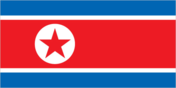
three horizontal bands of blue (top), red (triple width), and blue; the red band is edged in white; on the hoist side of the red band is a white disk with a red five-pointed star; the broad red band symbolizes revolutionary traditions; the narrow white bands stands for purity, strength, and dignity; the blue bands signify sovereignty, peace, and friendship; the red star represents socialism
Government type
Communist state one-man dictatorship
Independence
15 August 1945 (from Japan)
International law organization participation
has not submitted an ICJ jurisdiction declaration; non-party state to the ICCt
International organization participation
ARF, FAO, G-77, ICAO, ICC (NGOs), ICRM, IFAD, IFRCS, IHO, IMO, IOC, IPU, ISO, ITSO, ITU, NAM, UN, UNCTAD, UNESCO, UNIDO, UNWTO, UPU, WFTU (NGOs), WHO, WIPO, WMO
Judicial branch
Central Court (judges are elected by the Supreme People's Assembly)
Legal system
civil law system based on the Prussian model; system influenced by Japanese traditions and Communist legal theory
Legislative branch
- unicameral Supreme People's Assembly or Ch'oego Inmin Hoeui (687 seats; members elected by popular vote to serve five-year terms) last held on 8 March 2009 (next to be held in March 2014) percent of vote by party - NA; seats by party - NA; ruling party approves a list of candidates who are elected without opposition; a token number of seats are reserved for minor parties
- election results
- percent of vote by party - NA; seats by party - NA; ruling party approves a list of candidates who are elected without opposition; a token number of seats are reserved for minor parties
- elections
- last held on 8 March 2009 (next to be held in March 2014)
National anthem
- "Aegukka" (Patriotic Song) PAK Se Yong/KIM Won Gyun adopted 1947; both North Korea and South Korea's anthems share the same name and have a vaguely similar melody but have different lyrics; the North Korean anthem is also known as "Ach'imun pinnara" (Let Morning Shine)
- lyrics/music
- PAK Se Yong/KIM Won Gyun
- name
- "Aegukka" (Patriotic Song)
National holiday
Founding of the Democratic People's Republic of Korea (DPRK), 9 September (1948)
National symbol(s)
red star
Political parties and leaders
major party - Korean Workers' Party or KWP [KIM Jong Un]; minor parties - Chondoist Chongu Party [RYU Mi Yong] (under KWP control), Social Democratic Party [KIM Yong Dae] (under KWP control)
Political pressure groups and leaders
none
Suffrage
17 years of age; universal
Economy
Agriculture - products
rice, corn, potatoes, soybeans, pulses; cattle, pigs, pork, eggs
Budget
- $3.2 billion $3.3 billion (2007 est.)
- expenditures
- $3.3 billion (2007 est.)
- revenues
- $3.2 billion
Budget surplus (+) or deficit (-)
-0.4% of GDP (2007 est.)
Debt - external
$12.5 billion (2001 est.)
Economy - overview
North Korea, one of the world's most centrally directed and least open economies, faces chronic economic problems. Industrial capital stock is nearly beyond repair as a result of years of underinvestment, shortages of spare parts, and poor maintenance. Large-scale military spending draws off resources needed for investment and civilian consumption. Industrial and power output have stagnated for years at a fraction of pre-1990 levels. Frequent weather-related crop failures aggravated chronic food shortages caused by on-going systemic problems, including a lack of arable land, collective farming practices, poor soil quality, insufficient fertilization, and persistent shortages of tractors and fuel. Large-scale international food aid deliveries have allowed the people of North Korea to escape widespread starvation since famine threatened in 1995, but the population continues to suffer from prolonged malnutrition and poor living conditions. Since 2002, the government has allowed private "farmers' markets" to begin selling a wider range of goods. It also permitted some private farming - on an experimental basis - in an effort to boost agricultural output. In December 2009, North Korea carried out a redenomination of its currency, capping the amount of North Korean won that could be exchanged for the new notes, and limiting the exchange to a one-week window. A concurrent crackdown on markets and foreign currency use yielded severe shortages and inflation, forcing Pyongyang to ease the restrictions by February 2010. In response to the sinking of the South Korean destroyer Cheonan and the shelling of Yeonpyeong Island, South Korea's government cut off most aid, trade, and bilateral cooperation activities, with the exception of operations at the Kaesong Industrial Complex. In 2012, KIM Jong Un's first year of leadership, the North displayed increased focus on the economy by renewing its commitment to special economic zones with China, negotiating a new payment structure to settle its $11 billion Soviet-era debt to Russia, and purportedly proposing new agricultural and industrial policies to boost domestic production. The North Korean government often highlights its goal of becoming a "strong and prosperous" nation and attracting foreign investment, a key factor for improving the overall standard of living. Nevertheless, firm political control remains the government's overriding concern, which likely will inhibit fundamental reforms of North Korea's current economic system.
Exchange rates
North Korean won (KPW) per US dollar (market rate) 137 (2012 est.) 140 (2011 est.) 145 (2010 est.) 3,630 (December 2008) 140 (2007)
Exports
$4.707 billion (2011) $4.706 billion (2010 est.)
Exports - commodities
minerals, metallurgical products, manufactures (including armaments), textiles, agricultural and fishery products
Exports - partners
China 67.2%, South Korea 19.4%, India 3.6% (2011 est.)
Fiscal year
calendar year
GDP - composition by sector
- 23.1% 47.5% 29.4% (2011 est.)
- agriculture
- 23.1%
- industry
- 47.5%
- services
- 29.4% (2011 est.)
GDP - per capita (PPP)
$1,800 (2011 est.) $1,800 (2010 est.) $1,900 (2009 est.) data are in 2012 US dollars
GDP - real growth rate
0.8% (2011 est.) -0.5% (2010 est.) -0.9% (2009 est.)
GDP (official exchange rate)
$28 billion (2009 est.)
GDP (purchasing power parity)
$40 billion (2011 est.) $40 billion (2010 est.) $40 billion (2009 est.) data are in 2011 US dollars; North Korea does not publish reliable National Income Accounts data; the data shown here are derived from purchasing power parity (PPP) GDP estimates for North Korea that were made by Angus MADDISON in a study conducted for the OECD; his figure for 1999 was extrapolated to 2011 using estimated real growth rates for North Korea's GDP and an inflation factor based on the US GDP deflator; the results were rounded to the nearest $10 billion.
Household income or consumption by percentage share
- NA% NA%
- highest 10%
- NA%
- lowest 10%
- NA%
Imports
$4 billion (2011 est.) $2.934 billion (2010 est.)
Imports - commodities
petroleum, coking coal, machinery and equipment, textiles, grain
Imports - partners
China 61.6%, South Korea 20%, European Union 4% (2011 est.)
Industrial production growth rate
NA%
Inflation rate (consumer prices)
NA%
Labor force
12.2 million estimates vary widely (2009 est.)
Labor force - by occupation
- 35% 65% (2008 est.)
- agriculture
- 35%
- industry and services
- 65% (2008 est.)
Population below poverty line
NA%
Taxes and other revenues
11.4% of GDP excludes earnings from state-operated enterprises (2007 est.)
Unemployment rate
NA%
Energy
Carbon dioxide emissions from consumption of energy
63.69 million Mt (2010 est.)
Crude oil - exports
0 bbl/day (2009 est.)
Crude oil - imports
8,432 bbl/day (2009 est.)
Crude oil - production
0 bbl/day (2011 est.)
Crude oil - proved reserves
0 bbl (1 January 2012 est.)
Electricity - consumption
17.12 billion kWh (2009 est.)
Electricity - exports
0 kWh (2010 est.)
Electricity - from fossil fuels
47.4% of total installed capacity (2009 est.)
Electricity - from hydroelectric plants
52.6% of total installed capacity (2009 est.)
Electricity - from nuclear fuels
0% of total installed capacity (2009 est.)
Electricity - from other renewable sources
0% of total installed capacity (2009 est.)
Electricity - imports
0 kWh (2010 est.)
Electricity - installed generating capacity
9.5 million kW (2009 est.)
Electricity - production
20.45 billion kWh (2009 est.)
Natural gas - consumption
0 cu m (2010 est.)
Natural gas - exports
0 cu m (2010 est.)
Natural gas - imports
0 cu m (2010 est.)
Natural gas - production
0 cu m (2010 est.)
Natural gas - proved reserves
0 cu m (1 January 2012 est.)
Refined petroleum products - consumption
15,070 bbl/day (2011 est.)
Refined petroleum products - exports
0 bbl/day (2008 est.)
Refined petroleum products - imports
7,967 bbl/day (2008 est.)
Refined petroleum products - production
9,133 bbl/day (2008 est.)
Communications
Broadcast media
no independent media; radios and TVs are pre-tuned to government stations; 4 government-owned TV stations; the Korean Workers' Party owns and operates the Korean Central Broadcasting Station, and the state-run Voice of Korea operates an external broadcast service; the government prohibits listening to and jams foreign broadcasts (2008)
Internet country code
.kp
Internet hosts
8 (2012)
Telephone system
- adequate system; nationwide fiber-optic network; mobile-cellular service expanding beyond Pyongyang fiber-optic links installed down to the county level; telephone directories unavailable; GSM mobile-cellular service initiated in 2002 but suspended in 2004; Orascom Telecom Holding, an Egyptian company, launched W-CDMA mobile service on December 15, 2008 for the Pyongyang area and has expanded service to several large cities country code - 850; satellite earth stations - 2 (1 Intelsat - Indian Ocean, 1 Russian - Indian Ocean region); other international connections through Moscow and Beijing (2009)
- domestic
- fiber-optic links installed down to the county level; telephone directories unavailable; GSM mobile-cellular service initiated in 2002 but suspended in 2004; Orascom Telecom Holding, an Egyptian company, launched W-CDMA mobile service on December 15, 2008 for the Pyongyang area and has expanded service to several large cities
- general assessment
- adequate system; nationwide fiber-optic network; mobile-cellular service expanding beyond Pyongyang
- international
- country code - 850; satellite earth stations - 2 (1 Intelsat - Indian Ocean, 1 Russian - Indian Ocean region); other international connections through Moscow and Beijing (2009)
Telephones - main lines in use
1.18 million (2011)
Telephones - mobile cellular
1 million (2011)
Transportation
Airports
81 (2012)
Airports - with paved runways
- 4 (2012)
- 1,524 to 2,437 m
- 8
- 2,438 to 3,047 m
- 22
- 914 to 1,523 m
- 2
- over 3,047 m
- 3
- total
- 39
- under 914 m
- 4 (2012)
Airports - with unpaved runways
- 8 (2012)
- 1,524 to 2,437 m
- 17
- 2,438 to 3,047 m
- 3
- 914 to 1,523 m
- 14
- total
- 42
- under 914 m
- 8 (2012)
Heliports
23 (2012)
Merchant marine
- bulk carrier 6, cargo 131, carrier 1, chemical tanker 1, container 4, passenger/cargo 1, petroleum tanker 12, refrigerated cargo 2 13 (Belgium 1, China 3, Nigeria 1, Singapore 1, South Korea 1, Syria 4, UAE 2) 6 (Mongolia 1, Sierra Leone 2, unknown 3) (2010)
- foreign-owned
- 13 (Belgium 1, China 3, Nigeria 1, Singapore 1, South Korea 1, Syria 4, UAE 2)
- registered in other countries
- 6 (Mongolia 1, Sierra Leone 2, unknown 3) (2010)
- total
- 158
Pipelines
oil 154 km (2010)
Ports and terminals
Ch'ongjin, Haeju, Hungnam (Hamhung), Namp'o, Senbong, Songnim, Sonbong (formerly Unggi), Wonsan
Railways
- 5,242 km 5,242 km 1.435-m gauge (3,500 km electrified) (2009)
- total
- 5,242 km
Roadways
- 25,554 km 724 km 24,830 km (2006)
- total
- 25,554 km
- unpaved
- 24,830 km (2006)
Waterways
2,250 km (most navigable only by small craft) (2011)
Military and Security
Manpower available for military service
- 6,515,279 6,418,693 (2010 est.)
- females age 16-49
- 6,418,693 (2010 est.)
- males age 16-49
- 6,515,279
Manpower fit for military service
- 4,836,567 5,230,137 (2010 est.)
- females age 16-49
- 5,230,137 (2010 est.)
- males age 16-49
- 4,836,567
Manpower reaching militarily significant age annually
- 207,737 204,553 (2010 est.)
- female
- 204,553 (2010 est.)
- male
- 207,737
Military branches
- North Korean People's Army: Ground Forces, Navy, Air Force; civil security forces (2005)
- North Korean People's Army
- Ground Forces, Navy, Air Force; civil security forces (2005)
Military expenditures
NA
Military service age and obligation
17 years of age (2004)
Transnational Issues
Disputes - international
risking arrest, imprisonment, and deportation, tens of thousands of North Koreans cross into China to escape famine, economic privation, and political oppression; North Korea and China dispute the sovereignty of certain islands in Yalu and Tumen rivers; Military Demarcation Line within the 4-km-wide Demilitarized Zone has separated North from South Korea since 1953; periodic incidents in the Yellow Sea with South Korea which claims the Northern Limiting Line as a maritime boundary; North Korea supports South Korea in rejecting Japan's claim to Liancourt Rocks (Tok-do/Take-shima)
Illicit drugs
for years, from the 1970s into the 2000s, citizens of the Democratic People's Republic of (North) Korea (DPRK), many of them diplomatic employees of the government, were apprehended abroad while trafficking in narcotics, including two in Turkey in December 2004; police investigations in Taiwan and Japan in recent years have linked North Korea to large illicit shipments of heroin and methamphetamine, including an attempt by the North Korean merchant ship Pong Su to deliver 150 kg of heroin to Australia in April 2003
Refugees and internally displaced persons
- undetermined (flooding in mid-2007 and famine during mid-1990s) (2007)
- IDPs
- undetermined (flooding in mid-2007 and famine during mid-1990s) (2007)
Trafficking in persons
- North Korea is a source country for men, women, and children trafficked for the purposes of forced labor and commercial sexual exploitation; the most common form of trafficking involves North Korean women and girls who cross the border into China voluntarily; additionally, North Korean women and girls are lured out of North Korea to escape poor social and economic conditions by the promise of food, jobs, and freedom, only to be forced into prostitution, marriage, or exploitative labor arrangements once in China; within the country, North Koreans do not have a choice in the work the government assigns them and are not free to change jobs at will Tier 3 - North Korea does not fully comply with minimum standards for the elimination of trafficking and is not making significant efforts to do so; the government does not acknowledge the existence of human rights abuses in the country or recognize trafficking, either within the country or transnationally (2008)
- current situation
- North Korea is a source country for men, women, and children trafficked for the purposes of forced labor and commercial sexual exploitation; the most common form of trafficking involves North Korean women and girls who cross the border into China voluntarily; additionally, North Korean women and girls are lured out of North Korea to escape poor social and economic conditions by the promise of food, jobs, and freedom, only to be forced into prostitution, marriage, or exploitative labor arrangements once in China; within the country, North Koreans do not have a choice in the work the government assigns them and are not free to change jobs at will
- tier rating
- Tier 3 - North Korea does not fully comply with minimum standards for the elimination of trafficking and is not making significant efforts to do so; the government does not acknowledge the existence of human rights abuses in the country or recognize trafficking, either within the country or transnationally (2008)