2003 Edition
CIA World Factbook 2003 (Project Gutenberg)
Introduction
Administrative divisions
9 provinces (do, singular and plural) and 4 special cities* (si, singular and plural); Chagang-do (Chagang Province), Hamgyong-bukto (North Hamgyong Province), Hamgyong-namdo (South Hamgyong Province), Hwanghae-bukto (North Hwanghae Province), Hwanghae-namdo (South Hwanghae Province), Kaesong-si* (Kaesong City), Kangwon-do (Kangwon Province), Najin Sonbong-si*, Namp'o-si* (Namp'o City), P'yongan-bukto (North P'yongan Province), P'yongan-namdo (South P'yongan Province), P'yongyang-si* (Pyongyang City), Yanggang-do (Yanggang Province)
Age structure
0-14 years: 25% (male 2,845,727; female 2,763,800) 15-64 years: 67.8% (male 7,485,310; female 7,746,603) 65 years and over: 7.2% (male 541,155; female 1,083,886) (2003 est.)
Agriculture - products
rice, corn, potatoes, soybeans, pulses; cattle, pigs, pork, eggs
Airports
72 (2002)
Airports - with paved runways
- over 3,047 m
- 5 2,438 to 3,047 m: 18 1,524 to 2,437 m: 5 914 to 1,523 m: 3
- total
- 34
- under 914 m
- 3 (2002)
Airports - with unpaved runways
- total
- 38 2,438 to 3,047 m: 2 1,524 to 2,437 m: 18 914 to 1,523 m: 11
- under 914 m
- 7 (2002) Military Korea, North
Area
- land
- 120,410 sq km
- total
- 120,540 sq km
- water
- 130 sq km
Area - comparative
slightly smaller than Mississippi
Background
Following World War II, Korea was split, with the northern half coming under Communist domination and the southern portion becoming Western-oriented. KIM Chong-il has ruled North Korea since his father and the country's founder, president KIM Il-song, died in 1994. After decades of mismanagement, the North relies heavily on international food aid to feed its population while continuing to expend resources to maintain an army of about 1 million. North Korea's long-range missile development and research into nuclear, chemical, and biological weapons and massive conventional armed forces are of major concern to the international community. In December 2002, North Korea repudiated a 1994 agreement that shut down its nuclear reactors and expelled UN monitors, further raising fears it would produce nuclear weapons. Geography Korea, North
Birth rate
17.61 births/1,000 population (2003 est.)
Budget
- expenditures
- $NA, including capital expenditures of $NA
- revenues
- $NA
Capital
Pyongyang
Climate
temperate with rainfall concentrated in summer
Coastline
2,495 km
Constitution
adopted 1948, completely revised 27 December 1972, revised again in April 1992 and September 1998
Country name
- abbreviation
- DPRK
- conventional long form
- Democratic People's Republic of Korea
- conventional short form
- North Korea
- local long form
- Choson-minjujuui-inmin-konghwaguk
- local short form
- none
- note
- the North Koreans generally use the term "Choson" to refer to their country
Currency
North Korean won (KPW)
Currency code
KPW
Death rate
6.93 deaths/1,000 population (2003 est.)
Debt - external
$12 billion (1996 est.)
Diplomatic representation from the US
none (Swedish Embassy in P'yongyang represents the US as consular protecting power)
Diplomatic representation in the US
none; note - North Korea has a Permanent Mission to the UN in New York
Disputes - international
with China, certain islands in Yalu and Tumen rivers are in uncontested dispute; a section of boundary around Paektu-san (mountain) is indefinite; China objects to illegal migration of North Koreans into northern China; Military Demarcation Line within the 4-km wide Demilitarized Zone has separated North from South Korea since 1953 This page was last updated on 18 December, 2003
Economic aid - recipient
$NA; note - nearly $300 million in food aid alone from US, South Korea, Japan, and EU in 2001 plus much additional aid from the UN and non-governmental organizations
Economy - overview
North Korea, one of the world's most centrally planned and isolated economies, faces desperate economic conditions. Industrial capital stock is nearly beyond repair as a result of years of underinvestment and spare parts shortages. Industrial and power output have declined in parallel. The nation has suffered its tenth year of food shortages because of a lack of arable land; collective farming; weather-related problems, including major drought in 2000; and chronic shortages of fertilizer and fuel. Massive international food aid deliveries have allowed the regime to escape mass starvation since 1995-96, but the population remains the victim of prolonged malnutrition and deteriorating living conditions. Large-scale military spending eats up resources needed for investment and civilian consumption. Recently, the regime has placed emphasis on earning hard currency, developing information technology, addressing power shortages, and attracting foreign aid, but in no way at the expense of relinquishing central control over key national assets or undergoing widespread market-oriented reforms. In 2003, heightened political tensions with key donor countries and general donor fatigue have held down the flow of desperately needed food aid and have threatened fuel aid as well.
Electricity - consumption
27.91 billion kWh (2001)
Electricity - exports
0 kWh (2001)
Electricity - imports
0 kWh (2001)
Electricity - production
30.01 billion kWh (2001)
Electricity - production by source
- fossil fuel
- 29%
- hydro
- 71%
- nuclear
- 0%
- other
- 0% (2001)
Elevation extremes
- highest point
- Paektu-san 2,744 m
- lowest point
- Sea of Japan 0 m
Environment - current issues
water pollution; inadequate supplies of potable water; water-borne disease; deforestation; soil erosion and degradation
Environment - international agreements
- party to
- Antarctic Treaty, Biodiversity, Climate Change, Environmental Modification, Ozone Layer Protection, Ship Pollution
- signed, but not ratified
- Antarctic-Environmental Protocol, Law of the Sea
Ethnic groups
racially homogeneous; there is a small Chinese community and a few ethnic Japanese
Exchange rates
- official
- North Korean won per US dollar - 150 (December 2002), 2.15 (December 2001), 2.15 (May 1994), 2.13 (May 1992), 2.14 (September 1991), 2.1 (January 1990); market: North Korean won per US dollar - 300-600 (December 2002), 200 (December 2001)
Executive branch
- cabinet
- Cabinet (Naegak), members, except for the Minister of People's Armed Forces, are appointed by the Supreme People's Assembly
- chief of state
- KIM Chong-il (since NA July 1994); note - on 3 September 2003, KIM Chong-il was reelected Chairman of the National Defense Commission, a position accorded the nation's "highest administrative authority"; KIM Yong-nam was reelected President of the Supreme People's Assembly Presidium and given the responsibility of representing the state and receiving diplomatic credentials
- election results
- HONG Song-nam elected premier; percent of Supreme People's Assembly vote - NA%
- elections
- premier elected by the Supreme People's Assembly; election last held NA September 1998 (next to be held NA)
- head of government
- Premier PAK Pong-chu (since 3 September 2003); Vice Premiers KWAK Pom-ki (since 5 September 1998), CHON Sung-hun (since 3 September 2003), NO Tu-chol (since 3 September 2003)
Exports
$842 million f.o.b. (2001 est.)
Exports - commodities
minerals, metallurgical products, manufactures (including armaments); textiles and fishery products
Exports - partners
China 23.5%, Japan 19.9%, Costa Rica 12.4%, Brazil 6.5% (2002)
Fiscal year
calendar year Communications Korea, North
Flag description
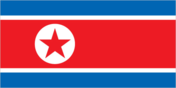
three horizontal bands of blue (top), red (triple width), and blue; the red band is edged in white; on the hoist side of the red band is a white disk with a red five-pointed star Economy Korea, North
GDP
purchasing power parity - $22.26 billion (2002 est.)
GDP - composition by sector
- agriculture
- 30.4%
- industry
- 32.3%
- services
- 37.3% (2000 est.)
GDP - per capita
purchasing power parity - $1,000 (2002 est.)
GDP - real growth rate
1% (2002 est.)
Geographic coordinates
40 00 N, 127 00 E
Geography - note
strategic location bordering China, South Korea, and Russia; mountainous interior is isolated and sparsely populated People Korea, North
Government type
authoritarian socialist; one-man dictatorship
Highways
- paved
- 1,997 km
- total
- 31,200 km
- unpaved
- 29,203 km (1999 est.)
HIV/AIDS - adult prevalence rate
NA
HIV/AIDS - deaths
NA
HIV/AIDS - people living with HIV/AIDS
NA
Household income or consumption by percentage share
- highest 10%
- NA%
- lowest 10%
- NA%
Imports
$1.314 billion c.i.f. (2001 est.)
Imports - commodities
petroleum, coking coal, machinery and equipment; textiles, grain
Imports - partners
China 24.9%, Brazil 12.1%, India 9.2%, Thailand 9.2%, Germany 7.8%, Japan 7.1%, Singapore 4.5%, Qatar 4% (2002)
Independence
15 August 1945 (from Japan)
Industrial production growth rate
NA%
Industries
military products; machine building, electric power, chemicals; mining (coal, iron ore, magnesite, graphite, copper, zinc, lead, and precious metals), metallurgy; textiles, food processing; tourism
Infant mortality rate
- female
- 23.79 deaths/1,000 live births (2003 est.)
- male
- 27.45 deaths/1,000 live births
- total
- 25.66 deaths/1,000 live births
Inflation rate (consumer prices)
NA%
International organization participation
ARF (dialogue partner), ESCAP, FAO, G-77, ICAO, ICRM, IFAD, IFRCS, IHO, IMO, IOC, ISO, ITU, NAM, UN, UNCTAD, UNESCO, UNIDO, UPU, WFTU, WHO, WIPO, WMO, WToO
Internet country code
.kp
Internet Service Providers (ISPs)
1 (2000)
Internet users
NA Transportation Korea, North
Irrigated land
14,600 sq km (1998 est.)
Judicial branch
Central Court (judges are elected by the Supreme People's Assembly)
Labor force
9.6 million
Labor force - by occupation
agricultural 36%, nonagricultural 64%
Land boundaries
- border countries
- China 1,416 km, South Korea 238 km, Russia 19 km
- total
- 1,673 km
Land use
- arable land
- 14.12%
- other
- 83.39% (1998 est.)
- permanent crops
- 2.49%
Languages
Korean
Legal system
based on German civil law system with Japanese influences and Communist legal theory; no judicial review of legislative acts; has not accepted compulsory ICJ jurisdiction
Legislative branch
- unicameral Supreme People's Assembly or Ch'oego Inmin Hoeui (687 seats; members elected by popular vote to serve five-year terms)
- election results
- percent of vote by party - NA; seats by party - NA; the KWP approves a list of candidates who are elected without opposition; some seats are held by minor parties
- elections
- last held 3 August 2003 (next to be held in August 2008)
Life expectancy at birth
- female
- 73.61 years (2003 est.)
- male
- 68.1 years
- total population
- 70.79 years
Literacy
- definition
- age 15 and over can read and write Korean
- female
- 99% Government Korea, North
- male
- 99%
- total population
- 99%
Location
Eastern Asia, northern half of the Korean Peninsula bordering the Korea Bay and the Sea of Japan, between China and South Korea
Map references
Asia
Maritime claims
- exclusive economic zone
- 200 NM
- note
- military boundary line 50 NM in the Sea of Japan and the exclusive economic zone limit in the Yellow Sea where all foreign vessels and aircraft without permission are banned
- territorial sea
- 12 NM
Median age
- female
- 32.3 years (2002)
- male
- 30 years
- total
- 31.1 years
Merchant marine
- convenience
- Denmark 1, Greece 2, Pakistan 1, Singapore 1 (2002 est.)
- note
- includes some foreign-owned ships registered here as a flag of
- ships by type
- bulk 8, cargo 120, combination bulk 2, container 1, multi-functional large-load carrier 1, passenger 2, passenger/cargo 1, petroleum tanker 8, refrigerated cargo 4, short-sea passenger 2
- total
- 149 ships (1,000 GRT or over) 881,276 GRT/1,309,547 DWT
Military branches
Korean People's Army (includes Army, Navy, Air Force), Civil Security Forces
Military expenditures - dollar figure
$5,217.4 million (FY02)
Military expenditures - percent of GDP
33.9% (FY02) Transnational Issues Korea, North
Military manpower - availability
- males age 15-49
- 6,103,615 (2003 est.)
Military manpower - fit for military service
- males age 15-49
- 3,654,223 (2003 est.)
Military manpower - military age
18 years of age (2003 est.)
Military manpower - reaching military age annually
- males
- 180,875 (2003 est.)
National holiday
Founding of the Democratic People's Republic of Korea (DPRK), 9 September (1948)
Nationality
- adjective
- Korean
- noun
- Korean(s)
Natural hazards
late spring droughts often followed by severe flooding; occasional typhoons during the early fall
Natural resources
coal, lead, tungsten, zinc, graphite, magnesite, iron ore, copper, gold, pyrites, salt, fluorspar, hydropower
Net migration rate
0 migrant(s)/1,000 population (2003 est.)
Oil - consumption
85,000 bbl/day (2001 est.)
Oil - exports
NA (2001)
Oil - imports
NA (2001)
Oil - production
0 bbl/day (2001 est.)
Pipelines
oil 136 km (2003)
Political parties and leaders
Chondoist Chongu Party [YU Mi-yong, chairwoman]; Social Democratic Party [KIM Yong-tae, chairman]; major party - Korean Workers' Party or KWP [KIM Chong-il, general secretary]
Political pressure groups and leaders
NA
Population
22,466,481 (July 2003 est.)
Population below poverty line
NA%
Population growth rate
1.07% (2003 est.)
Ports and harbors
Ch'ongjin, Haeju, Hungnam (Hamhung), Kimch'aek, Kosong, Najin, Namp'o, Sinuiju, Songnim, Sonbong (formerly Unggi), Ungsang, Wonsan
Radio broadcast stations
AM 16, FM 14, shortwave 12 (1999)
Radios
3.36 million (1997)
Railways
- narrow gauge
- 665 km 0.762-m gauge (2002)
- standard gauge
- 4,549 km 1.435-m gauge (3,500 km electrified)
- total
- 5,214 km
Religions
- traditionally Buddhist and Confucianist, some Christian and syncretic Chondogyo (Religion of the Heavenly Way)
- note
- autonomous religious activities now almost nonexistent; government-sponsored religious groups exist to provide illusion of religious freedom
Sex ratio
- at birth
- 1.05 male(s)/female
- total population
- 0.94 male(s)/female (2003 est.)
- under 15 years
- 1.03 male(s)/female 15-64 years: 0.97 male(s)/female 65 years and over: 0.5 male(s)/female
Suffrage
17 years of age; universal
Telephone system
- domestic
- NA
- general assessment
- NA
- international
- satellite earth stations - 1 Intelsat (Indian Ocean) and 1 Russian (Indian Ocean region); other international connections through Moscow and Beijing
Telephones - main lines in use
1.1 million (1997)
Telephones - mobile cellular
NA
Television broadcast stations
38 (1999)
Televisions
1.2 million (1997)
Terrain
mostly hills and mountains separated by deep, narrow valleys; coastal plains wide in west, discontinuous in east
Total fertility rate
2.25 children born/woman (2003 est.)
Unemployment rate
NA%
Waterways
- 2,253 km
- note
- mostly navigable by small craft only