1990 Edition
CIA World Factbook 1990 (Project Gutenberg)
Geography
Climate
temperate with rainfall concentrated in summer
Coastline
2,495 km
Comparative area
slightly smaller than Mississippi
Disputes
short section of boundary with China is indefinite; Demarcation Line with South Korea
Environment
mountainous interior is isolated, nearly inaccessible, and sparsely populated; late spring droughts often followed by severe flooding
Extended economic zone
200 nm;
Land boundaries
1,671 km total; China 1,416 km, South Korea 238 km, USSR 17 km
Land use
18% arable land; 1% permanent crops; NEGL% meadows and pastures; 74% forest and woodland; 7% other; includes 9% irrigated
Military boundary line
50 nm (all foreign vessels and aircraft without permission are banned)
Natural resources
coal, lead, tungsten, zinc, graphite, magnesite, iron ore, copper, gold, pyrites, salt, fluorspar, hydropower
Note
strategic location bordering China, South Korea, and USSR
Terrain
mostly hills and mountains separated by deep, narrow valleys; coastal plains wide in west, discontinuous in east
Territorial sea
12 nm;
Total area
120,540 km2; land area: 120,410 km2
People and Society
Birth rate
22 births/1,000 population (1990)
Death rate
5 deaths/1,000 population (1990)
Ethnic divisions
racially homogeneous
Infant mortality rate
27 deaths/1,000 live births (1990)
Labor force
9,615,000; 36% agricultural, 64% nonagricultural; shortage of skilled and unskilled labor (mid-1987 est.)
Language
Korean
Life expectancy at birth
69 years male, 75 years female (1990)
Literacy
95% (est.)
Nationality
noun--Korean(s); adjective--Korean
Net migration rate
0 migrants/1,000 population (1990)
Organized labor
1,600,000 members; single-trade union system coordinated by the General Federation of Trade Unions of Korea under the Central Committee
Population
21,292,649 (July 1990), growth rate 1.7% (1990)
Religion
Buddhism and Confucianism; religious activities now almost nonexistent
Total fertility rate
2.1 children born/woman (1990)
Government
Administrative divisions
9 provinces (do, singular and plural) and 3 special cities* (jikhalsi, singular and plural); Chagang-do, Hamgyong-namdo, Hamgyong-bukto, Hwanghae-namdo, Hwanghae-bukto, Kaesong-si*, Kangwon-do, Namp'o-si*, P'yongan-bukto, P'yongan-namdo, P'yongyang-si*, Yanggang-do
Capital
P'yongyang
Communists
KWP claims membership of about 2 million, or about one-tenth of population
Constitution
adopted 1948, revised 27 December 1972
Diplomatic representation
none
Elections
President--last held 29 December 1986 (next to be held December 1990); results--President Kim Il Song was reelected without opposition; Supreme People's Assembly--last held on 2 November 1986 (next to be held November 1990, but the constitutional provision for elections every four years is not always followed); results--KWP is the only party; seats--(655 total) KWP 655; the KWP approves a single list of candidates who are elected without opposition
Executive branch
president, two vice presidents, premier, nine vice premiers, State Administration Council (cabinet)
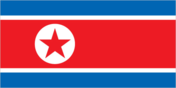
Flag
three horizontal bands of blue (top), red (triple width), and blue; the red band is edged in white; on the hoist side of the red band is a white disk with a red five-pointed star
Independence
9 September 1948
Judicial branch
Central Court
Leaders
Chief of State--President KIM Il-song (since 28 December 1972); Designated Successor KIM Chong-Il (son of President, born 16 February 1942); Head of Government--Premier YON Hyong-muk (since NA December 1988)
Legal system
based on German civil law system with Japanese influences and Communist legal theory; no judicial review of legislative acts; has not accepted compulsory ICJ jurisdiction
Legislative branch
unicameral Supreme People's Assembly (Choe Ko In Min Hoe Ui)
Long-form name
Democratic People's Republic of Korea; abbreviated DPRK
Member of
ESCAP, FAO, G-77, IAEA, ICAO, IMO, IPU, ITU, NAM, UNCTAD, UNESCO, UPU, WFTU, WHO, WIPO, WTO, UNIDO, WMO; official observer status at UN
National holiday
Independence Day, 9 September (1948)
Political parties and leaders
only party--Korean Workers' Party (KWP); Kim Il-song, General Secretary, and his son, Kim Chong-Il, Secretary, Central Committee
Suffrage
universal at age 17
Type
Communist state; one-man rule
Economy
Agriculture
accounts for about 25% of GNP and 36% of work force; principal crops--rice, corn, potatoes, soybeans, pulses; livestock and livestock products--cattle, hogs, pork, eggs; not self-sufficient in grain; fish catch estimated at 1.7 million metric tons in 1987
Aid
Communist countries (1970-88), $1.3 billion
Budget
revenues $15.6 billion; expenditures $15.6 billion, including capital expenditures of $NA (1989)
Currency
North Korean won (plural--won); 1 North Korean won (Wn) = 100 chon
Electricity
6,440,000 kW capacity; 40,250 million kWh produced, 1,740 kWh per capita (1989)
Exchange rates
North Korean won (Wn) per US$1--2.3 (December 1989), 2.13 (December 1988), 0.94 (March 1987), NA (1986), NA (1985)
Exports
$2.4 billion (f.o.b., 1988); commodities--minerals, metallurgical products, agricultural products, manufactures; partners--USSR, China, Japan, FRG, Hong Kong, Singapore
External debt
$2.5 billion hard currency (1989)
Fiscal year
calendar year
GNP
$28 billion, per capita $1,240; real growth rate 3% (1989)
Imports
$3.1 billion (f.o.b., 1988); commodities--petroleum, machinery and equipment, coking coal, grain; partners--USSR, Japan, China, FRG, Hong Kong, Singapore
Industrial production
growth rate NA%
Industries
machine building, military products, electric power, chemicals, mining, metallurgy, textiles, food processing
Inflation rate (consumer prices)
NA%
Overview
More than 90% of this command economy is socialized; agricultural land is collectivized; and state-owned industry produces 95% of manufactured goods. State control of economic affairs is unusually tight even for a Communist country because of the small size and homogeneity of the society and the strict one-man rule of Kim. Economic growth during the period 1984-89 has averaged approximately 3%. Abundant natural resources and hydropower form the basis of industrial development. Output of the extractive industries includes coal, iron ore, magnesite, graphite, copper, zinc, lead, and precious metals. Manufacturing emphasis is centered on heavy industry, with light industry lagging far behind. The use of high-yielding seed varieties, expansion of irrigation, and the heavy use of fertilizers have enabled North Korea to become largely self-sufficient in food production. North Korea, however, is far behind South Korea in economic development and living standards.
Unemployment rate
officially none
Communications
Airports
50 total, 50 usable; about 30 with permanent-surface runways; fewer than 5 with runways over 3,659 m; 20 with runways 2,440-3,659 m; 30 with runways 1,220-2,439 m
Highways
about 20,280 km (1980); 98.5% gravel, crushed stone, or earth surface; 1.5% concrete or bituminous
Inland waterways
2,253 km; mostly navigable by small craft only
Merchant marine
65 ships (1,000 GRT and over) totaling 437,103 GRT/663,835 DWT; includes 1 passenger, 1 short-sea passenger, 1 passenger-cargo, 56 cargo, 2 petroleum, oils, and lubricants (POL) tanker, 3 bulk, 1 combination bulk
Pipelines
crude oil, 37 km
Ports
Ch'ongjin, Haeju, Hungnam, Namp'o, Wonsan, Songnim, Najin
Railroads
4,535 km total operating in 1980; 3,870 km 1.435-meter standard gauge, 665 km 0.762-meter narrow gauge, 159 km double track; 3,175 km electrified; government owned
Telecommunications
stations--18 AM, no FM, 11 TV; 200,000 TV sets; 3,500,000 radio receivers; 1 Indian Ocean INTELSAT earth station
Military and Security
Branches
Ministry of People's Armed Forces (consists of the army, navy, and air force)
Defense expenditures
22% of GNP (1987)
Military manpower
males 15-49, 6,054,774; 3,699,088 fit for military service; 223,087 reach military age (18) annually