2020 Edition
factbook.json (GitHub)
Introduction
Background
Polynesians lived on Norfolk Island between 1200 and 1500, but the remote island was uninhabited by the time British explorer James COOK landed on the island in 1774. Two British attempts at establishing the island as a penal colony (1788-1814 and 1825-55) were ultimately abandoned. In 1856, almost 200 Pitcairn Islanders -- descendants of the Bounty mutineers and their Tahitian companions -- were relocated to Norfolk Island because of overcrowding on the Pitcairn Islands. Some returned to the Pitcairn Islands over the next few years, but most settled permanently on Norfolk Island and recreated their previous land tenure and governance structures. Norfolk Island retained a great degree of local control until 1897, when it became a dependency of New South Wales. During World War II, Norfolk Island was an airbase and an important refueling stop in the South Pacific. In 1976, an Australian judge recommended Norfolk Island be incorporated fully into Australia, which Norfolk Islanders rejected. After an appeal to the UN, Australia granted limited self-government to Norfolk Island in 1979. With growing financial troubles during the 2000s, Australia abolished the Norfolk Island Legislative Assembly in 2015, reduced Norfolk Island’s autonomy in 2016, and suspended the local council in 2020. Most services are provided by a mix of the Australian Capital Territory and the states of New South Wales and Queensland. These moves were unpopular on Norfolk Island, which has sought to have its self-government restored and as of 2024, the Australian Government was working with Norfolk Island to establish a new local governing body.
Geography
Area
- land
- 36 sq km
- total
- 36 sq km
- water
- 0 sq km
Area - comparative
about 0.2 times the size of Washington, D.C.
Climate
subtropical; mild, little seasonal temperature variation
Coastline
32 km
Elevation
- highest point
- Mount Bates 319 m
- lowest point
- Pacific Ocean 0 m
Geographic coordinates
29 02 S, 167 57 E
Geography - note
most of the 32-km (20-mi) coastline consists of almost inaccessible cliffs, but the land slopes down to the sea in one small southern area on Sydney Bay, where the capital of Kingston is located
Irrigated land
0 sq km (2022)
Land boundaries
- total
- 0 km
Land use
- agricultural land
- 25% (2023 est.)
- agricultural land: arable land
- arable land: 0% (2022 est.)
- agricultural land: permanent crops
- permanent crops: 0% (2022 est.)
- agricultural land: permanent pasture
- permanent pasture: 25% (2023 est.)
- forest
- 12.2% (2023 est.)
- other
- 62.8% (2023 est.)
Location
Oceania, island in the South Pacific Ocean, east of Australia
Map references
Oceania
Maritime claims
- contiguous zone
- 24 nm
- exclusive fishing zone
- 200 nm
- territorial sea
- 12 nm
Natural hazards
tropical cyclones (especially May to July)
Natural resources
fish
Population distribution
population concentrated around the capital of Kingston
Terrain
volcanic island with mostly rolling plains
People and Society
Ethnic groups
Australian 22.8%, English 22.4%, Pitcairn Islander 20%, Scottish 6%, Irish 5.2% (2011 est.)
Languages
English (official) 44.9%, Norfolk (official, a mixture of 18th century English and ancient Tahitian) 40.3%, Fijian 1.8%, other 6.8%, unspecified 6.2% (2016 est.)
Nationality
- adjective
- Norfolk Islander(s)
- noun
- Norfolk Islander(s)
Population
- female
- 916
- male
- 823
- total
- 1,739 (2021)
Population growth rate
0.01% (2014 est.)
Religions
Protestant 46.8% (Anglican 29.2%, Uniting Church in Australia 9.8%, Presbyterian 2.9%, Seventh Day Adventist 2.7%, other 2.2%), Roman Catholic 12.6%, other Christian 2.9%, other 1.4%, none 26.7%, unspecified 9.5% (2016 est.)
Government
Capital
- daylight saving time
- +1hr, begins first Sunday in October; ends first Sunday in April
- etymology
- the name blends the words "king's" and "town;" the English king at the time of the town's settlement in the late 18th century was GEORGE III
- geographic coordinates
- 29 03 S, 167 58 E
- name
- Kingston
- time difference
- UTC+11 (16 hours ahead of Washington, DC, during Standard Time)
Citizenship
see Australia
Constitution
- history
- previous 1913, 1957; latest effective 7 August 1979
Country name
- conventional long form
- Territory of Norfolk Island
- conventional short form
- Norfolk Island
- etymology
- named by British explorer Captain James COOK after Edward HOWARD, the ninth Duke of Norfolk, in 1774
Dependency status
administered as a territory of Australia; administered by the Australian Government through the Department of Infrastructure, Transport, Cities, & Regional Development
Diplomatic representation from the US
- embassy
- none (territory of Australia)
Diplomatic representation in the US
none (territory of Australia)
Executive branch
- chief of state
- King CHARLES III (since 8 September 2022); represented by Governor General of the Commonwealth of Australia General Sam MOSTYN (since 1 July 2024)
- election/appointment process
- the monarchy is hereditary; governor general appointed by the monarch; administrator appointed by the governor general of Australia for a 2-year term and represents the monarch and Australia
- head of government
- Administrator George PLANT (since 1 June 2023)
Flag
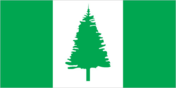
description: three vertical bands of green (left side), white, and green, with a large green Norfolk Island pine tree centered on the white band meaning: green stands for the island's rich vegetation, and the native pine tree is an island symbol
Government type
administered as an overseas territory of Australia
Independence
none (territory of Australia)
International organization participation
UPU
Judicial branch
- highest court(s)
- Supreme Court of Norfolk Island (consists of the chief justice and several justices)
- judge selection and term of office
- justices appointed by the governor general of Australia from among justices of the Federal Court of Australia; justices serve until mandatory retirement at age 70
- subordinate courts
- Petty Court of Sessions; specialized courts, including a Coroner's Court and the Employment Tribunal
Legal system
English common law and the laws of Australia
Legislative branch
- electoral system
- plurality/majority
- expected date of next election
- March 2021 (postponed)
- legislative structure
- unicameral
- legislature name
- Norfolk Island Regional Council
- most recent election date
- 5/28/2016
- number of seats
- 5 (directly elected)
- parties elected and seats per party
- independent (5)
- percentage of women in chamber
- 20%
- scope of elections
- full renewal
- term in office
- 4 years
National anthem(s)
- history
- royal anthem, as an Australian overseas territory
- lyrics/music
- unknown
- title
- "God Save the King"
National coat of arms
Norfolk Island is part of the Commonwealth of Australia, and in 1980, Queen Elizabeth II granted it a separate coat of arms (pictured); in the center is the island’s symbol, the Norfolk Island Pine, with Britain’s lion and Australia’s kangaroo supporting the shield; the island’s motto, “Inasmuch,” comes from a verse in the Bible’s Gospel of Matthew
National holiday
Bounty Day (commemorates the arrival of Pitcairn Islanders), 8 June (1856)
National symbol(s)
Norfolk Island pine
Political parties
Norfolk Island Labor Party Norfolk Liberals
Suffrage
18 years of age; universal
Economy
Agricultural products
Norfolk Island pine seed, Kentia palm seed, cereals, vegetables, fruit; cattle, poultry
Economic overview
high-income Australian territorial economy; key tourism and re-exportation industries; small labor force and declining participation creating more part-time jobs; former tax haven; increasing medical cannabis exporter; little transportation infrastructure
Exchange rates
- Currency
- Australian dollars (AUD) per US dollar -
- Exchange rates 2020
- 1.453 (2020 est.)
- Exchange rates 2021
- 1.331 (2021 est.)
- Exchange rates 2022
- 1.442 (2022 est.)
- Exchange rates 2023
- 1.505 (2023 est.)
- Exchange rates 2024
- 1.515 (2024 est.)
Exports - commodities
pine seeds, lumber, cars and vehicle parts, soybeans, lactose syrup (2021)
Exports - partners
USA 31%, Belgium 9%, Philippines 7%, Israel 6%, Singapore 6% (2023)
Imports - commodities
refined petroleum, plastics, electrical lighting/signalling equipment, cars, machinery (2023)
Imports - partners
Australia 52%, Fiji 13%, NZ 12%, Saudi Arabia 12%, Malaysia 5% (2023)
Industries
tourism, light industry, ready mixed concrete
Communications
Broadcast media
1 local radio station; broadcasts of several Australian radio and TV stations available via satellite (2009)
Internet country code
.nf
Internet users
- percent of population
- 46.1% (2021 est.)
Transportation
Airports
1 (2025)
Ports
- key ports
- Kingston
- large
- 0
- medium
- 0
- ports with oil terminals
- 1
- small
- 0
- total ports
- 1 (2024)
- very small
- 1
Military and Security
Military - note
defense is the responsibility of Australia
Environment
Environmental issues
inadequate solid-waste management; most freshwater obtained through rainwater catchment; preservation of unique ecosystem