2013 Edition
CIA World Factbook 2013 Archive (HTML)
Introduction
Background
The Pacific coast of Nicaragua was settled as a Spanish colony from Panama in the early 16th century. Independence from Spain was declared in 1821 and the country became an independent republic in 1838. Britain occupied the Caribbean Coast in the first half of the 19th century, but gradually ceded control of the region in subsequent decades. Violent opposition to governmental manipulation and corruption spread to all classes by 1978 and resulted in a short-lived civil war that brought the Marxist Sandinista guerrillas to power in 1979. Nicaraguan aid to leftist rebels in El Salvador caused the US to sponsor anti-Sandinista contra guerrillas through much of the 1980s. After losing free and fair elections in 1990, 1996, and 2001, former Sandinista President Daniel ORTEGA Saavedra was elected president in 2006 and reelected in 2011. The 2008 municipal elections, 2010 regional elections, November 2011 presidential elections, and 2012 municipal elections were marred by widespread irregularities. Nicaragua's infrastructure and economy - hard hit by the earlier civil war and by Hurricane Mitch in 1998 - are slowly being rebuilt, but democratic institutions have been weakened under the ORTEGA administration.
Geography
Area
- 130,370 sq km 119,990 sq km 10,380 sq km
- total
- 130,370 sq km
- water
- 10,380 sq km
Area - comparative
slightly smaller than New York state
Climate
tropical in lowlands, cooler in highlands
Coastline
910 km
Elevation extremes
- Pacific Ocean 0 m Mogoton 2,438 m
- highest point
- Mogoton 2,438 m
- lowest point
- Pacific Ocean 0 m
Environment - current issues
deforestation; soil erosion; water pollution
Environment - international agreements
- Biodiversity, Climate Change, Climate Change-Kyoto Protocol, Desertification, Endangered Species, Environmental Modification, Hazardous Wastes, Law of the Sea, Ozone Layer Protection, Ship Pollution, Wetlands, Whaling none of the selected agreements
- party to
- Biodiversity, Climate Change, Climate Change-Kyoto Protocol, Desertification, Endangered Species, Environmental Modification, Hazardous Wastes, Law of the Sea, Ozone Layer Protection, Ship Pollution, Wetlands, Whaling
- signed, but not ratified
- none of the selected agreements
Freshwater withdrawal (domestic/industrial/agricultural)
- 1.39 cu km/yr (23%/4%/73%) 265.9 cu m/yr (2008)
- per capita
- 265.9 cu m/yr (2008)
- total
- 1.39 cu km/yr (23%/4%/73%)
Geographic coordinates
13 00 N, 85 00 W
Geography - note
largest country in Central America; contains the largest freshwater body in Central America, Lago de Nicaragua
Irrigated land
942.4 sq km (2003)
Land boundaries
- 1,231 km Costa Rica 309 km, Honduras 922 km
- border countries
- Costa Rica 309 km, Honduras 922 km
- total
- 1,231 km
Land use
- 14.57% 1.76% 83.66% (2011)
- arable land
- 14.57%
- other
- 83.66% (2011)
- permanent crops
- 1.76%
Location
Central America, bordering both the Caribbean Sea and the North Pacific Ocean, between Costa Rica and Honduras
Map references
Central America and the Caribbean
Maritime claims
- 12 nm 24 nm natural prolongation
- contiguous zone
- 24 nm
- continental shelf
- natural prolongation
- territorial sea
- 12 nm
Natural hazards
- destructive earthquakes; volcanoes; landslides; extremely susceptible to hurricanes significant volcanic activity; Cerro Negro (elev. 728 m), which last erupted in 1999, is one of Nicaragua's most active volcanoes; its lava flows and ash have been known to cause significant damage to farmland and buildings; other historically active volcanoes include Concepcion, Cosiguina, Las Pilas, Masaya, Momotombo, San Cristobal, and Telica
- volcanism
- significant volcanic activity; Cerro Negro (elev. 728 m), which last erupted in 1999, is one of Nicaragua's most active volcanoes; its lava flows and ash have been known to cause significant damage to farmland and buildings; other historically active volcanoes include Concepcion, Cosiguina, Las Pilas, Masaya, Momotombo, San Cristobal, and Telica
Natural resources
gold, silver, copper, tungsten, lead, zinc, timber, fish
Terrain
extensive Atlantic coastal plains rising to central interior mountains; narrow Pacific coastal plain interrupted by volcanoes
Total renewable water resources
196.6 cu km (2011)
People and Society
Age structure
- 30% (male 886,490/female 852,690) 22.5% (male 653,868/female 651,076) 37.4% (male 1,024,395/female 1,143,011) 5.2% (male 141,026/female 162,159) 4.7% (male 123,878/female 149,938) (2013 est.)
- 0-14 years
- 30% (male 886,490/female 852,690)
- 15-24 years
- 22.5% (male 653,868/female 651,076)
- 25-54 years
- 37.4% (male 1,024,395/female 1,143,011)
- 55-64 years
- 5.2% (male 141,026/female 162,159)
- 65 years and over
- 4.7% (male 123,878/female 149,938) (2013 est.)
Birth rate
18.77 births/1,000 population (2013 est.)
Child labor - children ages 5-14
- 223,992 14 % data represents children ages 5-17 (2005 est.)
- percentage
- 14 %
- total number
- 223,992
Children under the age of 5 years underweight
5.7% (2007)
Contraceptive prevalence rate
72.4% (2006/07)
Death rate
5.06 deaths/1,000 population (2013 est.)
Demographic profile
Despite being one of the poorest countries in Latin America, Nicaragua has improved its access to potable water and sanitation and has ameliorated its life expectancy, infant and child mortality, and immunization rates. However, income distribution is very uneven, and the poor, agriculturalists, and indigenous people continue to have less access to healthcare services. Nicaragua's total fertility rate has fallen from around 6 children per woman in 1980 to just above replacement level today, but the high birth rate among adolescents perpetuates a cycle of poverty and low educational attainment. Nicaraguans emigrate primarily to Costa Rica and to a lesser extent the United States. Nicaraguan men have been migrating seasonally to Costa Rica to harvest bananas and coffee since the early 20th century. Political turmoil, civil war, and natural disasters from the 1970s through the 1990s dramatically increased the flow of refugees and permanent migrants seeking jobs, higher wages, and better social and healthcare benefits. Since 2000, Nicaraguan emigration to Costa Rica has slowed and stabilized. Today roughly 300,000 Nicaraguans are permanent residents of Costa Rica - about 75% of the foreign population - and thousands more migrate seasonally for work, many illegally.
Dependency ratios
- 59.9 % 52.5 % 7.4 % 13.5 (2013)
- elderly dependency ratio
- 7.4 %
- potential support ratio
- 13.5 (2013)
- total dependency ratio
- 59.9 %
- youth dependency ratio
- 52.5 %
Drinking water source
- urban: 98% of population rural: 68% of population total: 85% of population urban: 2% of population rural: 32% of population total: 15% of population (2010 est.)
- rural
- 32% of population
- total
- 15% of population (2010 est.)
- urban
- 2% of population
Education expenditures
4.7% of GDP (2010)
Ethnic groups
mestizo (mixed Amerindian and white) 69%, white 17%, black 9%, Amerindian 5%
Health expenditures
10.1% of GDP (2009)
HIV/AIDS - adult prevalence rate
0.2% (2009 est.)
HIV/AIDS - deaths
fewer than 500 (2009 est.)
HIV/AIDS - people living with HIV/AIDS
6,900 (2009 est.)
Hospital bed density
1.1 beds/1,000 population (2011)
Infant mortality rate
- 21.09 deaths/1,000 live births 24.19 deaths/1,000 live births 17.84 deaths/1,000 live births (2013 est.)
- female
- 17.84 deaths/1,000 live births (2013 est.)
- total
- 21.09 deaths/1,000 live births
Languages
Spanish (official) 97.5%, Miskito 1.7%, other 0.8% (1995 census) English and indigenous languages found on the Atlantic coast
Life expectancy at birth
- 72.45 years 70.32 years 74.68 years (2013 est.)
- female
- 74.68 years (2013 est.)
- total population
- 72.45 years
Literacy
- age 15 and over can read and write 78% 78.1% 77.9% (2005 est.)
- definition
- age 15 and over can read and write
- female
- 77.9% (2005 est.)
- male
- 78.1%
- total population
- 78%
Major infectious diseases
- high bacterial diarrhea, hepatitis A, and typhoid fever dengue fever and malaria (2013)
- degree of risk
- high
- food or waterborne diseases
- bacterial diarrhea, hepatitis A, and typhoid fever
- vectorborne disease
- dengue fever and malaria (2013)
Major urban areas - population
MANAGUA (capital) 934,000 (2009)
Maternal mortality rate
95 deaths/100,000 live births (2010)
Median age
- 23.7 years 22.8 years 24.6 years (2013 est.)
- female
- 24.6 years (2013 est.)
- male
- 22.8 years
- total
- 23.7 years
Mother's mean age at first birth
19.7 Median age at first birth among women 25-29 (2007 est.)
Nationality
- Nicaraguan(s) Nicaraguan
- adjective
- Nicaraguan
- noun
- Nicaraguan(s)
Net migration rate
-3.26 migrant(s)/1,000 population (2013 est.)
Obesity - adult prevalence rate
22.2% (2008)
Physicians density
0.37 physicians/1,000 population (2003)
Population
5,788,531 (July 2013 est.)
Population growth rate
1.05% (2013 est.)
Religions
Roman Catholic 58.5%, Protestant 23.2% (Evangelical 21.6%, Moravian 1.6%), Jehovah's Witnesses 0.9%, other 1.7%, none 15.7% (2005 census)
Sanitation facility access
- urban: 63% of population rural: 37% of population total: 52% of population urban: 37% of population rural: 63% of population total: 48% of population (2010 est.)
- rural
- 63% of population
- total
- 48% of population (2010 est.)
- urban
- 37% of population
School life expectancy (primary to tertiary education)
- 11 years 11 years 11 years (2003)
- female
- 11 years (2003)
- male
- 11 years
- total
- 11 years
Sex ratio
- 1.05 male(s)/female 1.04 male(s)/female 1 male(s)/female 0.9 male(s)/female 0.87 male(s)/female 0.83 male(s)/female 0.96 male(s)/female (2013 est.)
- 0-14 years
- 1.04 male(s)/female
- 15-24 years
- 1 male(s)/female
- 25-54 years
- 0.9 male(s)/female
- 55-64 years
- 0.87 male(s)/female
- 65 years and over
- 0.83 male(s)/female
- at birth
- 1.05 male(s)/female
- total population
- 0.96 male(s)/female (2013 est.)
Total fertility rate
2.03 children born/woman (2013 est.)
Unemployment, youth ages 15-24
- 8.6% 8.1% 9.7% (2006)
- female
- 9.7% (2006)
- total
- 8.6%
Urbanization
- 57% of total population (2010) 2% annual rate of change (2010-15 est.)
- rate of urbanization
- 2% annual rate of change (2010-15 est.)
- urban population
- 57% of total population (2010)
Government
Administrative divisions
15 departments (departamentos, singular - departamento) and 2 autonomous regions* (regiones autonomistas, singular - region autonoma); Atlantico Norte*, Atlantico Sur*, Boaco, Carazo, Chinandega, Chontales, Esteli, Granada, Jinotega, Leon, Madriz, Managua, Masaya, Matagalpa, Nueva Segovia, Rio San Juan, Rivas
Capital
- Managua 12 08 N, 86 15 W UTC-6 (1 hour behind Washington, DC during Standard Time)
- geographic coordinates
- 12 08 N, 86 15 W
- name
- Managua
- time difference
- UTC-6 (1 hour behind Washington, DC during Standard Time)
Constitution
several previous; latest adopted 19 November 1986, effective 9 January 1987; amended several times, last in 2007 (2007)
Country name
- Republic of Nicaragua Nicaragua Republica de Nicaragua Nicaragua
- conventional long form
- Republic of Nicaragua
- conventional short form
- Nicaragua
- local long form
- Republica de Nicaragua
- local short form
- Nicaragua
Diplomatic representation from the US
- Ambassador Phyllis M. POWERS (since 24 April 2012) Kilometer 5.5 Carretera Sur, Managua American Embassy Managua, APO AA 34021 [505] 2252-7100, 2252-7888; 2252-7634 (after hours) [505] 2252-7250
- chief of mission
- Ambassador Phyllis M. POWERS (since 24 April 2012)
- embassy
- Kilometer 5.5 Carretera Sur, Managua
- FAX
- [505] 2252-7250
- mailing address
- American Embassy Managua, APO AA 34021
- telephone
- [505] 2252-7100, 2252-7888; 2252-7634 (after hours)
Diplomatic representation in the US
- Ambassador Francisco Obadiah CAMPBELL Hooker (since 23 June 2010) 1627 New Hampshire Avenue NW, Washington, DC 20009 [1] (202) 939-6570, 6573 [1] (202) 939-6545 Houston, Los Angeles, Miami, New Orleans, New York, San Francisco
- chancery
- 1627 New Hampshire Avenue NW, Washington, DC 20009
- chief of mission
- Ambassador Francisco Obadiah CAMPBELL Hooker (since 23 June 2010)
- consulate(s) general
- Houston, Los Angeles, Miami, New Orleans, New York, San Francisco
- FAX
- [1] (202) 939-6545
- telephone
- [1] (202) 939-6570, 6573
Executive branch
- President Jose Daniel ORTEGA Saavedra (since 10 January 2007); Vice President Moises Omar HALLESLEVENS Acevedo (since 10 January 2012); note - the president is both chief of state and head of government President Jose Daniel ORTEGA Saavedra (since 10 January 2007); Vice President Moises Omar HALLESLEVENS Acevedo (since 10 January 2012) Council of Ministers appointed by the president president and vice president elected on the same ticket by popular vote for a five-year term; election last held on 6 November 2011 (next to be held by November 2016) Jose Daniel ORTEGA Saavedra reelected president; percent of vote - Jose Daniel ORTEGA Saavedra 62.5%, Fabio GADEA 31%, Arnoldo ALEMAN 5.9%, other 0.6%
- cabinet
- Council of Ministers appointed by the president
- chief of state
- President Jose Daniel ORTEGA Saavedra (since 10 January 2007); Vice President Moises Omar HALLESLEVENS Acevedo (since 10 January 2012); note - the president is both chief of state and head of government
- election results
- Jose Daniel ORTEGA Saavedra reelected president; percent of vote - Jose Daniel ORTEGA Saavedra 62.5%, Fabio GADEA 31%, Arnoldo ALEMAN 5.9%, other 0.6%
- elections
- president and vice president elected on the same ticket by popular vote for a five-year term; election last held on 6 November 2011 (next to be held by November 2016)
- head of government
- President Jose Daniel ORTEGA Saavedra (since 10 January 2007); Vice President Moises Omar HALLESLEVENS Acevedo (since 10 January 2012)
Flag description
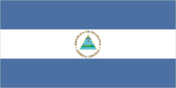
three equal horizontal bands of blue (top), white, and blue with the national coat of arms centered in the white band; the coat of arms features a triangle encircled by the words REPUBLICA DE NICARAGUA on the top and AMERICA CENTRAL on the bottom; the banner is based on the former blue-white-blue flag of the Federal Republic of Central America; the blue bands symbolize the Pacific Ocean and the Caribbean Sea, while the white band represents the land between the two bodies of water similar to the flag of El Salvador, which features a round emblem encircled by the words REPUBLICA DE EL SALVADOR EN LA AMERICA CENTRAL centered in the white band; also similar to the flag of Honduras, which has five blue stars arranged in an X pattern centered in the white band
Government type
republic
Independence
15 September 1821 (from Spain)
International law organization participation
accepts compulsory ICJ jurisdiction with reservations; non-party state to the ICCt
International organization participation
BCIE, CACM, CD, CELAC, FAO, G-77, IADB, IAEA, IBRD, ICAO, ICRM, IDA, IFAD, IFC, IFRCS, ILO, IMF, IMO, Interpol, IOC, IOM, IPU, ISO (correspondent), ITSO, ITU, ITUC (NGOs), LAES, LAIA, LAIA (observer), MIGA, NAM, OAS, OPANAL, OPCW, PCA, Petrocaribe, SICA, UN, UNCTAD, UNESCO, UNHCR, UNIDO, Union Latina, UNWTO, UPU, WCO, WHO, WIPO, WMO, WTO
Judicial branch
- Supreme Court or Corte Suprema de Justicia ( consists of 16 judges organized into administrative, civil, criminal, and constitutional chambers) Supreme Court judges elected by the National Assembly to serve 5-year staggered terms Appeals Court; first instance civil, criminal, and military courts
- highest court(s)
- Supreme Court or Corte Suprema de Justicia ( consists of 16 judges organized into administrative, civil, criminal, and constitutional chambers)
- judge selection and term of office
- Supreme Court judges elected by the National Assembly to serve 5-year staggered terms
- subordinate courts
- Appeals Court; first instance civil, criminal, and military courts
Legal system
civil law system; Supreme Court may review administrative acts
Legislative branch
- unicameral National Assembly or Asamblea Nacional (92 seats; 90 members elected by proportional representation and party lists to serve five-year terms; 1 seat for the previous president, 1 seat for the runner-up in previous presidential election) last held on 6 November 2011 (next to be held by November 2016) percent of vote by party - NA; seats by party - FSLN 64, PLI/MRS 26, PLC 2
- election results
- percent of vote by party - NA; seats by party - FSLN 64, PLI/MRS 26, PLC 2
- elections
- last held on 6 November 2011 (next to be held by November 2016)
National anthem
- "Salve a ti, Nicaragua" (Hail to Thee, Nicaragua) Salomon Ibarra MAYORGA/traditional, arranged by Luis Abraham DELGADILLO although only officially adopted in 1971, the music was approved in 1918 and the lyrics in 1939; the tune, originally from Spain, was used as an anthem for Nicaragua from the 1830's until 1876
- lyrics/music
- Salomon Ibarra MAYORGA/traditional, arranged by Luis Abraham DELGADILLO
- name
- "Salve a ti, Nicaragua" (Hail to Thee, Nicaragua)
National holiday
Independence Day, 15 September (1821)
National symbol(s)
turquoise-browed motmot (bird)
Political parties and leaders
Alliance for the Republic or APRE [Carlos CANALES] Conservative Party or PC [Alejandro BOLANOS Davis] Independent Liberal Party or PLI [Indalecio RODRIGUEZ] Liberal Constitutionalist Party or PLC [Maria Haydee OSUNA] Nicaraguan Liberal Alliance or ALN [Alejandro MEJIA Ferreti] Sandinista National Liberation Front or FSLN [Jose Daniel ORTEGA Saavedra] Sandinista Renovation Movement or MRS [Ana Margarita VIJIL]
Political pressure groups and leaders
- National Workers Front or FNT (a Sandinista umbrella group of eight labor unions including: Farm Workers Association or ATC, Health Workers Federation or FETASALUD, Heroes and Martyrs Confederation of Professional Associations or CONAPRO, National Association of Educators of Nicaragua or ANDEN, National Union of Employees or UNE, National Union of Farmers and Ranchers or UNAG, Sandinista Workers Central or CST, and Union of Journalists of Nicaragua or UPN) Permanent Congress of Workers or CPT (an umbrella group of four non-Sandinista labor unions including: Autonomous Nicaraguan Workers Central or CTN-A, Confederation of Labor Unification or CUS, Independent General Confederation of Labor or CGT-I, and Labor Action and Unity Central or CAUS) Nicaraguan Workers' Central or CTN (an independent labor union) Superior Council of Private Enterprise or COSEP (a confederation of business groups)
- National Workers Front or FNT (a Sandinista umbrella group of eight labor unions including
- Farm Workers Association or ATC, Health Workers Federation or FETASALUD, Heroes and Martyrs Confederation of Professional Associations or CONAPRO, National Association of Educators of Nicaragua or ANDEN, National Union of Employees or UNE, National Union of Farmers and Ranchers or UNAG, Sandinista Workers Central or CST, and Union of Journalists of Nicaragua or UPN)
- Permanent Congress of Workers or CPT (an umbrella group of four non-Sandinista labor unions including
- Autonomous Nicaraguan Workers Central or CTN-A, Confederation of Labor Unification or CUS, Independent General Confederation of Labor or CGT-I, and Labor Action and Unity Central or CAUS)
Suffrage
16 years of age; universal
Economy
Agriculture - products
coffee, bananas, sugarcane, rice, corn, tobacco, sesame, soya, beans; beef, veal, pork, poultry, dairy products; shrimp, lobsters, cotton
Budget
- $2.728 billion $2.752 billion (2012 est.)
- expenditures
- $2.752 billion (2012 est.)
- revenues
- $2.728 billion
Budget surplus (+) or deficit (-)
-0.2% of GDP (2012 est.)
Central bank discount rate
3% (31 December 2010 est.)
Commercial bank prime lending rate
11.99% (31 December 2012 est.) 10.54% (31 December 2011 est.)
Current account balance
$-1.35 billion (2012 est.) $-1.268 billion (2011 est.)
Debt - external
$7.79 billion (31 December 2012 est.) $7.309 billion (31 December 2011 est.)
Distribution of family income - Gini index
40.5 (2010) 60.3 (1998)
Economy - overview
Nicaragua, the poorest country in Central America and the second poorest in the Western Hemisphere, has widespread underemployment and poverty. The Dominican Republic-Central America-United States Free Trade Agreement (CAFTA-DR) has been in effect since April 2006 and has expanded export opportunities for many agricultural and manufactured goods. Textiles and agriculture combined account for nearly 50% of Nicaragua's exports. The ORTEGA administration's promotion of mixed business initiatives, owned by the Nicaraguan and Venezuelan state oil firms, together with the weak rule of law, could undermine the investment climate for domestic and international private firms in the near-term. Nicaragua relied on an IMF external credit facility to meet internal- and external-debt financing obligations. The most recent IMF program ended in 2011 and Nicaragua is currently in negotiations for a new program. Nicaragua depends heavily on foreign development assistance, however, donors have curtailed this funding in response to November 2008 and subsequent electoral fraud. Nicaragua still struggles with a high public debt burden, however, it succeeded in reducing that burden in 2011. The economy grew at a rate of about 4% in 2012.
Exchange rates
cordobas (NIO) per US dollar - 23.55 (2012 est.) 22.42 (2011 est.) 21.36 (2010 est.) 20.34 (2009) 19.37 (2008)
Exports
$4.157 billion (2012 est.) $3.655 billion (2011 est.)
Exports - commodities
coffee, beef, gold, sugar, peanuts, shrimp and lobster, tobacco, cigars, automobile wiring harnesses, textiles, apparel, cotton
Exports - partners
US 55.6%, Canada 8.6%, Venezuela 7.3%, El Salvador 4.2% (2012)
Fiscal year
calendar year
GDP - composition, by end use
- 86.3% 10.3% 32.8% 39.8% -69.2% (2012 est.)
- exports of goods and services
- 39.8%
- government consumption
- 10.3%
- household consumption
- 86.3%
- imports of goods and services
- -69.2%
- investment in fixed capital
- 32.8%
GDP - composition, by sector of origin
- 17.3% 25.9% 56.8% (2012 est.)
- agriculture
- 17.3%
- industry
- 25.9%
- services
- 56.8% (2012 est.)
GDP - per capita (PPP)
$4,400 (2012 est.) $4,200 (2011 est.) $4,000 (2010 est.) data are in 2012 US dollars
GDP - real growth rate
5.2% (2012 est.) 5.4% (2011 est.) 3.6% (2010 est.)
GDP (official exchange rate)
$10.36 billion (2012 est.)
GDP (purchasing power parity)
$26.38 billion (2012 est.) $25.07 billion (2011 est.) $23.78 billion (2010 est.) data are in 2012 US dollars
Household income or consumption by percentage share
- 1.4% 41.8% (2005)
- highest 10%
- 41.8% (2005)
- lowest 10%
- 1.4%
Imports
$6.45 billion (2012 est.) $5.836 billion (2011 est.)
Imports - commodities
consumer goods, machinery and equipment, raw materials, petroleum products
Imports - partners
US 19%, Venezuela 14.8%, Mexico 12.2%, Costa Rica 8.5%, Guatemala 8%, China 7.9%, El Salvador 4.7% (2012)
Industrial production growth rate
6% (2012 est.)
Industries
food processing, chemicals, machinery and metal products, knit and woven apparel, petroleum refining and distribution, beverages, footwear, wood, electric wire harness manufacturing, mining
Inflation rate (consumer prices)
7.2% (2012 est.) 8.1% (2011 est.)
Labor force
2.961 million (2012 est.)
Labor force - by occupation
- 28% 19% 53% (2010 est.)
- agriculture
- 28%
- industry
- 19%
- services
- 53% (2010 est.)
Market value of publicly traded shares
$NA
Population below poverty line
42.5% (2009)
Public debt
58.6% of GDP (2012 est.) 61.4% of GDP (2011 est.) official data; data cover general Government Debt, and includes debt instruments issued (or owned) by Government entities other than the treasury; the data include treasury debt held by foreign entities, as well as intra-governmental debt; intra-governmental debt consists of treasury borrowings from surpluses in the social funds, such as retirement, medical care, and unemployment, debt instruments for the social funds are not sold at public auctions; Nicaragua rebased its GDP figures in 2012, which reduced the figures for debt as a percentage of GDP
Reserves of foreign exchange and gold
$1.887 billion (31 December 2012 est.) $1.892 billion (31 December 2011 est.)
Stock of broad money
$3.136 billion (31 December 2011 est.) $2.924 billion (31 December 2010 est.)
Stock of domestic credit
$4.567 billion (31 December 2012 est.) $4.197 billion (31 December 2011 est.)
Stock of narrow money
$788.4 million (31 December 2012 est.) $709.7 million (31 December 2011 est.)
Taxes and other revenues
26.3% of GDP (2012 est.)
Unemployment rate
7.4% (2012 est.) 7.3% (2011 est.) underemployment was 46.5% in 2008
Energy
Carbon dioxide emissions from consumption of energy
5.035 million Mt (2011 est.)
Crude oil - exports
0 bbl/day (2011 est.)
Crude oil - imports
16,020 bbl/day (2011 est.)
Crude oil - production
0 bbl/day (2011 est.)
Crude oil - proved reserves
0 bbl (1 January 2013 es)
Electricity - consumption
2.941 billion kWh (2011 est.)
Electricity - exports
43 million kWh (2010 est.)
Electricity - from fossil fuels
66% of total installed capacity (2011 est.)
Electricity - from hydroelectric plants
9.5% of total installed capacity (2011 est.)
Electricity - from nuclear fuels
0% of total installed capacity (2011 est.)
Electricity - from other renewable sources
24.5% of total installed capacity (2011 est.)
Electricity - imports
10 million kWh (2010 est.)
Electricity - installed generating capacity
1.108 million kW (2011 est.)
Electricity - production
3.824 billion kWh (2011 est.)
Natural gas - consumption
0 cu m (2012 est.)
Natural gas - exports
0 cu m (2012 est.)
Natural gas - imports
0 cu m (2012 est.)
Natural gas - production
0 cu m (2012 est.)
Natural gas - proved reserves
0 cu m (1 January 2013 es)
Refined petroleum products - consumption
30,690 bbl/day (2011 est.)
Refined petroleum products - exports
999.6 bbl/day (2011 est.)
Refined petroleum products - imports
15,830 bbl/day (2011 est.)
Refined petroleum products - production
15,870 bbl/day (2010 est.)
Communications
Broadcast media
multiple privately owned terrestrial TV networks, supplemented by cable TV in most urban areas; of more than 100 radio stations, nearly all are privately owned; Radio Nicaragua is government-owned and Radio Sandino is controlled by the Sandinista National Liberation Front (FSLN) (2007)
Internet country code
.ni
Internet hosts
296,068 (2012)
Internet users
199,800 (2009)
Telephone system
- system being upgraded by foreign investment; nearly all installed telecommunications capacity now uses digital technology, owing to investments since privatization of the formerly state-owned telecommunications company since privatization, access to fixed-line and mobile-cellular services has improved; fixed-line teledensity roughly 5 per 100 persons; mobile-cellular telephone subscribership has increased to roughly 85 per 100 persons country code - 505; the Americas Region Caribbean Ring System (ARCOS-1) fiber optic submarine cable provides connectivity to South and Central America, parts of the Caribbean, and the US; satellite earth stations - 1 Intersputnik (Atlantic Ocean region) and 1 Intelsat (Atlantic Ocean) (2011)
- domestic
- since privatization, access to fixed-line and mobile-cellular services has improved; fixed-line teledensity roughly 5 per 100 persons; mobile-cellular telephone subscribership has increased to roughly 85 per 100 persons
- general assessment
- system being upgraded by foreign investment; nearly all installed telecommunications capacity now uses digital technology, owing to investments since privatization of the formerly state-owned telecommunications company
- international
- country code - 505; the Americas Region Caribbean Ring System (ARCOS-1) fiber optic submarine cable provides connectivity to South and Central America, parts of the Caribbean, and the US; satellite earth stations - 1 Intersputnik (Atlantic Ocean region) and 1 Intelsat (Atlantic Ocean) (2011)
Telephones - main lines in use
320,000 (2012)
Telephones - mobile cellular
5.346 million (2012)
Transportation
Airports
147 (2013)
Airports - with paved runways
- 4 (2013)
- 1,524 to 2,437 m
- 2
- 2,438 to 3,047 m
- 3
- 914 to 1,523 m
- 3
- total
- 12
- under 914 m
- 4 (2013)
Airports - with unpaved runways
- 119 (2013)
- 1,524 to 2,437 m
- 1
- 914 to 1,523 m
- 15
- total
- 135
Pipelines
oil 54 km (2013)
Ports and terminals
Bluefields, Corinto
Roadways
- 22,111 km 2,850 km 19,261 km (2010)
- total
- 22,111 km
- unpaved
- 19,261 km (2010)
Waterways
2,220 km (navigable waterways as well as the use of the large Lake Managua and Lake Nicaragua; rivers serve only the sparsely populated eastern part of the country) (2011)
Military and Security
Manpower available for military service
- 1,452,107 1,552,698 (2010 est.)
- females age 16-49
- 1,552,698 (2010 est.)
- males age 16-49
- 1,452,107
Manpower fit for military service
- 1,227,757 1,335,653 (2010 est.)
- females age 16-49
- 1,335,653 (2010 est.)
- males age 16-49
- 1,227,757
Manpower reaching militarily significant age annually
- 69,093 67,522 (2010 est.)
- female
- 67,522 (2010 est.)
- male
- 69,093
Military branches
National Army of Nicaragua (Ejercito Nacional de Nicaragua, ENN; includes Navy, Air Force) (2013)
Military expenditures
0.9% of GDP (2012)
Military service age and obligation
18-30 years of age for voluntary military service; no conscription; tour of duty 18-36 months; requires Nicaraguan nationality and 6th-grade education (2012)
Transnational Issues
Disputes - international
the 1992 ICJ ruling for El Salvador and Honduras advised a tripartite resolution to establish a maritime boundary in the Gulf of Fonseca, which considers Honduran access to the Pacific; legal dispute over navigational rights of San Juan River on border with Costa Rica
Illicit drugs
transshipment point for cocaine destined for the US and transshipment point for arms-for-drugs dealing