1996 Edition
CIA World Factbook 1996 (Project Gutenberg)
Introduction
Description
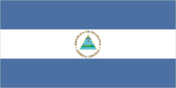
three equal horizontal bands of blue (top), white, and blue with the national coat of arms centered in the white band; the coat of arms features a triangle encircled by the words REPUBLICA DE NICARAGUA on the top and AMERICA CENTRAL on the bottom; similar to the flag of El Salvador, which features a round emblem encircled by the words REPUBLICA DE EL SALVADOR EN LA AMERICA CENTRAL centered in the white band; also similar to the flag of Honduras, which has five blue stars arranged in an X pattern centered in the white band
Location
13 00 N, 85 00 W -- Middle America, bordering both the Caribbean Sea and the North Pacific Ocean, between Costa Rica and Honduras Flag ----
Geography
Area
- comparative area
- slightly larger than New York State
- land area
- 120,254 sq km
- total area
- 129,494 sq km
Climate
tropical in lowlands, cooler in highlands
Coastline
910 km
Environment
- current issues
- deforestation; soil erosion; water pollution
- international agreements
- party to - Biodiversity, Climate Change, Endangered Species, Nuclear Test Ban, Ozone Layer Protection, Whaling; signed, but not ratified - Desertification, Environmental Modification, Law of the Sea
- natural hazards
- destructive earthquakes, volcanoes, landslides, and occasionally severe hurricanes
Geographic coordinates
13 00 N, 85 00 W
International disputes
territorial disputes with Colombia over the Archipelago de San Andres y Providencia and Quita Sueno Bank; with respect to the maritime boundary question in the Golfo de Fonseca, the International Court of Justice (ICJ) referred the disputants to an earlier agreement in this century and advised that some tripartite resolution among El Salvador, Honduras, and Nicaragua likely would be required; maritime boundary dispute with Honduras
Irrigated land
850 sq km (1989 est.)
Land boundaries
- border countries
- Costa Rica 309 km, Honduras 922 km
- total
- 1,231 km
Land use
- arable land
- 9%
- forest and woodland
- 35%
- meadows and pastures
- 43%
- other
- 12%
- permanent crops
- 1%
Location
Middle America, bordering both the Caribbean Sea and the North Pacific Ocean, between Costa Rica and Honduras
Map references
Central America and the Caribbean
Maritime claims
- contiguous zone
- 25-nm security zone
- continental shelf
- natural prolongation
- territorial sea
- 200 nm
Natural resources
gold, silver, copper, tungsten, lead, zinc, timber, fish
Terrain
- extensive Atlantic coastal plains rising to central interior mountains; narrow Pacific coastal plain interrupted by volcanoes
- highest point
- Mogoton 2,438 m
- lowest point
- Pacific Ocean 0 m
People and Society
Age structure
0-14 years: 44% (male 951,254; female 938,599) 15-64 years: 53% (male 1,105,069; female 1,164,144) 65 years and over: 3% (male 49,027; female 64,259) (July 1996 est.)
Birth rate
33.83 births/1,000 population (1996 est.)
Death rate
6.01 deaths/1,000 population (1996 est.)
Ethnic divisions
mestizo (mixed Amerindian and white) 69%, white 17%, black 9%, Indian 5%
Infant mortality rate
45.8 deaths/1,000 live births (1996 est.)
Languages
- Spanish (official)
- note
- English- and Indian-speaking minorities on Atlantic coast
Life expectancy at birth
- female
- 68.13 years (1996 est.)
- male
- 63.41 years
- total population
- 65.72 years
Literacy
- age 15 and over can read and write (1995 est.)
- female
- 66.6%
- male
- 64.6%
- total population
- 65.7%
Nationality
- adjective
- Nicaraguan
- noun
- Nicaraguan(s)
Net migration rate
-1.17 migrant(s)/1,000 population (1996 est.)
Population
4,272,352 (July 1996 est.)
Population growth rate
2.67% (1996 est.)
Religions
Roman Catholic 95%, Protestant 5%
Sex ratio
- all ages
- 0.97 male(s)/female (1996 est.)
- at birth
- 1.04 male(s)/female
- under 15 years
- 1.01 male(s)/female 15-64 years: 0.95 male(s)/female 65 years and over: 0.76 male(s)/female
Total fertility rate
4.03 children born/woman (1996 est.)
Government
Administrative divisions
15 departments (departamentos, singular - departamento), 2 autonomous regions* (regions autonomista, singular - region autonomista); Boaco, Carazo, Chinandega, Chontales, Esteli, Granada, Jinotega, Leon, Madriz, Managua, Masaya, Matagalpa, Nueva Segovia, Atlantica Norte*, Atlantica Sur*, Rio San Juan, Rivas
Capital
Managua
Constitution
9 January 1987
Data code
NU
Diplomatic representation in US
- chancery
- 1627 New Hampshire Avenue NW, Washington, DC 20009
- chief of mission
- Ambassador Roberto Genaro MAYORGA Cortes
- consulate(s) general
- Houston, Los Angeles, Miami, New Orleans, New York, San Francisco
- telephone
- [1] (202) 939-6570
Executive branch
- cabinet
- Cabinet
- chief of state and head of government
- President Violeta Barrios de CHAMORRO (since 25 April 1990) was elected for a six-year term (amended to a five-year term in July 1995) by universal suffrage; Vice President Julia MENA Rivera (since 22 October 1995) replaced Virgilio GODOY, who resigned to run for the presidency in 1996 as required by law; election last held 25 February 1990 (next to be held 20 October 1996); results - Violeta Barrios de CHAMORRO (UNO) 54.7%, Daniel ORTEGA Saavedra (FSLN) 40.8%, other 4.5%
FAX
[505] (2) 669074
Flag
three equal horizontal bands of blue (top), white, and blue with the national coat of arms centered in the white band; the coat of arms features a triangle encircled by the words REPUBLICA DE NICARAGUA on the top and AMERICA CENTRAL on the bottom; similar to the flag of El Salvador, which features a round emblem encircled by the words REPUBLICA DE EL SALVADOR EN LA AMERICA CENTRAL centered in the white band; also similar to the flag of Honduras, which has five blue stars arranged in an X pattern centered in the white band
Independence
15 September 1821 (from Spain)
International organization participation
BCIE, CACM, ECLAC, FAO, G-77, IADB, IAEA, IBRD, ICAO, ICFTU, ICRM, IDA, IFAD, IFC, IFRCS, ILO, IMF, IMO, Intelsat, Interpol, IOC, IOM, ITU, LAES, LAIA (observer), NAM, OAS, OPANAL, PCA, UN, UNCTAD, UNESCO, UNHCR, UNIDO, UPU, WCL, WFTU, WHO, WIPO, WMO, WToO, WTrO
Judicial branch
Supreme Court (Corte Suprema), judges elected for a six-year term (amended to a seven-year term in July 1995) by the National Assembly
Legal system
civil law system; Supreme Court may review administrative acts
Legislative branch
unicameral
Name of country
- conventional long form
- Republic of Nicaragua
- conventional short form
- Nicaragua
- local long form
- Republica de Nicaragua
- local short form
- Nicaragua
National Assembly (Asamblea Nacional)
elections last held 25 February 1990 (next to be held NA October 1996); results - UNO coalition 53.9%, Sandinista bloc 40.8%, PSC 1.6%, MUR 1.0%; seats - (92 total) UNO coalition 53 (Center Group 9, UDC 6, PSD 5, APC 5, PLC 5, PLI 4, PND 3, PAN 3, PNC 3, MDN 2, PCdeN 2, independents 6) and Sandinista bloc 39 (MRS 16, BUS-Sandinista 9, FSLN 8, Sandinista Group of Reflection 4, FSLN-independents 2)
National holiday
Independence Day, 15 September (1821)
Other political or pressure groups
National Workers Front (FNT) is a Sandinista umbrella group of eight labor unions: Sandinista Workers' Central (CST); Farm Workers Association (ATC); Health Workers Federation (FETASALUD); National Union of Employees (UNE); National Association of Educators of Nicaragua (ANDEN); Union of Journalists of Nicaragua (UPN); Heroes and Martyrs Confederation of Professional Associations (CONAPRO); and the National Union of Farmers and Ranchers (UNAG); Permanent Congress of Workers (CPT) is an umbrella group of four non-Sandinista labor unions: Confederation of Labor Unification (CUS); Autonomous Nicaraguan Workers' Central (CTN-A); Independent General Confederation of Labor (CGT-I); and Labor Action and Unity Central (CAUS); Nicaraguan Workers' Central (CTN) is an independent labor union; Superior Council of Private Enterprise (COSEP) is a confederation of business groups
Political parties and leaders
- center left
- Christian Democratic Union (UDC), Luis Humberto GUZMAN; Nicaraguan Democratic Movement (MDN), Alfredo GUZMAN; Social Democratic Party (PSD), Adolfo JARQUIN; National Justice Party (PJN), Jorge DIAZ Cruz; National Action Party (PAN), Delvis MONTIEL; Renovating Action Movement (MAR), Pablo HERNANDEZ; Sandinista Renovation Movement (MRS), Sergio RAMIREZ; Social Christian Party (PCS), Erick RAMIREZ; Democratic Action Party (PAD), Eden PASTORA; "Up with Nicaragua" (Arriba Nicaragua), Alvaro ROBELO; National Democratic Party (PND), Alfredo CESAR Aquirre; Communist Party of Nicaragua (PCdeN), Eli ALTIMIRANO Perez
- center right
- Neoliberal Party (PALI), Ricardo VEGA Garcia; Nicaraguan Resistance Party (PRN), Fabio GADEA, Enrique QUINONEZ; Independent Liberal Party (PLI), Wilfredo NAVARRO; National Project (PRONAL), Antonio LACAYO Oyanguren; Nicaraguan Democratic Alliance Party (PADENIC), Pedro MAYORGA Knilands; Nationalist Liberal Party (PLN), Roberto CASTILLO Quant; Party for Liberal Unity (PUL), Haroldo MONTEALEGRE; Fuerza '96, Francesco MAYORGA
- left
- Sandinista National Liberation Front (FSLN), Daniel ORTEGA; Revolutionary Workers' Party (PRT), Bonifacio MIRANDA; Popular Action Movement-Marxist-Leninist (MAP-ML), Isidro TELLEZ; Nicaraguan Socialist Party (PSN), Gustavo TABLADA; Unidad Nicaraguense de Obreros, Campesinos, y Profesionales (UNOCP), Rosalio GONZALEZ Urbina; Central American Unionist Party (PUCA), Blanca ROJAS Echaverry
- note
- the UNO coalition that won the 1990 elections no longer exists; the different blocs that formerly were united under the UNO umbrella and their opposition to the Sandinistas now act and vote independently
- right
- Liberal Constitutionalist Party (PLC), Arnold ALEMAN; Conservative Popular Alliance Party (APC), Myriam ARGUELLO; Independent Liberal Party for National Unity (PLIUN), Carlos GUERRA Gallardo; Conservative Action Movement (MAC); Conservative Party of Nicaragua (PCN - formed in 1992 by the merger of the Conservative Social Party or PSC with the Democratic Conservative Party or PCD and the Conservative party of Labor or PCL), Fernando AGUERO; National Conservative Party (PNC), Adolfo CALERO, Noel VIDUARRE
Suffrage
16 years of age; universal
Type of government
republic
US diplomatic representation
- chief of mission
- Ambassador John F. MAISTO
- embassy
- Kilometer 4.5 Carretera Sur., Managua
- mailing address
- APO AA 34021
- telephone
- [505] (2) 666010 through 666013, 666015 through 18, 666026, 666027, 666032 through 33
Economy
Agriculture
coffee, bananas, sugarcane, cotton, rice, corn, cassava (tapioca), citrus, beans; beef, veal, pork, poultry, dairy products
Budget
- expenditures
- $551 million, including capital expenditures of $NA (1996 est.)
- revenues
- $389 million
Currency
1 gold cordoba (C$) = 100 centavos
Economic aid
- recipient
- ODA, $NA
Economic overview
The Nicaraguan economy, devastated during the 1980s by economic mismanagement and civil war, is beginning to rebound. Since March 1991, when President CHAMORRO launched an ambitious economic stabilization program, Nicaragua has had considerable success in reducing inflation and obtaining substantial economic aid from abroad. Annual inflation fell from more than 750% in 1991 to less than 5% in 1992. After rising again to an estimated 20% in 1993, the annual inflation rate was 11.7% in 1994 and 11.4% in 1995. While economic growth was flat in 1992 and negative in 1993, the 1995 growth rate is about 4%, thanks to surges in most export categories. Recent legislation (November 1995) authorizing the privatization of the TELCOR telecommunications company and resolving the issue of property confiscated by the previous Sandinista government may reassure potential investors. The government's efforts to liberalize trade include a December 1995 decision to stop requiring exporters to bring their foreign exchange earnings into Nicaragua. On the debt front, the Nicaraguan Government launched a successful debt buyback program in 1995, purchasing 73% of its $1.373 billion commercial debt inherited from previous governments. Progress also occurred on reducing bilateral debt in November 1995 as Nicaragua reached an agreement with Germany, reducing Nicaragua's $616 million debt to the former GDR by 80%. Debt reduction agreements with Paris Club creditors and rescheduling with the US also took place. Unemployment remains a pressing problem, however, with roughly half the country's population unemployed or underemployed.
Electricity
- capacity
- 460,000 kW
- consumption per capita
- 376 kWh (1993)
- production
- 1.64 billion kWh (1994)
Exchange rates
gold cordobas (C$) per US$1 - 7.98 (December 1995), 6.72 (1994), 5.62 (1993), 5.00 (1992), 4.27 (1991)
Exports
- $525.5 million (f.o.b., 1995 est.)
- commodities
- meat, coffee, cotton, sugar, seafood, gold, bananas
- partners
- US, Central America, Canada, Germany
External debt
$11.7 billion (1994)
Fiscal year
calendar year
GDP
purchasing power parity - $7.1 billion (1995 est.)
GDP composition by sector
- agriculture
- NA%
- industry
- NA%
- services
- NA%
GDP per capita
$1,700 (1995 est.)
GDP real growth rate
4.2% (1995 est.)
Illicit drugs
transshipment point for cocaine destined for the US
Imports
- $870 million (c.i.f., 1995 est.)
- commodities
- consumer goods, machinery and equipment, petroleum products
- partners
- Central America, US, Venezuela, Japan
Industrial production growth rate
1.4% (1994 est.)
Industries
food processing, chemicals, metal products, textiles, clothing, petroleum refining and distribution, beverages, footwear
Inflation rate (consumer prices)
11.4% (1995 est.)
Labor force
- 1.086 million
- by occupation
- services 43%, agriculture 44%, industry 13% (1986)
Unemployment rate
20% substantial underemployment (1995 est.)
Communications
Branches
Ground Forces, Navy, Air Force
Defense expenditures
exchange rate conversion - $28.1 million, NA% of GDP (1996)
Manpower availability
- males age 15-49
- 988,883
- males fit for military service
- 608,753
- males reach military age (18) annually
- 47,786 (1996 est.)
Radio broadcast stations
AM 45, FM 0, shortwave 3
Radios
1.037 million (1992 est.)
Telephone system
- low-capacity microwave radio relay and wire system being expanded; connected to Central American Microwave System
- domestic
- wire and microwave radio relay
- international
- satellite earth stations - 1 Intersputnik (Atlantic Ocean Region) and 1 Intelsat (Atlantic Ocean)
Telephones
66,810 (1993 est.)
Television broadcast stations
7 (1994 est.)
Televisions
260,000 (1992 est.) Defense
Transportation
Airports
- total
- 148
- with paved runways 1 524 to 2 437 m
- 3
- with paved runways 2 438 to 3 047 m
- 1
- with paved runways 914 to 1 523 m
- 3
- with paved runways over 3 047 m
- 1
- with paved runways under 914 m
- 107
- with unpaved runways 1 524 to 2 437 m
- 1
- with unpaved runways 914 to 1 523 m
- 32 (1995 est.)
Highways
- note
- there is a 368.5 km portion of the Pan-American Highway which is not included in the total
- paved
- 4,000 km
- total
- 26,000 km
- unpaved
- 22,000 km (1993 est.)
Merchant marine
none
Pipelines
crude oil 56 km
Ports
Bluefields, Corinto, El Bluff, Puerto Cabezas, Puerto Sandino, Rama, San Juan del Sur
Railways
- narrow gauge
- 0 km 1.067-m gauge; note - part of the previous 376 km system was closed and dismantled in 1993 and, in 1994, the remainder was closed, the track and rolling stock being sold for scrap
- total
- 0 km
Waterways
2,220 km, including 2 large lakes