1991 Edition
CIA World Factbook 1991 (Project Gutenberg)
Geography
Climate
tropical in lowlands, cooler in highlands
Coastline
910 km
Comparative area
slightly larger than New York State
Disputes
territorial disputes with Colombia over the Archipelago de San Andres y Providencia and Quita Sueno Bank; unresolved maritime boundary in Golfo de Fonseca
Environment
subject to destructive earthquakes, volcanoes, landslides, and occasional severe hurricanes; deforestation; soil erosion; water pollution
Land boundaries
1,231 km total; Costa Rica 309 km, Honduras 922 km
Land use
arable land 9%; permanent crops 1%; meadows and pastures 43%; forest and woodland 35%; other 12%; including irrigated 1%
Maritime claims
Contiguous zone: 25 nm security zone (status of claim uncertain); Continental shelf: not specified; Territorial sea: 200 nm
Natural resources
gold, silver, copper, tungsten, lead, zinc, timber, fish
Terrain
extensive Atlantic coastal plains rising to central interior mountains; narrow Pacific coastal plain interrupted by volcanoes
Total area
129,494 km2; land area: 120,254 km2
People and Society
Birth rate
37 births/1,000 population (1991)
Death rate
7 deaths/1,000 population (1991)
Ethnic divisions
mestizo 69%, white 17%, black 9%, Indian 5%
Infant mortality rate
60 deaths/1,000 live births (1991)
Labor force
1,086,000; service 43%, agriculture 44%, industry 13% (1986)
Language
Spanish (official); English- and Indian-speaking minorities on Atlantic coast
Life expectancy at birth
60 years male, 65 years female (1991)
Literacy
57% (male 57%, female 57%) age 15 and over can read and write (1971)
Nationality
noun--Nicaraguan(s); adjective--Nicaraguan
Net migration rate
- 1 migrant/1,000 population (1991)
Organized labor
35% of labor force
Population
3,751,884 (July 1991), growth rate 2.8% (1991)
Religion
Roman Catholic 95%, Protestant 5%
Total fertility rate
4.7 children born/woman (1991)
Government
Administrative divisions
9 administrative regions encompassing 16 departments (departamentos, singular--departamento); Boaco, Carazo, Chinandega, Chontales, Esteli, Granada, Jinotega, Leon, Madriz, Managua, Masaya, Matagalpa, Nueva Segovia, Rio San Juan, Rivas, Zelaya; note--Zelaya may have been replaced by 2 autonomous regions (regiones autonomistas, singular--region autonomista) named North Atlantic Coast and South Atlantic Coast
Capital
Managua
Communists
15,000-20,000
Constitution
January 1987
Diplomatic representation
Ambassador Ernesto PALAZIO; Chancery at 1627 New Hampshire Avenue NW, Washington DC 20009; telephone (202) 387-4371 or 4372; US--Ambassador Harry W. SHLAUDEMAN; Embassy at Kilometer 4.5 Carretera Sur., Managua (mailing address is APO Miami 34021); telephone [505] (2) 666010 or 666013, 666015 through 18, 666026, 666027, 666032 through 34
Elections
President--last held on 25 February 1990 (next to be held February 1996); results--Violeta Barrios de CHAMORRO (UNO) 54.7%, Daniel ORTEGA Saavedra (FSLN) 40.8%, other 4.5%; National Assembly--last held on 25 February 1990 (next to be held February 1996); results--UNO 53.9%, FSLN 40.8%, PSC 1.6%, MUR 1.0%; seats--(92 total) UNO 51, FSLN 39, PSC 1, MUR 1
Executive branch
president, vice president, Cabinet
Flag
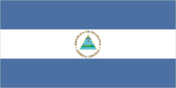
three equal horizontal bands of blue (top), white, and blue with the national coat of arms centered in the white band; the coat of arms features a triangle encircled by the words REPUBLICA DE NICARAGUA on the top and AMERICA CENTRAL on the bottom; similar to the flag of El Salvador which features a round emblem encircled by the words REPUBLICA DE EL SALVADOR EN LA AMERICA CENTRAL centered in the white band; also similar to the flag of Honduras, which has five blue stars arranged in an X pattern centered in the white band
Independence
15 September 1821 (from Spain)
Judicial branch
Supreme Court (Corte Suprema) and municipal courts
Leaders
Chief of State and Head of Government--President Violeta Barrios de CHAMORRO (since 25 April 1990); Vice President Virgilio GODOY (since 25 April 1990)
Legal system
civil law system; Supreme Court may review administrative acts
Legislative branch
National Assembly (Asamblea Nacional)
Long-form name
Republic of Nicaragua
Member of
BCIE, CACM, ECLAC, FAO, G-77, GATT, IADB, IAEA, IBRD, ICAO, ICFTU, IDA, IFAD, IFC, ILO, IMF, IMO, INTELSAT, INTERPOL, IOC, IOM, ITU, LAES, LORCS, NAM, OAS, OPANAL, PCA, UN, UNCTAD, UNESCO, UNHCR, UNIDO, UPU, WCL, WFTU, WHO, WIPO, WMO
National holiday
Independence Day, 15 September (1821)
Other political or pressure groups
Permanent Congress of Workers (CPT), Confederation of Labor Unification (CUS), Autonomous Nicaraguan Workers' Central (CTN-A), Independent General Confederation of Workers (CTG-I), Communist Labor Action and Unity Central (CAUS), Nicaraguan Workers' Central (CST); Superior Council of Private Enterprise (COSEP) is an umbrella group of 11 different business groups, including the Chamber of Commerce, the Chamber of Industry, and the Nicaraguan Development Institute (INDE)
Political parties and leaders
ruling coalition--National Opposition Union (UNO) is a 14-party alliance--National Conservative Party (PNC), Silviano MATAMOROS; Conservative Popular Alliance Party (PAPC), Myriam ARGUELLO; National Conservative Action Party (PANC), Hernaldo ZUNIGA; National Democratic Confidence Party (PDCN), Augustin JARQUIN; Independent Liberal Party (PLI), Wilfredo NAVARRO; Neo-Liberal Party (PALI), Andres ZUNIGA; Liberal Constitutionalist Party (PLC), Jose Ernesto SOMARRIBA; National Action Party (PAN), Eduardo RIVAS; Nicaraguan Socialist Party (PSN), Gustavo TABLADA; Communist Party of Nicaragua (PCdeN), Eli ALTIMIRANO; Popular Social Christian Party (PPSC), Luis HUMBERTO; Nicaraguan Democratic Movement (MDN), Roberto URROZ; Social Democratic Party (PSD), Guillermo POTOY; Central American Integrationist Party (PIAC), Alejandro PEREZ; opposition parties--Sandinista National Liberation Front (FSLN), Daniel ORTEGA; Central American Unionist Party (PUCA), Blanca ROJAS; Democratic Conservative Party of Nicaragua (PCDN), Jose BRENES; Liberal Party of National Unity (PLUIN), Eduardo CORONADO; Movement of Revolutionary Unity (MUR), Francisco SAMPER; Social Christian Party (PSC), Erick RAMIREZ; Revolutionary Workers' Party (PRT), Bonifacio MIRANDA; Social Conservative Party (PSOC), Fernando AGUERRO; Popular Action Movement--Marxist-Leninist (MAP-ML), Isidro TELLEZ; Popular Social Christian Party (PPSC), Mauricio DIAZ
Suffrage
universal at age 16
Type
republic
Economy
Agriculture
accounts for 23% of GDP and 44% of work force; cash crops--coffee, bananas, sugarcane, cotton; food crops--rice, corn, cassava, citrus fruit, beans; variety of animal products--beef, veal, pork, poultry, dairy; normally self-sufficient in food
Budget
revenues $244 million; expenditures $550 million, including capital expenditures of $73 million (1988)
Currency
cordoba (plural--cordobas); 1 cordoba (C$) = 100 centavos
Economic aid
US commitments, including Ex-Im (FY70-89), $294 million; Western (non-US) countries, ODA and OOF bilateral commitments (1970-88), $1,186 million; Communist countries (1970-89), $3.5 billion
Electricity
415,000 kW capacity; 1,342 million kWh produced, 360 kWh per capita (1990)
Exchange rates
cordobas (C$) per US$1--13,300,000 (January 1991), 15,655 (1989), 270 (1988), 102.60 (1987), 97.48 (1986), 38.90 (1985)
Exports
$298 million (f.o.b., 1989); commodities--coffee, cotton, sugar, bananas, seafood, meat, chemicals; partners--OECD 75%, USSR and Eastern Europe 15%, other 10%
External debt
$9 billion (December 1990)
Fiscal year
calendar year
GDP
$1.7 billion, per capita $470; real growth rate - 1.0% (1990 est.)
Imports
$710 million (c.i.f., 1989); commodities--petroleum, food, chemicals, machinery, clothing; partners--Latin America 30%, US 25%, EC 20%, USSR and Eastern Europe 10%, other 15% (1990 est.)
Industrial production
growth rate - 7% (1989); accounts for about 25% of GDP
Industries
food processing, chemicals, metal products, textiles, clothing, petroleum refining and distribution, beverages, footwear
Inflation rate (consumer prices)
11,800% (1990)
Overview
Government control of the economy historically has been extensive, although the Chamorro government has pledged to reduce it. The financial system is directly controlled by the state, which also regulates wholesale purchasing, production, sales, foreign trade, and distribution of most goods. Over 50% of the agricultural and industrial firms are state owned. Sandinista economic policies and the war have produced a severe economic crisis. The foundation of the economy continues to be the export of agricultural commodities, largely coffee and cotton. Farm production fell by roughly 7% in 1989, the fifth successive year of decline. The agricultural sector employs 44% of the work force and accounts for 23% of GDP and 86% of export earnings. Industry, which employs 13% of the work force and contributes about 25% to GDP, showed a drop of 7% in 1989 and remains below pre-1979 levels. External debt is one of the highest in the world on a per capita basis. In 1990 the annual inflation rate was 11,800%, sharply up from 1,800% in 1989.
Unemployment rate
35% (1990)
Communications
Airports
251 total, 162 usable; 10 with permanent-surface runways; none with runways over 3,659 m; 2 with runways 2,440-3,659 m; 12 with runways 1,220-2,439 m
Civil air
12 major transport aircraft
Highways
25,930 km total; 4,000 km paved, 2,170 km gravel or crushed stone, 5,425 km earth or graded earth, 14,335 km unimproved; Pan-American highway 368.5 km
Inland waterways
2,220 km, including 2 large lakes
Merchant marine
2 cargo ships (1,000 GRT or over) totaling 2,161 GRT/2,500 DWT
Pipelines
crude oil, 56 km
Ports
Corinto, El Bluff, Puerto Cabezas, Puerto Sandino, Rama
Railroads
373 km 1.067-meter gauge, government owned; majority of system not operating; 3 km 1.435-meter gauge line at Puerto Cabezas (does not connect with mainline)
Telecommunications
low-capacity radio relay and wire system being expanded; connection into Central American Microwave System; 60,000 telephones; stations--45 AM, no FM, 7 TV, 3 shortwave; earth stations--1 Intersputnik and 1 Atlantic Ocean INTELSAT
Military and Security
Branches
Army, Navy, Air Force
Defense expenditures
$70 million, 3.8% of GDP (1991) _%_
Manpower availability
males 15-49, 845,961; 521,425 fit for military service; 44,222 reach military age (18) annually