1987 Edition
CIA World Factbook 1987 (Internet Archive)
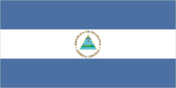
Geography
Boundary disputes
none; Nicaraguan interruption of transit in the Rio San Juan (the internationa] boundary) is an occasional source of friction with Costa Rica; territorial dispute with Columbia over San Andres and Providencia Archipelago
Climate
tropical in lowlands, cooler in highlands
Coastline
910 km
Comparative area
about the size of lowa
Continental shelf
200 meters depth
Environment
subject to destructive earthquakes, volcanoes, and landslides; deforestation; soil erosion; water pollution
Land boundaries
1,220 km total
Land use
9% arable land; 1% permanent crops; 43% meadows and pastures; 35% forest and woodland; 12% other; including 1% irrigated
Special notes
none
Terrain
extensive coastal plains rising to interior mountains
Territorial sea
200 nm
Total area
130,000 km?; land area: 118,750 km?
People and Society
Ethnic divisions
69% mestizo, 17% white, 9% black, 5% Indian
Infant mortality rate
84/1,000 (1983)
Labor force
1,086,000 (1986); 45% service, 42% agriculture, 13% industry; 25% unemployment
Language
Spanish (official); Englishand Indian-speaking minorities on Atlantic coast
Life expectancy
men 56, women 60
Literacy
66%
Nationality
noun—Nicaraguan(s); adjective—Nicaraguan
Organized labor
35% of Nicaragua's labor force is organized; of the seven confederations, five are Sandinista or Marxist oriented—the government-sponsored Sandinista Workers’ Central (CST), 115,000 members, including state and municipal employees; the Association of Campesino Workers (ATC), 180,000 members; the General Confederation of Independent Workers (CGI-1), about 15,000 members; the Workers Front, about 100 members; and the Central for Labor Action and Unity (CAUS), about 3,000 members; the other two unions are the Nicaraguan Workers’ Central (CTN), 25,000 members, and the Confederation of Labor Unification (CUS), 50,000 members
Population
3,319,059 (July 1987), average annual growth rate 2.50%
Religion
95% Roman Catholic
Government
Administrative divisions
16 departments; in 1982 the Sandinistas established six regions and three special zones, which both the government and the Sandinista National Liberation Front (FSLN) increasingly use for administrative purposes
Branches
executive and administrative responsibility formally reside in the President, Vice President, and Cabinet; in reality, the nine-member National Directorate of the Sandinista National Liberation Front (FSLN) shares power with and dominates the executive; National Assembly was elected in November 1984 and inaugurated in January 1985; the country’s highest judicial authority is the Sandinistaappointed Supreme Court, composed of seven members
Capital
Managua
Communists
the Nicaraguan Socialist Party (PSN), Gustavo Tablada, founded in 1944, has served as Nicaragua’s Moscowline Communist party; the Communist Party of Nicaragua (PCdeN), Eli Altamirano Pérez, is an ultraleft breakaway faction from the PSN; and the Popular Action Movement—Marxist-Leninist (MAP-ML), Isidro Téllez; only the PSN was a member of the FPR alliance with the FSLN, but all three have supported the revolution; the PCdeN and MAP-ML have criticized the Sandinistas for moving too slowly toward consolidation of a Marxist-Leninist regime; each of the three Communist parties has two seats in the National Assembly
Elections
national elections were held on 4 November 1984 for president and vice president (elected for a six-year term), and a 96-member National Assembly Political parties and leaders: Sandinista National Liberation Front (FSLN) is the ruling party and dominates political life; the FSLN has 61 seats in the National Assembly; government prohibited most political activities by opposition parties under the state of emergency in March 1982, expanded the emergency decree in October 1985, and reimposed the state of emergency in January 1987; main opposition parties boycotted the November 1984 elections on the grounds that the regime had not provided them with sufficient political guarantees; democratic opposition parties are highly fragmented and include Social Democratic Party (PSD), leadership undecided; Social Christian Party (PSC), Erick Ramirez; Democratic Conservative Party of Nicaragua (PCDN), split into factions—the most influential leaders are Mario Rappaccioli and Myriam Arguello; Constitutionalist Liberal Party (PLC), Alfredo Reyes Duque Estrada; Independent Liberal Party (PLI), Virgilio Godoy; Popular Social Christian Party (PPSC), Mauricio Diaz; and Democratic Conservative Party (PCD), split into factions—most influential leader Rafael Cordova Rivas; the PSD, PSC, PCDN and PLC, as well as opposition business and union organizations, form the Democratic Coordinating Board—Eduardo Rivas Gasteazoro, president; the PPSC and PLI were allied with the FSLN in the Patriotic Front of the Revolution (FPR) until early 1984 but fielded their own candidates in the elections; a pro-FSLN faction dominates the PCD; the PCD has 14 seats in the National Assembly, the PLI 9, and the PPSC 6; two additional relatively obscure parties, the Central American Unionist Party (PUCA) and the Revolutionary Party of the Workers (PRT), were founded in late 1984; a third obscure party, the Liberal Party (PALI, was founded in 1986
Government leaders
Cdte. (José) Daniel ORTEGA Saavedra, President (since 10 January 1985); Sergio RAMIREZ Mercado, Vice President (since 10 January 1985)
Legal system
the Sandinista-appointed Government of National Reconstruction revoked the constitution of 1974 and issued a Fundamental Statute and a Program of the Government of National Reconstruction, which guided its actions unti! the new constitution was promulgated in January 1987
Member of
CACM, CEMA (observer), FAO, G-77, GATT, IADB, IAEA, IBRD, ICAC, ICAO, ICO, IDA, IDB—InterAmerican Development Bank, IFAD, IFC, ILO, IMF, IMO, INTELSAT, INTERPOL, IPU, IRC, ISO, ITU, NAM, OAS, ODECA, PAHO, SELA, UN, UNESCO, UPEB, UPU, WFTU, WHO, WMO, WTO
National holiday
Independence Day, 15 September; Anniversary of the Revolution, 19 July
Official name
Republic of Nicaragua
Other political or pressure groups
the Superior Council of Private Enterprise (COSEP) is an umbrella group comprising 11 different chambers of associations, including such groups as the Chamber of Commerce, the Chamber of Industry, and the Nicaraguan Development Institute ~ (INDE)
Type
republic
Economy
Agriculture
cotton, coffee, sugarcane, rice, corn, beans, cattle
Aid
US, including Ex-Im (FY70-82), $290 million; Western (non-US) countries, ODA and OOF (1970-84), $634 million; Communist countries (1970-85), $1455 million
Budget
expenditures, $900 million; revenues, $0.5 billion; converted at 70 cordobas=US$1, official exchange rate (1985)
Electric power
398,000 kW capacity; 1,200 million kWh produced, 360 kWh per capita (1986)
Exports
$218 million (f.0.b., 1986); coffee, cotton, sugar, seafood, bananas
Fiscal year
calendar year
GDP
$1.6 billion (1985), $510 per capita; real GDP growth rate 1986, - 5% (conversion from national currency made at 70 cordobas=US$$1, the highly overvalued official exchange rate)
Imports
$840 million (f.0.b., 1986); food and nonfood agricultural products, chemicals and pharmaceuticals, transportation equipment, machinery, construction materials, clothing, petroleum
Major industries
food processing, chemicals, metal products, textiles and clothing, petroleum, beverages
Major trade partners
exports—40% EC, 20% Japan, 8% CACM, 7% US, 5% CEMA, 20% other; imports—438% CEMA, 12% EC, 10% Mexico, 8% US, 6% CACM, 21% other (1985)
Military transfers
US commitments (FY70-79), $20 million
Monetary conversion rate
multiple exchange policy; official rate 70 cordobas=US$1 (January 1986); free market 3,000 cordobas=US$1 (January 1986)
Natural resources
gold, silver, copper, tungsten, arable land, timber, livestock, fish
Communications
Airfields
289 total, 241 usable; 10 with permanent-surface runways; 2 with runways 2,440-3,659 m, 12 with runways 1,220-2,439 m
Civil air
12 major transport aircraft
Highways
23,585 km total; 1,655 km paved, 2,170 km gravel or crushed stone, 5,425 km earth or graded earth, 14,335 km unimproved
Inland waterways
2,220 km, including 2 large lakes
Pipelines
crude oil, 56 km
Ports
1 major (Corinto), 8 secondary, 13 minor
Railroads
344 km 1.067-meter gauge, government owned; majority of system not operating; 3 km 1.435-meter gauge line at Puerto Cabezas (does not connect with mainline)
Telecommunications
low-capacity radiorelay and wire system being expanded; connection into Central American microwave net; 60,000 telephones (2.2 per 100 popl.); 41 AM, 4 HF, 7 TV stations; Intersputnik communications satellite facility; Atlantic Ocean satellite station
Military and Security
Branches
Sandinista People’s Army, Sandinista Navy, Sandinista Air Force/Air Defense, Sandinista People’s Militia
Military budget
estimated for fiscal year ending 31 December 1986, $1.2-].6 billion; 50-65% of central government budget (includes both defense and security expenditures)
Military manpower
males 15-49, 716,000; 448,000 fit for military service; 38,000 reach military age (18) annually