2011 Edition
CIA World Factbook 2011 Archive (HTML)
Introduction
Background
The Polynesian Maori reached New Zealand in about A.D. 800. In 1840, their chieftains entered into a compact with Britain, the Treaty of Waitangi, in which they ceded sovereignty to Queen Victoria while retaining territorial rights. In that same year, the British began the first organized colonial settlement. A series of land wars between 1843 and 1872 ended with the defeat of the native peoples. The British colony of New Zealand became an independent dominion in 1907 and supported the UK militarily in both world wars. New Zealand's full participation in a number of defense alliances lapsed by the 1980s. In recent years, the government has sought to address longstanding Maori grievances.
Geography
Area
- 267,710 sq km 267,710 sq km NA includes Antipodes Islands, Auckland Islands, Bounty Islands, Campbell Island, Chatham Islands, and Kermadec Islands
- total
- 267,710 sq km
- water
- NA
Area - comparative
about the size of Colorado
Climate
temperate with sharp regional contrasts
Coastline
15,134 km
Elevation extremes
- Pacific Ocean 0 m Aoraki-Mount Cook 3,754 m
- highest point
- Aoraki-Mount Cook 3,754 m
- lowest point
- Pacific Ocean 0 m
Environment - current issues
deforestation; soil erosion; native flora and fauna hard-hit by invasive species
Environment - international agreements
- Antarctic-Environmental Protocol, Antarctic-Marine Living Resources, Antarctic Treaty, Biodiversity, Climate Change, Climate Change-Kyoto Protocol, Desertification, Endangered Species, Environmental Modification, Hazardous Wastes, Law of the Sea, Marine Dumping, Ozone Layer Protection, Ship Pollution, Tropical Timber 83, Tropical Timber 94, Wetlands, Whaling Antarctic Seals, Marine Life Conservation
- party to
- Antarctic-Environmental Protocol, Antarctic-Marine Living Resources, Antarctic Treaty, Biodiversity, Climate Change, Climate Change-Kyoto Protocol, Desertification, Endangered Species, Environmental Modification, Hazardous Wastes, Law of the Sea, Marine Dumping, Ozone Layer Protection, Ship Pollution, Tropical Timber 83, Tropical Timber 94, Wetlands, Whaling
- signed, but not ratified
- Antarctic Seals, Marine Life Conservation
Freshwater withdrawal (domestic/industrial/agricultural)
- 2.11 cu km/yr (48%/9%/42%) 524 cu m/yr (2000)
- per capita
- 524 cu m/yr (2000)
- total
- 2.11 cu km/yr (48%/9%/42%)
Geographic coordinates
41 00 S, 174 00 E
Geography - note
almost 90% of the population lives in cities; Wellington is the southernmost national capital in the world
Irrigated land
6,190 sq km (2008)
Land boundaries
0 km
Land use
- 5.54% 6.92% 87.54% (2005)
- arable land
- 5.54%
- other
- 87.54% (2005)
- permanent crops
- 6.92%
Location
Oceania, islands in the South Pacific Ocean, southeast of Australia
Map references
Oceania
Maritime claims
- 12 nm 24 nm 200 nm 200 nm or to the edge of the continental margin
- contiguous zone
- 24 nm
- continental shelf
- 200 nm or to the edge of the continental margin
- exclusive economic zone
- 200 nm
- territorial sea
- 12 nm
Natural hazards
- earthquakes are common, though usually not severe; volcanic activity New Zealand experiences significant volcanism on North Island; Ruapehu (elev. 2,797 m), which last erupted in 2007, has a history of large eruptions in the past century; Taranaki has the potential to produce dangerous avalanches and lahars; other historically active volcanoes include Okataina, Raoul Island, Tongariro, and White Island
- volcanism
- New Zealand experiences significant volcanism on North Island; Ruapehu (elev. 2,797 m), which last erupted in 2007, has a history of large eruptions in the past century; Taranaki has the potential to produce dangerous avalanches and lahars; other historically active volcanoes include Okataina, Raoul Island, Tongariro, and White Island
Natural resources
natural gas, iron ore, sand, coal, timber, hydropower, gold, limestone
Terrain
predominately mountainous with some large coastal plains
Total renewable water resources
397 cu km (1995)
People and Society
Age structure
- 20.4% (male 448,106/female 426,348) 66.4% (male 1,426,595/female 1,420,643) 13.3% (male 260,454/female 308,201) (2011 est.)
- 0-14 years
- 20.4% (male 448,106/female 426,348)
- 15-64 years
- 66.4% (male 1,426,595/female 1,420,643)
- 65 years and over
- 13.3% (male 260,454/female 308,201) (2011 est.)
Birth rate
13.68 births/1,000 population (2011 est.)
Death rate
7.15 deaths/1,000 population (July 2011 est.)
Drinking water source
- urban: 100% of population rural: 100% of population total: 100% of population (2008)
- rural
- 100% of population
- total
- 100% of population (2008)
- urban
- 100% of population
Education expenditures
6.1% of GDP (2007)
Ethnic groups
European 56.8%, Asian 8%, Maori 7.4%, Pacific islander 4.6%, mixed 9.7%, other 13.5% (2006 Census)
Health expenditures
9.7% of GDP (2009)
HIV/AIDS - adult prevalence rate
0.1% (2009 est.)
HIV/AIDS - deaths
fewer than 100 (2009 est.)
HIV/AIDS - people living with HIV/AIDS
2,500 (2009 est.)
Hospital bed density
6.18 beds/1,000 population (2002)
Infant mortality rate
- 4.78 deaths/1,000 live births 5.37 deaths/1,000 live births 4.16 deaths/1,000 live births (2011 est.)
- female
- 4.16 deaths/1,000 live births (2011 est.)
- total
- 4.78 deaths/1,000 live births
Languages
English (official) 91.2%, Maori (official) 3.9%, Samoan 2.1%, French 1.3%, Hindi 1.1%, Yue 1.1%, Northern Chinese 1%, other 12.9%, New Zealand Sign Language (official) shares sum to 114.6% due to multiple responses on census (2006 Census)
Life expectancy at birth
- 80.59 years 78.61 years 82.67 years (2011 est.)
- female
- 82.67 years (2011 est.)
- total population
- 80.59 years
Literacy
- age 15 and over can read and write 99% 99% 99% (2003 est.)
- definition
- age 15 and over can read and write
- female
- 99% (2003 est.)
- male
- 99%
- total population
- 99%
Major cities - population
Auckland 1.36 million; WELLINGTON (capital) 391,000 (2009)
Maternal mortality rate
14 deaths/100,000 live births (2008)
Median age
- 37 years 36.2 years 37.8 years (2011 est.)
- female
- 37.8 years (2011 est.)
- male
- 36.2 years
- total
- 37 years
Nationality
- New Zealander(s) New Zealand
- adjective
- New Zealand
- noun
- New Zealander(s)
Net migration rate
2.28 migrant(s)/1,000 population (2011 est.)
Obesity - adult prevalence rate
26.5% (2007)
Physicians density
2.384 physicians/1,000 population (2007)
Population
4,290,347 (July 2011 est.)
Population growth rate
0.882% (2011 est.)
Religions
Protestant 38.6% (Anglican 13.8%, Presbyterian, Congregational, and Reformed 10%, Christian (no denomination specified) 4.6%, Methodist 3%, Pentecostal 2%, Baptist 1.4%, other Christian 3.8%), Roman Catholic 12.6%, Maori Christian 1.6%, Hindu 1.6%, Buddhist 1.3%, other religions 2.2%, none 32.2%, other or unidentified 9.9% (2006 Census)
School life expectancy (primary to tertiary education)
- 19 years 19 years 20 years (2008)
- female
- 20 years (2008)
- male
- 19 years
- total
- 19 years
Sex ratio
- 1.048 male(s)/female 1.05 male(s)/female 1 male(s)/female 0.84 male(s)/female 0.99 male(s)/female (2011 est.)
- 15-64 years
- 1 male(s)/female
- 65 years and over
- 0.84 male(s)/female
- at birth
- 1.048 male(s)/female
- total population
- 0.99 male(s)/female (2011 est.)
- under 15 years
- 1.05 male(s)/female
Total fertility rate
2.08 children born/woman (2011 est.)
Unemployment, youth ages 15-24
- 16.6% 16% 17.2% (2009)
- female
- 17.2% (2009)
- total
- 16.6%
Urbanization
- 86% of total population (2010) 0.9% annual rate of change (2010-15 est.)
- rate of urbanization
- 0.9% annual rate of change (2010-15 est.)
- urban population
- 86% of total population (2010)
Government
Administrative divisions
16 regions and 1 territory*; Auckland, Bay of Plenty, Canterbury, Chatham Islands*, Gisborne, Hawke's Bay, Manawatu-Wanganui, Marlborough, Nelson, Northland, Otago, Southland, Taranaki, Tasman, Waikato, Wellington, West Coast
Capital
- Wellington 41 28 S, 174 51 E UTC+12 (17 hours ahead of Washington, DC during Standard Time) +1hr, begins last Sunday in September; ends first Sunday in April New Zealand is divided into two time zones - New Zealand standard time (12 hours in advance of UTC), and Chatham Islands time (45 minutes in advance of New Zealand standard time)
- daylight saving time
- +1hr, begins last Sunday in September; ends first Sunday in April
- geographic coordinates
- 41 28 S, 174 51 E
- name
- Wellington
- time difference
- UTC+12 (17 hours ahead of Washington, DC during Standard Time)
Constitution
consists of a series of legal documents, including certain acts of the UK and New Zealand parliaments, as well as The Constitution Act 1986, which is the principal formal charter; adopted 1 January 1987, effective 1 January 1987
Country name
- none New Zealand NZ
- abbreviation
- NZ
- conventional long form
- none
- conventional short form
- New Zealand
Dependent areas
Cook Islands, Niue, Tokelau
Diplomatic representation from the US
- Ambassador David HUEBNER 29 Fitzherbert Terrace, Thorndon, Wellington P. O. Box 1190, Wellington; PSC 467, Box 1, APO AP 96531-1034 [64] (4) 462-6000 [64] (4) 499-0490 Auckland
- chief of mission
- Ambassador David HUEBNER
- consulate(s) general
- Auckland
- embassy
- 29 Fitzherbert Terrace, Thorndon, Wellington
- FAX
- [64] (4) 499-0490
- mailing address
- P. O. Box 1190, Wellington; PSC 467, Box 1, APO AP 96531-1034
- telephone
- [64] (4) 462-6000
Diplomatic representation in the US
- Ambassador Michael K. MOORE 37 Observatory Circle NW, Washington, DC 20008 [1] (202) 328-4800 [1] (202) 667-5227 New York, Santa Monica
- chancery
- 37 Observatory Circle NW, Washington, DC 20008
- chief of mission
- Ambassador Michael K. MOORE
- consulate(s) general
- New York, Santa Monica
- FAX
- [1] (202) 667-5227
- telephone
- [1] (202) 328-4800
Executive branch
- Queen ELIZABETH II (since 6 February 1952); represented by Governor General Lt Gen Sir Jerry MATEPARAE (since 31 August 2011) Prime Minister John KEY (since 19 November 2008); Deputy Prime Minister Simon William ENGLISH (since 19 November 2008) Executive Council appointed by the governor general on the recommendation of the prime minister the monarchy is hereditary; governor general appointed by the monarch; following legislative elections, the leader of the majority party or the leader of a majority coalition usually appointed prime minister by the governor general; deputy prime minister appointed by the governor general
- cabinet
- Executive Council appointed by the governor general on the recommendation of the prime minister
- chief of state
- Queen ELIZABETH II (since 6 February 1952); represented by Governor General Lt Gen Sir Jerry MATEPARAE (since 31 August 2011)
- elections
- the monarchy is hereditary; governor general appointed by the monarch; following legislative elections, the leader of the majority party or the leader of a majority coalition usually appointed prime minister by the governor general; deputy prime minister appointed by the governor general
- head of government
- Prime Minister John KEY (since 19 November 2008); Deputy Prime Minister Simon William ENGLISH (since 19 November 2008)
Flag description
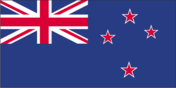
blue with the flag of the UK in the upper hoist-side quadrant with four red five-pointed stars edged in white centered in the outer half of the flag; the stars represent the Southern Cross constellation
Government - note
while not an official symbol, the Kiwi, a small native flightless bird, represents New Zealand
Government type
parliamentary democracy and a Commonwealth realm
Independence
26 September 1907 (from the UK)
International law organization participation
accepts compulsory ICJ jurisdiction with reservations; accepts ICCt jurisdiction
International organization participation
ADB, ANZUS (US suspended security obligations to NZ on 11 August 1986), APEC, ARF, ASEAN (dialogue partner), Australia Group, BIS, C, CP, EAS, EBRD, FAO, FATF, IAEA, IBRD, ICAO, ICC, ICRM, IDA, IEA, IFAD, IFC, IFRCS, IHO, ILO, IMF, IMO, IMSO, Interpol, IOC, IOM, IPU, ISO, ITSO, ITU, ITUC, MIGA, NSG, OECD, OPCW, Paris Club (associate), PCA, PIF, Sparteca, SPC, UN, UNCTAD, UNESCO, UNHCR, UNIDO, UNMISS, UNMIT, UNTSO, UPU, WCO, WFTU, WHO, WIPO, WMO, WTO
Judicial branch
Supreme Court; Court of Appeal; High Court; note - judges appointed by the governor general
Legal system
common law system, based on English model, with special legislation and land courts for the Maori
Legislative branch
- unicameral House of Representatives - commonly called Parliament (usually 120 seats; 70 members elected by popular vote in single-member constituencies including 7 Maori constituencies, 50 proportional seats chosen from party lists; serve three-year terms) last held on 26 November 2011 (next to be held not later than November 2014) percent of vote by party - National Party 48%, Labor Party 27.1%, Green Party 10.6%, NZ First 6.8%, Maori 1.4%, ACT Party 1.1%, Mana 1%, United Future 0.6%, other 3.43%; seats by party - National Party 60, Labor Party 34, Green Party 13, NZ First 8, Maori 3, ACT Party 1, Mana 1, United Future 1 results of 2011 election saw the total number of seats decline to 121
- election results
- percent of vote by party - National Party 48%, Labor Party 27.1%, Green Party 10.6%, NZ First 6.8%, Maori 1.4%, ACT Party 1.1%, Mana 1%, United Future 0.6%, other 3.43%; seats by party - National Party 60, Labor Party 34, Green Party 13, NZ First 8, Maori 3, ACT Party 1, Mana 1, United Future 1
- elections
- last held on 26 November 2011 (next to be held not later than November 2014)
National anthem
- "God Defend New Zealand" Thomas BRACKEN [English], Thomas Henry SMITH [Maori]/John Joseph WOODS adopted 1940 as national song, adopted 1977 as co-national anthem; New Zealand has two national anthems with equal status; as a commonwealth realm, in addition to "God Defend New Zealand," "God Save the Queen" serves as a national anthem (see United Kingdom); "God Save the Queen" normally is played only when a member of the royal family or the governor-general is present; in all other cases, "God Defend New Zealand" is played
- lyrics/music
- Thomas BRACKEN [English], Thomas Henry SMITH [Maori]/John Joseph WOODS
- name
- "God Defend New Zealand"
National holiday
Waitangi Day (Treaty of Waitangi established British sovereignty over New Zealand), 6 February (1840); ANZAC Day (commemorated as the anniversary of the landing of troops of the Australian and New Zealand Army Corps during World War I at Gallipoli, Turkey), 25 April (1915)
National symbol(s)
Southern Cross constellation (four, five-pointed stars); kiwi (bird)
Political parties and leaders
ACT New Zealand [Rodney HIDE]; Green Party [Russel NORMAN and Metiria TUREI]; Mana Party [Hone HARAWIRA]; Maori Party [Tariana TURIA and Dr. Pita SHARPLES]; New Zealand National Party [John KEY]; New Zealand First Party or NZ First [Winston PETERS]; New Zealand Labor Party [Phil GOFF]; Jim Anderton's Progressive Party [James (Jim) ANDERTON]; United Future New Zealand [Peter DUNNE]
Political pressure groups and leaders
- Women's Electoral Lobby or WEL apartheid groups; civil rights groups; farmers groups; Maori; nuclear weapons groups; women's rights groups
- other
- apartheid groups; civil rights groups; farmers groups; Maori; nuclear weapons groups; women's rights groups
Suffrage
18 years of age; universal
Economy
Agriculture - products
dairy products, lamb and mutton; wheat, barley, potatoes, pulses, fruits, vegetables; wool, beef; fish
Budget
- $53.9 billion $60.31 billion (2010 est.)
- expenditures
- $60.31 billion (2010 est.)
- revenues
- $53.9 billion
Budget surplus (+) or deficit (-)
-4.6% of GDP (2010 est.)
Central bank discount rate
2.5% (31 December 2009) 5% (31 December 2008)
Commercial bank prime lending rate
10.095% (31 December 2010 est.) 10.389% (31 December 2009 est.)
Current account balance
-$3.177 billion (2010 est.) -$3.625 billion (2009 est.)
Debt - external
$81.1 billion (31 December 2010 est.) $82.33 billion (31 December 2009 est.)
Distribution of family income - Gini index
36.2 (1997)
Economy - overview
Over the past 20 years the government has transformed New Zealand from an agrarian economy dependent on concessionary British market access to a more industrialized, free market economy that can compete globally. This dynamic growth has boosted real incomes - but left behind some at the bottom of the ladder - and broadened and deepened the technological capabilities of the industrial sector. Per capita income rose for ten consecutive years until 2007 in purchasing power parity terms, but fell in 2008-09. Debt-driven consumer spending drove robust growth in the first half of the decade, helping fuel a large balance of payments deficit that posed a challenge for economic managers. Inflationary pressures caused the central bank to raise its key rate steadily from January 2004 until it was among the highest in the OECD in 2007-08; international capital inflows attracted to the high rates further strengthened the currency and housing market, however, aggravating the current account deficit. The economy fell into recession before the start of the global financial crisis and contracted for five consecutive quarters in 2008-09. In line with global peers, the central bank cut interest rates aggressively and the government developed fiscal stimulus measures. The economy posted a 1.7% decline in 2009, but pulled out of recession late in the year, and achieved 2.1% growth in 2010. Nevertheless, key trade sectors remain vulnerable to weak external demand. The government plans to raise productivity growth and develop infrastructure, while reining in government spending.
Electricity - consumption
39.02 billion kWh (2008 est.)
Electricity - exports
0 kWh (2009 est.)
Electricity - imports
0 kWh (2009 est.)
Electricity - production
42 billion kWh (2009 est.)
Exchange rates
New Zealand dollars (NZD) per US dollar - 1.3874 (2010) 1.6002 (2009) 1.4151 (2008) 1.3811 (2007) 1.5408 (2006)
Exports
$31.88 billion (2010 est.) $25.34 billion (2009 est.)
Exports - commodities
dairy products, meat, wood and wood products, fish, machinery
Exports - partners
Australia 23.1%, China 11.2%, US 8.6%, Japan 7.8% (2010)
GDP - composition by sector
- 4.6% 24.4% 71% (2010 est.)
- agriculture
- 4.6%
- industry
- 24.4%
- services
- 71% (2010 est.)
GDP - per capita (PPP)
$27,700 (2010 est.) $27,500 (2009 est.) $28,400 (2008 est.) data are in 2010 US dollars
GDP - real growth rate
1.5% (2010 est.) -2.1% (2009 est.) -0.2% (2008 est.)
GDP (official exchange rate)
$140.4 billion (2010 est.)
GDP (purchasing power parity)
$117.8 billion (2010 est.) $116 billion (2009 est.) $118.5 billion (2008 est.) data are in 2010 US dollars
Household income or consumption by percentage share
- %NA %NA
- highest 10%
- %NA
- lowest 10%
- %NA
Imports
$29.52 billion (2010 est.) $24.02 billion (2009 est.)
Imports - commodities
machinery and equipment, vehicles and aircraft, petroleum, electronics, textiles, plastics
Imports - partners
Australia 18.1%, China 16%, US 10.5%, Japan 7.4%, Germany 4.1% (2010)
Industrial production growth rate
1.5% (2010 est.)
Industries
food processing, wood and paper products, textiles, machinery, transportation equipment, banking and insurance, tourism, mining
Inflation rate (consumer prices)
2.3% (2010 est.) 2.1% (2009 est.)
Investment (gross fixed)
19.5% of GDP (2010 est.)
Labor force
2.333 million (2010 est.)
Labor force - by occupation
- 7% 19% 74% (2006 est.)
- agriculture
- 7%
- industry
- 19%
- services
- 74% (2006 est.)
Market value of publicly traded shares
$36.3 billion (31 December 2010) $67.06 billion (31 December 2009) $24.17 billion (31 December 2008)
Natural gas - consumption
4.481 billion cu m (2010 est.)
Natural gas - exports
0 cu m (2010 est.)
Natural gas - imports
0 cu m (2010 est.)
Natural gas - production
4.481 billion cu m (2010 est.)
Natural gas - proved reserves
34.38 billion cu m (1 January 2011 est.)
Oil - consumption
149,700 bbl/day (2010 est.)
Oil - exports
47,200 bbl/day (2009 est.)
Oil - imports
138,000 bbl/day (2009 est.)
Oil - production
60,480 bbl/day (2010 est.)
Oil - proved reserves
112.5 million bbl (1 January 2011 est.)
Population below poverty line
NA%
Public debt
27.5% of GDP (2010 est.) 23.3% of GDP (2009 est.)
Reserves of foreign exchange and gold
$16.72 billion (31 December 2010 est.) $15.59 billion (31 December 2009 est.)
Stock of broad money
$145.3 billion (31 December 2010 est.) $125.5 billion (31 December 2009 est.)
Stock of direct foreign investment - abroad
$NA (31 December 2010) $59.08 billion (31 December 2009)
Stock of direct foreign investment - at home
$70.13 billion (31 December 2010 est.) $64.8 billion (31 December 2009 est.)
Stock of domestic credit
$236.2 billion (31 December 2010 est.) $208.9 billion (31 December 2009 est.)
Stock of narrow money
$28.11 billion (31 December 2010 est.) $25.18 billion (31 December 2009 est.)
Taxes and other revenues
38.4% of GDP (2010 est.)
Unemployment rate
6.5% (2010 est.) 6.2% (2009 est.)
Communications
Broadcast media
state-owned Television New Zealand operates multiple television networks while state-owned Radio New Zealand operates 3 radio networks and an external shortwave radio service to the South Pacific region; a small number of national commercial television and radio stations and a large number of regional commercial television and radio stations are available; cable and satellite TV systems are accessible (2008)
Internet country code
.nz
Internet hosts
2.47 million (2010)
Internet users
3.4 million (2009)
Telephone system
- excellent domestic and international systems combined fixed-line and mobile-cellular telephone subscribership exceeds 150 per 100 persons country code - 64; the Southern Cross submarine cable system provides links to Australia, Fiji, and the US; satellite earth stations - 8 (1 Inmarsat - Pacific Ocean, 7 other)
- domestic
- combined fixed-line and mobile-cellular telephone subscribership exceeds 150 per 100 persons
- general assessment
- excellent domestic and international systems
- international
- country code - 64; the Southern Cross submarine cable system provides links to Australia, Fiji, and the US; satellite earth stations - 8 (1 Inmarsat - Pacific Ocean, 7 other)
Telephones - main lines in use
1.87 million (2010)
Telephones - mobile cellular
5.02 million (2010)
Transportation
Airports
122 (2010)
Airports - with paved runways
- 1 (2010)
- 1,524 to 2,437 m
- 12
- 2,438 to 3,047 m
- 1
- 914 to 1,523 m
- 24
- over 3,047 m
- 2
- total
- 40
- under 914 m
- 1 (2010)
Airports - with unpaved runways
- 47 (2010)
- 1,524 to 2,437 m
- 3
- 914 to 1,523 m
- 32
- total
- 82
- under 914 m
- 47 (2010)
Merchant marine
- bulk carrier 3, cargo 3, chemical tanker 1, container 1, passenger/cargo 4, petroleum tanker 2 7 (Australia 1, Germany 2, Hong Kong 1, South Africa 1, Switzerland 2) 6 (Antigua and Barbuda 2, Cook Islands 1, France 1, Samoa 1, UK 1) (2010)
- foreign-owned
- 7 (Australia 1, Germany 2, Hong Kong 1, South Africa 1, Switzerland 2)
- registered in other countries
- 6 (Antigua and Barbuda 2, Cook Islands 1, France 1, Samoa 1, UK 1) (2010)
- total
- 14
Pipelines
condensate 331 km; gas 1,838 km; liquid petroleum gas 172 km; oil 288 km; refined products 198 km (2010)
Ports and terminals
Auckland, Lyttelton, Manukau Harbor, Marsden Point, Tauranga, Wellington
Railways
- 4,128 km 4,128 km 1.067-m gauge (506 km electrified) (2010)
- total
- 4,128 km
Roadways
- 93,911 km 61,879 km (includes 172 km of expressways) 32,032 km (2009)
- total
- 93,911 km
- unpaved
- 32,032 km (2009)
Military and Security
Manpower available for military service
- 1,019,798 1,003,429 (2010 est.)
- females age 16-49
- 1,003,429 (2010 est.)
- males age 16-49
- 1,019,798
Manpower fit for military service
- 843,526 828,779 (2010 est.)
- females age 16-49
- 828,779 (2010 est.)
- males age 16-49
- 843,526
Manpower reaching militarily significant age annually
- 30,846 28,825 (2010 est.)
- female
- 28,825 (2010 est.)
- male
- 30,846
Military branches
- New Zealand Defense Force (NZDF): New Zealand Army, Royal New Zealand Navy, Royal New Zealand Air Force (Te Hokowhitu o Kahurangi, RNZAF) (2010)
- New Zealand Defense Force (NZDF)
- New Zealand Army, Royal New Zealand Navy, Royal New Zealand Air Force (Te Hokowhitu o Kahurangi, RNZAF) (2010)
Military expenditures
1% of GDP (2005 est.)
Military service age and obligation
17 years of age for voluntary military service; soldiers cannot be deployed until the age of 18; no conscription (2010)
Transnational Issues
Disputes - international
asserts a territorial claim in Antarctica (Ross Dependency)
Illicit drugs
significant consumer of amphetamines