1993 Edition
CIA World Factbook 1993 (Project Gutenberg)
Geography
Area
total area: 268,680 km2 land area: 268,670 km2 comparative area: about the size of Colorado note: includes Antipodes Islands, Auckland Islands, Bounty Islands, Campbell Island, Chatham Islands, and Kermadec Islands
Climate
temperate with sharp regional contrasts
Coastline
15,134 km
Environment
earthquakes are common, though usually not severe
International disputes
territorial claim in Antarctica (Ross Dependency)
Irrigated land
2,800 km2 (1989 est.)
Land boundaries
0 km
Land use
arable land: 2% permanent crops: 0% meadows and pastures: 53% forest and woodland: 38% other: 7%
Location
Oceania, southeast of Australia in the South Pacific Ocean
Map references
Oceania, Standard Time Zones of the World
Maritime claims
continental shelf: 200 nm or the edge of continental margin exclusive economic zone: 200 nm territorial sea: 12 nm
Natural resources
natural gas, iron ore, sand, coal, timber, hydropower, gold, limestone
Terrain
predominately mountainous with some large coastal plains
People and Society
Birth rate
15.93 births/1,000 population (1993 est.)
Death rate
8.11 deaths/1,000 population (1993 est.)
Ethnic divisions
European 88%, Maori 8.9%, Pacific Islander 2.9%, other 0.2%
Infant mortality rate
9.1 deaths/1,000 live births (1993 est.)
Labor force
1,603,500 (June 1991) by occupation: services 67.4%, manufacturing 19.8%, primary production 9.3% (1987)
Languages
English (official), Maori
Life expectancy at birth
total population: 76.11 years male: 72.46 years female: 79.95 years (1993 est.)
Literacy
age 15 and over can read and write (1980) total population: 99% male: NA% female: NA%
Nationality
noun: New Zealander(s) adjective: New Zealand
Net migration rate
-1.69 migrant(s)/1,000 population (1993 est.)
Population
3,368,774 (July 1993 est.)
Population growth rate
0.61% (1993 est.)
Religions
Anglican 24%, Presbyterian 18%, Roman Catholic 15%, Methodist 5%, Baptist 2%, other Protestant 3%, unspecified or none 9% (1986)
Total fertility rate
2.07 children born/woman (1993 est.)
Government
Abbreviation
NZ
Administrative divisions
93 counties, 9 districts*, and 3 town districts**; Akaroa, Amuri,, Ashburton, Bay of Islands, Bruce, Buller, Chatham Islands, Cheviot, Clifton, Clutha, Cook, Dannevirke, Egmont, Eketahuna, Ellesmere, Eltham, Eyre, Featherston, Franklin, Golden Bay, Great Barrier Island, Grey, Hauraki Plains, Hawera*,, Hawke's Bay, Heathcote, Hikurangi**, Hobson, Hokianga, Horowhenua, Hurunui,, Hutt, Inangahua, Inglewood, Kaikoura, Kairanga, Kiwitea, Lake, Mackenzie, Malvern, Manaia**, Manawatu, Mangonui, Maniototo, Marlborough, Masterton,, Matamata, Mount Herbert, Ohinemuri, Opotiki, Oroua, Otamatea, Otorohanga*,, Oxford, Pahiatua, Paparua, Patea, Piako, Pohangina, Raglan, Rangiora*,, Rangitikei, Rodney, Rotorua*, Runanga, Saint Kilda,, Silverpeaks, Southland, Stewart Island, Stratford, Strathallan, Taranaki, Taumarunui, Taupo, Tauranga, Thames-Coromandel*, Tuapeka, Vincent, Waiapu, Waiheke, Waihemo,, Waikato, Waikohu, Waimairi, Waimarino, Waimate, Waimate West, Waimea, Waipa, Waipawa*, Waipukurau*, Wairarapa South, Wairewa, Wairoa, Waitaki, Waitomo*,, Waitotara, Wallace, Wanganui, Waverley**, Westland, Whakatane*, Whangarei,, Whangaroa, Woodville
Capital
Wellington
Chief of State
Queen ELIZABETH II (since 6 February 1952), represented by Governor General Dame Catherine TIZARD (since 12 December 1990)
Constitution
no formal, written constitution; consists of various documents, including certain acts of the UK and New Zealand Parliaments; Constitution Act 1986 was to have come into force 1 January 1987, but has not been enacted
Dependent areas
Cook Islands, Niue, Tokelau
Digraph
NZ
Diplomatic representation in US
chief of mission: Ambassador Denis Bazely Gordon McLEAN chancery: 37 Observatory Circle NW, Washington, DC 20008 telephone: (202) 328-4800 consulates general: Los Angeles and New York
Executive branch
British monarch, governor general, prime minister, deputy prime minister, Cabinet
FAX
[64] (4) 723-537 consulate general: Auckland
Flag
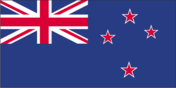
blue with the flag of the UK in the upper hoist-side quadrant with four red five-pointed stars edged in white centered in the outer half of the flag; the stars represent the Southern Cross constellation
Head of Government
Prime Minister James BOLGER (since 29 October 1990); Deputy Prime Minister Donald McKINNON (since 2 November 1990)
House of Representatives
last held on 27 October 1990 (next to be held NA November 1993); results - NP 49%, NZLP 35%, Green Party 7%, NLP 5%; seats - (97 total) NP 67, NZLP 29, NLP 1
Independence
26 September 1907 (from UK)
Judicial branch
High Court, Court of Appeal
Legal system
based on English law, with special land legislation and land courts for Maoris; accepts compulsory ICJ jurisdiction, with reservations
Legislative branch
unicameral House of Representatives (commonly called Parliament)
Member of
ANZUS (US suspended security obligations to NZ on 11 August 1986), APEC, AsDB, Australia Group, C, CCC, CP, COCOM (cooperating country), EBRD, ESCAP, FAO, GATT, IAEA, IBRD, ICAO, ICFTU, IDA, IEA, IFAD, IFC, ILO, IMF, IMO, INMARSAT, INTELSAT, INTERPOL, IOC, IOM (observer), ISO, ITU, LORCS, MTCR, NAM (guest), OECD, PCA, SPARTECA, SPC, SPF, UN, UNAVEM II, UNCTAD, UNESCO, UNIDO, UNOSOM, UNPROFOR, UNTAC, UNTSO, UPU, WHO, WIPO, WMO
Names
conventional long form: none conventional short form: New Zealand
National holiday
Waitangi Day, 6 February (1840) (Treaty of Waitangi established British sovereignty)
Political parties and leaders
National Party (NP; government), James BOLGER; New Zealand Labor Party (NZLP; opposition), Michael MOORE; NewLabor Party (NLP), Jim ANDERTON; Democratic Party, Dick RYAN; New Zealand Liberal Party, Hanmish MACINTYRE and Gilbert MYLES; Green Party, no official leader; Mana Motuhake, Martin RATA; Socialist Unity Party (SUP; pro-Soviet), Kenneth DOUGLAS note: the New Labor, Democratic, and Mana Motuhake parties formed a coalition called the Alliance Party, Jim ANDERTON, president, in September 1991; the Green Party joined the coalition in May 1992
Suffrage
18 years of age; universal
Type
parliamentary democracy
US diplomatic representation
chief of mission: (vacant) embassy: 29 Fitzherbert Terrace, Thorndon, Wellington mailing address: P. O. Box 1190, Wellington; PSC 467, Box 1, FPO AP 96531-1001 telephone: [64] (4) 722-068
Economy
Agriculture
accounts for about 9% of GDP and about 10% of the work force; livestock predominates - wool, meat, dairy products all export earners; crops - wheat, barley, potatoes, pulses, fruits, vegetables; surplus producer of farm products; fish catch reached a record 503,000 metric tons in 1988
Budget
revenues $14.0 billion; expenditures $15.2 billion, including capital expenditures of $NA (1992)
Currency
1 New Zealand dollar (NZ$) = 100 cents
Economic aid
donor - ODA and OOF commitments (1970-89), $526 million
Electricity
8,000,000 kW capacity; 31,000 million kWh produced, 9,250 kWh per capita (1992)
Exchange rates
New Zealand dollars (NZ$) per US$1 - 1.9486 (January 1993), 1.8584 (1992), 1.7265 (1991), 1.6750 (1990), 1.6711 (1989), 1.5244 (1988)
Exports
$3.65 billion (f.o.b., FY92) commodities: wool, lamb, mutton, beef, fruit, fish, cheese, manufactures, chemicals, forestry products partners: EC 18.3%, Japan 17.9%, Australia 17.5%, US 13.5%, China 3.6%, South Korea 3.1%
External debt
$38.5 billion (September 1992)
Fiscal year
1 July - 30 June
Imports
$3.99 billion (f.o.b., FY92) commodities: petroleum, consumer goods, motor vehicles, industrial equipment partners: Australia 19.7%, Japan 16.9%, EC 16.9%, US 15.3%, Taiwan 3.0%
Industrial production
growth rate 1.9% (1990); accounts for about 20% of GDP
Industries
food processing, wood and paper products, textiles, machinery, transportation equipment, banking and insurance, tourism, mining
Inflation rate (consumer prices)
2.2% (1991)
National product
GDP - purchasing power equivalent - $49.8 billion (1992)
National product per capita
$14,900 (1992)
National product real growth rate
3% (1992)
Overview
- Since 1984 the government has been reorienting an agrarian economy dependent on a guaranteed British market to an open free market economy that can compete on the global scene. The government has hoped that dynamic growth would boost real incomes, broaden and deepen the technological capabilities of the industrial sector, reduce inflationary pressures, and permit the
- down from double-digit levels, but growth was sluggish in 1988-91, and unemployment, always a highly sensitive issue, has exceeded 10% since May 1991. In 1992, growth picked up to 3%, a sign that the new economic approach is beginning to pay off.
- expansion of welfare benefits. The results have been mixed
- inflation is
Unemployment rate
10.1% (September 1992)
Communications
Airports
total: 120 usable: 120 with permanent-surface runways: 33 with runways over 3,659 m: 1 with runways 2,440-3,659 m: 2 with runways 1,220-2,439 m: 42
Highways
92,648 km total; 49,547 km paved, 43,101 km gravel or crushed stone
Inland waterways
1,609 km; of little importance to transportation
Merchant marine
18 ships (1,000 GRT or over) totaling 182,206 GRT/246,446 DWT; includes 2 cargo, 5 roll-on/roll-off, 1 railcar carrier, 4 oil tanker, 1 liquefied gas, 5 bulk
Pipelines
natural gas 1,000 km; petroleum products 160 km; condensate (liquified petroleum gas - LPG) 150 km
Ports
Auckland, Christchurch, Dunedin, Wellington, Tauranga
Railroads
4,716 km total; all 1.067-meter gauge; 274 km double track; 113 km electrified; over 99% government owned
Telecommunications
excellent international and domestic systems; 2,110,000 telephones; broadcast stations - 64 AM, 2 FM, 14 TV; submarine cables extend to Australia and Fiji; 2 Pacific Ocean INTELSAT earth stations
Military and Security
Branches
New Zealand Army, Royal New Zealand Navy, Royal New Zealand Air Force
Defense expenditures
exchange rate conversion - $792 million, 2% of GDP (FY90/91)
Manpower availability
males age 15-49 878,028; fit for military service 741,104; reach military age (20) annually 29,319 (1993 est.)