2020 Edition
factbook.json (GitHub)
Introduction
Background
During the late 18th and early 19th centuries, the principality of Gorkha united many of the other principalities and states of the sub-Himalayan region into a Nepali Kingdom. Nepal retained its independence after the Anglo-Nepalese War of 1814-16, and the subsequent peace treaty laid the foundations for two centuries of amicable relations between Britain and Nepal. In 1951, the Nepali monarch ended the century-old system of hereditary rule and instituted a cabinet system that brought political parties into the government. That arrangement lasted until 1960, when political parties were again banned, but it was reinstated in 1990 with the establishment of a multiparty democracy within the framework of a constitutional monarchy. A Maoist-led insurgency broke out in 1996. During the ensuing 10-year civil war between Maoist and government forces, the monarchy dissolved the cabinet and parliament. In 2001, Crown Prince DIPENDRA first massacred the royal family and then shot himself. His uncle GYANENDRA became king, and the monarchy reassumed absolute power the next year. A peace accord in 2006 led to the promulgation of an interim constitution in 2007. After a nationwide Constituent Assembly (CA) election in 2008, the newly formed CA declared Nepal a federal democratic republic, abolished the monarchy, and elected the country's first president. When the CA failed to draft a Supreme Court-mandated constitution, then-Prime Minister Baburam BHATTARAI dissolved the CA. An interim government held elections in 2013, in which the Nepali Congress (NC) won the largest share of seats. In 2014, NC formed a coalition government with the second-place Communist Party of Nepal-Unified Marxist-Leninist (UML). Nepal's new constitution came into effect in 2015, at which point the CA became the Parliament and Khagda Prasad Sharma OLI the first post-constitution prime minister (2015-16). He resigned ahead of a no-confidence motion, and Parliament elected Communist Party of Nepal-Maoist (CPN-M) leader Pushpa Kamal DAHAL as prime minister. The parties headed by OLI and DAHAL ran in coalition and swept the parliamentary elections in 2017, and OLI was sworn in as prime minister in 2018. OLI's efforts to dissolve parliament and hold elections were declared unconstitutional in 2021, and the opposition-supported NC leader Sher Bahadur DEUBA was named prime minister. The NC won a majority of seats in the parliamentary elections in 2022, but DAHAL then broke with the ruling coalition and partnered with OLI and the CPN-UML to become prime minister. DAHAL's first cabinet lasted about two months, until OLI withdrew his support over disagreements about ministerial assignments. In early 2023, DAHAL survived a vote of confidence and formed a coalition with the NC to remain prime minister.
Geography
Area
- land
- 143,351 sq km
- total
- 147,181 sq km
- water
- 3,830 sq km
Area - comparative
slightly larger than New York State
Climate
varies from cool summers and severe winters in north to subtropical summers and mild winters in south
Coastline
0 km (landlocked)
Elevation
- highest point
- Mount Everest (highest peak in Asia and highest point on earth above sea level) 8,849 m
- lowest point
- Kanchan Kalan 70 m
- mean elevation
- 2,565 m
Geographic coordinates
28 00 N, 84 00 E
Geography - note
landlocked; strategic location between China and India; contains eight of world's 10 highest peaks, including Mount Everest and Kanchenjunga -- the world's tallest and third-tallest mountains -- on the borders with China and India, respectively
Irrigated land
12,090 sq km (2022)
Land boundaries
- border countries
- China 1,389 km; India 1,770 km
- total
- 3,159 km
Land use
- agricultural land
- 26.1% (2023 est.)
- agricultural land: arable land
- arable land: 12.6% (2023 est.)
- agricultural land: permanent crops
- permanent crops: 1% (2023 est.)
- agricultural land: permanent pasture
- permanent pasture: 12.5% (2023 est.)
- forest
- 43.5% (2023 est.)
- other
- 27.7% (2023 est.)
Location
Southern Asia, between China and India
Major aquifers
Indus-Ganges-Brahmaputra Basin
Major watersheds (area sq km)
- Indian Ocean drainage
- Brahmaputra (651,335 sq km), Ganges (1,016,124 sq km), Indus (1,081,718 sq km)
Map references
Asia
Maritime claims
none (landlocked)
Natural hazards
severe thunderstorms; flooding; landslides; drought and famine depending on the timing, intensity, and duration of the summer monsoons
Natural resources
quartz, water, timber, hydropower, scenic beauty, small deposits of lignite, copper, cobalt, iron ore
Population distribution
most of the population is divided nearly equally between a concentration in the southern-most plains of the Tarai region and the central hilly region; overall density is low
Terrain
Tarai or flat river plain of the Ganges in south; central hill region with rugged Himalayas in north
People and Society
Age structure
- 0-14 years
- 25.8% (male 4,125,244/female 3,909,135)
- 15-64 years
- 67.8% (male 10,153,682/female 10,957,011)
- 65 years and over
- 6.4% (2024 est.) (male 961,717/female 1,015,598)
Alcohol consumption per capita
- beer
- 0.22 liters of pure alcohol (2019 est.)
- other alcohols
- 0 liters of pure alcohol (2019 est.)
- spirits
- 0.13 liters of pure alcohol (2019 est.)
- total
- 0.36 liters of pure alcohol (2019 est.)
- wine
- 0 liters of pure alcohol (2019 est.)
Birth rate
16.66 births/1,000 population (2025 est.)
Child marriage
- men married by age 18
- 7% (2022)
- women married by age 15
- 5.8% (2022)
- women married by age 18
- 34.9% (2022)
Children under the age of 5 years underweight
18.3% (2022 est.)
Currently married women (ages 15-49)
75.1% (2022 est.)
Death rate
5.62 deaths/1,000 population (2025 est.)
Dependency ratios
- elderly dependency ratio
- 9.6 (2025 est.)
- potential support ratio
- 10.4 (2025 est.)
- total dependency ratio
- 46.8 (2025 est.)
- youth dependency ratio
- 37.2 (2025 est.)
Drinking water source
- improved: rural
- rural: 91.6% of population (2022 est.)
- improved: total
- total: 91.2% of population (2022 est.)
- improved: urban
- urban: 90% of population (2022 est.)
- unimproved: rural
- rural: 8.4% of population (2022 est.)
- unimproved: total
- total: 8.8% of population (2022 est.)
- unimproved: urban
- urban: 10% of population (2022 est.)
Education expenditure
- Education expenditure (% GDP)
- 3.7% of GDP (2024 est.)
- Education expenditure (% national budget)
- 10.8% national budget (2025 est.)
Ethnic groups
Chhettri 16.5%, Brahman-Hill 11.3%, Magar 6.9%, Tharu 6.2%, Tamang 5.6%, Bishwokarma 5%, Musalman 4.9%, Newar 4.6%, Yadav 4.2%, Rai 2.2%, Pariyar 1.9%, Gurung 1.9%, Thakuri 1.7%, Mijar 1.6%, Teli 1.5%, Yakthung/Limbu 1.4%, Chamar/Harijan/Ram 1.4%, Koiri/Kushwaha 1.2%, other 20% (2021 est.)
Gross reproduction rate
0.88 (2025 est.)
Health expenditure
- Health expenditure (as % of GDP)
- 5.4% of GDP (2021)
- Health expenditure (as % of national budget)
- 8% of national budget (2022 est.)
Hospital bed density
0.4 beds/1,000 population (2021 est.)
Infant mortality rate
- female
- 22.7 deaths/1,000 live births
- male
- 25.2 deaths/1,000 live births
- total
- 23.4 deaths/1,000 live births (2025 est.)
Languages
- Languages
- Nepali (official) 44.9%, Maithali 11.1%, Bhojpuri 6.2%, Tharu 5.9%, Tamang 4.9%, Bajjika 3.9%, Avadhi 3%, Nepalbhasha (Newari) 3%, Magar Dhut 2.8%, Doteli 1.7%, Urdu 1.4%, Yakthung/Limbu 1.2%, Gurung 1.1%, other 8.9% (2021 est.)
- major-language sample(s)
- विश्व तथ्य पुस्तक,आधारभूत जानकारीको लागि अपरिहार्य स्रोत (Nepali) The World Factbook, the indispensable source for basic information.
Life expectancy at birth
- female
- 73.7 years
- male
- 72.2 years
- total population
- 73 years (2024 est.)
Literacy
- female
- 59.4% (2019 est.)
- male
- 79.8% (2019 est.)
- total population
- 68.7% (2019 est.)
Major urban areas - population
1.571 million KATHMANDU (capital) (2023)
Maternal mortality ratio
142 deaths/100,000 live births (2023 est.)
Median age
- female
- 28.6 years
- male
- 26.5 years
- total
- 28.1 years (2025 est.)
Mother's mean age at first birth
20.4 years (2016 est.)
Nationality
- adjective
- Nepali
- noun
- Nepali (singular and plural)
Net migration rate
-4.46 migrant(s)/1,000 population (2025 est.)
Obesity - adult prevalence rate
4.1% (2016)
Physician density
1.01 physicians/1,000 population (2023)
Population
- female
- 15,981,696
- male
- 15,352,706
- total
- 31,334,402 (2025 est.)
Population growth rate
0.66% (2025 est.)
Religions
Hindu 81.2%, Buddhist 8.2%, Muslim 5.1%, Kirat 3.2%, Christian 1.8%; less than 1%: Prakriti, Bon, Jains, Sikh (2021 est.)
Sanitation facility access
- improved: rural
- rural: 89.2% of population (2022 est.)
- improved: total
- total: 90.7% of population (2022 est.)
- improved: urban
- urban: 96.1% of population (2022 est.)
- unimproved: rural
- rural: 10.8% of population (2022 est.)
- unimproved: total
- total: 9.3% of population (2022 est.)
- unimproved: urban
- urban: 3.9% of population (2022 est.)
School life expectancy (primary to tertiary education)
- female
- 14 years (2023 est.)
- male
- 14 years (2023 est.)
- total
- 14 years (2023 est.)
Sex ratio
- 0-14 years
- 1.06 male(s)/female
- 15-64 years
- 0.93 male(s)/female
- 65 years and over
- 0.95 male(s)/female
- at birth
- 1.06 male(s)/female
- total population
- 0.96 male(s)/female (2024 est.)
Tobacco use
- female
- 7.6% (2025 est.)
- male
- 40.3% (2025 est.)
- total
- 22.9% (2025 est.)
Total fertility rate
1.82 children born/woman (2025 est.)
Urbanization
- rate of urbanization
- 3.09% annual rate of change (2020-25 est.)
- urban population
- 21.9% of total population (2023)
Government
Administrative divisions
7 provinces (pradesh, singular - pradesh); Bagmati, Gandaki, Karnali, Koshi, Lumbini, Madhesh, Sudurpashchim
Capital
- etymology
- the name comes from the Nepalese words kath (wooden) and mandu (temple), referring to the local temples that are often still built from wood
- geographic coordinates
- 27 43 N, 85 19 E
- name
- Kathmandu
- time difference
- UTC+5.75 (10.75 hours ahead of Washington, DC, during Standard Time)
Citizenship
- citizenship by birth
- yes
- citizenship by descent only
- yes
- dual citizenship recognized
- no
- residency requirement for naturalization
- 15 years
Constitution
- amendment process
- proposed as a bill by either house of the Federal Parliament; bills affecting a state border or powers delegated to a state must be submitted to the affected state assembly; passage of such bills requires a majority vote of that state assembly membership; bills not requiring state assembly consent require at least two-thirds majority vote by the membership of both houses of the Federal Parliament; parts of the constitution on the sovereignty, territorial integrity, independence, and sovereignty vested in the people cannot be amended
- history
- several previous; latest approved by the Second Constituent Assembly 16 September 2015, signed by the president and effective 20 September 2015
Country name
- conventional long form
- none
- conventional short form
- Nepal
- etymology
- the name probably comes from the Sanskrit term nepala, from the words for "fly down" and "house," which would refer to the villages at the base of the mountains
- local long form
- none
- local short form
- Nepal
Diplomatic representation from the US
- chief of mission
- Ambassador Dean R. THOMPSON (since October 2022)
- email address and website
- usembktm@state.gov https://np.usembassy.gov/
- embassy
- Maharajgunj, Kathmandu
- FAX
- [977] (1) 400-7272
- mailing address
- 6190 Kathmandu Place, Washington DC 20521-6190
- telephone
- [977] (1) 423-4000
Diplomatic representation in the US
- chancery
- 2730 34th Place NW, Washington, DC 20007
- chief of mission
- Ambassador (vacant); Chargé d'Affaires Sharad Raj ARAN (since November 2025)
- consulate(s) general
- New York
- email address and website
- info@nepalembassyusa.org https://us.nepalembassy.gov.np/
- FAX
- [1] (202) 667-5534
- telephone
- [1] (202) 667-4550
Executive branch
- cabinet
- Council of Ministers appointed by the prime minister; cabinet positions shared among Nepali Congress, Communist Party of Nepal-Maoist Centre, and various coalition partners
- chief of state
- President Ram Chandra POUDEL (since 13 March 2023)
- election results
- 2023: Ram Chandra POUDEL elected president; electoral college vote - Ram Chandra POUDEL (NC) 33,802, Subash Chandra NEMBANG (CPN-UML) 15,518
- election/appointment process
- president indirectly elected by an electoral college of the Federal Parliament and the state assemblies for a 5-year term (eligible for a second term)
- expected date of next election
- 5 March 2026
- head of government
- Prime Minister Sushila KARKI (since 12 September 2025)
- most recent election date
- 9 March 2023
Flag
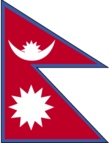
description: crimson red with a blue border, in the shape of two overlapping right triangles; the smaller upper triangle has a stylized white moon, and the larger lower triangle has a 12-pointed white sun meaning: red stands for the rhododendron (the national flower) and victory and bravery, and the blue border for peace and harmony; the two triangles are a combination of two pennants that originally symbolized the Himalaya Mountains, but today they refer to Hinduism and Buddhism, the country's two main religions; the moon stands for the serenity of the people, as well as Himalayan shade and cool weather, and the sun for the heat and higher temperatures in the rest of the country
Government type
federal parliamentary republic
Independence
1768 (unified by Prithvi Narayan SHAH)
International law organization participation
has not submitted an ICJ jurisdiction declaration; non-party state to the ICCt
International organization participation
ADB, BIMSTEC, CD, CP, FAO, G-77, IAEA, IBRD, ICAO, ICC (NGOs), ICRM, IDA, IFAD, IFC, IFRCS, ILO, IMF, IMO, Interpol, IOC, IOM, IPU, ISO, ITSO, ITU, ITUC (NGOs), MIGA, MINURSO, MINUSTAH, MONUSCO, NAM, OPCW, SAARC, SACEP, UN, UNAMID, UNCTAD, UNDOF, UNESCO, UNIDO, UNIFIL, UNISFA, UNMIL, UNMISS, UNOCI, UNSOM, UNTSO, UNWTO, UPU, WCO, WFTU (NGOs), WHO, WIPO, WMO, WTO
Judicial branch
- highest court(s)
- Supreme Court (consists of the chief justice and up to 20 judges)
- judge selection and term of office
- Supreme Court chief justice appointed by the president on the recommendation of the Constitutional Council, a 5-member, high-level advisory body headed by the prime minister; other judges appointed by the president on the recommendation of the Judicial Council, a 5-member advisory body headed by the chief justice; the chief justice serves a 6-year term; judges serve until age 65
- subordinate courts
- High Court; district courts
Legal system
English common law and Hindu legal concepts
Legislative branch
- legislative structure
- bicameral
- legislature name
- Federal Parliament (Sanghiya Sansad)
Legislative branch - lower chamber
- chamber name
- House of Representatives (Pratinidhi Sabha)
- electoral system
- mixed system
- expected date of next election
- 5 March 2026
- most recent election date
- 11/20/2022
- number of seats
- 275 (all directly elected)
- parties elected and seats per party
- Nepali Congress (NC) (89); Communist Party of Nepal (Unified Marxist-Leninist, UML) (78); Communist Party of Nepal-Maoist Centre (CPN-MC) (32); Rastriya Swatantra Party (20); Rastriya Prajatantra Party Nepal (RPP) (14); People's Socialist Party, Nepal (12); Communist Party of Nepal (Unified Socialist) (10); Janamat Party (6); Democratic Socialist Party, Nepal (4); People's Freedom Party (3); Nepal Workers Peasants Party (1); Rastriya Janamorcha (1); Independents (5)
- percentage of women in chamber
- 0%
- scope of elections
- full renewal
- term in office
- 5 years
Legislative branch - upper chamber
- chamber name
- National Assembly (Rastriya Sabha)
- expected date of next election
- January 2026
- most recent election date
- 1/25/2024
- number of seats
- 59 (56 indirectly elected; 3 appointed)
- percentage of women in chamber
- 37.3%
- scope of elections
- partial renewal
- term in office
- 6 years
National anthem(s)
- history
- adopted 2007
- lyrics/music
- Pradeep Kumar RAI/Ambar GURUNG
- title
- "Sayaun Thunga Phool Ka" (Hundreds of Flowers)
National color(s)
red
National heritage
- selected World Heritage Site locales
- Kathmandu Valley (c); Sagarmatha National Park (n); Chitwan National Park (n); Lumbini, Buddha Birthplace (c)
- total World Heritage Sites
- 4 (2 cultural, 2 natural)
National holiday
Constitution Day, 20 September (2015)
National symbol(s)
rhododendron blossom
Political parties
Communist Party of Nepal (Maoist Centre) or CPN-MC Communist Party of Nepal (Unified Marxist-Leninist) or CPN-UML Communist Party of Nepal (Unified Socialist) or CPN-US Janamat Party Janata Samajbaadi Party or JSP Loktantrik Samajwadi Party or LSP Naya Shakti Party, Nepal Nepali Congress or NC Nepal Mazdoor Kisan Party (Nepal Workers' and Peasants' Party) or NWPP Rastriya Janamorcha (National People's Front) Rastriya Prajatantra Party (National Democratic Party) or RPP Rastriya Swatantra Party or RSP
Suffrage
18 years of age; universal
Economy
Agricultural products
rice, vegetables, potatoes, sugarcane, maize, wheat, bison milk, milk, mangoes/guavas, bananas (2023)
Budget
- expenditures
- $9.1 billion (2021 est.)
- revenues
- $7.625 billion (2021 est.)
Current account balance
- Current account balance 2022
- -$3.088 billion (2022 est.)
- Current account balance 2023
- $146.66 million (2023 est.)
- Current account balance 2024
- $1.954 billion (2024 est.)
Debt - external
- Debt - external 2023
- $5.719 billion (2023 est.)
Economic overview
low-income South Asian economy; post-conflict fiscal federalism increasing stability; COVID-19 hurt trade and tourism; widening current account deficits; environmentally fragile economy from earthquakes; growing Chinese relations and investments
Exchange rates
- Currency
- Nepalese rupees (NPR) per US dollar -
- Exchange rates 2020
- 118.345 (2020 est.)
- Exchange rates 2021
- 118.134 (2021 est.)
- Exchange rates 2022
- 125.199 (2022 est.)
- Exchange rates 2023
- 132.115 (2023 est.)
- Exchange rates 2024
- 133.727 (2024 est.)
Exports
- Exports 2022
- $2.106 billion (2022 est.)
- Exports 2023
- $2.258 billion (2023 est.)
- Exports 2024
- $3.744 billion (2024 est.)
Exports - commodities
knotted carpets, garments, flat-rolled iron, synthetic fibers, palm oil (2023)
Exports - partners
India 67%, USA 12%, Germany 3%, China 2%, UK 2% (2023)
GDP - composition, by end use
- exports of goods and services
- 7.6% (2024 est.)
- government consumption
- 7.4% (2024 est.)
- household consumption
- 86.3% (2024 est.)
- imports of goods and services
- -32.9% (2024 est.)
- investment in fixed capital
- 24.3% (2024 est.)
- investment in inventories
- 6.1% (2024 est.)
GDP - composition, by sector of origin
- agriculture
- 21.9% (2024 est.)
- industry
- 11.4% (2024 est.)
- services
- 55.2% (2024 est.)
GDP (official exchange rate)
$42.914 billion (2024 est.)
Gini Index coefficient - distribution of family income
- Gini Index coefficient - distribution of family income 2022
- 30 (2022 est.)
Household income or consumption by percentage share
- highest 10%
- 24.2% (2022 est.)
- lowest 10%
- 3.7% (2022 est.)
Imports
- Imports 2022
- $15.227 billion (2022 est.)
- Imports 2023
- $13.877 billion (2023 est.)
- Imports 2024
- $17.777 billion (2024 est.)
Imports - commodities
refined petroleum, natural gas, garments, iron reductions, broadcasting equipment (2023)
Imports - partners
India 71%, China 17%, UAE 3%, Singapore 2%, Germany 1% (2023)
Industrial production growth rate
0.1% (2024 est.)
Industries
tourism, carpets, textiles, small rice, jute, sugar, oilseed mills, cigarettes, cement and brick production
Inflation rate (consumer prices)
- Inflation rate (consumer prices) 2021
- 4.1% (2021 est.)
- Inflation rate (consumer prices) 2022
- 7.7% (2022 est.)
- Inflation rate (consumer prices) 2023
- 7.1% (2023 est.)
Labor force
8.435 million (2024 est.)
Population below poverty line
20.3% (2022 est.)
Public debt
- Public debt 2021
- 39.9% of GDP (2021 est.)
Real GDP (purchasing power parity)
- Real GDP (purchasing power parity) 2022
- $141.546 billion (2022 est.)
- Real GDP (purchasing power parity) 2023
- $144.352 billion (2023 est.)
- Real GDP (purchasing power parity) 2024
- $149.643 billion (2024 est.)
Real GDP growth rate
- Real GDP growth rate 2022
- 5.6% (2022 est.)
- Real GDP growth rate 2023
- 2% (2023 est.)
- Real GDP growth rate 2024
- 3.7% (2024 est.)
Real GDP per capita
- Real GDP per capita 2022
- $4,800 (2022 est.)
- Real GDP per capita 2023
- $4,900 (2023 est.)
- Real GDP per capita 2024
- $5,000 (2024 est.)
Remittances
- Remittances 2022
- 22% of GDP (2022 est.)
- Remittances 2023
- 25.3% of GDP (2023 est.)
- Remittances 2024
- 33.1% of GDP (2024 est.)
Reserves of foreign exchange and gold
- Reserves of foreign exchange and gold 2021
- $9.639 billion (2021 est.)
- Reserves of foreign exchange and gold 2022
- $9.319 billion (2022 est.)
- Reserves of foreign exchange and gold 2023
- $12.456 billion (2023 est.)
Taxes and other revenues
17.5% (of GDP) (2021 est.)
Unemployment rate
- Unemployment rate 2022
- 10.9% (2022 est.)
- Unemployment rate 2023
- 10.7% (2023 est.)
- Unemployment rate 2024
- 10.8% (2024 est.)
Youth unemployment rate (ages 15-24)
- female
- 23.6% (2024 est.)
- male
- 19.3% (2024 est.)
- total
- 20.8% (2024 est.)
Energy
Coal
- consumption
- 1.091 million metric tons (2023 est.)
- exports
- 100 metric tons (2023 est.)
- imports
- 1.076 million metric tons (2023 est.)
- production
- 9,000 metric tons (2023 est.)
- proven reserves
- 8 million metric tons (2023 est.)
Electricity
- consumption
- 9.806 billion kWh (2023 est.)
- exports
- 1.1 billion kWh (2023 est.)
- imports
- 1.846 billion kWh (2023 est.)
- installed generating capacity
- 2.853 million kW (2023 est.)
- transmission/distribution losses
- 1.638 billion kWh (2023 est.)
Electricity access
- electrification - rural areas
- 93.7%
- electrification - total population
- 91.3% (2022 est.)
- electrification - urban areas
- 97.7%
Electricity generation sources
- hydroelectricity
- 99% of total installed capacity (2023 est.)
- solar
- 1% of total installed capacity (2023 est.)
- wind
- 0.1% of total installed capacity (2023 est.)
Energy consumption per capita
- Total energy consumption per capita 2023
- 6.604 million Btu/person (2023 est.)
Petroleum
- refined petroleum consumption
- 71,000 bbl/day (2023 est.)
Communications
Broadband - fixed subscriptions
- subscriptions per 100 inhabitants
- 5 (2022 est.)
- total
- 1.44 million (2022 est.)
Broadcast media
state operates 3 TV stations, as well as national and regional radio stations; 117 television channels are licensed, 71 of which are cable TV, 3 are distributed through Direct-To-Home (DTH) system, and 4 are digital terrestrial; 736 FM radio stations are licensed, and at least 314 of those are community stations (2019)
Internet country code
.np
Internet users
- percent of population
- 56% (2023 est.)
Telephones - fixed lines
- subscriptions per 100 inhabitants
- 2 (2022 est.)
- total subscriptions
- 726,000 (2021 est.)
Telephones - mobile cellular
- subscriptions per 100 inhabitants
- 100 (2024 est.)
- total subscriptions
- 29.6 million (2024 est.)
Transportation
Airports
51 (2025)
Civil aircraft registration country code prefix
9N
Heliports
14 (2025)
Railways
- narrow gauge
- 59 km (2018) 0.762-m gauge
- total
- 59 km (2018)
Military and Security
Military - note
the Nepali Army is responsible for territorial defense, fulfilling Nepal's commitments to UN peacekeeping, and some domestic duties such as disaster relief/humanitarian assistance, social services, and nature conservation efforts; during the 10-year civil war that ended in 2006, it conducted counterinsurgency operations against Maoist guerrillas; the Army has a long history of supporting UN missions, having sent its first UN observers to Lebanon in 1958 and its first troop contingent to Egypt in 1974; as of 2025, 150,000 Nepali military personnel have deployed on over 40 UN missions; Nepal's key security partners are China, India, and the US the British began to recruit Nepalese citizens (Gurkhas) into the East India Company Army during the Anglo-Nepalese War (1814-1816); the Gurkhas subsequently were brought into the British Indian Army and by 1914, there were 10 Gurkha regiments, collectively known as the Gurkha Brigade; following the partition of India in 1947, an agreement between Nepal, India, and Great Britain allowed for the transfer of the 10 regiments from the British Indian Army to the separate British and Indian armies; four regiments were transferred to the British Army, where they have since served continuously as the Brigade of Gurkhas; six Gurkha (aka Gorkha in India) regiments went to the new Indian Army; a seventh regiment was later added; Gurkhas are also recruited into the Singaporean Police and a special guard in the Sultanate of Brunei known as the Gurkha Reserve Unit (2025)
Military and security forces
Nepalese Armed Forces (Ministry of Defense): Nepali Army (includes Air Wing) Ministry of Home Affairs: Nepal Police, Nepal Armed Police Force (APF) (2025)
Military and security service personnel strengths
approximately 95,000 active Armed Forces (2025)
Military deployments
1240 Central African Republic (MINUSCA); 1,150 Democratic Republic of the Congo (MONUSCO); 440 Golan Heights (UNDOF); 875 Lebanon (UNIFIL); 225 Liberia (UNSMIL); 100 South Sudan/Sudan (UNISFA); 1,750 (plus about 200 police) South Sudan (UNMISS) (2025)
Military equipment inventories and acquisitions
the Army's inventory includes a mix of mostly older equipment largely of British, Chinese, Indian, Russian, and South African origin; in recent years, Nepal has received limited amounts of newer hardware from several countries, including China, Indonesia, Italy, and Russia (2025)
Military expenditures
- Military Expenditures 2020
- 1.3% of GDP (2020 est.)
- Military Expenditures 2021
- 1.3% of GDP (2021 est.)
- Military Expenditures 2022
- 1.1% of GDP (2022 est.)
- Military Expenditures 2023
- 1% of GDP (2023 est.)
- Military Expenditures 2024
- 1% of GDP (2024 est.)
Military service age and obligation
18 years of age for voluntary military service for men and women; upper age limit varies; no conscription (2025)
Transnational Issues
Refugees and internally displaced persons
- IDPs
- 18,671 (2024 est.)
- refugees
- 19,874 (2024 est.)
- stateless persons
- 467 (2024 est.)
Trafficking in persons
- tier rating
- Tier 2 Watch List — the government did not demonstrate overall increasing efforts to eliminate trafficking compared with the previous reporting period, therefore Nepal remained on Tier 2 Watch List for the second consecutive year; for more details, go to: https://www.state.gov/reports/2025-trafficking-in-persons-report/nepal/
Terrorism
Terrorist group(s)
Indian Mujahedeen
Environment
Carbon dioxide emissions
- from coal and metallurgical coke
- 2.025 million metric tonnes of CO2 (2023 est.)
- from petroleum and other liquids
- 9.332 million metric tonnes of CO2 (2023 est.)
- total emissions
- 11.357 million metric tonnes of CO2 (2023 est.)
Environmental issues
deforestation (overuse of wood for fuel and lack of alternatives); forest degradation; soil erosion; contaminated water from human and animal wastes, agricultural runoff, and industrial effluents; unmanaged solid waste; wildlife conservation; air pollution from vehicular emissions
International environmental agreements
- party to
- Biodiversity, Climate Change, Climate Change-Kyoto Protocol, Climate Change-Paris Agreement, Desertification, Endangered Species, Hazardous Wastes, Law of the Sea, Nuclear Test Ban, Ozone Layer Protection, Wetlands
- signed, but not ratified
- Comprehensive Nuclear Test Ban, Marine Life Conservation
Particulate matter emissions
36.9 micrograms per cubic meter (2019 est.)
Total renewable water resources
210.2 billion cubic meters (2022 est.)
Total water withdrawal
- agricultural
- 9.32 billion cubic meters (2022 est.)
- industrial
- 29.5 million cubic meters (2022 est.)
- municipal
- 147.6 million cubic meters (2022 est.)
Waste and recycling
- municipal solid waste generated annually
- 1.769 million tons (2024 est.)
- percent of municipal solid waste recycled
- 4.6% (2022 est.)