1989 Edition
CIA World Factbook 1989 (Internet Archive)
Geography
Climate
- varies from cool summers and severe winters in north to subtropical summers and mild winter in south
- temperate; marine; cool summers and mild winters
Coastline
- none — landlocked
- 45 1 km
Comparative area
- slightly larger than Arkansas
- slightly less than twice the size of New Jersey
Environment
- contains eight of world's 10 highest peaks; deforestation; soil erosion; water pollution
- 27% of the land area is below sea level and protected from the North Sea by dikes
Exclusive fishing zone
200 nm
Land boundaries
- 2,926 km total; China 1,236 km, India 1,690 km
- 1,027 km total; Belgium 450 km, FRG 577 km
Land use
- 17% arable land; NEGL% permanent crops; 1 3% meadows and pastures; 33% forest and woodland; 37% other; includes 2% irrigated
- 25% arable land; 1% permanent crops; 34% meadows and pastures; 9% forest and woodland; 31% other; includes 15% irrigated
Maritime claims
none — landlocked
Natural resources
- quartz, water, timber, hydroelectric potential, scenic beauty; small deposits of lignite, copper, cobalt, iron ore
- natural gas, crude oil, fertile soil
Note
- landlocked; strategic location between China and India
- located at mouths of three major European rivers (Rhine, Maas or Meuse, Schelde)
Terrain
- Tarai or flat river plain of the Ganges in south, central hill region, rugged Himalayas in north
- mostly coastal lowland and reclaimed land (polders); some hills in southeast
Territorial sea
1 2 nm
Total area
- 140,800 km2; land area: 1 36,800 km2
- 37,290 km2; land area: 33,940 km2
Total area
200km KATHMANDU Biritnagar
People and Society
Birth rate
- 39 births/ 1 ,000 population (1990)
- 13 births/ 1,000 population (1990)
Death rate
- 15 deaths/ 1,000 population (1990)
- 8 deaths/ 1 ,000 population (1990)
Ethnic divisions
- Newars, Indians, Tibetans, Gurungs, Magars, Tamangs, Bhotias, Rais, Limbus, Sherpas, as well as many smaller groups
- 96% Dutch, 4% Moroccans, Turks, and others (1988)
Infant mortality rate
- 99 deaths/ 1,000 live births (1990)
- 7 deaths/ 1, 000 live births (1990)
Labor force
- 4,100,000; 93% agriculture, 5% services, 2% industry; severe lack of skilled labor
- 5,300,000; 50.1% services, 28.2% manufacturing and construction, 15.9% government, 5.8% agriculture (1986)
Language
- Nepali (official); 20 languages divided into numerous dialects
- Dutch
Life expectancy at birth
- 50 years male, 50 years female (1990)
- 74 years male, 81 years female (1990)
Literacy
- 20%
- 99%
Nationality
- noun — Nepalese (sing, and pi.); adjective — Nepalese
- noun — Dutchman(men), Dutch woman(women); adjective — Dutch
Net migration rate
- 0 migrants/ 1,000 population (1990)
- 2 migrants/ 1,000 population (1990)
Organized labor
- Teachers' Union, not officially recognized
- 29% of labor force
Population
- 19,145,800 (July 1990), growth rate 2.4% (1990)
- 14,936,032 (July 1990). growth rate 0.6% (1990)
Religion
- only official Hindu state in world, although no sharp distinction between many Hindu (about 88% of population) and Buddhist groups; small groups of Muslims and Christians
- 36% Roman Catholic, 27% Protestant, 4% other, 33% unaffiliated (1986)
Total fertility rate
- 5.6 children born/ woman (1990)
- 1.6 children born/ woman (1990)
Government
Administrative divisions
- 14 zones (anchal, singular and plural); BagmatI, BherT, DhawalSgiri, GandakI, Janakpur, Karnall, KosT, Lumbinl, MahakalT, Mechl, NarSyanI, Rapt!, Sagarmatha, Set!
- 1 2 provinces (provincien, singular — provincie); Drenthe, Flevoland, Friesland, Gelderland, Groningen, Limburg, Noord-Brabant, NoordHolland, Overijssel, Utrecht, Zeeland, Zuid-Holland
Capital
- Kathmandu
- Amsterdam, but government resides at The Hague
Communists
- Communist Party of Nepal (CPN); factions include V. B. Manandhar, Man Mohan Adhikari/Sahana Pradhan, Bharat Raj Joshi, Rai Majhi, Tulsi Lai, Krishna Raj Burma
- about 6,000
Constitution
- 16 December 1962
- 17 February 1983
Dependent areas
Aruba, Netherlands Antilles
Diplomatic representation
- Ambassador Mohan Man SAINJU; Chancery at 2131 Leroy Place NW, Washington DC 20008; telephone (202) 667-4550; there is a Nepalese Consulate General in New York; US— Ambassador Julia Chang BLOCH; Embassy at Pani Pokhari, Kathmandu; telephone [977] 41 1 179 or 412718, 41 1601
- Ambassador Richard H. FEIN; Chancery at 4200 Linnean Avenue NW, Washington DC 20008; telephone (202) 244-5300; there are Dutch Consulates General in Chicago, Houston, Los Angeles, New York, and San Francisco; US — Ambassador C. Howard WILKINS; Embassy at Lange Voorhout 102, 2514 EJ The Hague (mailing address APO New York 09159); telephone [31] (70) 62-49-1 1; there is a US Consulate General in Amsterdam
Elections
- National Assembly — last held on 12 May 1986 (next to be held May 1991); results — all independents since political parties are officially banned; seats — (140 total, 112 elected) independents 1 12
- First Chamber — last held on 9 June 1987 (next to be held 9 June 1991); results — elected by the country's 12 provincial councils; seats — (75 total) percent of seats by party NA; Second Chamber — last held on 6 September 1989 (next to be held by September 1993); results— CDA 35.3%, PvdA 31.9%, VVD 14.6%, D'66 7.9%, others 10.3%; seats— (150 total) CDA 54, PvdA 49, VVD 22, D'66 12, others 13
Executive branch
- monarch, chairman of the Council of State, Council of State, prime minister
- monarch, prime minister, vice prime minister, Cabinet, Cabinet of Ministers
Flag
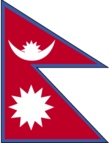
- red with a blue border around the unique shape of two overlapping right triangles; the smaller, upper triangle bears a white stylized moon and the larger, lower triangle bears a white 12-pointed sun
- three equal horizontal bands of red (top), white, and blue; similar to the flag of Luxembourg which uses a lighter blue and is longer
Independence
- 1768, unified by Prithyi Narayan Shah
- 1 579 (from Spain)
Judicial branch
- Supreme Court (Sarbochha Adalat)
- Supreme Court (De Hoge Raad)
Leaders
- Chief of Stale— King BIRENDRA Bir Bikram Shah Dev (since 31 January 1972, crowned King 24 February 1985); Heir Apparent Crown Prince DIPENDRA Bir Bikram Shah Dev, son of the King (born 21 June 1971); Head of Government — Prime Minister Marich Man Singh SHRESTHA (since 15 July 1986) Political parties and leaders: all political parties outlawed but operate more or less openly; Nepali Congress Party (NCP), Ganesh Man Singh, K. P. Bhattarai, G. P. Koirala
- Chief of State — Queen BEATRIX Wilhelmina Armgard (since 30 April 1980); Heir Apparent WILLEMALEXANDER, Prince of Orange, son of Queen Beatrix (born 27 April 1967); Head of Government — Prime Minister Ruud (Rudolph) F. M. LUBBERS (since 4 November 1982); Deputy Prime Minister Wim KOK (since 2 November 1989) Political parties and leaders: Christian Democratic Appeal (CDA), Willem van Velzen; Labor (PvdA), Wim Kok; Liberal (VVD), Joris Voorhoeve; Democrats '66 (D'66), Hans van Mierio; Communist (CPN), Henk Hoekstra; a host of minor parties
Legal system
- based on Hindu legal concepts and English common law; has not accepted compulsory ICJ jurisdiction
- civil law system incorporating French penal theory; judicial review in the Supreme Court of legislation of lower order rather than Acts of Parliament; accepts compulsory ICJ jurisdiction, with reservations
Legislative branch
- unicameral National Assembly (Rashtriya Panchayat)
- bicameral States General (Staten Generaal) consists of an upper chamber or First Chamber (Eerste Kamer) and a lower chamber or Second Chamber (Tweede Kamer)
Long-form name
- Kingdom of Nepal
- Kingdom of the Netherlands
Member of
- ADB, CCC, Colombo Plan, ESCAP, FAO, G-77, IBRD, ICAO, IDA, I FAD, IFC, ILO, IMF, I MO, INTERPOL, IPU, IRC, ITU, NAM, SAARC, UN, UNESCO, UPU, WHO, WMO, WTO
- ADB, Benelux, CCC, Council of Europe, DAC, EC, ECE, EIB, EMS, ESA, ESCAP, FAQ, GATT, IAEA, IBRD, ICAC, ICAO, ICES, ICO, IDA, IDB — Inter-American Development Bank, IEA, IFAD, IFC, IHO, ILO, ILZSG, IMF, IMO, INRO, INTELSAT, INTERPOL, IPU, IRC, ITC, ITU, IWC — International Wheat Council (with respect to interests of the Netherlands Antilles and Suriname), NATO, OAS (observer), OECD, UN, UNESCO, UPU, WEU, WHO,
National holiday
- Birthday of His Majesty the King, 28 December (1945)
- Queen's Day, 30 April (1938)
Other political or pressure groups
- numerous small, left-leaning student groups in the capital; Indian merchants in Tarai and capital; several small, radical Nepalese antimonarchist groups operating from north India
- large multinational firms; Federation of Netherlands Trade Union Movement (comprising Socialist and Catholic trade unions) and a Protestant trade union; Federation of Catholic and Protestant Employers Associations; the nondenominational Federation of Netherlands Enterprises; and IKV — Interchurch Peace Council
Suffrage
- universal at age 21
- universal at age 18
Type
- constitutional monarchy, but King Birendra exercises control over multitiered system of government
- constitutional monarchy
Economy
Agriculture
- accounts for 60% of GDP and 90% of work force; farm products — rice, corn, wheat, sugarcane, root crops, milk, buffalo meat; not self-sufficient in food, particularly in drought years
- accounts for 4% of GDP; animal production predominates; crops — grains, potatoes, sugar beets, fruits, vegetables; shortages of grain, fats, and oils
Aid
- US commitments, including Ex-Im (FY70-88), $285 million; Western (nonUS) countries, ODA and OOF bilateral commitments (1980-87), $1.8 billion; OPEC bilateral aid (1979-89), $30 million; Communist countries (1970-88), $273 million
- donor — ODA and OOF commitments (1970-87), $15.8 billion
Budget
- revenues $296 million; expenditures $635 million, including capital expenditures of $394 million (FY89 est.)
- revenues $71 billion; expenditures $82 billion, including capital expenditures of $NA billion (1989)
Currency
- Nepalese rupee (plural — rupees); 1 Nepalese rupee (NR) = 100 paisa
- Netherlands guilder, gulden, or florin (plural — guilders, gulden, or florins); 1 Netherlands guilder, gulden, or florin (f.) = 100 cents
Electricity
- 205,000 kW capacity; 535 million kWh produced, 30 kWh per capita (1989)
- 22,216,000 kW capacity; 63,570 million kWh produced, 4,300 kWh per capita (1989)
Exchange rates
- Nepalese rupees (NRs) per US$1— 28.559 (January 1990), 27.189 (1989), 23.289 (1988), 21.819 (1987), 21.230(1986), 18.246(1985)
- Netherlands guilders, gulden, or florins (f.) per US$1— 2.2906 (January 1990), 2.1207 (1989), 1.9766 (1988), 2.0257 (1987), 2.4500 (1986), 3.3214 (1985)
Exports
- $374 million (f.o.b., FY89 est.), but does not include unrecorded border trade with India; commodities — clothing, carpets, leather goods, grain; partners — India 38%, US 23%, UK 6%, other Europe 9% (FY88)
- $1 10.3 billion (f.o.b., 1989); commodities— agricultural products, processed foods and tobacco, natural gas, chemicals, metal products, textiles, clothing; partners—EC 74.9% (FRG 28.3%, BelgiumLuxembourg 14.2%, France 10.7%, UK 10.2%), US 4.7% (1 988)
External debt
- $1.3 billion (December 1989 est.)
- none
Fiscal year
- 16 July15 July
- calendar year
GDP
- $2.9 billion, per capita $158; real growth rate 1.5%(FY89)
- $205.9 billion, per capita $13,900; real growth rate 4.2% (1989 est.)
Illicit drugs
illicit producer of cannabis for the domestic and international drug markets
Imports
- $724 million (c.i.f., FY89 est.); commodities — petroleum products 20%, fertilizer 11%, machinery 10%; partners — India 36%, Japan 13%, Europe 4%, US 1%(FY88)
- $100.9 billion (c.i.f., 1989); commodities— raw materials and semifinished products, consumer goods, transportation equipment, crude oil, food products; partners—EC 63.8% (FRG 26.5%, BelgiumLuxembourg 23.1%, UK 8.1%), US 7.9% (1988)
Industrial production
- growth rate —4.5% (FY89 est.)
- growth rate 4.8% (1989 est.)
Industries
- small rice, jute, sugar, and oilseed mills; cigarette, textiles, cement, brick; tourism
- agroindustries, metal and engineering products, electrical machinery and equipment, chemicals, petroleum, fishing, construction, microelectronics
Inflation rate (consumer prices)
- 8.1% (FY89 est.)
- 1.5% (1989 est.)
Overview
- Nepal is among the poorest and least developed countries in the world with a per capita income of only $158. Real growth averaged 4% in the 1980s until FY89, when it plunged to 1.5% because of the ongoing trade/transit dispute with India. Agriculture is the mainstay of the economy, providing a livelihood for over 90% of the population and accounting for 60% of GDP and about 75% of exports. Industrial activity is limited, and what there is involves the processing of agricultural produce (jute, sugarcane, tobacco, and grain). Apart from agricultural land and forests, the only other exploitable natural resources are mica, hydropower, and tourism. Despite considerable investment in the agricultural sector, production in the 1980s has not kept pace with the population growth of 2.7%, which has led to a reduction in exportable surpluses and balance-of-payments difficulties. Economic prospects for the 1990s remain grim.
- This highly developed and affluent economy is based on private enterprise. The government makes its presence felt, however, through many regulations, permit requirements, and welfare programs affecting most aspects of economic activity. The trade and financial services sector contributes over 50% of GDP. Industrial activity, including construction, provides about 25% of GDP, and is led by the food-processing, oil-refining, and metal-working industries. The highly mechanized agricultural sector employs only 6% of the labor force, but provides large surpluses for export and the domestic food-processing industry. An unemployment rate of over 8.6% and a sizable budget deficit are currently the most serious economic problems.
Unemployment rate
- 5%; underemployment estimated at 25-40% (1987) Nepal (continued) Netherlands
- 8.6% (1989 est.)
Communications
Airports
38 total, 38 usable; 5 with permanent-surface runways; none with runways over 3,659 m; 1 with runways 2,440-3,659 m; 9 with runways 1,220-2,439 m
Branches
Royal Nepalese Army, Royal Nepalese Army Air Service, Nepalese Police Force
Civil air
5 major and 1 1 minor transport aircraft
Defense expenditures
2% of GDP, or $58 million (1989 est.) "°rth o.n 0 H.lder Sea Leauwarden Groningen V...J See refionsl mip V
Highways
5,958 km total (1986); 2,645 km paved, 8 1 5 km gravel or crushed stone, 2,257 km improved and unimproved earth; also 241 km of seasonally motorable tracks
Military manpower
males 15-49, 4,531,660; 2,347,412 fit for military service; 225,349 reach military age (17) annually
Railroads
52 km (1985), all 0.762-meter narrow gauge; all in Tarai close to Indian border; 10 km from Raxaul to Blrganj is government owned
Telecommunications
poor telephone and telegraph service; fair radio communication and broadcast service; international radio communication service is poor; 30,000 telephones (1987); stations— 4 AM, no FM, 1 TV; 1 Indian Ocean INTELSAT earth station Defense Forces