1998 Edition
CIA World Factbook 1998 (Internet Archive)
Geography
Area
total: 825,418 sq km land: 825,418 sq km water: 0 sq km
Area-comparative
slightly more than half the size of Alaska
Climate
desert; hot, dry; rainfall sparse and erratic
Coastline
1,572 km
Elevation extremes
lowest point: Atlantic Ocean 0 m highest point: Konigstein 2,606 m
Environment-current issues
very limited natural fresh water resources; desertification
Environment-international agreements
party to: Biodiversity, Climate Change, Desertification, Endangered Species, Hazardous Wastes, Law of the Sea, Ozone Layer Protection, Wetlands signed, but not ratified: none of the selected agreements
Geographic coordinates
22 00 S, 17 00 E
Irrigated land
60 sq km (1993 est.)
Land boundaries
total: 3,824 km border countries: Angola 1,376 km, Botswana 1,360 km, South Africa 855 km, Zambia 233 km
Land use
arable land: 1% permanent crops: 0% permanent pastures: 46% forests and woodland: 22% other: 31% (1993 est.)
Location
Southern Africa, bordering the South Atlantic Ocean, between Angola and South Africa
Map references
Africa
Maritime claims
contiguous zone: 24 nm exclusive economic zone: 200 nm territorial sea: 12 nm
Natural hazards
prolonged periods of drought
Natural resources
diamonds, copper, uranium, gold, lead, tin, lithium, cadmium, zinc, salt, vanadium, natural gas, fish; suspected deposits of oil, natural gas, coal, iron ore
Terrain
mostly high plateau; Namib Desert along coast; Kalahari Desert in east
People and Society
Age structure
0-14 years: 44% (male 362,310; female 354,386) 15-64 years: 52% (male 414,281; female 426,921) 65 years and over: 4% (male 27,001; female 37,429) (July 1998 est.)
Birth rate
35.84 births/1,000 population (1998 est.)
Death rate
19.82 deaths/1,000 population (1998 est.)
Ethnic groups
black 86%, white 6.6%, mixed 7.4% note: about 50% of the population belong to the Ovambo tribe and 9% to the Kavangos tribe; other ethnic groups are: Herero 7%, Damara 7%, Nama 5%, Caprivian 4%, Bushmen 3%, Baster 2%, Tswana 0.5%
Infant mortality rate
66.76 deaths/1,000 live births (1998 est.)
Languages
English 7% (official), Afrikaans common language of most of the population and about 60% of the white population, German 32%, indigenous languages: Oshivambo, Herero, Nama
Life expectancy at birth
total population: 41.48 years male: 41.73 years female: 41.24 years (1998 est.)
Literacy
definition: age 15 and over can read and write total population: 38% male: 45% female: 31% (1960 est.)
Nationality
noun: Namibian(s) adjective: Namibian
Net migration rate
0 migrant(s)/1,000 population (1998 est.)
Population
1,622,328 (July 1998 est.)
Population growth rate
1.6% (1998 est.)
Religions
Christian 80% to 90% (Lutheran 50% at least, other Christian denominations 30%), native religions 10% to 20%
Sex ratio
at birth: 1.03 male(s)/female under 15 years: 1.02 male(s)/female 15-64 years: 0.97 male(s)/female 65 years and over: 0.72 male(s)/female (1998 est.)
Total fertility rate
4.99 children born/woman (1998 est.)
Government
Administrative divisions
13 regions; Caprivi, Erongo, Hardap, Karas, Khomas, Kunene, Ohangwena, Okavango, Omaheke, Omusati, Oshana, Oshikoto, Otjozondjupa
Constitution
ratified 9 February 1990; effective 12 March 1990
Country name
conventional long form: Republic of Namibia conventional short form: Namibia
Data code
WA
Executive branch
chief of state: President Sam NUJOMA (since 21 March 1990); note-the president is both the chief of state and head of government head of government: President Sam NUJOMA (since 21 March 1990); note-the president is both the chief of state and head of government cabinet: Cabinet appointed by the president from among the members of the National Assembly elections: president elected by popular vote for a five-year term; election last held 7-8 December 1994 (next to be held NA December 1999) election results: Sam NUJOMA elected president; percent of vote-76%
FAX
- [1] (202) 986-0443 Diplomatic representation from the US: chief of mission: Ambassador George F. WARD, Jr. (24 July 1996) embassy: Ausplan Building, 14 Lossen St., Windhoek mailing address: Private Bag 12029 Ausspannplatz, Windhoek telephone: [264] (61) 221601
- [264] (61) 229792
Flag description
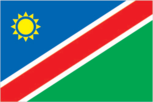
a large blue triangle with a yellow sunburst fills the upper left section and an equal green triangle (solid) fills the lower right section; the triangles are separated by a red stripe that is contrasted by two narrow white-edge borders
Government type
republic
Independence
21 March 1990 (from South African mandate)
International organization participation
ACP, AfDB, C, CCC, ECA, FAO, G-77, IAEA, IBRD, ICAO, ICRM, IFAD, IFC, IFRCS, ILO, IMF, IMO, Intelsat, Interpol, IOC, IOM (observer), ISO (subscriber), ITU, NAM, OAU, SACU, SADC, UN, UNCTAD, UNESCO, UNHCR, UNIDO, UPU, WCL, WHO, WIPO, WMO, WTrO Diplomatic representation in the US: chief of mission: Ambassador Veiccoh NGHIWETE chancery: 1605 New Hampshire Avenue NW, Washington, DC 20009 telephone: [1] (202) 986-0540
Judicial branch
Supreme Court, judges appointed by the president Political parties and leaders: South West Africa People's Organization or SWAPO [Sam NUJOMA]; National Democratic Party for Justice or NDPFJ [Nbhwete NDJOBA]; Democratic Turnhalle Alliance of Namibia or DTA [Mishake MUYONGO, president]; United Democratic Front or UDF [Justus GAROEB]; Monitor Action Group or MAG [Kosie PRETORIUS]; Democratic Coalition of Namibia or DCN [Moses K. KATJIUONGUA] Political pressure groups and leaders: NA
Legal system
based on Roman-Dutch law and 1990 constitution
Legislative branch
bicameral legislature consists of the National Council (26 seats; two members are chosen from each regional council to serve six-year terms) and the National Assembly (72 seats; members are elected by popular vote to serve five-year terms) elections: National Council-last held 30 November-3 December 1992 (next to be held by December 1998); National Assembly-last held 7-8 December 1994 (next to be held NA December 1999) election results: National Council-percent of vote by party-NA; seats by party-SWAPO 19, DTA 6, UDF 1; National Assembly-percent of vote by party-SWAPO 73.89%, DTA 20.78%, UDF 2.72%, DCN 0.83%, MAG 0.82%; seats by party-SWAPO 53, DTA 15, UDF 2, MAG 1, DCN 1 note: the National Council is a purely advisory body
National capital
Windhoek
National holiday
Independence Day, 21 March (1990)
Suffrage
18 years of age; universal
Economy
Agriculture-products
millet, sorghum, peanuts; livestock; fish
Budget
revenues: $1.1 billion expenditures: $1.2 billion, including capital expenditures of $193 million (FY96/97 est.)
Currency
1 Namibian dollar (N$) = 100 cents
Debt-external
$315 million (1996 est.)
Economic aid
recipient: ODA, $NA
Economy-overview
The economy is heavily dependent on the extraction and processing of minerals for export. Mining accounts for 20% of GDP. Namibia is the fourth-largest exporter of nonfuel minerals in Africa and the world's fifth-largest producer of uranium. Rich alluvial diamond deposits make Namibia a primary source for gem-quality diamonds. Namibia also produces large quantities of lead, zinc, tin, silver, and tungsten. Half of the population depends on agriculture (largely subsistence agriculture) for its livelihood. Namibia must import some of its food. Although per capita GDP is three to six times the per capita GDP of Africa's poorest countries, the majority of Namibia's people live in pronounced poverty because of the great inequality of income distribution and the large amounts going to foreigners. The Namibian economy has close links to South Africa.
Electricity-capacity
0 kW (1995)
Electricity-consumption per capita
584 kWh (1995)
Electricity-production
0 kWh (1995) note: imports electricity from South Africa
Exchange rates
Nambian dollars (N$) per US$1-4.94193 (January 1998), 4.60796 (1997), 4.29935 (1996), 3.62709 (1995), 3.55080 (1994), 3.26774 (1993)
Exports
total value: $1.45 billion (f.o.b., 1996 est.) commodities: diamonds, copper, gold, zinc, lead, uranium, cattle, processed fish, karakul skins partners: UK, South Africa, Spain, Japan (1994)
Fiscal year
1 April-31 March Communications
GDP
purchasing power parity-$6.2 billion (1996 est.)
GDP-composition by sector
agriculture: 15% industry: 20% services: 65% (1995 est.)
GDP-per capita
purchasing power parity-$3,700 (1996 est.)
GDP-real growth rate
3% (1996 est.)
Imports
total value: $1.55 billion (f.o.b., 1996 est.) commodities: foodstuffs, petroleum products and fuel, machinery and equipment, chemicals partners: South Africa 85%, Germany, US, Japan (1994 est.)
Industrial production growth rate
10% (1994)
Industries
meat packing, fish processing, dairy products; mining (diamond, lead, zinc, tin, silver, tungsten, uranium, copper)
Inflation rate-consumer price index
8% (1996 est.)
Labor force
total: 500,000 by occupation: agriculture 49%, industry and commerce 25%, services 5%, government 18%, mining 3% (1994 est.)
Radio broadcast stations
AM 4, FM 40, shortwave 0
Radios
195,000 (1992 est.)
Telephone system
domestic: good urban services; fair rural service; microwave radio relay links major towns; connections to other populated places are by open wire international: NA note: a fully automated digital network is to be operational by 1997
Telephones
89,722 (1992 est.)
Television broadcast stations
3
Televisions
27,000 (1993 est.)
Unemployment rate
30% to 40%, including underemployment (1997 est.)
Transportation
Airports
135 (1997 est.) Airports-with paved runways: total: 22 over 3,047 m: 2 2,438 to 3,047 m: 2 1,524 to 2,437 m: 15 914 to 1,523 m: 3 (1997 est.) Airports-with unpaved runways: total: 113 2,438 to 3,047 m: 2 1,524 to 2,437 m: 20 914 to 1,523 m: 70 under 914 m: 21 (1997 est.)
Highways
total: 64,799 km paved: 7,841 km unpaved: 56,958 km (1996 est.) Ports and harbors: Luderitz, Walvis Bay
Merchant marine
none
Railways
total: 2,382 km narrow gauge: 2,382 km 1.067-m gauge; single track (1995)
Military and Security
Military branches
National Defense Force (Army), Police
Military expenditures-dollar figure
$64 million (FY95/96)
Military expenditures-percent of GDP
2.1% (FY95/96)
Military manpower-availability
males age 15-49: 369,826 (1998 est.) Military manpower-fit for military service: males: 221,624 (1998 est.)
Transnational Issues
Disputes-international
quadripoint with Botswana, Zambia, and Zimbabwe is in disagreement; dispute with Botswana over uninhabited Kasikili (Sidudu) Island in Linyanti (Chobe) River is presently at the ICJ; at least one other island in Linyanti River is contested