1989 Edition
CIA World Factbook 1989 (Internet Archive)
Geography
Climate
desert; hot, dry; rainfall sparse and erratic
Coastline
1,489 km
Comparative area
slightly more than half the size of Alaska
Disputes
short section of boundary with Botswana is indefinite; quadripoint with Botswana, Zambia, and Zimbabwe is in disagreement; possible future claim to South Africa's Walvis Bay
Environment
inhospitable with very limited natural water resources; desertification
Exclusive fishing zone
12 nm
Flag
three equal horizontal bands of green (top), black, and yellow with a red isosceles triangle based on the hoist side; the black band is edged in white; centered in the triangle is a yellow five-pointed star bearing a crossed rifle and hoe in black superimposed on an open white book
Land boundaries
3,935 km total; Angola 1,376 km, Botswana 1,360 km, South Africa 966 km, Zambia 233 km
Land use
1% arable land; NEGL% permanent crops; 64% meadows and pastures; 22% forest and woodland; 13% other; includes NEGL% irrigated
Natural resources
diamonds, copper, uranium, gold, lead, tin, zinc, salt, vanadium, natural gas, fish; suspected deposits of coal and iron ore
Note
Walvis Bay area is an exclave of South Africa in Namibia
Terrain
mostly high plateau; Namib Desert along coast; Kalahari Desert in east
Territorial sea
6 nm
Total area
824,290 km2; land area: 823,290 km2
People and Society
Birth rate
46 births/ 1,000 population (1990)
Death rate
1 0 deaths/ 1 ,000 population (1990)
Ethnic divisions
86% black, 6.5% white, 7.5% mixed; about 50% of the population belong to the Ovambo tribe and 9% from the Kavangos tribe
Infant mortality rate
71 deaths/ 1,000 live births (1990)
Labor force
500,000; 60% agriculture, 19% industry and commerce, 8% services, 7% government, 6% mining (1981 est.)
Language
Afrikaans principal language of about 60% of white population, German of 33%, and English of 7% (all official); several indigenous languages
Life expectancy at birth
57 years male, 63 years female (1990)
Literacy
1 00% whites, 1 6% nonwhites
Nationality
noun — Namibian(s); adjective— Namibian
Net migration rate
20 migrants/ 1,000 population (1990) Namibia (continued)
Organized labor
1 5 trade unions — largest is the mineworkers' union which has a sizable black membership
Population
1,452,951 (July 1990), growth rate 5.6% (1990)
Religion
predominantly Christian
Total fertility rate
6.6 children born/ woman (1990)
Government
Administrative divisions
26 districts; Bethanien, Boesmanland, Caprivi Oos, Damaraland, Gobabis, Grootfontein, Hereroland Oos, Hereroland Wes, Kaokoland, Karasburg, Karibib, Kavango, Keetmanshoop, Liideritz, Maltahohe, Mariental, Namaland, Okahandja, Omaruru, Otjiwarongo, Outjo, Owambo, Rehoboth, Swakopmund, Tsumeb, Windhoek
Capital
Windhoek
Communists
no Communist party
Constitution
ratified 9 February 1990
Diplomatic representation
NA
Elections
National Assembly — last held on 7-1 1 November 1989 (next to be held NA); results — percent of vote by party NA; seats— (72 total) SWAPO 41, DTA 21, UDF 4, ACN 3, NNF 1, FCN 1, NPF I
Executive branch
president. Cabinet, Constitutional Council
Flag
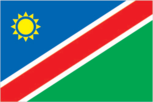
a large blue triangle with a yellow sunburst fills the upper left section, and an equal green triangle (solid) fills the lower right section; the triangles are separated by a red stripe which is contrasted by two narrow white edge borders
Independence
21 March 1990
Judicial branch
Supreme Court
Leaders
Chief of State and Head of Government President Sam NUJOMA (since 21 March 1990) Political parties and leaders: SouthWest Africa People's Organization (SWAPO), Sam Nujoma; Democratic Turnhalle Alliance (DTA), Dirk Mudge; United Democratic Front (UDF), Justus Garoeb; Action Christian National (ACN), Kosie Pretorius; National Patriotic Front (NPF), Moses Katjiuongua; Federal Convention of Namibia (FCN), Hans Diergaardt; Namibia National Front (NNF), Vekuii Rukoro
Legal system
based on Roman-Dutch law and customary law
Legislative branch
bicameral National Assembly
Long-form name
Republic of Namibia
Member of
FAO, IAEA, ILO, UNESCO, WHO
National holiday
Settlers' Day, 10 December
Other political or pressure groups
NA
Suffrage
universal at age 18
Type
republic as of 21 March 1990
Economy
Agriculture
- accounts for 50% of GDP, over 80% of labor force, and about 90% of exports; cash crops — cotton, cashew nuts, sugarcane, tea, shrimp; other crops — cassava, corn, rice, tropical fruits; not selfsufficient in food
- accounts for 10% of GDP (including fishing); mostly subsistence farming; livestock raising major source of cash income; crops — millet, sorghum, peanuts; fish catch potential of over 1 million metric tons not being fulfilled, 1987 catch reaching only 520,000 metric tons; not self-sufficient in food
Aid
- US commitments, including Ex-Im (FY70-88), $282 million; Western (nonUS) countries, ODA and OOF bilateral commitments (1 970-87), $3.1 billion; OPEC bilateral aid (1979-89), $37 million; Communist countries (1970-88), $887 million
- Western (non-US) countries, ODA and OOF bilateral commitments (197087), $47.2 million
Budget
- revenues $186 million; expenditures $239 million, including capital expenditures of $208 million (1988 est.)
- revenues $781 million; expenditures $932 million, including capital expenditures of $NA (FY88)
Currency
- metical (plural — meticais); 1 metical (Mt) = 100 centavos
- South African rand (plural — rand); I South African rand (R) = 100 cents
Electricity
- 2,265,000 kW capacity; 1,740 million kWh produced, 1 20 kWh per capita (1 989)
- 486,000 kW capacity; 1 ,280 million kWh produced, 930 kWh per capita (1989)
Exchange rates
- meticais (Mt) per US$1 — 800 (September 1989), 528.60 (1988), 289.44 (1987), 40.43 (1986), 43.18 (1985)
- South African rand (R) per US$1— 2.5555 (January 1990), 2.6166 (1989), 2.261 1 (1988), 2.0350 (1987), 2.2685(1986), 2.1911 (1985)
Exports
- $100 million (f.o.b., 1988); commodities— shrimp 48%, cashews 21%, sugar 10%, copra 3%, citrus 3%; partners — US, Western Europe, GDR, Japan
- $935 million (f.o.b., 1988); commodities— diamonds, uranium, zinc, copper, meat, processed fish, karakul skins; partners — South Africa
External debt
- $4.4 billion (1988)
- about $27 million at independence; under a 1971 International Court of Justice (ICJ) ruling, Namibia may not be liable for debt incurred during its colonial period
Fiscal year
- calendar year
- 1 April-31 March
GDP
$1.6 billion, per capita less than $110; real growth rate 5.0% (1988)
GNP
$1.54 billion, per capita $1,245; real growth rate 2.9% (1987)
Imports
- $764 million (c.i.f., 1988), including aid; commodities — food, clothing, farm equipment, petroleum; partners — US, Western Europe, USSR
- $856 million (f.o.b., 1988); commodities— foodstuffs, manufactured consumer goods, machinery and equipment; partners— South Africa, FRO, UK, US
Industrial production
- growth rate 7% (1989 est.)
- growth rate NA%
Industries
- food, beverages, chemicals (fertilizer, soap, paints), petroleum products, textiles, nonmetallic mineral products (cement, glass, asbestos), tobacco
- meatpacking, fish processing, dairy products, mining (copper, lead, zinc, diamond, uranium)
Inflation rate (consumer prices)
- 81.1% (1988)
- 15.1% (1989)
Overview
- One of Africa's poorest countries, with a per capita GDP of little more than $100, Mozambique has failed to exploit the economic potential of its sizable agricultural, hydropower, and transportation resources. Indeed, national output, consumption, and investment declined throughout the first half of the 1980s because of internal disorders, lack of government administrative control, and a growing foreign debt. A sharp increase in foreign aid, attracted by an economic reform policy, has resulted in successive years of economic growth since 1985. Agricultural output, nevertheless, is only at about 75% of its 1981 level, and grain has to be imported. Industry operates at only 20-40% of capacity. The economy depends heavily on foreign assistance to keep afloat.
- The economy is heavily dependent on the mining industry to extract and process minerals for export. Mining accounts for almost 35% of GDP, agriculture and fisheries 10-15%, and manufacturing about 5%. Namibia is the fourth-largest exporter of nonfuel minerals in Africa and the world's fifth-largest producer of uranium. Alluvial diamond deposits are among the richest in the world, making Namibia a primary source for gem-quality diamonds. Namibia also produces large quantities of lead, zinc, tin, silver, and tungsten, and it has substantial resources of coal.
Unemployment rate
- 40.0 (1988)
- over 30% (1988)
Communications
Airports
- 203 total, 153 usable; 27 with permanent-surface runways; none with runways over 3,659 m; 6 with runways 2,440-3,659 m; 29 with runways 1,2202,439 m
- 143 total, 123 usable; 21 with permanent-surface runways; 1 with runways over 3,659 m; 5 with runways 2,4403,659 m; 63 with runways 1,220-2,439 m
Branches
- Mozambique Armed Forces (including Army, Border Guard, Naval Command, Air Defense Forces)
- NA
Civil air
- 5 major transport aircraft
- 2 major transport aircraft
Defense expenditures
- 8.4% of GDP (1987)
- 4.9% of GNP (1986)
Highways
- 26,498 km total; 4,593 km paved; 829 km gravel, crushed stone, stabilized soil; 21,076 km unimproved earth
- 54,500 km; 4,079 km paved, 2,540 km gravel, 47,881 km earth roads and tracks
Inland waterways
about 3,750 km of navigable routes
Merchant marine
5 cargo ships ( 1 ,000 GRT or over) totaling 7,806 GRT/ 12,873 DWT
Military manpower
- males 15-49, 3,295,067; 1,892,699 fit for military service
- males 15-49, 298,249; 176,660 fit for military service
Note
the South-West Africa Territorial Force, established in 1980, was demobilized in June 1989; a new national defense force will probably be formed by the new government
Pipelines
306 km crude oil (not operating); 289 km refined products
Ports
- Maputo, Beira, Nacala
- Luderitz; primary maritime outlet is Walvis Bay (South Africa)
Railroads
- 3,288 km total; 3,140 km 1.067-meter gauge; 148 km 0.762-meter narrow gauge; Malawi-Nacala, MalawiBeira, and Zimbabwe-Maputo lines are subject to closure because of insurgency
- 2,341 km 1.067-meter gauge, single track
Telecommunications
- fair system of troposcatter, open-wire lines, and radio relay; 57,400 telephones; stations — 15 AM, 3 FM, 1 TV; satellite earth stations — 1 Atlantic Ocean INTELSAT and 3 domestic Defense Forces
- good urban, fair rural services; radio relay connects major towns, wires extend to other population centers; 62,800 telephones; stations — 2 AM, 40 FM, 3 TV Defense Forces