2023 Edition
CIA World Factbook 2023 (factbook.json @ 0d4fa4984ecb)
Introduction
Background
In the first half of the second millennium A.D., northern Mozambican port towns were frequented by traders from Somalia, Ethiopia, Egypt, Arabia, Persia, and India. The Portuguese were able to wrest much of the coastal trade from Arab Muslims in the centuries after 1500 and to set up their own colonies. Portugal did not relinquish Mozambique until 1975. Large-scale emigration, economic dependence on South Africa, a severe drought, and a prolonged civil war hindered the country's development until the mid-1990s. The ruling Front for the Liberation of Mozambique (FRELIMO) party formally abandoned Marxism in 1989, and a new constitution the following year provided for multiparty elections and a free market economy. A UN-negotiated peace agreement between FRELIMO and rebel Mozambique National Resistance (RENAMO) forces ended the fighting in 1992. In 2004, Mozambique underwent a delicate transition as Joaquim CHISSANO stepped down after 18 years in office. His elected successor, Armando GUEBUZA, served two terms and then passed executive power to Filipe NYUSI in 2015. RENAMO’s residual armed forces intermittently engaged in a low-level insurgency after 2012, but a late December 2016 cease-fire eventually led to the two sides signing a comprehensive peace deal in August 2019. Elections in October 2019, challenged by Western observers and civil society as being problematic, resulted in resounding wins for NYUSI and FRELIMO across the country. Since October 2017, violent extremists - who an official ISIS media outlet recognized as ISIS's network in Mozambique for the first time in June 2019 - have been conducting attacks against civilians and security services in the northern province of Cabo Delgado. In 2021, Rwanda and the Southern African Development Community deployed forces to support Mozambique’s efforts to counter the extremist group.
Geography
Area
- land
- 786,380 sq km
- total
- 799,380 sq km
- water
- 13,000 sq km
Area - comparative
slightly more than five times the size of Georgia; slightly less than twice the size of California
Climate
tropical to subtropical
Coastline
2,470 km
Elevation
- highest point
- Monte Binga 2,436 m
- lowest point
- Indian Ocean 0 m
- mean elevation
- 345 m
Geographic coordinates
18 15 S, 35 00 E
Geography - note
the Zambezi River flows through the north-central and most fertile part of the country
Irrigated land
1,180 sq km (2012)
Land boundaries
- border countries
- Malawi 1498 km; South Africa 496 km; Eswatini 108 km; Tanzania 840 km; Zambia 439 km; Zimbabwe 1,402 km
- total
- 4,783 km
Land use
- agricultural land
- 56.3% (2018 est.)
- agricultural land: arable land
- arable land: 6.4% (2018 est.)
- agricultural land: permanent crops
- permanent crops: 0.3% (2018 est.)
- agricultural land: permanent pasture
- permanent pasture: 49.6% (2018 est.)
- forest
- 43.7% (2018 est.)
- other
- 0% (2018 est.)
Location
Southeastern Africa, bordering the Mozambique Channel, between South Africa and Tanzania
Major lakes (area sq km)
- fresh water lake(s)
- Lake Malawi (shared with Malawi and Tanzania) - 22,490
Major rivers (by length in km)
Rio Zambeze (Zambezi) river mouth (shared with Zambia [s]), Angola, Namibia, Botswana, and Zimbabwe) - 2,740 km; Rio Limpopo river mouth (shared with South Africa [s], Botswana, and Zimbabwe) - 1,800 kmnote – [s] after country name indicates river source; [m] after country name indicates river mouth
Major watersheds (area sq km)
Indian Ocean drainage: Zambezi (1,332,412 sq km)
Map references
Africa
Maritime claims
- exclusive economic zone
- 200 nm
- territorial sea
- 12 nm
Natural hazards
severe droughts; devastating cyclones and floods in central and southern provinces
Natural resources
coal, titanium, natural gas, hydropower, tantalum, graphite
Population distribution
three large populations clusters are found along the southern coast between Maputo and Inhambane, in the central area between Beira and Chimoio along the Zambezi River, and in and around the northern cities of Nampula, Cidade de Nacala, and Pemba; the northwest and southwest are the least populated areas as shown in this population distribution map
Terrain
mostly coastal lowlands, uplands in center, high plateaus in northwest, mountains in west
People and Society
Age structure
- 0-14 years
- 45% (male 7,413,197/female 7,217,953)
- 15-64 years
- 52.1% (male 8,153,175/female 8,787,792)
- 65 years and over
- 2.9% (2023 est.) (male 461,904/female 479,784)
Alcohol consumption per capita
- beer
- 1.03 liters of pure alcohol (2019 est.)
- other alcohols
- 0 liters of pure alcohol (2019 est.)
- spirits
- 0.21 liters of pure alcohol (2019 est.)
- total
- 1.46 liters of pure alcohol (2019 est.)
- wine
- 0.22 liters of pure alcohol (2019 est.)
Birth rate
36.9 births/1,000 population (2023 est.)
Children under the age of 5 years underweight
14.6% (2019/20)
Contraceptive prevalence rate
27.1% (2015)
Current health expenditure
7.6% of GDP (2020)
Currently married women (ages 15-49)
63.7% (2023 est.)
Death rate
9.9 deaths/1,000 population (2023 est.)
Demographic profile
Mozambique is a poor, sparsely populated country with high fertility and mortality rates and a rapidly growing youthful population – 45% of the population is younger than 15, as of 2020. Mozambique’s high poverty rate is sustained by natural disasters, disease, high population growth, low agricultural productivity, and the unequal distribution of wealth. The country’s birth rate is among the world’s highest, averaging around 5 children per woman (and higher in rural areas) for at least the last three decades. The sustained high level of fertility reflects gender inequality, low contraceptive use, early marriages and childbearing, and a lack of education, particularly among women. The high population growth rate is somewhat restrained by the country’s high HIV/AIDS and overall mortality rates. Mozambique ranks among the worst in the world for HIV/AIDS prevalence, HIV/AIDS deaths, and life expectancy at birth, as of 2022. Mozambique is predominantly a country of emigration, but internal, rural-urban migration has begun to grow. Mozambicans, primarily from the country’s southern region, have been migrating to South Africa for work for more than a century. Additionally, approximately 1.7 million Mozambicans fled to Malawi, South Africa, and other neighboring countries between 1979 and 1992 to escape from civil war. Labor migrants have usually been men from rural areas whose crops have failed or who are unemployed and have headed to South Africa to work as miners; multiple generations of the same family often become miners. Since the abolition of apartheid in South Africa in 1991, other job opportunities have opened to Mozambicans, including in the informal and manufacturing sectors, but mining remains their main source of employment.
Dependency ratios
- elderly dependency ratio
- 4.8
- potential support ratio
- 20.8 (2021 est.)
- total dependency ratio
- 86.1
- youth dependency ratio
- 81.3
Drinking water source
- improved: rural
- rural: 61.5% of population
- improved: total
- total: 73.3% of population
- improved: urban
- urban: 93.4% of population
- unimproved: rural
- rural: 38.5% of population
- unimproved: total
- total: 26.7% of population (2020 est.)
- unimproved: urban
- urban: 6.6% of population
Education expenditures
6.3% of GDP (2020 est.)
Ethnic groups
African 99% (Makhuwa, Tsonga, Lomwe, Sena, and others), Mestizo 0.8%, other (includes European, Indian, Pakistani, Chinese) 0.2% (2017 est.)
Gross reproduction rate
2.33 (2023 est.)
Hospital bed density
0.7 beds/1,000 population (2011)
Infant mortality rate
- female
- 57.8 deaths/1,000 live births
- male
- 61.7 deaths/1,000 live births
- total
- 59.8 deaths/1,000 live births (2023 est.)
Languages
Makhuwa 26.1%, Portuguese (official) 16.6%, Tsonga 8.6%, Nyanja 8.1, Sena 7.1%, Lomwe 7.1%, Chuwabo 4.7%, Ndau 3.8%, Tswa 3.8%, other Mozambican languages 11.8%, other 0.5%, unspecified 1.8% (2017 est.)
Life expectancy at birth
- female
- 59 years
- male
- 56.4 years
- total population
- 57.7 years (2023 est.)
Literacy
- definition
- age 15 and over can read and write
- female
- 53.8% (2021)
- male
- 74.1%
- total population
- 63.4%
Major infectious diseases
- animal contact diseases
- rabies
- degree of risk
- very high (2023)
- food or waterborne diseases
- bacterial and protozoal diarrhea, hepatitis A, and typhoid fever
- note
- note: on 31 August 2023, the US Centers for Disease Control and Prevention (CDC) issued a Travel Alert for polio in Africa; Mozambique is currently considered a high risk to travelers for circulating vaccine-derived polioviruses (cVDPV); vaccine-derived poliovirus (VDPV) is a strain of the weakened poliovirus that was initially included in oral polio vaccine (OPV) and that has changed over time and behaves more like the wild or naturally occurring virus; this means it can be spread more easily to people who are unvaccinated against polio and who come in contact with the stool or respiratory secretions, such as from a sneeze, of an “infected” person who received oral polio vaccine; the CDC recommends that before any international travel, anyone unvaccinated, incompletely vaccinated, or with an unknown polio vaccination status should complete the routine polio vaccine series; before travel to any high-risk destination, the CDC recommends that adults who previously completed the full, routine polio vaccine series receive a single, lifetime booster dose of polio vaccine
- vectorborne diseases
- malaria and dengue fever
- water contact diseases
- schistosomiasis
Major urban areas - population
1.852 million Matola, 1.163 million MAPUTO (capital), 969,000 Nampula (2023)
Maternal mortality ratio
127 deaths/100,000 live births (2020 est.)
Median age
- female
- 17.8 years
- male
- 16.6 years
- total
- 17.2 years (2023 est.)
Mother's mean age at first birth
- 19.2 years (2011 est.)
- note
- note: data represents median age at first birth among women 20-49
Nationality
- adjective
- Mozambican
- noun
- Mozambican(s)
Net migration rate
-1.5 migrant(s)/1,000 population (2023 est.)
Obesity - adult prevalence rate
7.2% (2016)
Physicians density
0.09 physicians/1,000 population (2020)
Population
32,513,805 (2023 est.)
Population distribution
three large populations clusters are found along the southern coast between Maputo and Inhambane, in the central area between Beira and Chimoio along the Zambezi River, and in and around the northern cities of Nampula, Cidade de Nacala, and Pemba; the northwest and southwest are the least populated areas as shown in this population distribution map
Population growth rate
2.55% (2023 est.)
Religions
Roman Catholic 27.2%, Muslim 18.9%, Zionist Christian 15.6%, Evangelical/Pentecostal 15.3%, Anglican 1.7%, other 4.8%, none 13.9%, unspecified 2.5% (2017 est.)
Sanitation facility access
- improved: rural
- rural: 24.7% of population
- improved: total
- total: 42.2% of population
- improved: urban
- urban: 71.9% of population (2015 est.)
- unimproved: rural
- rural: 75.3% of population
- unimproved: total
- total: 57.8% of population (2020 est.)
- unimproved: urban
- urban: 28.1% of population
School life expectancy (primary to tertiary education)
- female
- 9 years (2017)
- male
- 10 years
- total
- 10 years
Sex ratio
- 0-14 years
- 1.03 male(s)/female
- 15-64 years
- 0.93 male(s)/female
- 65 years and over
- 0.96 male(s)/female
- at birth
- 1.03 male(s)/female
- total population
- 0.97 male(s)/female (2023 est.)
Tobacco use
- female
- 5.6% (2020 est.)
- male
- 23% (2020 est.)
- total
- 14.3% (2020 est.)
Total fertility rate
4.74 children born/woman (2023 est.)
Urbanization
- rate of urbanization
- 4.24% annual rate of change (2020-25 est.)
- urban population
- 38.8% of total population (2023)
Youth unemployment rate (ages 15-24)
- female
- 8.2%
- male
- 8.1%
- total
- 8.1% (2021 est.)
Government
Administrative divisions
10 provinces (provincias, singular - provincia), 1 city (cidade)*; Cabo Delgado, Gaza, Inhambane, Manica, Maputo, Cidade de Maputo*, Nampula, Niassa, Sofala, Tete, Zambezia
Capital
- etymology
- reputedly named after the Maputo River, which drains into Maputo Bay south of the city
- geographic coordinates
- 25 57 S, 32 35 E
- name
- Maputo
- time difference
- UTC+2 (7 hours ahead of Washington, DC, during Standard Time)
Citizenship
- citizenship by birth
- no
- citizenship by descent only
- at least one parent must be a citizen of Mozambique
- dual citizenship recognized
- no
- residency requirement for naturalization
- 5 years
Constitution
- amendments
- proposed by the president of the republic or supported by at least one third of the Assembly of the Republic membership; passage of amendments affecting constitutional provisions, including the independence and sovereignty of the state, the republican form of government, basic rights and freedoms, and universal suffrage, requires at least a two-thirds majority vote by the Assembly and approval in a referendum; referenda not required for passage of other amendments; amended 2007, 2018
- history
- previous 1975, 1990; latest adopted 16 November 2004, effective 21 December 2004
Country name
- conventional long form
- Republic of Mozambique
- conventional short form
- Mozambique
- etymology
- named for the offshore island of Mozambique; the island was apparently named after Mussa al-BIK, an influential Arab slave trader who set himself up as sultan on the island in the 15th century
- former
- Portuguese East Africa, People's Republic of Mozambique
- local long form
- Republica de Mocambique
- local short form
- Mocambique
Diplomatic representation from the US
- chief of mission
- Ambassador Peter Hendrick VROOMAN (since 3 March 2022)
- email address and website
- consularmaputos@state.govhttps://mz.usembassy.gov/
- embassy
- Avenida Kenneth Kaunda, 193, Caixa Postal, 783, Maputo
- FAX
- [258] (21) 49-01-14
- mailing address
- 2330 Maputo Place, Washington DC 20521-2330
- telephone
- [258] (21) 49-27-97
Diplomatic representation in the US
- chancery
- 1525 New Hampshire Avenue NW, Washington, DC 20036
- chief of mission
- Ambassador Alfredo Fabaio NUVUNGA (since 19 April 2023)
- email address and website
- washington.dc@embamoc.gov.mzhttps://usa.embamoc.gov.mz/
- FAX
- [1] (202) 835-0245
- telephone
- [1] (202) 293-7147
Executive branch
- cabinet
- Cabinet appointed by the president
- chief of state
- President Filipe Jacinto NYUSI (since 15 January 2015); note - the president is both chief of state and head of government
- election results
- 2019: Filipe NYUSI reelected president in first round; percent of vote - Filipe NYUSI (FRELIMO) 73.0%, Ossufo MOMADE (RENAMO) 21.9%, Daviz SIMANGO (MDM) 5.1%2014: Filipe NYUSI elected president in first round; percent of vote - Filipe NYUSI (FRELIMO) 57.0%, Afonso DHLAKAMA (RENAMO) 36.6%, Daviz SIMANGO (MDM) 6.4%
- elections/appointments
- president elected directly by absolute majority popular vote in 2 rounds if needed for a 5-year term (eligible for 2 consecutive terms); election last held on 15 October 2019 (next to be held on 9 October 2024); prime minister appointed by the president
- head of government
- President Filipe Jacinto NYUSI (since 15 January 2015); Prime Minister Adriano Afonso MALEIANE (since 3 March 2022); note - President NYUSI removed Prime Minister Carlos Agostinho DO ROSARIO from office on 3 March 2022 as part of a cabinet reshuffle
Flag description
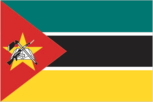
- three equal horizontal bands of green (top), black, and yellow with a red isosceles triangle based on the hoist side; the black band is edged in white; centered in the triangle is a yellow five-pointed star bearing a crossed rifle and hoe in black superimposed on an open white book; green represents the riches of the land, white peace, black the African continent, yellow the country's minerals, and red the struggle for independence; the rifle symbolizes defense and vigilance, the hoe refers to the country's agriculture, the open book stresses the importance of education, and the star represents Marxism and internationalism
- note
- note: one of only two national flags featuring a firearm, the other is Guatemala
Government type
presidential republic
Independence
25 June 1975 (from Portugal)
International law organization participation
has not submitted an ICJ jurisdiction declaration; non-party state to the ICCt
International organization participation
ACP, AfDB, AU, C, CD, CPLP, EITI (compliant country), FAO, G-77, IAEA, IBRD, ICAO, ICC (NGOs), ICRM, IDA, IDB, IFAD, IFC, IFRCS, IHO, ILO, IMF, IMO, IMSO, Interpol, IOC, IOM, IPU, ISO (correspondent), ITSO, ITU, ITUC (NGOs), MIGA, NAM, OIC, OIF (observer), OPCW, SADC, UN, UNCTAD, UNDP, UNEP, UNESCO, UNHCR, UNIDO, UNWTO, Union Latina, UPU, WCO, WFP, WFTU (NGOs), WHO, WIPO, WMO, WTO
Judicial branch
- highest court(s)
- Supreme Court (consists of the court president, vice president, and 5 judges); Constitutional Council (consists of 7 judges); note - the Higher Council of the Judiciary Magistracy is responsible for judiciary management and discipline
- judge selection and term of office
- Supreme Court president appointed by the president of the republic; vice president appointed by the president in consultation with the Higher Council of the Judiciary (CSMJ) and ratified by the Assembly of the Republic; other judges elected by the Assembly; judges serve 5-year renewable terms; Constitutional Council judges appointed - 1 by the president, 5 by the Assembly, and 1 by the CSMJ; judges serve 5-year nonrenewable terms
- subordinate courts
- Administrative Court (capital city only); provincial courts or Tribunais Judicias de Provincia; District Courts or Tribunais Judicias de Districto; customs courts; maritime courts; courts marshal; labor courts; community courts
Legal system
mixed legal system of Portuguese civil law and customary law
Legislative branch
- description
- unicameral Assembly of the Republic or Assembleia da Republica (250 seats; 248 members elected in multi-seat constituencies by party-list proportional representation vote and 2 members representing Mozambicans abroad directly elected by simple majority vote; members serve 5-year terms)
- election results
- percent of vote by party - FRELIMO 71%, RENAMO 23%, MDM 4%; seats by party - FRELIMO 184, RENAMO 60, MDM 6; composition as of July 2022 - men 144, women 106, percent of women 42.4%
- elections
- last held on 15 October 2019 (next to be held on 15 October 2024)
National anthem
- lyrics/music
- Salomao J. MANHICA/unknown
- name
- "Patria Amada" (Lovely Fatherland)
- note
- note: adopted 2002
National heritage
- selected World Heritage Site locales
- Island of Mozambique
- total World Heritage Sites
- 1 (cultural)
National holiday
Independence Day, 25 June (1975)
National symbol(s)
national colors: green, black, yellow, white, red
Political parties and leaders
Democratic Movement of Mozambique (Movimento Democratico de Mocambique) or MDM [vacant]Liberation Front of Mozambique (Frente de Liberatacao de Mocambique) or FRELIMO [Filipe NYUSI]Mozambican National Resistance (Resistencia Nacional Mocambicana) or RENAMO [Ossufo MOMADE]note: only parties with seats in the legislature listed
Suffrage
18 years of age; universal
Economy
Agricultural products
sugar cane, cassava, maize, milk, bananas, tomatoes, sweet potatoes, rice, sorghum, potatoes
Budget
- expenditures
- $4.591 billion (2019 est.)
- revenues
- $4.569 billion (2019 est.)
Budget surplus (+) or deficit (-)
-5.6% (of GDP) (2017 est.)
Credit ratings
- Fitch rating
- CCC (2019)
- Moody's rating
- Caa2 (2019)
- note
- note: The year refers to the year in which the current credit rating was first obtained.
- Standard & Poors rating
- CCC+ (2019)
Current account balance
- Current account balance 2019
- -$2.934 billion (2019 est.)
- Current account balance 2020
- -$3.869 billion (2020 est.)
- Current account balance 2021
- -$3.601 billion (2021 est.)
Debt - external
- Debt - external 31 December 2016
- $10.48 billion (31 December 2016 est.)
- Debt - external 31 December 2017
- $10.91 billion (31 December 2017 est.)
Economic overview
low-income East African economy; mostly rural labor force; natural resource rich; strong South African ties; Islamist terrorism in north endangers newly discovered natural gas; currently in court over massive (possibly unauthorized) debt
Exchange rates
- Currency
- meticais (MZM) per US dollar -
- Exchange rates 2017
- 63.584 (2017 est.)
- Exchange rates 2018
- 60.326 (2018 est.)
- Exchange rates 2019
- 62.548 (2019 est.)
- Exchange rates 2020
- 69.465 (2020 est.)
- Exchange rates 2021
- 65.465 (2021 est.)
Exports
- Exports 2019
- $5.6 billion (2019 est.) note: data are in current year dollars
- Exports 2020
- $4.37 billion (2020 est.) note: data are in current year dollars
- Exports 2021
- $6.404 billion (2021 est.) note: data are in current year dollars
Exports - commodities
coal, aluminum, gold, natural gas, electricity, titanium, coke (2021)
Exports - partners
South Africa 16%, India 13%, China 12%, Italy 7%, United Arab Emirates 5%, Germany 5% (2019)
Fiscal year
calendar year
GDP - composition, by end use
- exports of goods and services
- 38.3% (2017 est.)
- government consumption
- 27.2% (2017 est.)
- household consumption
- 69.7% (2017 est.)
- imports of goods and services
- -70.6% (2017 est.)
- investment in fixed capital
- 21.7% (2017 est.)
- investment in inventories
- 13.9% (2017 est.)
GDP - composition, by sector of origin
- agriculture
- 23.9% (2017 est.)
- industry
- 19.3% (2017 est.)
- services
- 56.8% (2017 est.)
GDP (official exchange rate)
$14.964 billion (2019 est.)
Gini Index coefficient - distribution of family income
- Gini Index coefficient - distribution of family income 2014
- 54 (2014 est.)
Household income or consumption by percentage share
- highest 10%
- 36.7% (2008)
- lowest 10%
- 1.9%
Imports
- Imports 2019
- $9.503 billion (2019 est.) note: data are in current year dollars
- Imports 2020
- $8.63 billion (2020 est.) note: data are in current year dollars
- Imports 2021
- $10.392 billion (2021 est.) note: data are in current year dollars
Imports - commodities
refined petroleum, chromium, iron, bauxite, electricity (2019)
Imports - partners
South Africa 31%, India 18%, China 17% (2019)
Industrial production growth rate
-0.42% (2019 est.)
Industries
aluminum, petroleum products, chemicals (fertilizer, soap, paints), textiles, cement, glass, asbestos, tobacco, food, beverages
Inflation rate (consumer prices)
- Inflation rate (consumer prices) 2019
- 2.78% (2019 est.)
- Inflation rate (consumer prices) 2020
- 3.14% (2020 est.)
- Inflation rate (consumer prices) 2021
- 5.69% (2021 est.)
Labor force
14.137 million (2021 est.)
Labor force - by occupation
- agriculture
- 74.4%
- industry
- 3.9%
- services
- 21.7% (2015 est.)
Population below poverty line
46.1% (2014 est.)
Public debt
- Public debt 2018
- 82.3% of GDP (2018 est.)
- Public debt 2019
- 79.51% of GDP (2019 est.)
- Public debt 2020
- 102.88% of GDP (2020 est.)
Real GDP (purchasing power parity)
- note
- note: data are in 2017 dollars
- Real GDP (purchasing power parity) 2019
- $38.923 billion (2019 est.)
- Real GDP (purchasing power parity) 2020
- $38.442 billion (2020 est.)
- Real GDP (purchasing power parity) 2021
- $39.351 billion (2021 est.)
Real GDP growth rate
- Real GDP growth rate 2019
- 2.31% (2019 est.)
- Real GDP growth rate 2020
- -1.23% (2020 est.)
- Real GDP growth rate 2021
- 2.36% (2021 est.)
Real GDP per capita
- note
- note: data are in 2017 dollars
- Real GDP per capita 2019
- $1,300 (2019 est.)
- Real GDP per capita 2020
- $1,200 (2020 est.)
- Real GDP per capita 2021
- $1,200 (2021 est.)
Reserves of foreign exchange and gold
- Reserves of foreign exchange and gold 31 December 2019
- $20.664 billion (31 December 2019 est.)
- Reserves of foreign exchange and gold 31 December 2020
- $47.597 billion (31 December 2020 est.)
- Reserves of foreign exchange and gold 31 December 2021
- $67.51 billion (31 December 2021 est.)
Taxes and other revenues
21.84% (of GDP) (2020 est.)
Unemployment rate
- Unemployment rate 2019
- 3.47% (2019 est.)
- Unemployment rate 2020
- 3.81% (2020 est.)
- Unemployment rate 2021
- 3.98% (2021 est.)
Youth unemployment rate (ages 15-24)
- female
- 8.2%
- male
- 8.1%
- total
- 8.1% (2021 est.)
Energy
Carbon dioxide emissions
- from coal and metallurgical coke
- 109,000 metric tonnes of CO2 (2019 est.)
- from consumed natural gas
- 2.901 million metric tonnes of CO2 (2019 est.)
- from petroleum and other liquids
- 4.743 million metric tonnes of CO2 (2019 est.)
- total emissions
- 7.753 million metric tonnes of CO2 (2019 est.)
Coal
- consumption
- 46,000 metric tons (2020 est.)
- exports
- 8.355 million metric tons (2020 est.)
- imports
- 48,000 metric tons (2020 est.)
- production
- 7.25 million metric tons (2020 est.)
- proven reserves
- 1.792 billion metric tons (2019 est.)
Electricity
- consumption
- 12,724,100,000 kWh (2019 est.)
- exports
- 10.771 billion kWh (2019 est.)
- imports
- 8.276 billion kWh (2019 est.)
- installed generating capacity
- 2.765 million kW (2020 est.)
- transmission/distribution losses
- 2.768 billion kWh (2019 est.)
Electricity access
- electrification - rural areas
- 3.8% (2021)
- electrification - total population
- 31.4% (2021)
- electrification - urban areas
- 77.3% (2021)
- population without electricity
- 19 million (2020)
Electricity generation sources
- biomass and waste
- 0.6% of total installed capacity (2020 est.)
- fossil fuels
- 19.6% of total installed capacity (2020 est.)
- geothermal
- 0% of total installed capacity (2020 est.)
- hydroelectricity
- 79.6% of total installed capacity (2020 est.)
- nuclear
- 0% of total installed capacity (2020 est.)
- solar
- 0.2% of total installed capacity (2020 est.)
- tide and wave
- 0% of total installed capacity (2020 est.)
- wind
- 0% of total installed capacity (2020 est.)
Energy consumption per capita
- Total energy consumption per capita 2019
- 8.107 million Btu/person (2019 est.)
Natural gas
- consumption
- 1,397,604,000 cubic meters (2019 est.)
- exports
- 4,067,255,000 cubic meters (2019 est.)
- imports
- 0 cubic meters (2021 est.)
- production
- 5,423,828,000 cubic meters (2019 est.)
- proven reserves
- 2,831,680,000,000 cubic meters (2021 est.)
Petroleum
- crude oil and lease condensate exports
- 0 bbl/day (2018 est.)
- crude oil and lease condensate imports
- 0 bbl/day (2018 est.)
- crude oil estimated reserves
- 0 barrels (2021 est.)
- refined petroleum consumption
- 35,400 bbl/day (2019 est.)
- total petroleum production
- 0 bbl/day (2021 est.)
Refined petroleum products - exports
0 bbl/day (2015 est.)
Refined petroleum products - imports
25,130 bbl/day (2015 est.)
Refined petroleum products - production
0 bbl/day (2015 est.)
Communications
Broadband - fixed subscriptions
- subscriptions per 100 inhabitants
- 0.2 (2020 est.)
- total
- 70,000 (2020 est.)
Broadcast media
1 state-run TV station supplemented by private TV station; Portuguese state TV's African service, RTP Africa, and Brazilian-owned TV Miramar are available; state-run radio provides nearly 100% territorial coverage and broadcasts in multiple languages; a number of privately owned and community-operated stations; transmissions of multiple international broadcasters are available (2019)
Internet country code
.mz
Internet users
- percent of population
- 17% (2021 est.)
- total
- 5.44 million (2021 est.)
Telecommunication systems
- domestic
- fixed-line less than 1 per 100 and nearly 43 per 100 mobile-cellular teledensity (2021)
- general assessment
- one of the first countries in the region to embark upon telecom reform and to open the sector to competition; the mobile segment in particular has shown strong growth; additional competition followed in late 2020; a new licensing regime ensured that by mid-2019 all operators had been provided with universal licenses, enabling them to offer all types of telephony and data services; mobile, fixed-line and broadband penetration rates remain far below the average for the region; in recent years the government has enforced the registration of SIM cards, but with varying success; at the end of 2016 almost five million unregistered SIM cards were deactivated but poor monitoring meant that the process was revisited in mid-2019 and again in late 2020; the high cost of international bandwidth had long hampered internet use, though the landing of two international submarine cables (SEACOM and EASSy) has reduced the cost of bandwidth and so led to drastic reductions in broadband retail prices as well as a significant jump in available bandwidth; there is some cross-platform competition, with DSL, cable, fibre, WiMAX, and mobile broadband options available, though fixed broadband options can be limited to urban areas; improvements can be expected from the ongoing rollout of a national fiber backbone networks and of upgrades to mobile infrastructure (2022)
- international
- country code - 258; landing points for the EASSy and SEACOM/ Tata TGN-Eurasia fiber-optic submarine cable systems linking numerous east African countries, the Middle East and Asia ; satellite earth stations - 5 Intelsat (2 Atlantic Ocean and 3 Indian Ocean); TdM contracts for Itelsat for satellite broadband and bulk haul services (2020)
Telephones - fixed lines
- subscriptions per 100 inhabitants
- (2021 est.) less than 1
- total subscriptions
- 59,682 (2021 est.)
Telephones - mobile cellular
- subscriptions per 100 inhabitants
- 43 (2021 est.)
- total subscriptions
- 13,686,234 (2021 est.)
Transportation
Airports
98 (2021)
Airports - with paved runways
- 21
- note
- note: paved runways have a concrete or asphalt surface but not all have facilities for refueling, maintenance, or air traffic control; the length of a runway required for aircraft to safely operate depends on a number of factors including the type of aircraft, the takeoff weight (including passengers, cargo, and fuel), engine types, flap settings, landing speed, elevation of the airport, and average maximum daily air temperature; paved runways can reach a length of 5,000 m (16,000 ft.), but the “typical” length of a commercial airline runway is between 2,500-4,000 m (8,000-13,000 ft.)
Airports - with unpaved runways
- 77
- note
- note: unpaved runways have a surface composition such as grass or packed earth and are most suited to the operation of light aircraft; unpaved runways are usually short, often less than 1,000 m (3,280 ft.) in length; airports with unpaved runways often lack facilities for refueling, maintenance, or air traffic control
Civil aircraft registration country code prefix
C9
Merchant marine
- by type
- general cargo 9, other 21
- total
- 30 (2022)
National air transport system
- annual freight traffic on registered air carriers
- 4.78 million (2018) mt-km
- annual passenger traffic on registered air carriers
- 540,124 (2018)
- inventory of registered aircraft operated by air carriers
- 11
- number of registered air carriers
- 2 (2020)
Pipelines
972 km gas, 278 km refined products (2013)
Ports and terminals
- LNG terminal(s) (export)
- Coral Sul (FLNG)
- major seaport(s)
- Beira, Maputo, Nacala
Railways
- narrow gauge
- 4,787 km (2014) 1.067-m gauge
- total
- 4,787 km (2014)
Roadways
- paved
- 7,365 km (2015)
- total
- 31,083 km (2015)
- unpaved
- 23,718 km (2015)
Waterways
460 km (2010) (Zambezi River navigable to Tete and along Cahora Bassa Lake)
Military and Security
Military - note
the FADM is responsible for external security, cooperating with police on internal security, and responding to natural disasters and other emergencies; the current primary focus of the FADM is countering an insurgency driven by militants with ties to the Islamic State of Iraq and ash-Sham (ISIS) terrorist group in the northern province of Cabo Delgado, an area known for rich liquid natural gas deposits; insurgent attacks in the province began in 2017 and the fighting has left over 4,000 estimated dead and nearly 1 million displaced; the FADM is widely assessed as lacking the training, equipment, and overall capabilities to address the insurgency; several countries from the Southern Africa Development Community (SADC) and the EU, as well as Rwanda and the US are providing various forms of military assistance; the SADC countries and Zambia have sent more than 3,000 military and security personnel, while some EU member states and the US have provided training assistancethe FADM’s Army is comprised largely of light infantry supplemented by several battalions of artillery and special forces; the Air Force has small numbers of Soviet-era combat aircraft and helicoptersin 2023, the Mozambique Government legalized local militias that have been assisting security forces operating in Cabo Delgado against Islamic militants since 2020; this Local Force is comprised of ex-combatants and other civilians and is to receive training, uniforms, weapons, and logistical support from the FADM (2023)
Military and security forces
- Armed Forces for the Defense of Mozambique (Forcas Armadas de Defesa de Mocambique, FADM): Mozambique Army (Ramo do Exercito), Mozambique Navy (Marinha de Guerra de Mocambique, MGM), Mozambique Air Force (Forca Aerea de Mocambique, FAM)Ministry of Interior: Mozambique National Police (PRM), the National Criminal Investigation Service (SERNIC), Rapid Intervention Unit (UIR; police special forces), Border Security Force; other security forces include the Presidential Guard and the Force for the Protection of High-Level Individuals (2023)
- note
- note 1: the FADM and other security forces are referred to collectively as the Defense and Security Forces (DFS)note 2: the PRM, SERNIC, and the UIR are responsible for law enforcement and internal security; the Border Security Force is responsible for protecting the country’s international borders and for carrying out police duties within 24 miles of bordersnote 3: the Presidential Guard provides security for the president, and the Force for the Protection of High-level Individuals provides security for senior-level officials at the national and provincial levels
Military and security service personnel strengths
information limited and varied; estimated 12,000 active personnel (11,000 Army and about 1,000 Air Force and Navy) (2023)
Military equipment inventories and acquisitions
the FADM's inventory consists primarily of Soviet-era equipment, although in recent years it has received limited quantities of more modern equipment from a variety of countries, mostly as aid/donations (2023)
Military expenditures
- Military Expenditures 2018
- 1.1% of GDP (2018 est.)
- Military Expenditures 2019
- 1.2% of GDP (2019 est.)
- Military Expenditures 2020
- 1.1% of GDP (2020 est.)
- Military Expenditures 2021
- 1.2% of GDP (2021 est.)
- Military Expenditures 2022
- 1.2% of GDP (2022 est.)
Military service age and obligation
registration for military service is mandatory for all men and women at 18 years of age; 18-35 years of age for selective compulsory military service; 18 years of age for voluntary service for men and women; 24-month service obligation (2023)
Transnational Issues
Disputes - international
Mozambique-Eswatini: none identified Mozambique-Malawi: the two countries have held exercises to reaffirm boundaries a number of times Mozambique-South Africa: South Africa has placed military units to assist police operations along the border of Lesotho, Zimbabwe, and Mozambique to control smuggling, poaching, and illegal migration Mozambique-Tanzania: none identified Mozambique-Zambia: none identified Mozambique-Zimbabwe: none identified
Illicit drugs
a transit country for large shipments of heroin and methamphetamine originating from Afghanistan to primarily South Africa
Refugees and internally displaced persons
- IDPs
- 850,599 (north Mozambique, violence between the government and an opposition group, violence associated with extremists groups in 2018, political violence 2019) (2023)
- refugees (country of origin)
- 12,810 (Democratic Republic of Congo) (refugees and asylum seekers), 10,655 (Burundi) (refugees and asylum seekers) (2023)
Trafficking in persons
- tier rating
- Tier 2 Watch List — Mozambique does not fully meet the minimum standards for the elimination of trafficking but is making significant efforts to do so; the government increased investigations and prosecutions, trained law enforcement and front-line officials, published and disseminated draft standard operating procedures (SOPs) for victim referral and care and raising public awareness; officials convened government and civil society stakeholders and coordinated with neighboring governments; however, the government did not demonstrate overall increasing efforts, compared with the previous reporting period, to expand its anti-trafficking capacity; despite increased investigations, Mozambique did not report identifying any victims and lacked adequate procedures to screen vulnerable populations for trafficking; for the seventh consecutive year, the government failed to adopt its draft National Referral Mechanism and SOPs for care and referral of victims; Mozambique did not report providing financial or in-kind support to the civil society organizations that identify and assist victims; the lack of a formally adopted National Action Plan, including dedicated resources for preventing trafficking, reduced integration of anti-trafficking efforts; reports of low-level official complicity in trafficking crimes persisted; the government did not provide sufficient resources to victim protection services, relying on NGOs and international organizations to provide the majority of services to victims; the government lacked effective policies or laws to regulate foreign labor recruiters and hold them liable for fraudulent recruiting; therefore, Mozambique was downgraded to Tier 2 Watch List (2023)
- trafficking profile
- human traffickers exploit domestic and foreign victims in Mozambique, as well as Mozambicans abroad; forced child labor occurs in agriculture, mining, and market vending in rural areas, often with the complicity of family members; migrants, especially women and girls from rural areas in neighboring countries such as Malawi, are lured to cities in Mozambique, Eswatini, or South Africa with promises of employment or education but are exploited in domestic servitude or sex trafficking; individuals with albinism may be vulnerable to sex and labor trafficking by traditional healers; Mozambican girls are exploited in bars, roadside clubs, overnight stopping points, and restaurants along the southern transport corridor that links Maputo with Eswatini and South Africa; girls are exploited in sex trafficking in and around mining worksites; women and girls are recruited online with false employment promises, then exploited in sex trafficking or forced labor; children from vulnerable families are at risk of trafficking, including children from Gaza province who migrate to Maputo and work in street vending; child sex trafficking is prevalent in the cities that have highly mobile populations and large numbers of long-distance truck drivers; individuals in displacement camps or otherwise affected by cyclones were vulnerable to trafficking; non-state armed groups exploited women and children, among the over one million IDPs in northern and central Mozambique displaced by violent extremism, in forced labor and sex trafficking; non-state armed groups also recruited or used child soldiers; extremists lure youth with promises of employment in the fishing sector, and then force them to fight with non-state armed groups; Mozambican men and boys are exploited in forced labor on South African farms and mines before being turned over to police for deportation as undocumented migrants; Mozambican boys who migrate to Eswatini are at risk of forced labor; Mozambican adults and girls are exploited in forced labor and sex trafficking abroad, including in Angola, Cyprus, Germany, Hungary, Italy, and Portugal; traffickers allegedly bribe officials to move victims within the country and across borders to Eswatini and South Africa (2023)
Terrorism
Terrorist group(s)
- Islamic State of Iraq and ash-Sham - Mozambique (ISIS-M)
- note
- note: details about the history, aims, leadership, organization, areas of operation, tactics, targets, weapons, size, and sources of support of the group(s) appear(s) in Appendix-T
Environment
Air pollutants
- carbon dioxide emissions
- 7.94 megatons (2016 est.)
- methane emissions
- 16.26 megatons (2020 est.)
- particulate matter emissions
- 16.45 micrograms per cubic meter (2019 est.)
Climate
tropical to subtropical
Environment - current issues
increased migration of the population to urban and coastal areas with adverse environmental consequences; desertification; soil erosion; deforestation; water pollution caused by artisanal mining; pollution of surface and coastal waters; wildlife preservation (elephant poaching for ivory)
Environment - international agreements
- party to
- Biodiversity, Climate Change, Climate Change-Kyoto Protocol, Climate Change-Paris Agreement, Comprehensive Nuclear Test Ban, Desertification, Endangered Species, Hazardous Wastes, Law of the Sea, Ozone Layer Protection, Ship Pollution, Tropical Timber 2006, Wetlands
- signed, but not ratified
- none of the selected agreements
Food insecurity
- severe localized food insecurity
- due to shortfall in insecurity in northern areas and extreme weather events - food insecurity estimates for 2023 are not yet available, but the landing of cyclone Freddy in February 2023 is expected to have caused disruptions to livelihoods and resulted in crop damage, aggravating food insecurity of the affected population (2023)
Land use
- agricultural land
- 56.3% (2018 est.)
- agricultural land: arable land
- arable land: 6.4% (2018 est.)
- agricultural land: permanent crops
- permanent crops: 0.3% (2018 est.)
- agricultural land: permanent pasture
- permanent pasture: 49.6% (2018 est.)
- forest
- 43.7% (2018 est.)
- other
- 0% (2018 est.)
Major lakes (area sq km)
- fresh water lake(s)
- Lake Malawi (shared with Malawi and Tanzania) - 22,490
Major rivers (by length in km)
Rio Zambeze (Zambezi) river mouth (shared with Zambia [s]), Angola, Namibia, Botswana, and Zimbabwe) - 2,740 km; Rio Limpopo river mouth (shared with South Africa [s], Botswana, and Zimbabwe) - 1,800 kmnote – [s] after country name indicates river source; [m] after country name indicates river mouth
Major watersheds (area sq km)
Indian Ocean drainage: Zambezi (1,332,412 sq km)
Revenue from coal
4.17% of GDP (2018 est.)
Revenue from forest resources
6.46% of GDP (2018 est.)
Total renewable water resources
217.1 billion cubic meters (2020 est.)
Total water withdrawal
- agricultural
- 1.08 billion cubic meters (2020 est.)
- industrial
- 30 million cubic meters (2020 est.)
- municipal
- 370 million cubic meters (2020 est.)
Urbanization
- rate of urbanization
- 4.24% annual rate of change (2020-25 est.)
- urban population
- 38.8% of total population (2023)
Waste and recycling
- municipal solid waste generated annually
- 2.5 million tons (2014 est.)
- municipal solid waste recycled annually
- 25,000 tons (2014 est.)
- percent of municipal solid waste recycled
- 1% (2014 est.)