2017 Edition
CIA World Factbook 2017 Archive (HTML)
Introduction
Background
Almost five centuries as a Portuguese colony came to a close with independence in 1975. Large-scale emigration, economic dependence on South Africa, a severe drought, and a prolonged civil war hindered the country's development until the mid-1990s. The ruling Front for the Liberation of Mozambique (FRELIMO) party formally abandoned Marxism in 1989, and a new constitution the following year provided for multiparty elections and a free market economy. A UN-negotiated peace agreement between FRELIMO and rebel Mozambique National Resistance (RENAMO) forces ended the fighting in 1992. In 2004, Mozambique underwent a delicate transition as Joaquim CHISSANO stepped down after 18 years in office. His elected successor, Armando GUEBUZA, served two terms and then passed executive power to Filipe NYUSI in 2014. RENAMO’s residual armed forces have continued to engage in a low-level insurgency since 2012.
Geography
Area
- 799,380 sq km 786,380 sq km 13,000 sq km
- land
- 786,380 sq km
- total
- 799,380 sq km
- water
- 13,000 sq km
Area - comparative
slightly more than five times the size of Georgia; slightly less than twice the size of California
Climate
tropical to subtropical
Coastline
2,470 km
Elevation
- 345 m lowest point: Indian Ocean 0 m highest point: Monte Binga 2,436 m
- elevation extremes
- lowest point: Indian Ocean 0 m
- highest point
- Monte Binga 2,436 m
- mean elevation
- 345 m
Environment - current issues
increased migration of the population to urban and coastal areas with adverse environmental consequences; desertification; pollution of surface and coastal waters; elephant poaching for ivory is a problem
Environment - international agreements
- Biodiversity, Climate Change, Climate Change-Kyoto Protocol, Desertification, Endangered Species, Hazardous Wastes, Law of the Sea, Ozone Layer Protection, Ship Pollution, Wetlands none of the selected agreements
- party to
- Biodiversity, Climate Change, Climate Change-Kyoto Protocol, Desertification, Endangered Species, Hazardous Wastes, Law of the Sea, Ozone Layer Protection, Ship Pollution, Wetlands
- signed, but not ratified
- none of the selected agreements
Geographic coordinates
18 15 S, 35 00 E
Geography - note
the Zambezi River flows through the north-central and most fertile part of the country
Irrigated land
1,180 sq km (2012)
Land boundaries
- 4,783 km Malawi 1,498 km, South Africa 496 km, Swaziland 108 km, Tanzania 840 km, Zambia 439 km, Zimbabwe 1,402 km
- border countries (6)
- Malawi 1,498 km, South Africa 496 km, Swaziland 108 km, Tanzania 840 km, Zambia 439 km, Zimbabwe 1,402 km
- total
- 4,783 km
Land use
- 56.3% arable land 6.4%; permanent crops 0.3%; permanent pasture 49.6% 43.7% 0% (2011 est.)
- agricultural land
- 56.3%
- forest
- 43.7%
- other
- 0% (2011 est.)
Location
Southeastern Africa, bordering the Mozambique Channel, between South Africa and Tanzania
Map references
Africa
Maritime claims
- 12 nm 200 nm
- exclusive economic zone
- 200 nm
- territorial sea
- 12 nm
Natural hazards
severe droughts; devastating cyclones and floods in central and southern provinces
Natural resources
coal, titanium, natural gas, hydropower, tantalum, graphite
Population - distribution
three large populations clusters are found along the southern coast between Maputo and Inhambane, in the central area between Beira and Chimoio along the Zambezi River, and in and around the northern cities of Nampula, Cidade de Nacala, and Pemba; the northwest and southwest are the least populated areas
Terrain
mostly coastal lowlands, uplands in center, high plateaus in northwest, mountains in west
People and Society
Age structure
- 44.72% (male 5,975,407/female 5,908,511) 21.57% (male 2,824,012/female 2,907,033) 27.42% (male 3,409,425/female 3,875,837) 3.4% (male 435,203/female 468,939) 2.9% (male 352,546/female 416,793) (2017 est.)
- 0-14 years
- 44.72% (male 5,975,407/female 5,908,511)
- 15-24 years
- 21.57% (male 2,824,012/female 2,907,033)
- 25-54 years
- 27.42% (male 3,409,425/female 3,875,837)
- 55-64 years
- 3.4% (male 435,203/female 468,939)
- 65 years and over
- 2.9% (male 352,546/female 416,793) (2017 est.)
Birth rate
38.1 births/1,000 population (2017 est.)
Children under the age of 5 years underweight
15.6% (2011)
Contraceptive prevalence rate
11.6% (2011)
Death rate
11.6 deaths/1,000 population (2017 est.)
Demographic profile
Mozambique is a poor, sparsely populated country with high fertility and mortality rates and a rapidly growing youthful population – 45% of the population is younger than 15. Mozambique’s high poverty rate is sustained by natural disasters, disease, high population growth, low agricultural productivity, and the unequal distribution of wealth. The country’s birth rate is among the world’s highest, averaging around more than 5 children per woman (and higher in rural areas) for at least the last three decades. The sustained high level of fertility reflects gender inequality, low contraceptive use, early marriages and childbearing, and a lack of education, particularly among women. The high population growth rate is somewhat restrained by the country’s high HIV/AIDS and overall mortality rates. Mozambique ranks among the worst in the world for HIV/AIDS prevalence, HIV/AIDS deaths, and life expectancy at birth. Mozambique is predominantly a country of emigration, but internal, rural-urban migration has begun to grow. Mozambicans, primarily from the country’s southern region, have been migrating to South Africa for work for more than a century. Additionally, approximately 1.7 million Mozambicans fled to Malawi, South Africa, and other neighboring countries between 1979 and 1992 to escape from civil war. Labor migrants have usually been men from rural areas whose crops have failed or who are unemployed and have headed to South Africa to work as miners; multiple generations of the same family often become miners. Since the abolition of apartheid in South Africa in 1991, other job opportunities have opened to Mozambicans, including in the informal and manufacturing sectors, but mining remains their main source of employment.
Dependency ratios
- 93.5 87.5 6.1 16.5 (2015 est.)
- elderly dependency ratio
- 6.1
- potential support ratio
- 16.5 (2015 est.)
- total dependency ratio
- 93.5
- youth dependency ratio
- 87.5
Drinking water source
- urban: 80.6% of population rural: 37% of population total: 51.1% of population urban: 19.4% of population rural: 63% of population total: 48.9% of population (2015 est.)
- rural
- 63% of population
- total
- 48.9% of population (2015 est.)
- urban
- 19.4% of population
Education expenditures
6.5% of GDP (2013)
Ethnic groups
African 99.66% (Makhuwa, Tsonga, Lomwe, Sena, and others), Europeans 0.06%, Euro-Africans 0.2%, Indians 0.08%
Health expenditures
7% of GDP (2014)
HIV/AIDS - adult prevalence rate
12.3% (2016 est.)
HIV/AIDS - deaths
62,000 (2016 est.)
HIV/AIDS - people living with HIV/AIDS
1.8 million (2016 est.)
Hospital bed density
0.7 beds/1,000 population (2011)
Infant mortality rate
- 65.9 deaths/1,000 live births 67.9 deaths/1,000 live births 63.8 deaths/1,000 live births (2017 est.)
- female
- 63.8 deaths/1,000 live births (2017 est.)
- male
- 67.9 deaths/1,000 live births
- total
- 65.9 deaths/1,000 live births
Languages
Emakhuwa 25.3%, Portuguese (official) 10.7%, Xichangana 10.3%, Cisena 7.5%, Elomwe 7%, Echuwabo 5.1%, other Mozambican languages 30.1%, other 0.3%, unspecified 3.7% (2007 est.)
Life expectancy at birth
- 53.7 years 52.9 years 54.5 years (2017 est.)
- female
- 54.5 years (2017 est.)
- male
- 52.9 years
- total population
- 53.7 years
Literacy
- age 15 and over can read and write 58.8% 73.3% 45.4% (2015 est.)
- definition
- age 15 and over can read and write
- female
- 45.4% (2015 est.)
- male
- 73.3%
- total population
- 58.8%
Major infectious diseases
- very high bacterial and protozoal diarrhea, hepatitis A, and typhoid fever malaria and dengue fever schistosomiasis rabies (2016)
- animal contact disease
- rabies (2016)
- degree of risk
- very high
- food or waterborne diseases
- bacterial and protozoal diarrhea, hepatitis A, and typhoid fever
- vectorborne diseases
- malaria and dengue fever
- water contact disease
- schistosomiasis
Major urban areas - population
MAPUTO (capital) 1.187 million; Matola 937,000 (2015)
Maternal mortality rate
489 deaths/100,000 live births (2015 est.)
Median age
- 17.2 years 16.6 years 17.8 years (2017 est.)
- female
- 17.8 years (2017 est.)
- male
- 16.6 years
- total
- 17.2 years
Mother's mean age at first birth
18.9 years median age at first birth among women 25-29 (2011 est.)
Nationality
- Mozambican(s) Mozambican
- adjective
- Mozambican
- noun
- Mozambican(s)
Net migration rate
-1.9 migrant(s)/1,000 population (2017 est.)
Obesity - adult prevalence rate
7.2% (2016)
Physicians density
0.06 physicians/1,000 population (2013)
Population
- 26,573,706 estimates for this country explicitly take into account the effects of excess mortality due to AIDS; this can result in lower life expectancy, higher infant mortality, higher death rates, lower population growth rates, and changes in the distribution of population by age and sex than would otherwise be expected (July 2017 est.)
- note
- estimates for this country explicitly take into account the effects of excess mortality due to AIDS; this can result in lower life expectancy, higher infant mortality, higher death rates, lower population growth rates, and changes in the distribution of population by age and sex than would otherwise be expected (July 2017 est.)
Population distribution
three large populations clusters are found along the southern coast between Maputo and Inhambane, in the central area between Beira and Chimoio along the Zambezi River, and in and around the northern cities of Nampula, Cidade de Nacala, and Pemba; the northwest and southwest are the least populated areas
Population growth rate
2.46% (2017 est.)
Religions
Roman Catholic 28.4%, Muslim 17.9%, Zionist Christian 15.5%, Protestant 12.2% (includes Pentecostal 10.9% and Anglican 1.3%), other 6.7%, none 18.7%, unspecified 0.7% (2007 est.)
Sanitation facility access
- urban: 42.4% of population rural: 10.1% of population total: 20.5% of population urban: 57.6% of population rural: 89.9% of population total: 79.5% of population (2015 est.)
- rural
- 89.9% of population
- total
- 79.5% of population (2015 est.)
- urban
- 57.6% of population
School life expectancy (primary to tertiary education)
- 10 years 10 years 9 years (2014)
- female
- 9 years (2014)
- male
- 10 years
- total
- 10 years
Sex ratio
- 1.02 male(s)/female 1.01 male(s)/female 0.97 male(s)/female 0.88 male(s)/female 0.92 male(s)/female 0.85 male(s)/female 0.96 male(s)/female (2016 est.)
- 0-14 years
- 1.01 male(s)/female
- 15-24 years
- 0.97 male(s)/female
- 25-54 years
- 0.88 male(s)/female
- 55-64 years
- 0.92 male(s)/female
- 65 years and over
- 0.85 male(s)/female
- at birth
- 1.02 male(s)/female
- total population
- 0.96 male(s)/female (2016 est.)
Total fertility rate
5.08 children born/woman (2017 est.)
Unemployment, youth ages 15-24
- 39.3% 40.2% 38.7% (2012 est.)
- female
- 38.7% (2012 est.)
- male
- 40.2%
- total
- 39.3%
Urbanization
- 32.8% of total population (2017) 3.36% annual rate of change (2015-20 est.)
- rate of urbanization
- 3.36% annual rate of change (2015-20 est.)
- urban population
- 32.8% of total population (2017)
Government
Administrative divisions
10 provinces (provincias, singular - provincia), 1 city (cidade)*; Cabo Delgado, Gaza, Inhambane, Manica, Maputo, Cidade de Maputo*, Nampula, Niassa, Sofala, Tete, Zambezia
Capital
- Maputo 25 57 S, 32 35 E UTC+2 (7 hours ahead of Washington, DC, during Standard Time)
- geographic coordinates
- 25 57 S, 32 35 E
- name
- Maputo
- time difference
- UTC+2 (7 hours ahead of Washington, DC, during Standard Time)
Citizenship
- no at least one parent must be a citizen of Mozambique no 5 years
- citizenship by birth
- no
- citizenship by descent only
- at least one parent must be a citizen of Mozambique
- dual citizenship recognized
- no
- residency requirement for naturalization
- 5 years
Constitution
- previous 1975, 1990; latest adopted 16 November 2004, effective 21 December 2004 proposed by the president of the republic or supported by at least one-third of the Assembly of the Republic membership; passage of amendments affecting constitutional provisions including the independence and sovereignty of the state, the republican form of government, basic rights and freedoms, and universal suffrage requires at least a two-thirds majority vote by the Assembly and approval in a referendum; referenda not required for passage of other amendments; amended 2007 (2017)
- amendments
- proposed by the president of the republic or supported by at least one-third of the Assembly of the Republic membership; passage of amendments affecting constitutional provisions including the independence and sovereignty of the state, the republican form of government, basic rights and freedoms, and universal suffrage requires at least a two-thirds majority vote by the Assembly and approval in a referendum; referenda not required for passage of other amendments; amended 2007 (2017)
- history
- previous 1975, 1990; latest adopted 16 November 2004, effective 21 December 2004
Country name
- Republic of Mozambique Mozambique Republica de Mocambique Mocambique Portuguese East Africa named for the offshore island of Mozambique; the island was apparently named after Mussa al-BIK, an influential Arab slave trader who set himself up as sultan on the island in the 15th century
- conventional long form
- Republic of Mozambique
- conventional short form
- Mozambique
- etymology
- named for the offshore island of Mozambique; the island was apparently named after Mussa al-BIK, an influential Arab slave trader who set himself up as sultan on the island in the 15th century
- former
- Portuguese East Africa
- local long form
- Republica de Mocambique
- local short form
- Mocambique
Diplomatic representation from the US
- Ambassador H. Dean PITTMAN (since 18 February 2016) Avenida Kenneth Kuanda 193, Maputo P.O. Box 783, Maputo [258] (21) 49 2797 [258] (21) 49 0114
- chief of mission
- Ambassador H. Dean PITTMAN (since 18 February 2016)
- embassy
- Avenida Kenneth Kuanda 193, Maputo
- FAX
- [258] (21) 49 0114
- mailing address
- P.O. Box 783, Maputo
- telephone
- [258] (21) 49 2797
Diplomatic representation in the US
- Ambassador Carlos DOS SANTOS (since 28 January 2016) 1525 New Hampshire Avenue NW, Washington, DC 20036 [1] (202) 293-7146 [1] (202) 835-0245
- chancery
- 1525 New Hampshire Avenue NW, Washington, DC 20036
- chief of mission
- Ambassador Carlos DOS SANTOS (since 28 January 2016)
- FAX
- [1] (202) 835-0245
- telephone
- [1] (202) 293-7146
Executive branch
- President Filipe Jacinto NYUSI (since 15 January 2015) President Filipe Jacinto NYUSI (since 15 January 2015); Prime Minister Carlos Agostinho DO ROSARIO (since 17 January 2015); President Alberto Clementino Antonio VAQUINA removed from office 9 January 2015 Cabinet appointed by the president president elected directly elected by absolute majority popular vote in 2 rounds if needed for a 5-year term (eligible for 2 consecutive terms); election last held on 15 October 2014 (next to be held in October 2019); prime minister appointed by the president Filipe NYUSI elected president; percent of vote - Filipe NYUSI (FRELIMO) 57.0%, Afonso DHLAKAMA (RENAMO) 36.6%, Daviz SIMANGO (MDM) 6.4%
- cabinet
- Cabinet appointed by the president
- chief of state
- President Filipe Jacinto NYUSI (since 15 January 2015)
- election results
- Filipe NYUSI elected president; percent of vote - Filipe NYUSI (FRELIMO) 57.0%, Afonso DHLAKAMA (RENAMO) 36.6%, Daviz SIMANGO (MDM) 6.4%
- elections/appointments
- president elected directly elected by absolute majority popular vote in 2 rounds if needed for a 5-year term (eligible for 2 consecutive terms); election last held on 15 October 2014 (next to be held in October 2019); prime minister appointed by the president
- head of government
- President Filipe Jacinto NYUSI (since 15 January 2015); Prime Minister Carlos Agostinho DO ROSARIO (since 17 January 2015); President Alberto Clementino Antonio VAQUINA removed from office 9 January 2015
Flag description
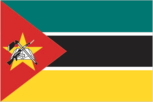
- three equal horizontal bands of green (top), black, and yellow with a red isosceles triangle based on the hoist side; the black band is edged in white; centered in the triangle is a yellow five-pointed star bearing a crossed rifle and hoe in black superimposed on an open white book; green represents the riches of the land, white peace, black the African continent, yellow the country's minerals, and red the struggle for independence; the rifle symbolizes defense and vigilance, the hoe refers to the country's agriculture, the open book stresses the importance of education, and the star represents Marxism and internationalism one of only two national flags featuring a firearm, the other is Guatemala
- note
- one of only two national flags featuring a firearm, the other is Guatemala
Government type
presidential republic
Independence
25 June 1975 (from Portugal)
International law organization participation
has not submitted an ICJ jurisdiction declaration; non-party state to the ICCt
International organization participation
ACP, AfDB, AU, C, CD, CPLP, EITI (compliant country), FAO, G-77, IAEA, IBRD, ICAO, ICC (NGOs), ICRM, IDA, IDB, IFAD, IFC, IFRCS, IHO, ILO, IMF, IMO, IMSO, Interpol, IOC, IOM, IPU, ISO (correspondent), ITSO, ITU, ITUC (NGOs), MIGA, NAM, OIC, OIF (observer), OPCW, SADC, UN, UNCTAD, UNESCO, UNHCR, UNIDO, Union Latina, UNISFA, UNWTO, UPU, WCO, WFTU (NGOs), WHO, WIPO, WMO, WTO
Judicial branch
- Supreme Court (consists of the court president, vice president, and 5 judges); Constitutional Council (consists of 7 judges); note - the Higher Council of the Judiciary is responsible for judiciary management and discipline Supreme Court president and vice president appointed by Mozambique president in consultation with the Higher Council of the Judiciary (CSMJ) and with ratification by the legislature; other judges elected by the legislature; judges serve 5-year renewable terms; Constitutional Council judges appointed - 1 by the president, 5 by the legislature, and 1 by the CSMJ; judges serve 5-year nonrenewable terms Administrative Court (capital city only); provincial courts or Tribunais Judicias de Provincia; District Courts or Tribunais Judicias de Districto; customs courts; maritime courts; courts marshal; labor courts; community courts
- highest court(s)
- Supreme Court (consists of the court president, vice president, and 5 judges); Constitutional Council (consists of 7 judges); note - the Higher Council of the Judiciary is responsible for judiciary management and discipline
- judge selection and term of office
- Supreme Court president and vice president appointed by Mozambique president in consultation with the Higher Council of the Judiciary (CSMJ) and with ratification by the legislature; other judges elected by the legislature; judges serve 5-year renewable terms; Constitutional Council judges appointed - 1 by the president, 5 by the legislature, and 1 by the CSMJ; judges serve 5-year nonrenewable terms
- subordinate courts
- Administrative Court (capital city only); provincial courts or Tribunais Judicias de Provincia; District Courts or Tribunais Judicias de Districto; customs courts; maritime courts; courts marshal; labor courts; community courts
Legal system
mixed legal system of Portuguese civil law, and customary law; note - in rural, predominately Muslim villages with no formal legal system, Islamic law may be applied
Legislative branch
- unicameral Assembly of the Republic or Assembleia da Republica (250 seats; members directly elected in single- and multi-seat constituencies by proportional representation vote and 2 members representing Mozambicans abroad who are appointed by the elected party; members serve 5-year terms) last held on 15 October 2014 (next to be held in October 2019) percent of vote by party - FRELIMO 55.9%, RENAMO 32.5%, MDM 8.4%, other 3.3%; seats by party - FRELIMO 144, RENAMO 89, MDM 17
- description
- unicameral Assembly of the Republic or Assembleia da Republica (250 seats; members directly elected in single- and multi-seat constituencies by proportional representation vote and 2 members representing Mozambicans abroad who are appointed by the elected party; members serve 5-year terms)
- election results
- percent of vote by party - FRELIMO 55.9%, RENAMO 32.5%, MDM 8.4%, other 3.3%; seats by party - FRELIMO 144, RENAMO 89, MDM 17
- elections
- last held on 15 October 2014 (next to be held in October 2019)
National anthem
- "Patria Amada" (Lovely Fatherland) Salomao J. MANHICA/unknown adopted 2002
- lyrics/music
- Salomao J. MANHICA/unknown
- name
- "Patria Amada" (Lovely Fatherland)
- note
- adopted 2002
National holiday
Independence Day, 25 June (1975)
National symbol(s)
- national colors: green, black, yellow, white, red
- national colors
- green, black, yellow, white, red
Political parties and leaders
Democratic Movement of Mozambique (Movimento Democratico de Mocambique) or MDM [Daviz SIMANGO] Front for the Liberation of Mozambique (Frente de Liberatacao de Mocambique) or FRELIMO [Filipe NYUS] Mozambique National Resistance (Resistencia Nacional Mocambicana) or RENAMO [Afonso DHLAKAMA]
Political pressure groups and leaders
Mozambican League of Human Rights (Liga Mocambicana dos Direitos Humanos) or LDH [Alice MABOTA, president] Youth Parliament (Parlamento Juvenil) [Salomao MUCHANGA]
Suffrage
18 years of age; universal
Economy
Agriculture - products
cotton, cashew nuts, sugarcane, tea, cassava (manioc, tapioca), corn, coconuts, sisal, citrus and tropical fruits, potatoes, sunflowers; beef, poultry
Budget
- $2.514 billion $3.548 billion (2016 est.)
- expenditures
- $3.548 billion (2016 est.)
- revenues
- $2.514 billion
Budget surplus (+) or deficit (-)
-9.2% of GDP (2016 est.)
Central bank discount rate
9.5% (17 January 2013) 3.25% (31 December 2010)
Commercial bank prime lending rate
21.18% (31 December 2016 est.) 14.87% (31 December 2015 est.)
Current account balance
$-4.307 billion (2016 est.) $-5.968 billion (2015 est.)
Debt - external
$10.48 billion (31 December 2016 est.) $10.06 billion (31 December 2015 est.)
Distribution of family income - Gini index
45.6 (2008) 47.3 (2002)
Economy - overview
At independence in 1975, Mozambique was one of the world's poorest countries. Socialist policies, economic mismanagement, and a brutal civil war from 1977 to 1992 further impoverished the country. In 1987, the government embarked on a series of macroeconomic reforms designed to stabilize the economy. These steps, combined with donor assistance and with political stability since the multi-party elections in 1994, propelled the country’s GDP from $4 billion in 1993, following the war, to about $35 billion in 2016. Fiscal reforms, including the introduction of a value-added tax and reform of the customs service, have improved the government's revenue collection abilities. In spite of these gains, more than half the population remains below the poverty line. Subsistence agriculture continues to employ the vast majority of the country's work force. Citizens rioted in September 2010 after fuel, water, electricity, and bread price increases were announced. In an attempt to lessen the negative impact on the population, the government implemented subsidies, decreased taxes and tariffs, and instituted other fiscal measures. A substantial trade imbalance persists, although aluminum production from the Mozal Aluminum Smelter has significantly boosted export earnings in recent years. In 2012, the Mozambican Government took over Portugal's last remaining share in the Cahora Bassa Hydroelectricity Company, a significant contributor to the Southern African Power Pool. The government has plans to expand the Cahora Bassa Dam and build additional dams to increase its electricity exports and fulfill the needs of its burgeoning domestic industries. Mozambique's once substantial foreign debt was reduced through forgiveness and rescheduling under the IMF's Heavily Indebted Poor Countries (HIPC) and Enhanced HIPC initiatives. However, in 2016, information surfaced revealing that the Mozambican Government was responsible for over $2 billion in government-backed loans originally secured between 2012-14 by state-owned defense and security companies without parliamentary approval or national budget inclusion, which prompted the IMF and international donors to halt direct budget support to the Government of Mozambique. This sizable external debt burden, donor withdrawal, elevated inflation, and currency depreciation contributed to weak growth in 2016 and forebode weaker economic growth in the next few years. Mozambique grew at an average annual rate of 6%-8% in the decade leading up to 2015, one of Africa's strongest performances, but growth slowed in 2016 to about 3.5% as low commodity prices reduced export earnings. However, many forecasts predict an increase in growth in 2017 as coal exports grow. Two major international consortiums are seeking approval to develop massive natural gas deposits off the coast of Cabo Delgado province, in what has the potential to become the largest infrastructure project in Africa. The government predicts sales of liquefied natural gas from these projects could generate several billion dollars in revenues annually sometime after 2022.
Exchange rates
meticais (MZM) per US dollar - 63.067 (2016 est.) 63.067 (2015 est.) 39.983 (2014 est.) 31.367 (2013 est.) 28.38 (2012 est.)
Exports
$3.328 billion (2016 est.) $3.413 billion (2015 est.)
Exports - commodities
aluminum, prawns, cashews, cotton, sugar, citrus, timber; bulk electricity
Exports - partners
Netherlands 30.8%, India 15.2%, South Africa 14.6% (2016)
Fiscal year
calendar year
GDP - composition, by end use
- 71.5% 28.2% 20.5% 22.1% 34.8% -77.2% (2016 est.)
- exports of goods and services
- 34.8%
- government consumption
- 28.2%
- household consumption
- 71.5%
- imports of goods and services
- -77.2% (2016 est.)
- investment in fixed capital
- 20.5%
- investment in inventories
- 22.1%
GDP - composition, by sector of origin
- 24.8% 21.6% 53.6% (2016 est.)
- agriculture
- 24.8%
- industry
- 21.6%
- services
- 53.6% (2016 est.)
GDP - per capita (PPP)
- $1,200 (2016 est.) $1,200 (2015 est.) $1,200 (2014 est.) data are in 2016 dollars
- note
- data are in 2016 dollars
GDP - real growth rate
3.8% (2016 est.) 6.6% (2015 est.) 7.4% (2014 est.)
GDP (official exchange rate)
$11.27 billion (2016 est.)
GDP (purchasing power parity)
- $35.08 billion (2016 est.) $33.35 billion (2015 est.) $30.96 billion (2014 est.) data are in 2016 dollars
- note
- data are in 2016 dollars
Gross national saving
5.6% of GDP (2016 est.) 5% of GDP (2015 est.) 17.2% of GDP (2014 est.)
Household income or consumption by percentage share
- 1.9% 36.7% (2008)
- highest 10%
- 36.7% (2008)
- lowest 10%
- 1.9%
Imports
$4.733 billion (2016 est.) $7.577 billion (2015 est.)
Imports - commodities
machinery and equipment, vehicles, fuel, chemicals, metal products, foodstuffs, textiles
Imports - partners
South Africa 36.6%, China 10.9%, Netherlands 7.8%, Bahrain 5.2%, France 4.2%, Portugal 4.2%, UAE 4.1% (2016)
Industrial production growth rate
5.4% (2016 est.)
Industries
aluminum, petroleum products, chemicals (fertilizer, soap, paints), textiles, cement, glass, asbestos, tobacco, food, beverages
Inflation rate (consumer prices)
19.2% (2016 est.) 3.6% (2015 est.)
Labor force
12.5 million (2016 est.)
Labor force - by occupation
- 81% 6% 13% (1997 est.)
- agriculture
- 81%
- industry
- 6%
- services
- 13% (1997 est.)
Market value of publicly traded shares
$NA
Population below poverty line
46.1% (2015 est.)
Public debt
121.2% of GDP (2016 est.) 72.1% of GDP (2015 est.)
Reserves of foreign exchange and gold
$2.081 billion (31 December 2016 est.) $2.582 billion (31 December 2015 est.)
Stock of broad money
$5.142 billion (31 December 2016 est.) $7.265 billion (31 December 2015 est.)
Stock of domestic credit
$4.242 billion (31 December 2016 est.) $5.565 billion (31 December 2015 est.)
Stock of narrow money
$3.411 billion (31 December 2016 est.) $4.758 billion (31 December 2015 est.)
Taxes and other revenues
22.3% of GDP (2016 est.)
Unemployment rate
22.4% (2014 est.) 17% (2007 est.)
Energy
Carbon dioxide emissions from consumption of energy
3.9 million Mt (2013 est.)
Crude oil - exports
0 bbl/day (2014 est.)
Crude oil - imports
0 bbl/day (2014 est.)
Crude oil - production
0 bbl/day (2016 est.)
Crude oil - proved reserves
0 bbl (1 January 2017 es)
Electricity - consumption
13.86 billion kWh (2015 est.)
Electricity - exports
12.88 billion kWh (2015 est.)
Electricity - from fossil fuels
14% of total installed capacity (2015 est.)
Electricity - from hydroelectric plants
85.6% of total installed capacity (2015 est.)
Electricity - from nuclear fuels
0% of total installed capacity (2015 est.)
Electricity - from other renewable sources
0.5% of total installed capacity (2015 est.)
Electricity - imports
10.55 billion kWh (2015 est.)
Electricity - installed generating capacity
2.556 million kW (2015 est.)
Electricity - production
19.58 billion kWh (2015 est.)
Electricity access
- 15,700,000 39% 66% 27% (2013)
- electrification - rural areas
- 27% (2013)
- electrification - total population
- 39%
- electrification - urban areas
- 66%
- population without electricity
- 15,700,000
Natural gas - consumption
2.726 billion cu m (2015 est.)
Natural gas - exports
3.8 billion cu m (2015 est.)
Natural gas - imports
0 cu m (2013 est.)
Natural gas - production
5.695 billion cu m (2015 est.)
Natural gas - proved reserves
2.832 trillion cu m (1 January 2017 es)
Refined petroleum products - consumption
23,000 bbl/day (2015 est.)
Refined petroleum products - exports
0 bbl/day (2014 est.)
Refined petroleum products - imports
21,890 bbl/day (2014 est.)
Refined petroleum products - production
0 bbl/day (2014 est.)
Communications
Broadcast media
1 state-run TV station supplemented by private TV station; Portuguese state TV's African service, RTP Africa, and Brazilian-owned TV Miramar are available; state-run radio provides nearly 100% territorial coverage and broadcasts in multiple languages; a number of privately owned and community-operated stations; transmissions of multiple international broadcasters are available (2007)
Internet country code
.mz
Internet users
- 4,543,284 17.5% (July 2016 est.)
- percent of population
- 17.5% (July 2016 est.)
- total
- 4,543,284
Telephone system
- the mobile segment has shown strong growth since the introduction of competition in 2003; poor fixed-line infrastructure means most Internet access is through mobile accounts extremely low fixed-line teledensity contrasts with rapid growth in the mobile-cellular network; three mobile-cellular operators provide coverage that includes all the main cities and key roads; mobile-cellular teledensity now about 70 per 100 persons country code - 258; landing point for the EASSy and SEACOM fiber-optic submarine cable systems; satellite earth stations - 5 Intelsat (2 Atlantic Ocean and 3 Indian Ocean) (2016)
- domestic
- extremely low fixed-line teledensity contrasts with rapid growth in the mobile-cellular network; three mobile-cellular operators provide coverage that includes all the main cities and key roads; mobile-cellular teledensity now about 70 per 100 persons
- general assessment
- the mobile segment has shown strong growth since the introduction of competition in 2003; poor fixed-line infrastructure means most Internet access is through mobile accounts
- international
- country code - 258; landing point for the EASSy and SEACOM fiber-optic submarine cable systems; satellite earth stations - 5 Intelsat (2 Atlantic Ocean and 3 Indian Ocean) (2016)
Telephones - fixed lines
- 84,310 less than 1 (July 2016 est.)
- subscriptions per 100 inhabitants
- less than 1 (July 2016 est.)
- total subscriptions
- 84,310
Telephones - mobile cellular
- 18,404,857 71 (July 2016 est.)
- subscriptions per 100 inhabitants
- 71 (July 2016 est.)
- total
- 18,404,857
Transportation
Airports
98 (2013)
Airports - with paved runways
- 4 (2017)
- 1,524 to 2,437 m
- 9
- 2,438 to 3,047 m
- 2
- 914 to 1,523 m
- 5
- over 3,047 m
- 1
- total
- 21
- under 914 m
- 4 (2017)
Airports - with unpaved runways
- 38 (2013)
- 1,524 to 2,437 m
- 9
- 2,438 to 3,047 m
- 1
- 914 to 1,523 m
- 29
- total
- 77
- under 914 m
- 38 (2013)
Civil aircraft registration country code prefix
C9 (2016)
Merchant marine
- cargo 2 2 (Belgium 2) (2010)
- by type
- cargo 2
- foreign-owned
- 2 (Belgium 2) (2010)
- total
- 2
National air transport system
- 686,892 5,138,916 mt-km (2015)
- annual freight traffic on registered air carriers
- 5,138,916 mt-km (2015)
- annual passenger traffic on registered air carriers
- 686,892
- inventory of registered aircraft operated by air carriers
- 16
- number of registered air carriers
- 3
Pipelines
gas 972 km; refined products 278 km (2013)
Ports and terminals
- Beira, Maputo, Nacala
- major seaport(s)
- Beira, Maputo, Nacala
Railways
- 4,787 km 4,787 km 1.067-m gauge (2014)
- narrow gauge
- 4,787 km 1.067-m gauge (2014)
- total
- 4,787 km
Roadways
- 31,083 km 7,365 km 23,718 km (2015)
- paved
- 7,365 km
- total
- 31,083 km
- unpaved
- 23,718 km (2015)
Waterways
460 km (Zambezi River navigable to Tete and along Cahora Bassa Lake) (2010)
Military and Security
Military branches
- Mozambique Armed Defense Forces (Forcas Armadas de Defesa de Mocambique, FADM): Mozambique Army, Mozambique Navy (Marinha de Guerra de Mocambique, MGM), Mozambique Air Force (Forca Aerea de Mocambique, FAM) (2012)
- Mozambique Armed Defense Forces (Forcas Armadas de Defesa de Mocambique, FADM)
- Mozambique Army, Mozambique Navy (Marinha de Guerra de Mocambique, MGM), Mozambique Air Force (Forca Aerea de Mocambique, FAM) (2012)
Military expenditures
1.03% of GDP (2016) 0.99% of GDP (2015) 1.02% of GDP (2014) 0.99% of GDP (2013) 0.91% of GDP (2012)
Military service age and obligation
registration for military service is mandatory for all males and females at 18 years of age; 18-35 years of age for selective compulsory military service; 18 years of age for voluntary service; 2-year service obligation; women may serve as officers or enlisted (2012)
Transnational Issues
Disputes - international
South Africa has placed military units to assist police operations along the border of Lesotho, Zimbabwe, and Mozambique to control smuggling, poaching, and illegal migration
Illicit drugs
southern African transit point for South Asian hashish and heroin, and South American cocaine probably destined for the European and South African markets; producer of cannabis (for local consumption) and methaqualone (for export to South Africa); corruption and poor regulatory capability make the banking system vulnerable to money laundering, but the lack of a well-developed financial infrastructure limits the country's utility as a money-laundering center
Refugees and internally displaced persons
- 15,000 (2016)
- IDPs
- 15,000 (2016)