2003 Edition
CIA World Factbook 2003 (Project Gutenberg)
Introduction
Administrative divisions
10 provinces (provincias, singular - provincia), 1 city*; Cabo Delgado, Gaza, Inhambane, Manica, Maputo, Maputo City*, Nampula, Niassa, Sofala, Tete, Zambezia
Age structure
0-14 years: 42.1% (male 3,634,173; female 3,725,396) 15-64 years: 55.3% (male 4,712,891; female 4,945,123) 65 years and over: 2.6% (male 189,778; female 271,905) (2003 est.)
Agriculture - products
cotton, cashew nuts, sugarcane, tea, cassava (tapioca), corn, coconuts, sisal, citrus and tropical fruits, potatoes, sunflowers; beef, poultry
Airports
165 (2002)
Airports - with paved runways
- over 3,047 m
- 1 2,438 to 3,047 m: 3 1,524 to 2,437 m: 10 914 to 1,523 m: 3
- total
- 22
- under 914 m
- 5 (2002)
Airports - with unpaved runways
- total
- 143 2,438 to 3,047 m: 1 1,524 to 2,437 m: 16 914 to 1,523 m: 35
- under 914 m
- 91 (2002) Military Mozambique
Area
- land
- 784,090 sq km
- total
- 801,590 sq km
- water
- 17,500 sq km
Area - comparative
slightly less than twice the size of California
Background
Almost five centuries as a Portuguese colony came to a close with independence in 1975. Large-scale emigration by whites, economic dependence on South Africa, a severe drought, and a prolonged civil war hindered the country's development. The ruling party formally abandoned Marxism in 1989, and a new constitution the following year provided for multiparty elections and a free market economy. A UN-negotiated peace agreement with rebel forces ended the fighting in 1992. Heavy flooding in both 1999 and 2000 severely hurt the economy. Political stability and sound economic policies have encouraged recent foreign investment. Geography Mozambique
Birth rate
38.2 births/1,000 population (2003 est.)
Budget
- expenditures
- $1.025 billion, including capital expenditures of $479.4 million (2001 est.)
- revenues
- $393.1 million
Capital
Maputo
Climate
tropical to subtropical
Coastline
2,470 km
Constitution
30 November 1990
Country name
- conventional long form
- Republic of Mozambique
- conventional short form
- Mozambique
- former
- Portuguese East Africa
- local long form
- Republica de Mocambique
- local short form
- Mocambique
Currency
metical (MZM)
Currency code
MZM
Death rate
30.04 deaths/1,000 population (2003 est.)
Debt - external
$966 million (2002 est.)
Diplomatic representation from the US
- chief of mission
- Ambassador Sharon P. WILKINSON
- embassy
- Avenida Kenneth Kuanda 193, Maputo
- mailing address
- P. O. Box 783, Maputo
- telephone
- [258] (1) 492797
Diplomatic representation in the US
- chief of mission
- Ambassador Armando PANGUENE
Disputes - international
none
Distribution of family income - Gini index
39.6 (1996-97)
Economic aid - recipient
$632.8 million (2001)
Economy - overview
At independence in 1975, Mozambique was one of the world's poorest countries. Socialist mismanagement and a brutal civil war from 1977-92 exacerbated the situation. In 1987, the government embarked on a series of macroeconomic reforms designed to stabilize the economy. These steps, combined with donor assistance and with political stability since the multi-party elections in 1994, have led to dramatic improvements in the country's growth rate. Inflation was brought to single digits during the late 1990s although it returned to double digits in 2000-02. Fiscal reforms, including the introduction of a value-added tax and reform of the customs service, have improved the government's revenue collection abilities. In spite of these gains, Mozambique remains dependent upon foreign assistance for much of its annual budget, and the majority of the population remains below the poverty line. Subsistence agriculture continues to employ the vast majority of the country's workforce. A substantial trade imbalance persists although the opening of the MOZAL aluminum smelter, the country's largest foreign investment project to date has increased export earnings. Additional investment projects in titanium extraction and processing and garment manufacturing should further close the import/export gap. Mozambique's once substantial foreign debt has been reduced through forgiveness and rescheduling under the IMF's Heavily Indebted Poor Countries (HIPC) and Enhanced HIPC initiatives, and is now at a manageable level.
Electricity - consumption
1.39 billion kWh (2001)
Electricity - exports
5.8 billion kWh (2001)
Electricity - imports
500 million kWh (2001)
Electricity - production
7.193 billion kWh (2001)
Electricity - production by source
- fossil fuel
- 2.9%
- hydro
- 97.1%
- nuclear
- 0%
- other
- 0% (2001)
Elevation extremes
- highest point
- Monte Binga 2,436 m
- lowest point
- Indian Ocean 0 m
Environment - current issues
a long civil war and recurrent drought in the hinterlands have resulted in increased migration of the population to urban and coastal areas with adverse environmental consequences; desertification; pollution of surface and coastal waters; elephant poaching for ivory is a problem
Environment - international agreements
- party to
- Biodiversity, Climate Change, Desertification, Endangered Species, Hazardous Wastes, Law of the Sea, Ozone Layer Protection
- signed, but not ratified
- none of the selected agreements
Ethnic groups
indigenous tribal groups 99.66% (Shangaan, Chokwe, Manyika, Sena, Makua, and others), Europeans 0.06%, Euro-Africans 0.2%, Indians 0.08%
Exchange rates
- meticais per US dollar - 23,678 (2002), 20,703.6 (2001), 15,447.1 (2000), 13,028.6 (1999), 12,110.2 (1998)
- note
- effective October 2000, the exchange rate is determined as the weighted average of buying and selling exchange rates of all transactions of commercial banks and stock exchanges with the public
Executive branch
- cabinet
- Cabinet
- chief of state
- President Joaquim Alberto CHISSANO (since 6 November 1986); note - before being popularly elected, CHISSANO was elected president by Frelimo's Central Committee on 4 November 1986 (reelected by the Committee 30 July 1989)
- election results
- Joaquim Alberto CHISSANO reelected president; percent of vote - Joaquim Alberto CHISSANO 52.29%, Afonso DHLAKAMA 47.71%
- elections
- president elected by popular vote for a five-year term; election last held 3-5 December 1999 (next to be held NA 2004); prime minister appointed by the president
- head of government
- Prime Minister Pascoal MOCUMBI (since 17 December 1994)
Exports
$680 million f.o.b. (2002 est.)
Exports - commodities
aluminum, prawns, cashews, cotton, sugar, citrus, timber; bulk electricity
Exports - partners
Belgium 24.3%, South Africa 9.1%, Germany 6.2% (2002)
FAX
- [1] (202) 835-0245
- [258] (1) 490448
- chancery
- 1990 M Street NW, Suite 570, Washington, DC 20036
- telephone
- [1] (202) 293-7146
Fiscal year
calendar year Communications Mozambique
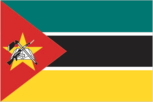
Flag description
three equal horizontal bands of green (top), black, and yellow with a red isosceles triangle based on the hoist side; the black band is edged in white; centered in the triangle is a yellow five-pointed star bearing a crossed rifle and hoe in black superimposed on an open white book Economy Mozambique
GDP
purchasing power parity - $19.52 billion (2002 est.)
GDP - composition by sector
- agriculture
- 22%
- industry
- 23%
- services
- 55% (2001 est.)
GDP - per capita
purchasing power parity - $1,100 (2002 est.)
GDP - real growth rate
7.7% (2002 est.)
Geographic coordinates
18 15 S, 35 00 E
Geography - note
the Zambezi flows through the north-central and most fertile part of the country People Mozambique
Government type
republic
Highways
- paved
- 5,685 km
- total
- 30,400 km
- unpaved
- 24,715 km (1999 est.)
HIV/AIDS - adult prevalence rate
13% 12.6 to 16.4%, estimates vary (2001 est.)
HIV/AIDS - deaths
60,000 (2001 est.)
HIV/AIDS - people living with HIV/AIDS
1.1 million (2001 est.)
Household income or consumption by percentage share
- highest 10%
- 31.7% (1997)
- lowest 10%
- 2.5%
Illicit drugs
Southern African transit point for South Asian hashish, South Asian heroin, and South American cocaine probably destined for the European and South African markets; producer of cannabis (for local consumption) and methaqualone (for export to South Africa); corruption and poor regulatory capability makes the banking system vulnerable to money laundering, but the lack of a well-developed financial infrastructure limits the country's utility as a money-laundering center This page was last updated on 18 December, 2003
Imports
$1.18 billion c.i.f. (2002 est.)
Imports - commodities
machinery and equipment, vehicles, fuel, chemicals, metal products, foodstuffs, textiles
Imports - partners
South Africa 27.5%, France 8.9%, US 7%, Australia 6.9%, Japan 6%, Malaysia 4% (2002)
Independence
25 June 1975 (from Portugal)
Industrial production growth rate
3.4% (2000)
Industries
food, beverages, chemicals (fertilizer, soap, paints), aluminum, petroleum products, textiles, cement, glass, asbestos, tobacco
Infant mortality rate
- female
- 180.61 deaths/1,000 live births (2003 est.)
- male
- 216.85 deaths/1,000 live births
- total
- 199 deaths/1,000 live births
Inflation rate (consumer prices)
15.2% (2002 est.)
International organization participation
ACP, AfDB, C, ECA, FAO, G-77, IBRD, ICAO, ICCt (signatory), ICFTU, ICRM, IDA, IDB, IFAD, IFC, IFRCS, IHO, ILO, IMF, IMO, Interpol, IOC, IOM (observer), ISO (correspondent), ITU, MONUC, NAM, OAU, OIC, OPCW, SADC, UN, UNCTAD, UNESCO, UNHCR, UNIDO, UNMISET, UPU, WCO, WFTU, WHO, WIPO, WMO, WToO, WTrO
Internet country code
.mz
Internet Service Providers (ISPs)
11 (2002)
Internet users
22,500 (2000) Transportation Mozambique
Irrigated land
1,070 sq km (1998 est.)
Judicial branch
- Supreme Court (the court of final appeal; some of its professional judges are appointed by the president and some are elected by the Assembly); other courts include an Administrative Court, customs courts, maritime courts, courts marshal, labor courts
- note
- although the constitution provides for the creation of a separate Constitutional Court, one has never been established; in its absence the Supreme Court reviews constitutional cases
Labor force
9.2 million (2000 est.)
Labor force - by occupation
agriculture 81%, industry 6%, services 13% (1997 est.)
Land boundaries
- border countries
- Malawi 1,569 km, South Africa 491 km, Swaziland 105 km, Tanzania 756 km, Zambia 419 km, Zimbabwe 1,231 km
- total
- 4,571 km
Land use
- arable land
- 3.98%
- other
- 95.73% (1998 est.)
- permanent crops
- 0.29%
Languages
Portuguese (official), indigenous dialects
Legal system
based on Portuguese civil law system and customary law
Legislative branch
- unicameral Assembly of the Republic or Assembleia da Republica (250 seats; members are directly elected by popular vote on a secret ballot to serve five-year terms)
- election results
- percent of vote by party - Frelimo 48.54%, Renamo-UE 38.81%; seats by party - Frelimo 133, Renamo-UE 117
- elections
- last held 3-5 December 1999 (next to be held NA 2004)
- note
- Renamo-UE ran as a multiparty coalition; none of the other opposition parties received the 5% required to win parliamentary seats; in September 2000, Renamo-UE member Raul DOMINGOS was expelled from the party; he continues to hold his parliamentary seat as an independent
Life expectancy at birth
- female
- 31.63 years (2003 est.)
- male
- 30.98 years
- total population
- 31.3 years
Literacy
- definition
- age 15 and over can read and write
- female
- 32.7% (2003 est.) Government Mozambique
- male
- 63.5%
- total population
- 47.8%
Location
South-eastern Africa, bordering the Mozambique Channel, between South Africa and Tanzania
Map references
Africa
Maritime claims
- exclusive economic zone
- 200 NM
- territorial sea
- 12 NM
Median age
- female
- 19.3 years (2002)
- male
- 18.7 years
- total
- 19 years
Merchant marine
- convenience
- Belgium 2 (2002 est.)
- note
- includes some foreign-owned ships registered here as a flag of
- ships by type
- cargo 3
- total
- 3 ships (1,000 GRT or over) 4,125 GRT/7,024 DWT
Military branches
Army, Naval Command, Air and Air Defense Forces, Special Forces, Militia
Military expenditures - dollar figure
$35.1 million (2000 est.)
Military expenditures - percent of GDP
1% (2000 est.) Transnational Issues Mozambique
Military manpower - availability
- males age 15-49
- 4,142,449 (2003 est.)
Military manpower - fit for military service
- males age 15-49
- 2,373,444 (2003 est.)
National holiday
Independence Day, 25 June (1975)
Nationality
- adjective
- Mozambican
- noun
- Mozambican(s)
Natural gas - consumption
60 million cu m (2001 est.)
Natural gas - exports
0 cu m (2001 est.)
Natural gas - imports
0 cu m (2001 est.)
Natural gas - production
60 million cu m (2001 est.)
Natural gas - proved reserves
63.71 billion cu m (37257)
Natural hazards
severe droughts; devastating cyclones and floods occur in central and southern provinces
Natural resources
coal, titanium, natural gas, hydropower, tantalum, graphite
Net migration rate
0 migrant(s)/1,000 population (2003 est.)
Oil - consumption
8,500 bbl/day (2001 est.)
Oil - exports
NA (2001)
Oil - imports
NA (2001)
Oil - production
0 bbl/day (2001 est.)
Oil - proved reserves
0 bbl (37257)
Pipelines
gas 189 km; refined products 292 km (2003)
Political parties and leaders
Front for the Liberation of Mozambique (Frente de Liberatacao de Mocambique) or Frelimo [Joaquim Alberto CHISSANO, president]; Mozambique National Resistance-Electoral Union (Resistencia Nacional Mocambicana-Uniao Eleitoral) or Renamo-UE [Afonso DHLAKAMA, president]
Political pressure groups and leaders
Institute for Peace and Democracy (Instituto para Paz e Democracia) or IPADE [Raul DOMINGOS, president]; Etica [Abdul CARIMO Issa, chairman]; Movement for Peace and Citizenship (Movimento para Paz e Cidadania); Mozambican League of Human Rights (Liga Mocambicana dos Direitos Humanos) or LDH [Alice MABOTE, president]; Human Rights and Development (Direitos Humanos e Desenvolvimento) or DHD [Artemisia FRANCO, secretary general]
Population
- 17,479,266
- note
- estimates for this country explicitly take into account the effects of excess mortality due to AIDS; this can result in lower life expectancy, higher infant mortality and death rates, lower population and growth rates, and changes in the distribution of population by age and sex than would otherwise be expected; the 1997 Mozambican census reported a population of 16,099,246 (July 2003 est.)
Population below poverty line
70% (2001 est.)
Population growth rate
0.82% (2003 est.)
Ports and harbors
Beira, Inhambane, Maputo, Nacala, Pemba, Quelimane
Radio broadcast stations
AM 13, FM 17, shortwave 11 (2001)
Radios
730,000 (1997)
Railways
- narrow gauge
- 2,983 km 1.067-m gauge; 140 km 0.762-m gauge (2002)
- total
- 3,123 km
Religions
indigenous beliefs 50%, Christian 30%, Muslim 20%
Sex ratio
- at birth
- 1.03 male(s)/female
- total population
- 0.96 male(s)/female (2003 est.)
- under 15 years
- 0.98 male(s)/female 15-64 years: 0.95 male(s)/female 65 years and over: 0.7 male(s)/female
Suffrage
18 years of age; universal
Telephone system
- domestic
- the system consists of open-wire lines and trunk connection by microwave radio relay and tropospheric scatter
- general assessment
- fair system but not available generally (telephone density is only 16 telephones for each 1,000 persons)
- international
- satellite earth stations - 5 Intelsat (2 Atlantic Ocean and 3 Indian Ocean)
Telephones - main lines in use
90,000 (2001)
Telephones - mobile cellular
287,000 (2002)
Television broadcast stations
1 (2001)
Televisions
67,600 (2000)
Terrain
mostly coastal lowlands, uplands in center, high plateaus in northwest, mountains in west
Total fertility rate
4.87 children born/woman (2003 est.)
Unemployment rate
21% (1997 est.)
Waterways
3,750 km (navigable routes)