1999 Edition
CIA World Factbook 1999 (Internet Archive)
Geography
Area
total: 801,590 sq km land: 784,090 sq km water: 17,500 sq km
Area--comparative
slightly less than twice the size of California
Climate
tropical to subtropical
Coastline
2,470 km
Elevation extremes
lowest point: Indian Ocean 0 m highest point: Monte Binga 2,436 m
Environment--current issues
a long civil war and recurrent drought in the hinterlands have resulted in increased migration of the population to urban and coastal areas with adverse environmental consequences; desertification; pollution of surface and coastal waters
Environment--international agreements
party to: Biodiversity, Climate Change, Desertification, Endangered Species, Hazardous Wastes, Law of the Sea, Ozone Layer Protection signed, but not ratified: none of the selected agreements
Geographic coordinates
18 15 S, 35 00 E
Irrigated land
1,180 sq km (1993 est.)
Land boundaries
total: 4,571 km border countries: Malawi 1,569 km, South Africa 491 km, Swaziland 105 km, Tanzania 756 km, Zambia 419 km, Zimbabwe 1,231 km
Land use
arable land: 4% permanent crops: 0% permanent pastures: 56% forests and woodland: 18% other: 22% (1993 est.)
Location
Southern Africa, bordering the Mozambique Channel, between South Africa and Tanzania
Map references
Africa
Maritime claims
exclusive economic zone: 200 nm territorial sea: 12 nm
Natural hazards
severe droughts and floods occur in central and southern provinces; devastating cyclones
Natural resources
coal, titanium, natural gas
Terrain
mostly coastal lowlands, uplands in center, high plateaus in northwest, mountains in west
People and Society
Age structure
0-14 years: 45% (male 4,236,545; female 4,325,586) 15-64 years: 53% (male 4,941,048; female 5,181,282) 65 years and over: 2% (male 182,857; female 257,017) (1999 est.)
Birth rate
42.75 births/1,000 population (1999 est.)
Death rate
17.31 deaths/1,000 population (1999 est.)
Ethnic groups
indigenous tribal groups 99.66% (Shangaan, Chokwe, Manyika, Sena, Makua, and others), Europeans 0.06%, Euro-Africans 0.2%, Indians 0.08%
Infant mortality rate
117.56 deaths/1,000 live births (1999 est.)
Languages
Portuguese (official), indigenous dialects
Life expectancy at birth
total population: 45.89 years male: 44.73 years female: 47.09 years (1999 est.)
Literacy
definition: age 15 and over can read and write total population: 40.1% male: 57.7% female: 23.3% (1995 est.)
Nationality
noun: Mozambican(s) adjective: Mozambican
Net migration rate
0 migrant(s)/1,000 population (1999 est.)
Population
19,124,335 (July 1999 est.) note: the 1997 Mozambican census reported a population of 16,542,800; other estimates range as low as 16.9 million
Population growth rate
2.54% (1999 est.)
Religions
indigenous beliefs 50%, Christian 30%, Muslim 20%
Sex ratio
at birth: 1.03 male(s)/female under 15 years: 0.98 male(s)/female 15-64 years: 0.95 male(s)/female 65 years and over: 0.71 male(s)/female total population: 0.96 male(s)/female (1999 est.)
Total fertility rate
5.88 children born/woman (1999 est.)
Government
Administrative divisions
10 provinces (provincias, singular--provincia); Cabo Delgado, Gaza, Inhambane, Manica, Maputo, Nampula, Niassa, Sofala, Tete, Zambezia
Capital
Maputo
Constitution
30 November 1990
Country name
conventional long form: Republic of Mozambique conventional short form: Mozambique local long form: Republica de Mocambique local short form: Mocambique
Data code
MZ
Executive branch
chief of state: President Joaquim Alberto CHISSANO (since 6 November 1986); note--before being popularly elected, CHISSANO was elected president by Frelimo's Central Committee 4 November 1986 (reelected by the Committee 30 July 1989) head of government: Prime Minister Pascoal MOCUMBI (since NA December 1994) cabinet: Cabinet elections: president elected by popular vote for a five-year term; election last held 27 October 1994 (next to be held NA October 1999); prime minister appointed by the president election results: Joaquim Alberto CHISSANO elected president; percent of vote--Joaquim CHISSANO 53.3%, Afonso DHLAKAMA 33.3%
Flag description
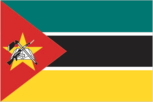
three equal horizontal bands of green (top), black, and yellow with a red isosceles triangle based on the hoist side; the black band is edged in white; centered in the triangle is a yellow five-pointed star bearing a crossed rifle and hoe in black superimposed on an open white book
Government type
republic
Independence
25 June 1975 (from Portugal)
International organization participation
ACP, AfDB, C, CCC, ECA, FAO, G-77, IBRD, ICAO, ICFTU, ICRM, IDA, IDB, IFAD, IFC, IFRCS, IHO (pending member), ILO, IMF, IMO, Inmarsat, Intelsat, Interpol, IOC, IOM (observer), ISO (correspondent), ITU, NAM, OAU, OIC, SADC, UN, UNCTAD, UNESCO, UNIDO, UPU, WFTU, WHO, WIPO, WMO, WToO, WTrO Diplomatic representation in the US: chief of mission: Ambassador Marcos Geraldo NAMASHULUA chancery: Suite 570, 1990 M Street NW, Washington, DC 20036 Diplomatic representation from the US: chief of mission: Ambassador Bryan Dean CURRAN embassy: Avenida Kenneth Kuanda 193, Maputo mailing address: P. O. Box 783, Maputo
Judicial branch
Supreme Court, judges appointed by the president and judges elected by the Assembly Political parties and leaders: Front for the Liberation of Alberto CHISSANO, chairman]; Mozambique National Resistance secretary]; note--the DU may have broken up into the three parties that composed it--Liberal and Democratic Party of Mozambique, National Democratic Party, and National Party of Mozambique
Legal system
based on Portuguese civil law system and customary law
Legislative branch
unicameral Assembly of the Republic or Assembleia da Republica (250 seats; members are directly elected by popular vote on a secret ballot to serve five-year terms) elections: last held 27-29 October 1994 (next to be held NA October 1999) election results: percent of vote by party--Frelimo 44.33%, Renamo 33.78%, DU 5.15%, other 16.74%; seats by party--Frelimo 129, Renamo 112, DU 9
National holiday
Independence Day, 25 June (1975)
Suffrage
18 years of age; universal
Economy
Agriculture--products
cotton, cashew nuts, sugarcane, tea, cassava (tapioca), corn, rice, tropical fruits; beef, poultry
Budget
revenues: $402 million expenditures: $799 million, including capital expenditures of $NA (1997 est.)
Currency
1 metical (Mt) = 100 centavos
Debt--external
$5.7 billion (December 1997)
Economic aid--recipient
$1.115 billion (1995)
Economy--overview
Before the peace accord of October 1992, Mozambique's economy was devastated by a protracted civil war and socialist mismanagement. In 1994, it ranked as one of the poorest countries in the world. Since then, Mozambique has undertaken a series of economic reforms. Almost all aspects of the economy have been liberalized to some extent. More than 900 state enterprises have been privatized. Pending are tax and much needed commercial code reform, as well as greater private sector involvement in the transportation, telecommunications, and energy sectors. Since 1996, inflation has been low and foreign exchange rates stable. Albeit from a small base, Mozambique achieved one of the highest growth rates in the world in 1997-98. Still, the country depends on foreign assistance to balance the budget and to pay for a trade imbalance in which imports outnumber exports by three to one. The medium-term outlook for the country looks bright, as trade and transportation links to South Africa and the rest of the region are expected to improve and sizable foreign investments materialize. Among these investments are metal production (aluminum, steel), natural gas, power generation, agriculture (cotton, sugar), fishing, timber, and transportation services. Additional exports in these areas should bring in needed foreign exchange.
Electricity--consumption
1.11 billion kWh (1997)
Electricity--exports
0 kWh (1996)
Electricity--imports
685.6 million kWh (1997)
Electricity--production
426 million kWh (1997)
Electricity--production by source
NA%
Exchange rates
meticais (Mt) per US$1--12,394.0 (January 1999), 11,874.6 (1998), 11.543.6 (1997), 11,293.8 (1996), 9,024.3 (1995), 6,038.6 (1994)
Exports
$295 million (f.o.b., 1998 est.)
Exports--commodities
shrimp 40%, cashews, cotton, sugar, copra, citrus (1997)
Exports--partners
Spain 17%, South Africa 16%, Portugal 12%, US 10%, Japan, Malawi, India, Zimbabwe (1996 est.)
Fiscal year
calendar year
GDP
purchasing power parity--$16.8 billion (1998 est.)
GDP--composition by sector
agriculture: 35% industry: 13% services: 52% (1996 est.)
GDP--per capita
purchasing power parity?$900 (1998 est.)
GDP--real growth rate
11% (1998 est.)
Household income or consumption by percentage share
lowest 10%: NA% highest 10%: NA%
Imports
$965 million (c.i.f., 1998 est.)
Imports--commodities
food, clothing, farm equipment, petroleum (1997)
Imports--partners
South Africa 55%, Zimbabwe 7%, Saudi Arabia 5%, Portugal 4%, US, Japan, India (1996 est.)
Industrial production growth rate
39% (1997)
Industries
food, beverages, chemicals (fertilizer, soap, paints), petroleum products, textiles, cement, glass, asbestos, tobacco
Inflation rate (consumer prices)
-1.3% (1998 est.)
Labor force
NA
Labor force--by occupation
agriculture 80%, industry 9.5%, services 5.5%, wage earners working abroad 5% (1993 est)
Population below poverty line
NA%
Unemployment rate
NA
Communications
Radio broadcast stations
AM 29, FM 4, shortwave 0
Radios
700,000 (1992 est.)
Telephone system
fair system of tropospheric scatter, open-wire lines, and microwave radio relay domestic: microwave radio relay and tropospheric scatter international: satellite earth stations--5 Intelsat (2 Atlantic Ocean and 3 Indian Ocean)
Telephones
70,000 (1998 est.)
Television broadcast stations
1 (1997)
Televisions
44,000 (1992 est.)
Transportation
Airports
174 (1998 est.) Airports--with paved runways: total: 22 over 3,047 m: 1 2,438 to 3,047 m: 3 1,524 to 2,437 m: 10 914 to 1,523 m: 4 under 914 m: 4 (1998 est.) Airports--with unpaved runways: total: 152 2,438 to 3,047 m: 1 1,524 to 2,437 m: 16 914 to 1,523 m: 39 under 914 m: 96 (1998 est.)
Highways
total: 30,400 km paved: 5,685 km unpaved: 24,715 km (1996 est.)
Merchant marine
total: 3 cargo ships (1,000 GRT or over) totaling 4,125 GRT/7,024 DWT (1998 est.)
Pipelines
crude oil 306 km; petroleum products 289 km note: not operating Ports and harbors: Beira, Inhambane, Maputo, Nacala, Pemba, Quelimane
Railways
total: 3,131 km narrow gauge: 2,988 km 1.067-m gauge; 143 km 0.762-m gauge (1994)
Waterways
about 3,750 km of navigable routes
Military and Security
Military branches
Army, Naval Command, Air and Air Defense Forces, Militia
Military expenditures--dollar figure
$72 million (FY97)
Military expenditures--percent of GDP
4.7% (1997)
Military manpower--availability
males age 15-49: 4,385,483 (1999 est.) Military manpower--fit for military service: males age 15-49: 2,526,447 (1999 est.)
Transnational Issues
Disputes--international
none
Illicit drugs
Southern African transit hub for South American cocaine probably destined for the European and US markets; producer of hashish and methaqualone