1995 Edition
CIA World Factbook 1995 (Project Gutenberg)
Geography
Area
total area: 801,590 sq km land area: 784,090 sq km comparative area: slightly less than twice the size of California
Climate
tropical to subtropical
Coastline
2,470 km
Environment
current issues: civil strife and recurrent drought in the hinterlands have resulted in increased migration to urban and coastal areas with adverse environmental consequences; desertification; pollution of surface and coastal waters natural hazards: severe droughts and floods occur in central and southern provinces; devastating cyclones international agreements: party to - Endangered Species, Ozone Layer Protection; signed, but not ratified - Biodiversity, Climate Change, Law of the Sea
International disputes
none
Irrigated land
1,150 sq km (1989 est.)
Land boundaries
total 4,571 km, Malawi 1,569 km, South Africa 491 km, Swaziland 105 km, Tanzania 756 km, Zambia 419 km, Zimbabwe 1,231 km
Land use
arable land: 4% permanent crops: 0% meadows and pastures: 56% forest and woodland: 20% other: 20%
Location
Southern Africa, bordering the Mozambique Channel, between South Africa and Tanzania
Map references
Africa
Maritime claims
exclusive economic zone: 200 nm territorial sea: 12 nm
Natural resources
coal, titanium
Terrain
mostly coastal lowlands, uplands in center, high plateaus in northwest, mountains in west
People and Society
Age structure
0-14 years: 45% (female 4,069,117; male 4,078,429) 15-64 years: 53% (female 4,882,292; male 4,630,193) 65 years and over: 2% (female 260,057; male 195,162) (July 1995 est.)
Birth rate
44.6 births/1,000 population (1995 est.)
Death rate
15.94 deaths/1,000 population (1995 est.)
Ethnic divisions
indigenous tribal groups, Europeans about 10,000, Euro-Africans 35,000, Indians 15,000
Infant mortality rate
126 deaths/1,000 live births (1995 est.)
Labor force
NA by occupation: 90% engaged in agriculture
Languages
Portuguese (official), indigenous dialects
Life expectancy at birth
total population: 48.95 years male: 47.04 years female: 50.92 years (1995 est.)
Literacy
age 15 and over can read and write (1990) total population: 33% male: 45% female: 21%
Nationality
noun: Mozambican(s) adjective: Mozambican
Net migration rate
NA migrant(s)/1,000 population (1995 est.) note: by the end of 1994, an estimated 1.6 million Mozambican refugees, who fled to Malawi, Zimbabwa, and South Africa in earlier years from the civil war, had returned; an estimated 100,000 refugees remain to be repatriated from those countries
Population
18,115,250 (July 1995 est.)
Population growth rate
2.87% (1995 est.)
Religions
indigenous beliefs 60%, Christian 30%, Muslim 10%
Total fertility rate
6.19 children born/woman (1995 est.)
Government
Administrative divisions
10 provinces (provincias, singular - provincia); Cabo Delgado, Gaza, Inhambane, Manica, Maputo, Nampula, Niassa, Sofala, Tete, Zambezia
Assembly of the Republic (Assembleia da Republica)
draft electoral law provides for periodic, direct presidential and Assembly elections note: as called for in the 1992 peace accords, presidential and legislative elections took place during 27-29 October 1994; fourteen parties, including the Mozambique National Resistance (RENAMO) participated; Joaquim Alberto CHISSANO was elected president and his FRELIMO party gathered a slim majority in the 250 seat legislature
Capital
Maputo
Constitution
30 November 1990
Digraph
MZ
Diplomatic representation in US
chief of mission: Ambassador Hipolito Pereira Zozimo PATRICIO chancery: Suite 570, 1990 M Street NW, Washington, DC 20036 telephone: [1] (202) 293-7146
Executive branch
chief of state: President Joaquim Alberto CHISSANO (since 6 November 1986) head of government: Prime Minister Pascoal MOCUMBI (since December 1994) cabinet: Cabinet
FAX
- [1] (202) 835-0245
- [258] (1) 490114
Flag
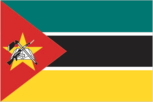
three equal horizontal bands of green (top), black, and yellow with a red isosceles triangle based on the hoist side; the black band is edged in white; centered in the triangle is a yellow five-pointed star bearing a crossed rifle and hoe in black superimposed on an open white book
Independence
25 June 1975 (from Portugal)
Judicial branch
Supreme Court
Legal system
based on Portuguese civil law system and customary law
Legislative branch
unicameral
Member of
ACP, AfDB, CCC, ECA, FAO, FLS, G-77, GATT, IBRD, ICAO, ICRM, IDA, IFAD, IFC, IFRCS, ILO, IMF, IMO, INMARSAT, INTELSAT, INTERPOL, IOC, IOM (observer), ITU, NAM, OAU, OIC, SADC, UN, UNCTAD, UNESCO, UNIDO, UPU, WFTU, WHO, WMO
Names
conventional long form: Republic of Mozambique conventional short form: Mozambique local long form: Republica Popular de Mocambique local short form: Mocambique
National holiday
Independence Day, 25 June (1975)
Political parties and leaders
Front for the Liberation of Mozambique (FRELIMO), Joaquim Alberto CHISSANO, chairman; the ruling party since independence, FRELIMO was the only legal party before 30 November 1990 when the new Constitution went into effect establishing a multiparty system
Suffrage
18 years of age; universal
Type
republic
US diplomatic representation
chief of mission: Ambassador Dennis Coleman JETT embassy: Avenida Kenneth Kuanda, 193 Maputo mailing address: P. O. Box 783, Maputo telephone: [258] (1) 492797
Economy
Agriculture
accounts for 50% of GDP and about 90% of exports; cash crops - cotton, cashew nuts, sugarcane, tea, shrimp; other crops - cassava, corn, rice, tropical fruits; not self-sufficient in food
Budget
revenues: $252 million expenditures: $607 million, including capital expenditures of $NA (1992 est.)
Currency
1 metical (Mt) = 100 centavos
Economic aid
recipient: US commitments, including Ex-Im (FY70-89), $350 million; Western (non-US) countries, ODA and OOF bilateral commitments (1970-89), $4.4 billion; OPEC bilateral aid (1979-89), $37 million; Communist countries (1970-89), $890 million
Electricity
capacity: 2,360,000 kW production: 1.7 billion kWh consumption per capita: 58 kWh (1993)
Exchange rates
meticais (Mt) per US$1 - 5,220.63 (1st quarter 1994), 3,874.24 (1993), 2,550.40 (1992), 1,763.99 (1991), 1,053.09 (1990)
Exports
$150 million (f.o.b., 1994 est.) commodities: shrimp 40%, cashews, cotton, sugar, copra, citrus partners: Spain, South Africa, US, Portugal, Japan
External debt
$5 billion (1992 est.)
Fiscal year
calendar year
Imports
$1.14 billion (c.i.f., 1994 est.) commodities: food, clothing, farm equipment, petroleum partners: South Africa, UK, France, Japan, Portugal
Industrial production
growth rate 5% (1989 est.)
Industries
food, beverages, chemicals (fertilizer, soap, paints), petroleum products, textiles, nonmetallic mineral products (cement, glass, asbestos), tobacco
Inflation rate (consumer prices)
50% (1994 est.)
National product
GDP - purchasing power parity - $10.6 billion (1994 est.)
National product per capita
$610 (1994 est.)
National product real growth rate
5.8% (1994 est.)
Overview
One of Africa's poorest countries, Mozambique has failed to exploit the economic potential of its sizable agricultural, hydropower, and transportation resources. Indeed, national output, consumption, and investment declined throughout the first half of the 1980s because of internal disorders, lack of government administrative control, and a growing foreign debt. A sharp increase in foreign aid, attracted by an economic reform policy, resulted in successive years of economic growth in the late 1980s, but aid has declined steadily since 1989. Agricultural output is at only 75% of its 1981 level, and grain has to be imported. Industry operates at only 20%-40% of capacity. The economy depends heavily on foreign assistance to keep afloat. Peace accords signed in October 1992 improved chances of foreign investment, aided IMF-supported economic reforms, and supported continued economic recovery. Elections held in 1994 diverted government attention from the economy, resulting in slippage and delays in the economic reform program. Nonetheless, growth in 1994 was solid and can continue into the late 1990s given continued foreign help in meeting debt obligations.
Unemployment rate
50% (1989 est.)
Communications
Radio
broadcast stations: AM 29, FM 4, shortwave 0 radios: NA
Telephone system
NA telephone density; fair system of troposcatter, open-wire lines, and radio relay local: NA intercity: microwave radio relay and tropospheric scatter international: 5 INTELSAT (2 Atlantic Ocean and 3 Indian Ocean) earth stations
Television
broadcast stations: 1 televisions: NA
Transportation
Airports
total: 192 with paved runways over 3,047 m: 1 with paved runways 2,438 to 3,047 m: 4 with paved runways 1,524 to 2,437 m: 11 with paved runways 914 to 1,523 m: 5 with paved runways under 914 m: 112 with unpaved runways 1,524 to 2,438 m: 15 with unpaved runways 914 to 1,523 m: 44
Highways
total: 26,498 km paved: 4,593 km unpaved: gravel, crushed stone, stabilized earth 829 km; unimproved earth 21,076 km
Inland waterways
about 3,750 km of navigable routes
Merchant marine
total: 3 cargo ships (1,000 GRT or over) totaling 4,533 GRT/8,024 DWT
Note
note: highway traffic impeded by land mines not removed at end of civil war
Pipelines
crude oil (not operating) 306 km; petroleum products 289 km
Ports
Beira, Inhambane, Maputo, Nacala, Pemba
Railroads
total: 3,288 km narrow gauge: 3,140 km 1.067-m gauge; 148 km 0.762-m gauge
Military and Security
Branches
Army, Naval Command, Air and Air Defense Forces, Militia; note - by late 1994, the army and former RENAMO rebels had demobilized; under UN supervision and training, recruits from both the army and rebel forces joined an integrated force that is still forming
Defense expenditures
exchange rate conversion - $110 million, 7.3% of GDP (1993) ________________________________________________________________________ NAMIBIA
Manpower availability
males age 15-49 4,061,109; males fit for military service 2,331,793 (1995 est.)