1992 Edition
CIA World Factbook 1992 (Project Gutenberg)
Geography
Climate
tropical to subtropical
Coastline
2,470 km
Comparative area
slightly less than twice the size of California
Disputes
none
Environment
severe drought and floods occur in south; desertification
Exclusive economic zone
200 nm
Land area
784,090 km2
Land boundaries
4,571 km total; Malawi 1,569 km, South Africa 491 km, Swaziland 105 km, Tanzania 756 km, Zambia 419 km, Zimbabwe 1,231 km
Land use
arable land 4%; permanent crops NEGL%; meadows and pastures 56%; forest and woodland 20%; other 20%; includes irrigated NEGL%
Natural resources
coal, titanium
Terrain
mostly coastal lowlands, uplands in center, high plateaus in northwest, mountains in west
Territorial sea
12 nm
Total area
801,590 km2
People and Society
Birth rate
46 births/1,000 population (1992)
Death rate
17 deaths/1,000 population (1992)
Ethnic divisions
majority from indigenous tribal groups; Europeans about 10,000, Euro-Africans 35,000, Indians 15,000
Infant mortality rate
134 deaths/1,000 live births (1992)
Labor force
NA, but 90% engaged in agriculture
Languages
Portuguese (official); many indigenous dialects
Life expectancy at birth
46 years male, 49 years female (1992)
Literacy
33% (male 45%, female 21%) age 15 and over can read and write (1990 est.)
Nationality
noun - Mozambican(s); adjective - Mozambican
Net migration rate
12 migrants/1,000 population (1992)
Organized labor
225,000 workers belong to a single union, the Mozambique Workers' Organization (OTM)
Population
15,469,150 (July 1992), growth rate 4.1% (1992); note - 1.5 million Mozambican refugees; 900,000 in Malawi (1991 est.)
Religions
indigenous beliefs 60%, Christian 30%, Muslim 10%
Total fertility rate
6.4 children born/woman (1992)
Government
Administrative divisions
10 provinces (provincias, singular - provincia); Cabo Delgado, Gaza, Inhambane, Manica, Maputo, Nampula, Niassa, Sofala, Tete, Zambezia
Capital
Maputo
Chief of State
President Joaquim Alberto CHISSANO (since 6 November 1986)
Communists
about 200,000 FRELIMO members; note - FRELIMO no longer considers itself a Communist party
Constitution
30 November 1990
Diplomatic representation
Ambassador Hipolito PATRICIO; Chancery at Suite 570, 1990 M Street NW, Washington, DC 20036; telephone (202) 293-7146 US: Ambassador Townsend B. FRIEDMAN, Jr.; Embassy at Avenida Kenneth Kuanda, 193 Maputo (mailing address is P. O. Box 783, Maputo); telephone [258] (1) 49-27-97, 49-01-67, 49-03-50; FAX [258] (1) 49-01-14
Elections
draft electoral law provides for periodic, direct presidential and Assembly elections
Executive branch
president, prime minister, Cabinet
Flag
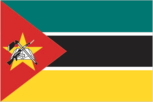
three equal horizontal bands of green (top), black, and yellow with a red isosceles triangle based on the hoist side; the black band is edged in white; centered in the triangle is a yellow five-pointed star bearing a crossed rifle and hoe in black superimposed on an open white book
Head of Government
Prime Minister Mario da Graca MACHUNGO (since 17 July 1986)
Independence
25 June 1975 (from Portugal)
Judicial branch
People's Courts at all levels
Legal system
based on Portuguese civil law system and customary law
Legislative branch
unicameral Assembly of the Republic (Assembleia da Republica)
Long-form name
Republic of Mozambique
Member of
ACP, AfDB, CCC, ECA, FAO, FLS, G-77, IBRD, ICAO, IDA, IFAD, IFC, ILO, IMF, INMARSAT, IMO, INTELSAT, INTERPOL, IOC, ITU, LORCS, NAM, OAU, SADCC, UN, UNCTAD, UNESCO, UNIDO, UPU, WHO, WMO
National holiday
Independence Day, 25 June (1975)
Political parties and leaders
Front for the Liberation of Mozambique (FRELIMO) - formerly a Marxist organization with close ties to the USSR - was the only legal party before 30 November 1990 when the new Constitution went into effect establishing a multiparty system; note - the government plans multiparty elections as early as 1993; 14 parties, including the Liberal Democratic Party of Mozambique (PALMO), the Mozambique National Union (UNAMO), and the Mozambique National Movement (MONAMO) have already emerged
Suffrage
universal adult at age 18
Type
republic
Economy
Agriculture
accounts for 80% of the labor force, 50% of GDP, and about 90% of exports; cash crops - cotton, cashew nuts, sugarcane, tea, shrimp; other crops - cassava, corn, rice, tropical fruits; not self-sufficient in food
Budget
revenues $369 million; expenditures $860 million, including capital expenditures of $432 million (1989 est.)
Currency
metical (plural - meticais); 1 metical (Mt) = 100 centavos
Economic aid
US commitments, including Ex-Im (FY70-89), $350 million; Western (non-US) countries, ODA and OOF bilateral commitments (1970-89), $4.4 billion; OPEC bilateral aid (1979-89), $37 million; Communist countries (1970-89), $890 million
Electricity
2,270,000 kW capacity; 1,745 million kWh produced, 115 kWh per capita (1991)
Exchange rates
meticais (Mt) per US$1 - 2,358 (1 May 1992), 1,811.18 (1991), 929.00 (1990), 800.00 (1989), 528.60 (1988), 289.44 (1987)
Exports
$117 million (f.o.b., 1990 est.) commodities: shrimp 48%, cashews 21%, sugar 10%, copra 3%, citrus 3% partners: US, Western Europe, GDR, Japan
External debt
$4.9 billion (1991 est.)
Fiscal year
calendar year
GDP
exchange rate conversion - $1.7 billion, per capita $120; real growth rate 1.0% (1991 est.)
Imports
$870 million (c.i.f., 1990 est.), including aid commodities: food, clothing, farm equipment, petroleum partners: US, Western Europe, USSR
Industrial production
growth rate 5% (1989 est.)
Industries
food, beverages, chemicals (fertilizer, soap, paints), petroleum products, textiles, nonmetallic mineral products (cement, glass, asbestos), tobacco
Inflation rate (consumer prices)
40.5% (1990 est.)
Overview
One of Africa's poorest countries, Mozambique has failed to exploit the economic potential of its sizable agricultural, hydropower, and transportation resources. Indeed, national output, consumption, and investment declined throughout the first half of the 1980s because of internal disorders, lack of government administrative control, and a growing foreign debt. A sharp increase in foreign aid, attracted by an economic reform policy, has resulted in successive years of economic growth since 1985. Agricultural output, nevertheless, is at about only 75% of its 1981 level, and grain has to be imported. Industry operates at only 20-40% of capacity. The economy depends heavily on foreign assistance to keep afloat. The continuation of civil strife through 1991 has dimmed chances of foreign investment, and growth was a mere 1%. Living standards, already abysmally low, dropped by 3-4% in both 1990 and 1991.
Unemployment rate
50% (1989 est.)
Communications
Airports
195 total, 137 usable; 27 with permanent-surface runways; 1 with runways over 3,659 m; 5 with runways 2,440-3,659 m; 26 with runways 1,220-2,439 m
Civil air
7 major transport aircraft
Highways
26,498 km total; 4,593 km paved; 829 km gravel, crushed stone, stabilized soil; 21,076 km unimproved earth
Inland waterways
about 3,750 km of navigable routes
Merchant marine
5 cargo ships (1,000 GRT or over) totaling 7,806 GRT/12,873 DWT
Pipelines
crude oil (not operating) 306 km; petroleum products 289 km
Ports
Maputo, Beira, Nacala
Railroads
3,288 km total; 3,140 km 1.067-meter gauge; 148 km 0.762-meter narrow gauge; Malawi-Nacala, Malawi-Beira, and Zimbabwe-Maputo lines are subject to closure because of insurgency
Telecommunications
fair system of troposcatter, open-wire lines, and radio relay; broadcast stations - 29 AM, 4 FM, 1 TV; earth stations - 2 Atlantic Ocean INTELSAT and 3 domestic Indian Ocean INTELSAT
Military and Security
Branches
Army, Naval Command, Air and Air Defense Forces, Border Guards, Militia
Defense expenditures
exchange rate conversion - $107 million, 6-7% of GDP (1989)
Manpower availability
males 15-49, 3,490,554; 2,004,913 fit for military service