2013 Edition
CIA World Factbook 2013 Archive (HTML)
Introduction
Background
In 788, about a century after the Arab conquest of North Africa, a series of Moroccan Muslim dynasties began to rule in Morocco. In the 16th century, the Sa'adi monarchy, particularly under Ahmad al-MANSUR (1578-1603), repelled foreign invaders and inaugurated a golden age. The Alaouite dynasty, to which the current Moroccan royal family belongs, dates from the 17th century. In 1860, Spain occupied northern Morocco and ushered in a half century of trade rivalry among European powers that saw Morocco's sovereignty steadily erode; in 1912, the French imposed a protectorate over the country. A protracted independence struggle with France ended successfully in 1956. The internationalized city of Tangier and most Spanish possessions were turned over to the new country that same year. Sultan MOHAMMED V, the current monarch's grandfather, organized the new state as a constitutional monarchy and in 1957 assumed the title of king. Although Morocco is not the UN-recognized Administering Power for the Western Sahara, it exercises de facto administrative control there. The UN assists with direct negotiations between Morocco and the Polisario Front, but the status of the territory remains unresolved. Gradual political reforms in the 1990s resulted in the establishment of a bicameral legislature, which first met in 1997. Morocco enjoys a moderately free press, but the government has taken action against journalists who they perceive to be challenging the monarchy, Islam, or the status of Western Sahara. Influenced by protests elsewhere in the region, in February 2011 thousands of Moroccans began weekly rallies in multiple cities across the country to demand greater democracy and end to government corruption. Overall the response of Moroccan security forces was subdued compared to the violence elsewhere in the region. King MOHAMMED VI responded quickly with a reform program that included a new constitution and early elections. The constitution was passed by popular referendum in July 2011; some new powers were extended to parliament and the prime minister, but ultimate authority remains in the hands of the monarch. In early elections in November 2012, the Justice and Development Party - a moderate Islamist party, won the largest number of seats, becoming the first Islamist party to lead the Moroccan Government. In January 2012, Morocco assumed a nonpermanent seat on the UN Security Council for the 2012-13 term.
Geography
Area
- 446,550 sq km 446,300 sq km 250 sq km
- total
- 446,550 sq km
- water
- 250 sq km
Area - comparative
slightly larger than California
Climate
Mediterranean, becoming more extreme in the interior
Coastline
1,835 km
Elevation extremes
- Sebkha Tah -55 m Jebel Toubkal 4,165 m
- highest point
- Jebel Toubkal 4,165 m
- lowest point
- Sebkha Tah -55 m
Environment - current issues
land degradation/desertification (soil erosion resulting from farming of marginal areas, overgrazing, destruction of vegetation); water supplies contaminated by raw sewage; siltation of reservoirs; oil pollution of coastal waters
Environment - international agreements
- Biodiversity, Climate Change, Climate Change-Kyoto Protocol, Desertification, Endangered Species, Hazardous Wastes, Law of the Sea, Marine Dumping, Ozone Layer Protection, Ship Pollution, Wetlands, Whaling Environmental Modification
- party to
- Biodiversity, Climate Change, Climate Change-Kyoto Protocol, Desertification, Endangered Species, Hazardous Wastes, Law of the Sea, Marine Dumping, Ozone Layer Protection, Ship Pollution, Wetlands, Whaling
- signed, but not ratified
- Environmental Modification
Freshwater withdrawal (domestic/industrial/agricultural)
- 12.61 cu km/yr (12%/4%/84%) 428.1 cu m/yr (2005)
- per capita
- 428.1 cu m/yr (2005)
- total
- 12.61 cu km/yr (12%/4%/84%)
Geographic coordinates
32 00 N, 5 00 W
Geography - note
strategic location along Strait of Gibraltar
Irrigated land
14,850 sq km (2004)
Land boundaries
- 2,017.9 km Algeria 1,559 km, Western Sahara 443 km, Spain (Ceuta) 6.3 km, Spain (Melilla) 9.6 km
- border countries
- Algeria 1,559 km, Western Sahara 443 km, Spain (Ceuta) 6.3 km, Spain (Melilla) 9.6 km
- total
- 2,017.9 km
Land use
- 17.79% 2.6% 79.61% (2011)
- arable land
- 17.79%
- other
- 79.61% (2011)
- permanent crops
- 2.6%
Location
Northern Africa, bordering the North Atlantic Ocean and the Mediterranean Sea, between Algeria and Western Sahara
Map references
Africa
Maritime claims
- 12 nm 24 nm 200 nm 200 m depth or to the depth of exploitation
- contiguous zone
- 24 nm
- continental shelf
- 200 m depth or to the depth of exploitation
- exclusive economic zone
- 200 nm
- territorial sea
- 12 nm
Natural hazards
northern mountains geologically unstable and subject to earthquakes; periodic droughts
Natural resources
phosphates, iron ore, manganese, lead, zinc, fish, salt
Terrain
northern coast and interior are mountainous with large areas of bordering plateaus, intermontane valleys, and rich coastal plains
Total renewable water resources
29 cu km (2011)
People and Society
Age structure
- 27.1% (male 4,489,297/female 4,353,921) 18% (male 2,918,765/female 2,951,131) 41.7% (male 6,590,575/female 7,033,013) 7% (male 1,135,921/female 1,135,747) 6.3% (male 919,236/female 1,121,524) (2013 est.)
- 0-14 years
- 27.1% (male 4,489,297/female 4,353,921)
- 15-24 years
- 18% (male 2,918,765/female 2,951,131)
- 25-54 years
- 41.7% (male 6,590,575/female 7,033,013)
- 55-64 years
- 7% (male 1,135,921/female 1,135,747)
- 65 years and over
- 6.3% (male 919,236/female 1,121,524) (2013 est.)
Birth rate
18.73 births/1,000 population (2013 est.)
Child labor - children ages 5-14
- 500,960 8 % (2007 est.)
- percentage
- 8 % (2007 est.)
- total number
- 500,960
Children under the age of 5 years underweight
3.1% (2011)
Contraceptive prevalence rate
67.4% (2011)
Death rate
4.78 deaths/1,000 population (2013 est.)
Dependency ratios
- 48.9 % 41.5 % 7.4 % 13.5 (2013)
- elderly dependency ratio
- 7.4 %
- potential support ratio
- 13.5 (2013)
- total dependency ratio
- 48.9 %
- youth dependency ratio
- 41.5 %
Drinking water source
- urban: 98% of population rural: 61% of population total: 83% of population urban: 2% of population rural: 39% of population total: 17% of population (2010 est.)
- rural
- 39% of population
- total
- 17% of population (2010 est.)
- urban
- 2% of population
Education expenditures
5.4% of GDP (2009)
Ethnic groups
Arab-Berber 99%, other 1%
Health expenditures
6% of GDP (2011)
HIV/AIDS - adult prevalence rate
0.1% (2009 est.)
HIV/AIDS - deaths
1,200 (2009 est.)
HIV/AIDS - people living with HIV/AIDS
26,000 (2009 est.)
Hospital bed density
1.1 beds/1,000 population (2009)
Infant mortality rate
- 25.49 deaths/1,000 live births 30.04 deaths/1,000 live births 20.71 deaths/1,000 live births (2013 est.)
- female
- 20.71 deaths/1,000 live births (2013 est.)
- total
- 25.49 deaths/1,000 live births
Languages
Arabic (official), Berber languages (Tamazight (official), Tachelhit, Tarifit), French (often the language of business, government, and diplomacy)
Life expectancy at birth
- 76.31 years 73.25 years 79.53 years (2013 est.)
- female
- 79.53 years (2013 est.)
- total population
- 76.31 years
Literacy
- age 15 and over can read and write 67.1% 76.1% 57.6% (2011 est.)
- definition
- age 15 and over can read and write
- female
- 57.6% (2011 est.)
- male
- 76.1%
- total population
- 67.1%
Major urban areas - population
Casablanca 3.245 million; RABAT (capital) 1.77 million; Fes 1.044 million; Marrakech 909,000; Tangier 768,000 (2009)
Maternal mortality rate
100 deaths/100,000 live births (2010)
Median age
- 27.7 years 27.1 years 28.2 years (2013 est.)
- female
- 28.2 years (2013 est.)
- male
- 27.1 years
- total
- 27.7 years
Mother's mean age at first birth
25.4 (2004 est.)
Nationality
- Moroccan(s) Moroccan
- adjective
- Moroccan
- noun
- Moroccan(s)
Net migration rate
-3.56 migrant(s)/1,000 population (2013 est.)
Obesity - adult prevalence rate
16.4% (2008)
Physicians density
0.62 physicians/1,000 population (2009)
Population
32,649,130 (July 2013 est.)
Population growth rate
1.04% (2013 est.)
Religions
Muslim 99% (official), Christian 1%, Jewish about 6,000
Sanitation facility access
- urban: 83% of population rural: 52% of population total: 70% of population urban: 17% of population rural: 48% of population total: 30% of population (2010 est.)
- rural
- 48% of population
- total
- 30% of population (2010 est.)
- urban
- 17% of population
School life expectancy (primary to tertiary education)
- 11 years 12 years 11 years (2010)
- female
- 11 years (2010)
- male
- 12 years
- total
- 11 years
Sex ratio
- 1.05 male(s)/female 1.03 male(s)/female 0.99 male(s)/female 0.94 male(s)/female 1 male(s)/female 0.82 male(s)/female 0.97 male(s)/female (2013 est.)
- 0-14 years
- 1.03 male(s)/female
- 15-24 years
- 0.99 male(s)/female
- 25-54 years
- 0.94 male(s)/female
- 55-64 years
- 1 male(s)/female
- 65 years and over
- 0.82 male(s)/female
- at birth
- 1.05 male(s)/female
- total population
- 0.97 male(s)/female (2013 est.)
Total fertility rate
2.17 children born/woman (2013 est.)
Unemployment, youth ages 15-24
- 17.9% 18.1% 17.4% (2011)
- female
- 17.4% (2011)
- total
- 17.9%
Urbanization
- 57% of total population (2011) 1.62% annual rate of change (2010-15 est.)
- rate of urbanization
- 1.62% annual rate of change (2010-15 est.)
- urban population
- 57% of total population (2011)
Government
Administrative divisions
15 regions; Grand Casablanca, Chaouia-Ouardigha, Doukkala-Abda, Fes-Boulemane, Gharb-Chrarda-Beni Hssen, Guelmim-Es Smara, Laayoune-Boujdour-Sakia El Hamra, Marrakech-Tensift-Al Haouz, Meknes-Tafilalet, Oriental, Rabat-Sale-Zemmour-Zaer, Souss-Massa-Draa, Tadla-Azilal, Tanger-Tetouan, Taza-Al Hoceima-Taounate Morocco claims the territory of Western Sahara, the political status of which is considered undetermined by the US Government; portions of the regions Guelmim-Es Smara and Laayoune-Boujdour-Sakia El Hamra as claimed by Morocco lie within Western Sahara; Morocco also claims Oued Eddahab-Lagouira, another region that falls entirely within Western Sahara
Capital
- Rabat 34 01 N, 6 49 W UTC 0 (5 hours ahead of Washington, DC during Standard Time) +1 hr, begins last Sunday in April; ends last Sunday in September
- daylight saving time
- +1 hr, begins last Sunday in April; ends last Sunday in September
- geographic coordinates
- 34 01 N, 6 49 W
- name
- Rabat
- time difference
- UTC 0 (5 hours ahead of Washington, DC during Standard Time)
Constitution
several previous; latest drafted 17 June 2011, approved by referendum 1 July 2011; note - sources disagree on whether the 2011 referendum was for a new constitution or for reforms to the previous constitution (2011)
Country name
- Kingdom of Morocco Morocco Al Mamlakah al Maghribiyah Al Maghrib
- conventional long form
- Kingdom of Morocco
- conventional short form
- Morocco
- local long form
- Al Mamlakah al Maghribiyah
- local short form
- Al Maghrib
Diplomatic representation from the US
- Ambassador (vacant); Charge d'Affaires Matthew LUSSENHOP (since July 2013) 2 Avenue de Mohamed El Fassi, Rabat Unit 9400, Box 021, DPO AE 09718 [212] (537) 76 22 65 [212] (537) 76 56 61 Casablanca
- chief of mission
- Ambassador (vacant); Charge d'Affaires Matthew LUSSENHOP (since July 2013)
- consulate(s) general
- Casablanca
- embassy
- 2 Avenue de Mohamed El Fassi, Rabat
- FAX
- [212] (537) 76 56 61
- mailing address
- Unit 9400, Box 021, DPO AE 09718
- telephone
- [212] (537) 76 22 65
Diplomatic representation in the US
- Ambassador Mohammed Rachad BOUHLAL (since 22 December 2011) 1601 21st Street NW, Washington, DC 20009 [1] (202) 462-7979 [1] (202) 462-7643 New York
- chancery
- 1601 21st Street NW, Washington, DC 20009
- chief of mission
- Ambassador Mohammed Rachad BOUHLAL (since 22 December 2011)
- consulate(s) general
- New York
- FAX
- [1] (202) 462-7643
- telephone
- [1] (202) 462-7979
Executive branch
- King MOHAMMED VI (since 30 July 1999) Prime Minister Abdelillah BENKIRANE (since 29 November 2011) Council of Ministers appointed by the prime minister as well as Minister Delegates to each ministry appoined by the Palace the monarchy is hereditary; prime minister appointed by the monarch following legislative elections
- cabinet
- Council of Ministers appointed by the prime minister as well as Minister Delegates to each ministry appoined by the Palace
- chief of state
- King MOHAMMED VI (since 30 July 1999)
- elections
- the monarchy is hereditary; prime minister appointed by the monarch following legislative elections
- head of government
- Prime Minister Abdelillah BENKIRANE (since 29 November 2011)
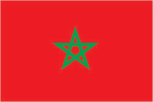
Flag description
red with a green pentacle (five-pointed, linear star) known as Sulayman's (Solomon's) seal in the center of the flag; red and green are traditional colors in Arab flags, although the use of red is more commonly associated with the Arab states of the Persian gulf; the pentacle represents the five pillars of Islam and signifies the association between God and the nation; design dates to 1912
Government type
constitutional monarchy
Independence
2 March 1956 (from France)
International law organization participation
has not submitted an ICJ jurisdiction declaration; non-party state to the ICCt
International organization participation
ABEDA, AfDB, AFESD, AMF, AMU, CAEU, CD, EBRD, FAO, G-11, G-77, IAEA, IBRD, ICAO, ICC (national committees), ICRM, IDA, IDB, IFAD, IFC, IFRCS, IHO, ILO, IMF, IMO, IMSO, Interpol, IOC, IOM, IPU, ISO, ITSO, ITU, ITUC (NGOs), LAS, MIGA, MONUSCO, NAM, OAS (observer), OIC, OIF, OPCW, OSCE (partner), Paris Club (associate), PCA, UN, UNCTAD, UNESCO, UNHCR, UNIDO, UNOCI, UNSC (temporary), UNWTO, UPU, WCO, WHO, WIPO, WMO, WTO
Judicial branch
- Supreme Court or Court of Cassation (consists of 5-judge panels organized into civil, family matters, commercial, administrative, social, and criminal sections) Supreme Court judges appointed by the monarch upon the recommendation of the Supreme Council of the Judiciary courts of appeal; regional and sadad courts (for religious, civil and administrative, and penal adjudication)
- highest court(s)
- Supreme Court or Court of Cassation (consists of 5-judge panels organized into civil, family matters, commercial, administrative, social, and criminal sections)
- judge selection and term of office
- Supreme Court judges appointed by the monarch upon the recommendation of the Supreme Council of the Judiciary
- subordinate courts
- courts of appeal; regional and sadad courts (for religious, civil and administrative, and penal adjudication)
Legal system
mixed legal system of civil law based on French law and Islamic law; judicial review of legislative acts by Supreme Court
Legislative branch
- bicameral Parliament consists of the Chamber of Counsilors (or upper house) (270 seats - to be reduced to a maximum of 120; members elected indirectly by local councils, professional organizations, and labor syndicates to serve six-year terms; one-third of the members are elected every three years) and Chamber of Representatives (or lower house) (395 seats; members elected by popular vote to serve five-year terms) Chamber of Counselors - last held on 3 October 2009 (next to be held in mid-2013); Chamber of Representatives - last held on 25 November 2011 (next to be held in 2016) Chamber of Counselors - percent of vote by party - NA; seats by party - NA; Chamber of Representatives - percent of vote by party - NA; seats by party - PJD 107, PI 60, RNI 52, PAM 47, USFP 39, MP 32, UC 23, PPS 18, other 17
- election results
- Chamber of Counselors - percent of vote by party - NA; seats by party - NA; Chamber of Representatives - percent of vote by party - NA; seats by party - PJD 107, PI 60, RNI 52, PAM 47, USFP 39, MP 32, UC 23, PPS 18, other 17
- elections
- Chamber of Counselors - last held on 3 October 2009 (next to be held in mid-2013); Chamber of Representatives - last held on 25 November 2011 (next to be held in 2016)
National anthem
- "Hymne Cherifien" (Hymn of the Sharif) Ali Squalli HOUSSAINI/Leo MORGAN music adopted 1956, lyrics adopted 1970
- lyrics/music
- Ali Squalli HOUSSAINI/Leo MORGAN
- name
- "Hymne Cherifien" (Hymn of the Sharif)
National holiday
Throne Day (accession of King MOHAMMED VI to the throne), 30 July (1999)
National symbol(s)
pentacle symbol; lion
Political parties and leaders
Action Party or PA [Mohammed EL IDRISSI] Al Ahd (The Covenant) Party [Najib EL OUAZZANI] Alliance des Libert'es (Alliance of Liberty) or ADL [Ali BELHAJ] An-Nahj Ad-Dimocrati or An-Nahj [Abdellah EL HARIF] Authenticity and Modernity Party or PAM [Mustapha BAKKOURY, secretary general] Choura et Istiqlal (Consultation and Independence) Party or PCI [Abdelwahed MAACH] Citizens' Forces or FC [Abderrahman LAHJOUJI] Citizenship and Development Initiative or ICD [Mohamed BENHAMOU] Constitutional Union Party or UC [Mohammed ABIED] Democratic and Social Movement or MDS [Mahmoud ARCHANE] Democratic Forces Front or FFD [Touhami EL KHIARI] Democratic Socialist Vanguard Party or PADS [Ahmed BENJELLOUN] Democratic Society Party or PSD [Zhor CHEKKAFI] Democratic Union or UD [Bouazza IKKEN] Environment and Development Party or PED [Ahmed EL ALAMI] Istiqlal (Independence) Party or PI [Hamid CHABAT] Party of Justice and Development or PJD [Abdelillah BENKIRANE] Labor Party or LP [Abdelkrim BENATIK] Moroccan Liberal Party or PML [Mohamed ZIANE] National Democratic Party or PND [Abdallah KADIRI] National Ittihadi Congress Party or CNI [Abdelmajid BOUZOUBAA] National Popular Movement or MNP [Mahjoubi AHERDANE] National Rally of Independents or RNI [Mustapha EL MANSOURI] National Union of Popular Forces or UNFP [Abdellah IBRAHIM] Popular Movement or MP [Mohamed LAENSER] Progress and Socialism Party or PPS [Ismail ALAOUI] Reform and Development Party or PRD [Abderrahmane EL KOUHEN] Renaissance and Virtue Party or PRV [Mohamed KHALIDI] Renewal and Equity Party or PRE [Chakir ACHABAR] Social Center Party or PSC [Lahcen MADIH] Socialist Democratic Party or PSD [Aissa OUARDIGHI] Socialist Union of Popular Forces or USFP [Driss LACHGAR] Unified Socialist Left Party or PGSU [Mohamed Ben Said AIT IDDER]
Political pressure groups and leaders
Democratic Confederation of Labor or CDT [Noubir AMAOUI] General Union of Moroccan Workers or UGTM [Abderrazzak AFILAL] Justice and Charity Organization or JCO Moroccan Employers Association or CGEM [Hassan CHAMI] National Labor Union of Morocco or UNMT [Abdelslam MAATI] Union of Moroccan Workers or UMT [Mahjoub BENSEDDIK]
Suffrage
18 years of age; universal
Economy
Agriculture - products
barley, wheat, citrus fruits, grapes, vegetables, olives; livestock; wine
Budget
- $25.35 billion $33.32 billion (2012 est.)
- expenditures
- $33.32 billion (2012 est.)
- revenues
- $25.35 billion
Budget surplus (+) or deficit (-)
-8.4% of GDP (2012 est.)
Central bank discount rate
6.5% (31 December 2010 est.) 3.31% (31 December 2009 est.)
Commercial bank prime lending rate
6.3% (31 December 2012 est.) 6.32% (31 December 2011 est.)
Current account balance
$-9.843 billion (2012 est.) $-8.337 billion (2011 est.)
Debt - external
$32.15 billion (31 December 2012 est.) $29.05 billion (31 December 2011 est.)
Distribution of family income - Gini index
40.9 (2007 est.) 39.5 (1999 est.)
Economy - overview
Morocco has capitalized on its proximity to Europe and relatively low labor costs to build a diverse, open, market-oriented economy. In the 1980s Morocco was a heavily indebted country before pursuing austerity measures and pro-market reforms, overseen by the IMF. Since taking the throne in 1999, King MOHAMMED VI has presided over a stable economy marked by steady growth, low inflation, and gradually falling unemployment, although a poor harvest and economic difficulties in Europe contributed to an economic slowdown in 2012. Industrial development strategies and infrastructure improvements - most visibly illustrated by a new port and free trade zone near Tangier - are improving Morocco's competitiveness. Morocco also seeks to expand its renewable energy capacity with a goal of making renewable 40% of electricity output by 2020. Key sectors of the economy include agriculture, tourism, phosphates, textiles, apparel, and subcomponents. To boost exports, Morocco entered into a bilateral Free Trade Agreement with the United States in 2006 and an Advanced Status agreement with the European Union in 2008. Despite Morocco's economic progress, the country suffers from high unemployment, poverty, and illiteracy, particularly in rural areas. In 2011 and 2012, high prices on fuel - which is subsidized and almost entirely imported - strained the government''s budget and widened the country''s current account deficit. Key economic challenges for Morocco include fighting corruption and reforming the education system, the judiciary, and the government''s costly subsidy program.
Exchange rates
Moroccan dirhams (MAD) per US dollar - 8.6 (2012 est.) 8.07 (2011 est.) 8.42 (2010 est.) 8.06 (2009) 7.53 (2008)
Exports
$16.99 billion (2012 est.) $15.95 billion (2011 est.)
Exports - commodities
clothing and textiles, electric components, inorganic chemicals, transistors, crude minerals, fertilizers (including phosphates), petroleum products, citrus fruits, vegetables, fish
Exports - partners
France 21%, Spain 17.3%, Brazil 5.4%, India 4.9%, US 4.6% (2012)
Fiscal year
calendar year
GDP - composition, by end use
- 59.7% 19.2% 31.4% 3.9% 36.2% -50.4% (2012 est.)
- exports of goods and services
- 36.2%
- government consumption
- 19.2%
- household consumption
- 59.7%
- imports of goods and services
- -50.4%
- investment in fixed capital
- 31.4%
- investment in inventories
- 3.9%
GDP - composition, by sector of origin
- 15.1% 31.7% 53.2% (2012 est.)
- agriculture
- 15.1%
- industry
- 31.7%
- services
- 53.2% (2012 est.)
GDP - per capita (PPP)
$5,200 (2012 est.) $5,100 (2011 est.) $4,900 (2010 est.) data are in 2012 US dollars
GDP - real growth rate
2.7% (2012 est.) 5% (2011 est.) 3.6% (2010 est.)
GDP (official exchange rate)
$94.83 billion (2012 est.)
GDP (purchasing power parity)
$168.9 billion (2012 est.) $164.5 billion (2011 est.) $156.7 billion (2010 est.) data are in 2012 US dollars
Gross national saving
25.1% of GDP (2012 est.) 27.6% of GDP (2011 est.) 30.1% of GDP (2010 est.)
Household income or consumption by percentage share
- 2.7% 33.2% (2007)
- highest 10%
- 33.2% (2007)
- lowest 10%
- 2.7%
Imports
$38.88 billion (2012 est.) $37.33 billion (2011 est.)
Imports - commodities
crude petroleum, textile fabric, telecommunications equipment, wheat, gas and electricity, transistors, plastics
Imports - partners
Spain 13.1%, France 12.1%, China 6.9%, US 6.8%, Saudi Arabia 6.2%, Italy 5.1%, Russia 5%, Germany 4.9% (2012)
Industrial production growth rate
0.7% (2012 est.)
Industries
phosphate rock mining and processing, food processing, leather goods, textiles, construction, energy, tourism
Inflation rate (consumer prices)
1.2% (2012 est.) 0.9% (2011 est.)
Labor force
11.53 million (2012 est.)
Labor force - by occupation
- 44.6% 19.8% 35.5% (2006 est.)
- agriculture
- 44.6%
- industry
- 19.8%
- services
- 35.5% (2006 est.)
Market value of publicly traded shares
$60.09 billion (31 December 2011) $69.15 billion (31 December 2010) $62.91 billion (31 December 2009)
Population below poverty line
15% (2007 est.)
Public debt
71.2% of GDP (2012 est.) 64.8% of GDP (2011 est.)
Reserves of foreign exchange and gold
$17.54 billion (31 December 2012 est.) $20.64 billion (31 December 2011 est.)
Stock of broad money
$107.2 billion (31 December 2011 est.) $102.4 billion (31 December 2010 est.)
Stock of direct foreign investment - abroad
$2.423 billion (31 December 2012 est.) $1.905 billion (31 December 2011 est.)
Stock of direct foreign investment - at home
$48.18 billion (31 December 2012 est.) $44.49 billion (31 December 2011 est.)
Stock of domestic credit
$111.6 billion (31 December 2012 est.) $111.2 billion (31 December 2011 est.)
Stock of narrow money
$71.51 billion (31 December 2012 est.) $73.12 billion (31 December 2011 est.)
Taxes and other revenues
26.7% of GDP (2012 est.)
Unemployment rate
9% (2012 est.) 8.9% (2011 est.)
Energy
Carbon dioxide emissions from consumption of energy
43.71 million Mt (2011 est.)
Crude oil - exports
0 bbl/day (2010 est.)
Crude oil - imports
122,900 bbl/day (2010 est.)
Crude oil - production
5,057 bbl/day (2012 est.)
Crude oil - proved reserves
680,000 bbl (1 January 2013 es)
Electricity - consumption
23.61 billion kWh (2010 est.)
Electricity - exports
0 kWh (2012 est.)
Electricity - from fossil fuels
69.3% of total installed capacity (2010 est.)
Electricity - from hydroelectric plants
19.4% of total installed capacity (2010 est.)
Electricity - from nuclear fuels
0% of total installed capacity (2010 est.)
Electricity - from other renewable sources
4.3% of total installed capacity (2010 est.)
Electricity - imports
3.94 billion kWh (2010 est.)
Electricity - installed generating capacity
6.62 million kW (2010 est.)
Electricity - production
21.13 billion kWh (2010 est.)
Natural gas - consumption
560 million cu m (2010 est.)
Natural gas - exports
0 cu m (2011 est.)
Natural gas - imports
150 million cu m (2011 est.)
Natural gas - production
60 million cu m (2011 est.)
Natural gas - proved reserves
1.444 billion cu m (1 January 2013 es)
Refined petroleum products - consumption
203,600 bbl/day (2011 est.)
Refined petroleum products - exports
20,830 bbl/day (2010 est.)
Refined petroleum products - imports
143,000 bbl/day (2010 est.)
Refined petroleum products - production
131,500 bbl/day (2010 est.)
Communications
Broadcast media
2 TV broadcast networks with state-run Radio-Television Marocaine (RTM) operating one network and the state partially owning the other; foreign TV broadcasts are available via satellite dish; 3 radio broadcast networks with RTM operating one; the government-owned network includes 10 regional radio channels in addition to its national service (2007)
Internet country code
.ma
Internet hosts
277,338 (2012)
Internet users
13.213 million (2009)
Telephone system
- good system composed of open-wire lines, cables, and microwave radio relay links; principal switching centers are Casablanca and Rabat; national network nearly 100% digital using fiber-optic links; improved rural service employs microwave radio relay; Internet available but expensive fixed-line teledensity is roughly 10 per 100 persons; mobile-cellular subscribership exceeds 100 per 100 persons country code - 212; landing point for the Atlas Offshore, Estepona-Tetouan, Euroafrica, Spain-Morocco, and SEA-ME-WE-3 fiber-optic telecommunications undersea cables that provide connectivity to Asia, the Middle East, and Europe; satellite earth stations - 2 Intelsat (Atlantic Ocean) and 1 Arabsat; microwave radio relay to Gibraltar, Spain, and Western Sahara; coaxial cable and microwave radio relay to Algeria; participant in Medarabtel; fiber-optic cable link from Agadir to Algeria and Tunisia (2011)
- domestic
- fixed-line teledensity is roughly 10 per 100 persons; mobile-cellular subscribership exceeds 100 per 100 persons
- general assessment
- good system composed of open-wire lines, cables, and microwave radio relay links; principal switching centers are Casablanca and Rabat; national network nearly 100% digital using fiber-optic links; improved rural service employs microwave radio relay; Internet available but expensive
- international
- country code - 212; landing point for the Atlas Offshore, Estepona-Tetouan, Euroafrica, Spain-Morocco, and SEA-ME-WE-3 fiber-optic telecommunications undersea cables that provide connectivity to Asia, the Middle East, and Europe; satellite earth stations - 2 Intelsat (Atlantic Ocean) and 1 Arabsat; microwave radio relay to Gibraltar, Spain, and Western Sahara; coaxial cable and microwave radio relay to Algeria; participant in Medarabtel; fiber-optic cable link from Agadir to Algeria and Tunisia (2011)
Telephones - main lines in use
3.28 million (2012)
Telephones - mobile cellular
39.016 million (2012)
Transportation
Airports
55 (2013)
Airports - with paved runways
- 4 (2013)
- 1,524 to 2,437 m
- 7
- 2,438 to 3,047 m
- 9
- 914 to 1,523 m
- 4 (2013)
- over 3,047 m
- 11
- total
- 31
Airports - with unpaved runways
- 5 (2013)
- 1,524 to 2,437 m
- 7
- 2,438 to 3,047 m
- 1
- 914 to 1,523 m
- 11
- total
- 24
Heliports
1 (2013)
Merchant marine
- cargo 1, chemical tanker 3, container 6, passenger/cargo 14, roll on/roll off 2 14 (France 3, Germany 1, Italy 1, Spain 9) 4 (Gibraltar 4) (2010)
- foreign-owned
- 14 (France 3, Germany 1, Italy 1, Spain 9)
- registered in other countries
- 4 (Gibraltar 4) (2010)
- total
- 26
Pipelines
gas 944 km; oil 270 km; refined products 175 km (2013)
Ports and terminals
Casablanca, Jorf Lasfar, Mohammedia, Safi, Tangier
Railways
- 2,067 km 2,067 km 1.435-m gauge (1,022 km electrified) (2008)
- total
- 2,067 km
Roadways
- 58,395 km 41,116 km (includes 1,080 km of expressways) 17,279 km (2010)
- total
- 58,395 km
- unpaved
- 17,279 km (2010)
Military and Security
Manpower available for military service
- 8,252,682 8,691,419 (2010 est.)
- females age 16-49
- 8,691,419 (2010 est.)
- males age 16-49
- 8,252,682
Manpower fit for military service
- 7,026,016 7,377,045 (2010 est.)
- females age 16-49
- 7,377,045 (2010 est.)
- males age 16-49
- 7,026,016
Manpower reaching militarily significant age annually
- 300,327 298,366 (2010 est.)
- female
- 298,366 (2010 est.)
- male
- 300,327
Military branches
- Royal Armed Forces (Forces Armees Royales, FAR): Royal Moroccan Army (includes Air Defense), Royal Moroccan Navy (includes Coast Guard, Marines), Royal Moroccan Air Force (Al Quwwat al Jawyiya al Malakiya Marakishiya; Force Aerienne Royale Marocaine) (2010)
- Royal Armed Forces (Forces Armees Royales, FAR)
- Royal Moroccan Army (includes Air Defense), Royal Moroccan Navy (includes Coast Guard, Marines), Royal Moroccan Air Force (Al Quwwat al Jawyiya al Malakiya Marakishiya; Force Aerienne Royale Marocaine) (2010)
Military expenditures
4.8% of GDP (2012)
Military service age and obligation
20 years of age for voluntary military service; no conscription; service obligation - 18 months (2012)
Transnational Issues
Disputes - international
claims and administers Western Sahara whose sovereignty remains unresolved; Morocco protests Spain's control over the coastal enclaves of Ceuta, Melilla, and Penon de Velez de la Gomera, the islands of Penon de Alhucemas and Islas Chafarinas, and surrounding waters; both countries claim Isla Perejil (Leila Island); discussions have not progressed on a comprehensive maritime delimitation, setting limits on resource exploration and refugee interdiction, since Morocco's 2002 rejection of Spain's unilateral designation of a median line from the Canary Islands; Morocco serves as one of the primary launching areas of illegal migration into Spain from North Africa; Algeria's border with Morocco remains an irritant to bilateral relations, each nation accusing the other of harboring militants and arms smuggling; the National Liberation Front's assertions of a claim to Chirac Pastures in southeastern Morocco is a dormant dispute
Illicit drugs
one of the world's largest producers of illicit hashish; shipments of hashish mostly directed to Western Europe; transit point for cocaine from South America destined for Western Europe; significant consumer of cannabis
Trafficking in persons
- Morocco is a source, destination, and transit country for men, women, and children who are subjected to forced labor and sex trafficking; Moroccan adults and children are exploited for forced labor and forced prostitution in the Middle East and Europe; some Moroccan girls recruited to work as maids experience conditions of forced labor, while some Moroccan boys are forced to work as apprentices in the artisan and construction industries and in mechanic shops; women and children from sub-Saharan Africa and South Asia who voluntarily enter Morocco are subsequently coerced into prostitution or, less frequently, domestic service; women and children from Cote d'Ivoire, the Democratic Republic of the Congo, and Nigeria are also vulnerable to sex trafficking and, to a lesser extent, forced labor in Morocco Tier 2 Watch List - Morocco does not comply with the minimum standards for the elimination of trafficking; however, it is making significant efforts to do so; the government does not demonstrate progress in investigating, prosecuting, convicting, and adequately punishing trafficking offenders and has failed to provide law enforcement data; it has not developed or employed systematic procedures to proactively identify trafficking victims among vulnerable groups, particularly the sub-Saharan migrant community, but has made some efforts to offer protective services to Moroccan women and child trafficking victims; Morocco continues to lack a single comprehensive anti-trafficking law (2013)
- current situation
- Morocco is a source, destination, and transit country for men, women, and children who are subjected to forced labor and sex trafficking; Moroccan adults and children are exploited for forced labor and forced prostitution in the Middle East and Europe; some Moroccan girls recruited to work as maids experience conditions of forced labor, while some Moroccan boys are forced to work as apprentices in the artisan and construction industries and in mechanic shops; women and children from sub-Saharan Africa and South Asia who voluntarily enter Morocco are subsequently coerced into prostitution or, less frequently, domestic service; women and children from Cote d'Ivoire, the Democratic Republic of the Congo, and Nigeria are also vulnerable to sex trafficking and, to a lesser extent, forced labor in Morocco
- tier rating
- Tier 2 Watch List - Morocco does not comply with the minimum standards for the elimination of trafficking; however, it is making significant efforts to do so; the government does not demonstrate progress in investigating, prosecuting, convicting, and adequately punishing trafficking offenders and has failed to provide law enforcement data; it has not developed or employed systematic procedures to proactively identify trafficking victims among vulnerable groups, particularly the sub-Saharan migrant community, but has made some efforts to offer protective services to Moroccan women and child trafficking victims; Morocco continues to lack a single comprehensive anti-trafficking law (2013)