1998 Edition
CIA World Factbook 1998 (Internet Archive)
Geography
Area
total: 446,550 sq km land: 446,300 sq km water: 250 sq km
Area-comparative
slightly larger than California
Climate
Mediterranean, becoming more extreme in the interior
Coastline
1,835 km
Elevation extremes
lowest point: Sebkha Tah -55 m highest point: Jebel Toubkal 4,165 m
Environment-current issues
land degradation/desertification (soil erosion resulting from farming of marginal areas, overgrazing, destruction of vegetation); water supplies contaminated by raw sewage; siltation of reservoirs; oil pollution of coastal waters
Environment-international agreements
party to: Biodiversity, Climate Change, Desertification, Endangered Species, Hazardous Wastes, Marine Dumping, Nuclear Test Ban, Ozone Layer Protection, Ship Pollution, Wetlands signed, but not ratified: Environmental Modification, Law of the Sea
Geographic coordinates
32 00 N, 5 00 W
Geography-note
strategic location along Strait of Gibraltar
Irrigated land
12,580 sq km (1993 est.)
Land boundaries
total: 2,017.9 km border countries: Algeria 1,559 km, Western Sahara 443 km, Spain (Ceuta) 6.3 km, Spain (Melilla) 9.6 km
Land use
arable land: 21% permanent crops: 1% permanent pastures: 47% forests and woodland: 20% other: 11% (1993 est.)
Location
Northern Africa, bordering the North Atlantic Ocean and the Mediterranean Sea, between Algeria and Western Sahara
Map references
Africa
Maritime claims
contiguous zone: 24 nm continental shelf: 200-m depth or to the depth of exploitation exclusive economic zone: 200 nm territorial sea: 12 nm
Natural hazards
northern mountains geologically unstable and subject to earthquakes; periodic droughts
Natural resources
phosphates, iron ore, manganese, lead, zinc, fish, salt
Terrain
northern coast and interior are mountainous with large areas of bordering plateaus, intermontane valleys, and rich coastal plains
People and Society
Age structure
0-14 years: 36% (male 5,398,692; female 5,200,660) 15-64 years: 59% (male 8,525,344; female 8,682,277) 65 years and over: 5% (male 606,203; female 701,321) (July 1998 est.)
Birth rate
26.37 births/1,000 population (1998 est.)
Death rate
6.24 deaths/1,000 population (1998 est.)
Ethnic groups
Arab-Berber 99.1%, other 0.7%, Jewish 0.2%
Infant mortality rate
52.99 deaths/1,000 live births (1998 est.)
Languages
Arabic (official), Berber dialects, French often the language of business, government, and diplomacy
Life expectancy at birth
total population: 68.51 years male: 66.49 years female: 70.64 years (1998 est.)
Literacy
definition: age 15 and over can read and write total population: 43.7% male: 56.6% female: 31% (1995 est.)
Nationality
noun: Moroccan(s) adjective: Moroccan
Net migration rate
-1.28 migrant(s)/1,000 population (1998 est.)
Population
29,114,497 (July 1998 est.)
Population growth rate
1.89% (1998 est.)
Religions
Muslim 98.7%, Christian 1.1%, Jewish 0.2%
Sex ratio
at birth: 1.05 male(s)/female under 15 years: 1.04 male(s)/female 15-64 years: 0.98 male(s)/female 65 years and over: 0.86 male(s)/female (1998 est.)
Total fertility rate
3.35 children born/woman (1998 est.)
Government
Administrative divisions
37 provinces and 2 wilayas*; Agadir, Al Hoceima, Azilal, Beni Mellal, Ben Slimane, Boulemane, Casablanca*, Chaouen, El Jadida, El Kelaa des Srarhna, Er Rachidia, Essaouira, Fes, Figuig, Guelmim, Ifrane, Kenitra, Khemisset, Khenifra, Khouribga, Laayoune, Larache, Marrakech, Meknes, Nador, Ouarzazate, Oujda, Rabat-Sale*, Safi, Settat, Sidi Kacem, Tanger, Tan-Tan, Taounate, Taroudannt, Tata, Taza, Tetouan, Tiznit note: three additional provinces of Ad Dakhla (Oued Eddahab), Boujdour, and Es Smara as well as parts of Tan-Tan and Laayoune fall within Moroccan-claimed Western Sahara; decentralization/regionalization law passed by the legislature in March 1997 creating many new provinces/regions; specific details and scope of the reorganization not yet available
Constitution
10 March 1972, revised 4 September 1992, amended (to create bicameral legislature) September 1996
Country name
conventional long form: Kingdom of Morocco conventional short form: Morocco local long form: Al Mamlakah al Maghribiyah local short form: Al Maghrib
Data code
MO
Executive branch
chief of state: King HASSAN II (since 3 March 1961) head of government: Prime Minister Abderrahmane YOUSSOUFI (since 14 March 1998) cabinet: Council of Ministers appointed by the king elections: none; the king is a hereditary monarch; prime minister appointed by the king
FAX
- [1] (202) 265-0161 consulate(s) general: New York Diplomatic representation from the US: chief of mission: Ambassador Edward M. GABRIEL embassy: 2 Avenue de Marrakech, Rabat mailing address: PSC 74, Box 003, APO AE 09718 telephone: [212] (7) 76 22 65
- [212] (7) 76 56 61 consulate(s) general: Casablanca
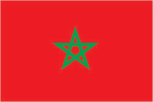
Flag description
red with a green pentacle (five-pointed, linear star) known as Solomon's seal in the center of the flag; green is the traditional color of Islam
Government type
constitutional monarchy
Independence
2 March 1956 (from France)
International organization participation
ABEDA, ACCT (associate), AfDB, AFESD, AL, AMF, AMU, CCC, EBRD, ECA, FAO, G-77, IAEA, IBRD, ICAO, ICC, ICFTU, ICRM, IDA, IDB, IFAD, IFC, IFRCS, IHO (pending member), ILO, IMF, IMO, Intelsat, Interpol, IOC, IOM (observer), ISO, ITU, NAM, OAS (observer), OIC, OSCE (partner), UN, UNCTAD, UNESCO, UNHCR, UNIDO, UPU, WHO, WIPO, WMO, WToO, WTrO Diplomatic representation in the US: chief of mission: Ambassador Mohamed BENAISSA chancery: 1601 21st Street NW, Washington, DC 20009 telephone: [1] (202) 462-7979 through 7982
Judicial branch
Supreme Court, judges are appointed on the recommendation of the Supreme Council of the Judiciary, presided over by the king Political parties and leaders: opposition: Socialist Union of Popular Forces (USFP), Abderrahmane YOUSSOUFI; Istiqlal Party (IP), M'Hamed BOUCETTA; Party of Progress and Socialism (PPS), Moulay Ismail al ALAOUI; Organization of Democratic and Popular Action (OADP), Mohamed Ben SAID; Democratic Socialist Party (PSD), Issa al-OUARDIGHI; Democratic Forces Front (FFD), Thami KHIARI; Popular Constitutional and Democratic Movement (MPCD), Dr. Abdelkarim al-KHATIB pro-government: Constitutional Union (UC), Noureddine ALAMI; Popular Movement (MP), Mohamed LAENSER; National Democratic Party (PND), Mohamed Arsalane EL-JADIDI; National Popular Movement (MNP), Mahjoubi AHARDANE; Social Democratic Movement (MDS), Mahmoud ARCHANE independents: National Rally of Independents (RNI), Ahmed OSMAN; Democracy and Istiqlal Party (PDI), Abdelwahed MACHE; Action Party (PA), Ahmed ABAKIL; Labor Party (UT), leader NA labor unions and community organizations (indirect elections only) : Democratic Confederation of Labor (CDT), Noubir AMAOUI; General Union of Moroccan Workers (UGTM), Abderrazzak AFILAL; Moroccan Union of Workers (UTM), Mahjoub BENSEDIQ; Party of Shura and Istiqlal, Abdelwaheb MAASH; Labor Union Commissions (CS), leader NA; Democratic Trade Union (SD), leader NA; Association of Popular Trade Unions (ADP), leader NA; Democratic National Trade Union (SND), leader NA; Moroccan National Workers Union (UNMT), leader NA
Legal system
based on Islamic law and French and Spanish civil law system; judicial review of legislative acts in Constitutional Chamber of Supreme Court
Legislative branch
bicameral Parliament consists of an upper house or Chamber of Counselors (270 seats; members elected indirectly by local councils, professional organizations, and labor syndicates for nine-year terms; one-third of the members are renewed every three years) and a lower house or Chamber of Representatives (325 seats; members elected by popular vote for five-year terms) elections: Chamber of Counselors-last held 5 December 1997 (next to be held NA December 2000); Chamber of Representatives-last held 14 November 1997 (next to be held NA November 2002) election results: Chamber of Counselors-percent of vote by party-NA; seats by party - RNI 42, MDS 33, UC 28, MP 27, PND 21, IP 21, USFP 16, MNP 15, UT 13, FFD 12, CDT 11, UTM 8, PPS 7, PSD 4, PDI 4, UGTM 3, UNMT 2, SD 1, ADP 1, SND 1, CS 1; Chamber of Representatives-percent of vote by party-NA; seats by party-USFP 57, UC 50, RNI 46, MP 40, MDS 32, IP 32, MNP 19, PND 10, MPCD 9, PPS 9, FFD 9, PSD 5, OADP 4, PA 2, PDI 1
National capital
Rabat
National holiday
National Day, 3 March (1961) (anniversary of King HASSAN II's accession to the throne)
Suffrage
21 years of age; universal
Economy
Agriculture-products
barley, wheat, citrus, wine, vegetables, olives; livestock
Budget
revenues: $10.4 billion expenditures: $10.75 billion, including capital expenditures of $1.9 billion (1996 est.)
Currency
1 Moroccan dirham (DH) = 100 centimes
Debt-external
$23.4 billion (1996 est.)
Economic aid
recipient: ODA, $297 million (1993) note: $2.8 billion debt canceled by Saudi Arabia (1991)
Economy-overview
Morocco faces the problems typical of developing countries-restraining government spending, reducing constraints on private activity and foreign trade, and keeping inflation within manageable bounds. Since the early 1980s the government has pursued an economic program toward these objectives with the support of the IMF, the World Bank, and the Paris Club of creditors. The dirham is now fully convertible for current account transactions; reforms of the financial sector have been implemented; and state enterprises are slowly being privatized. Drought conditions in 1997 depressed activity in the key agricultural sector, holding down exports and contributing to a 2.2% contraction in real GDP. Favorable rainfalls in the fall of 1997 have led to forecasts of robust, 8%-9% real GDP growth in 1998. Servicing the external debt, preparing the economy for freer trade with the European Union, improving education and living standards, and finding jobs for Morocco's youthful population remain long-term challenges.
Electricity-capacity
3.788 million kW (1995)
Electricity-consumption per capita
411 kWh (1995)
Electricity-production
10.8 billion kWh (1995)
Exchange rates
Moroccan dirhams (DH) per US$1-9.822 (January 1998), 9.527 (1997), 8.716 (1996), 8.540 (1995), 9.203 (1994), 9.299 (1993)
Exports
total value: $6.9 billion (f.o.b., 1996) commodities: food and beverages 30%, semiprocessed goods 23%, consumer goods 21%, phosphates 17% (1995 est.) partners: EU 63%, Japan 7.7%, India 6.6%, US 3.4%, Libya 3.4% (1996 est.)
Fiscal year
July 1-June 30 Communications
GDP
purchasing power parity-$107 billion (1997 est.)
GDP-composition by sector
agriculture: 14% industry: 33% services: 53% (1997)
GDP-per capita
purchasing power parity-$3,500 (1997 est.)
GDP-real growth rate
-2.2% (1997 est.)
Imports
total value: $9.7 billion (c.i.f., 1996) commodities: semiprocessed goods 26%, capital goods 25%, food and beverages 18%, fuel and lubricants 15%, consumer goods 12%, raw materials 4% (1995 est.) partners: EU 57%, US 6.6%, Saudi Arabia 5.3%, Brazil 2.8% (1996 est.)
Industrial production growth rate
4.5% (1996 est.)
Industries
phosphate rock mining and processing, food processing, leather goods, textiles, construction, tourism
Inflation rate-consumer price index
3% (1997 est.)
Labor force
total: 7.4 million by occupation: agriculture 50%, services 26%, industry 15%, other 9% (1985)
Radio broadcast stations
AM 20, FM 7, shortwave 0
Radios
5.527 million (1992 est.)
Telephone system
domestic: good system composed of open-wire lines, cables, and microwave radio relay links; principal centers are Casablanca and Rabat; secondary centers are Fes, Marrakech, Oujda, Tangier, and Tetouan international: 5 submarine cables; satellite earth stations-2 Intelsat (Atlantic Ocean) and 1 Arabsat; microwave radio relay to Gibraltar, Spain, and Western Sahara; coaxial cable and microwave radio relay to Algeria; participant in Medarabtel
Telephones
270,100 (1987 est.)
Television broadcast stations
26 (repeaters 26)
Televisions
1.21 million (1993 est.)
Unemployment rate
16% (1997 est.)
Transportation
Airports
70 (1997 est.) Airports-with paved runways: total: 26 over 3,047 m: 11 2,438 to 3,047 m: 4 1,524 to 2,437 m: 7 914 to 1,523 m: 3 under 914 m: 1 (1997 est.) Airports-with unpaved runways: total: 44 2,438 to 3,047 m: 1 1,524 to 2,437 m: 11 914 to 1,523 m: 21 under 914 m: 11 (1997 est.)
Heliports
1 (1997 est.)
Highways
total: 60,626 km paved: 30,556 km (including 219 km of expressways) unpaved: 30,070 km (1996 est.)
Merchant marine
total: 40 ships (1,000 GRT or over) totaling 205,053 GRT/259,339 DWT ships by type: cargo 9, chemical tanker 6, container 2, oil tanker 3, refrigerated cargo 11, roll-on/roll-off cargo 8, short-sea passenger 1 (1997 est.)
Pipelines
crude oil 362 km; petroleum products 491 km (abandoned); natural gas 241 km Ports and harbors: Agadir, El Jadida, Casablanca, El Jorf Lasfar, Kenitra, Mohammedia, Nador, Rabat, Safi, Tangier; also Spanish-controlled Ceuta and Melilla
Railways
total: 1,907 km standard gauge: 1,907 km 1.435-m gauge (1003 km electrified; 246 km double track) (1994)
Military and Security
Military branches
Royal Armed Forces (includes Army, Navy, Air Force)
Military expenditures-dollar figure
$1.313 billion (1996)
Military expenditures-percent of GDP
3.7% (1996)
Military manpower-availability
males age 15-49: 7,505,524 (1998 est.) Military manpower-fit for military service: males: 4,748,018 (1998 est.)
Military manpower-military age
18 years of age
Military manpower-reaching military age annually
males: 314,329 (1998 est.)
Transnational Issues
Disputes-international
claims and administers Western Sahara, but sovereignty is unresolved and the UN is attempting to hold a referendum on the issue; the UN-administered cease-fire has been in effect since September 1991; Spain controls five places of sovereignty (plazas de soberania) on and off the coast of Morocco-the coastal enclaves of Ceuta and Melilla which Morocco contests, as well as the islands of Penon de Alhucemas, Penon de Velez de la Gomera, and Islas Chafarinas
Illicit drugs
illicit producer of hashish; trafficking on the increase for both domestic and international drug markets; shipments of hashish mostly directed to Western Europe; transit point for cocaine from South America destined for Western Europe