1992 Edition
CIA World Factbook 1992 (Project Gutenberg)
Geography
Climate
Mediterranean, becoming more extreme in the interior
Coastline
1,835 km
Comparative area
slightly larger than California
Contiguous zone
24 nm
Continental shelf
200 m (depth) or to depth of exploitation
Disputes
claims and administers Western Sahara, but sovereignty is unresolved; the UN is attempting to hold a referendum; the UN-administered cease-fire has been currently in effect since September 1991 Spain controls five places of sovereignty (plazas de soberania) on and off the coast of Morocco - the coastal enclaves of Ceuta and Melilla which Morocco contests as well as the islands of Penon de Alhucemas, Penon de Velez de la Gomera, and Islas Chafarinas
Environment
northern mountains geologically unstable and subject to earthquakes; desertification
Exclusive economic zone
200 nm
Land area
446,300 km2
Land boundaries
2,002 km; Algeria 1,559 km, Western Sahara 443 km
Land use
arable land 18%; permanent crops 1%; meadows and pastures 28%; forest and woodland 12%; other 41%; includes irrigated 1%
Natural resources
phosphates, iron ore, manganese, lead, zinc, fish, salt
Note
strategic location along Strait of Gibraltar
Terrain
mostly mountains with rich coastal plains
Territorial sea
12 nm
Total area
446,550 km2
People and Society
Birth rate
29 births/1,000 population (1992)
Death rate
8 deaths/1,000 population (1992)
Ethnic divisions
Arab-Berber 99.1%, non-Moroccan 0.7%, Jewish 0.2%
Infant mortality rate
56 deaths/1,000 live births (1992)
Labor force
7,400,000; agriculture 50%, services 26%, industry 15%, other 9% (1985)
Languages
Arabic (official); several Berber dialects; French is often the language of business, government, and diplomacy
Life expectancy at birth
63 years male, 67 years female (1992)
Literacy
50% (male 61%, female 38%) age 15 and over can read and write (1990 est.)
Nationality
noun - Moroccan(s); adjective - Moroccan
Net migration rate
- 1 migrant/1,000 population (1992)
Organized labor
about 5% of the labor force, mainly in the Union of Moroccan Workers (UMT) and the Democratic Confederation of Labor (CDT)
Population
26,708,587 (July 1992), growth rate 2.1% (1992)
Religions
Muslim 98.7%, Christian 1.1%, Jewish 0.2%
Total fertility rate
3.7 children born/woman (1992)
Government
Administrative divisions
37 provinces and 5 municipalities* (wilayas, singular - wilaya); Agadir, Al Hoceima, Azilal, Beni Mellal, Ben Slimane, Boulemane, Casablanca*, Chaouen, El Jadida, El Kelaa des Srarhna, Er Rachidia, Essaouira, Fes, Fes*, Figuig, Guelmim, Ifrane, Kenitra, Khemisset, Khenifra, Khouribga, Laayoune, Larache, Marrakech, Marrakech*, Meknes, Meknes*, Nador, Ouarzazate, Oujda, Rabat-Sale*, Safi, Settat, Sidi Kacem, Tanger, Tan-Tan, Taounate, Taroudannt, Tata, Taza, Tetouan, Tiznit
Capital
Rabat
Chamber of Representatives
last held on 14 September 1984 (were scheduled for September 1990, but postponed until NA 1992); results - percent of vote by party NA; seats - (306 total, 206 elected) CU 83, RNI 61, MP 47, Istiqlal 41, USFP 36, PND 24, other 14
Chief of State
King HASSAN II (since 3 March 1961)
Communists
about 2,000
Constitution
10 March 1972
Diplomatic representation
Ambassador Mohamed BELKHAYAT; Chancery at 1601 21st Street NW, Washington, DC 20009; telephone (202) 462-7979; there is a Moroccan Consulate General in New York US: Ambassador Frederick VREELAND; Embassy at 2 Avenue de Marrakech, Rabat (mailing address is P. O. Box 120, Rabat, or PSC 74, APO AE 09718; telephone [212] (7) 76-22-65; FAX [212] (7) 76-56-61; there is a US Consulate General in Casablanca
Executive branch
monarch, prime minister, Council of Ministers (cabinet)
Flag
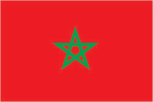
red with a green pentacle (five-pointed, linear star) known as Solomon's seal in the center of the flag; green is the traditional color of Islam
Head of Government
Prime Minister Dr. Azzedine LARAKI (since 30 September 1986)
Independence
2 March 1956 (from France)
Judicial branch
Supreme Court
Legal system
based on Islamic law and French and Spanish civil law system; judicial review of legislative acts in Constitutional Chamber of Supreme Court
Legislative branch
unicameral Chamber of Representatives (Majlis Nawab)
Long-form name
Kingdom of Morocco
Member of
ABEDA, ACCT (associate), AfDB, AFESD, AL, AMF, AMU, CCC, EBRD, ECA, FAO, G-77, GATT, IAEA, IBRD, ICAO, ICC, ICFTU, IDA, IDB, IFAD, IFC, IIB, ILO, IMF, IMO, INTELSAT, INTERPOL, IOC, ISO, ITU, LORCS, OAS (observer), NAM, OIC, UN, UNCTAD, UNESCO, UNHCR, UNIDO, UPU, WHO, WIPO, WMO, WTO
National holiday
National Day (anniversary of King Hassan II's accession to the throne), 3 March (1961)
Political parties and leaders
Morocco has 15 political parties; the major ones are Istiqlal, M'Hamed BOUCETTA; Socialist Union of Popular Forces (USFP); Popular Movement (MP), Secretariat General; National Assembly of Independents (RNI), Ahmed OSMAN; National Democratic Party (PND), Mohamed Arsalane EL-JADIDI; Party for Progress and Socialism (PPS); Constitutional Union (UC), Maati BOUABID
Suffrage
universal at age 21
Type
constitutional monarchy
Economy
Agriculture
50% of employment and 30% of export value; not self-sufficient in food; cereal farming and livestock raising predominate; barley, wheat, citrus fruit, wine, vegetables, olives; fishing catch of 491,000 metric tons in 1987
Budget
revenues $7.5 billion; expenditures $7.7 billion, including capital expenditures of $1.9 billion (1992)
Currency
Moroccan dirham (plural - dirhams); 1 Moroccan dirham (DH) = 100 centimes
Economic aid
US commitments, including Ex-Im (FY70-89), $1.3 billion; Western (non-US) countries, ODA and OOF bilateral commitments (1970-89), $7.5 billion; OPEC bilateral aid (1979-89), $4.8 billion; Communist countries (1970-89), $2.5 billion; $2.8 billion debt canceled by Saudi Arabia (1991); IMF standby agreement worth $13 million; World Bank, $450 million (1991)
Electricity
2,270,000 kW capacity; 8,170 million kWh produced, 310 kWh per capita (1991)
Exchange rates
Moroccan dirhams (DH) per US$1 - 8.889 (March 1992), 8.707 (1991), 8.242 (1990), 8.488 (1989), 8.209 (1988), 8.359 (1987)
Exports
$4.1 billion (f.o.b., 1991) commodities: food and beverages 30%, semiprocessed goods 23%, consumer goods 21%, phosphates 17% partners: EC 58%, India 7%, Japan 5%, USSR 3%, US 2%
External debt
$20 billion (1991)
Fiscal year
calendar year
GDP
exchange rate conversion - $27.3 billion, per capita $1,060; real growth rate 4.2% (1991)
Illicit drugs
illicit producer of hashish; trafficking on the increase for both domestic and international drug markets; shipments of hashish mostly directed to Western Europe; occasional transit point for cocaine from South America destined for Western Europe.
Imports
$6.0 billion (f.o.b., 1991) commodities: capital goods 24%, semiprocessed goods 22%, raw materials 16%, fuel and lubricants 16%, food and beverages 13%, consumer goods 9% partners: EC 53%, US 11%, Canada 4%, Iraq 3%, USSR 3%, Japan 2%
Industrial production
growth rate 4% (1989 est.); accounts for an estimated 20% of GDP
Industries
phosphate rock mining and processing, food processing, leather goods, textiles, construction, tourism
Inflation rate (consumer prices)
8.1% (1991 )
Overview
The economy had recovered moderately in 1990 because of: the resolution of a trade dispute with India over phosphoric acid sales, a rebound in textile sales to the EC, lower prices for food imports, a sharp increase in worker remittances, increased Arab donor aid, and generous debt rescheduling agreements. Economic performance in 1991 was mixed. A record harvest helped real GDP advance by 4.2%, although nonagricultural output grew by less than 1%. Inflation accelerated slightly as easier financial policies triggered rapid credit and monetary growth. Despite recovery of domestic demand, import volume growth slowed while export volume was adversely affected by phosphate marketing difficulties. In January 1992, Morocco reached a new 12-month standby arrangement for $129 million with the IMF. In February 1992, the Paris Club rescheduled $1.4 billion of Morocco's commercial debt. This is thought to be Morocco's last rescheduling. By 1993 the Moroccan authorities hope to be in a position to meet all debt service obligations without additional rescheduling. Servicing this large debt, high unemployment, and Morocco's vulnerability to external economic forces remain severe long-term problems.
Unemployment rate
16% (1991)
Communications
Airports
75 total, 67 usable; 26 with permanent-surface runways; 2 with runways over 3,659 m; 13 with runways 2,440-3,659 m; 27 with runways 1,220-2,439 m
Civil air
28 major transport aircraft
Highways
59,198 km total; 27,740 km paved, 31,458 km gravel, crushed stone, improved earth, and unimproved earth
Merchant marine
51 ships (1,000 GRT or over) totaling 315,249 GRT/487,479 DWT; includes 10 cargo, 2 container, 12 refrigerated cargo, 6 roll-on/roll-off, 3 petroleum tanker, 11 chemical tanker, 4 bulk, 3 short-sea passenger
Pipelines
crude oil 362 km; petroleum products (abandoned) 491 km; natural gas 241 km
Ports
Agadir, Casablanca, El Jorf Lasfar, Kenitra, Mohammedia, Nador, Safi, Tangier; also Spanish-controlled Ceuta and Melilla
Railroads
1,893 km 1.435-meter standard gauge (246 km double track, 974 km electrified)
Telecommunications
good system composed of wire lines, cables, and radio relay links; principal centers are Casablanca and Rabat; secondary centers are Fes, Marrakech, Oujda, Tangier, and Tetouan; 280,000 telephones; broadcast stations - 20 AM, 7 FM, 26 TV and 26 additional rebroadcast sites; 5 submarine cables; satellite earth stations - 2 Atlantic Ocean INTELSAT and 1 ARABSAT; radio relay to Gibraltar, Spain, and Western Sahara; coaxial cable and microwave to Algeria; microwave network linking Syria, Jordan, Egypt, Libya, Tunisia, Algeria, and Morocco
Military and Security
Branches
Royal Moroccan Army, Royal Moroccan Navy, Royal Moroccan Air Force, Royal Gendarmerie, Auxiliary Forces
Defense expenditures
exchange rate conversion - $1.1 billion, 4.2% of GDP (1992 budget)
Manpower availability
males 15-49, 6,604,712; 4,196,449 fit for military service; 293,204 reach military age (18) annually; limited conscription