1988 Edition
CIA World Factbook 1988 (Internet Archive)
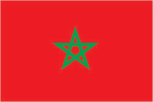
Geography
Boundary disputes
none; claims and administers Western Sahara, but sovereignty is unresolved; Western Sahara question with Mauritania; Spain controls two coastal presidios or places of sovereignty (Ceuta, Melilla)
Climate
Mediterranean, becoming more extreme in the interior
Coastline
1,835 km
Comparative area
about the same size as California
Contiguous zone
24 nm
Continental shelf
200 meters or to depth of exploitation
Environment
northern mountains geologically unstable and subject to earthquakes; desertification
Ethnic divisions
99.1% ArabBerber, 0.7% non-Moroccan, 0.2% Jewish
Extended economic zone
200 nm
Infant mortality rate
117/1,000 (1978)
Labor force
7.5 million (1985); 50% agriculture, 26% services, 15% industry, 9% other; at least 20% of urban labor unemployed
Land boundaries
1,996 km total
Land use
18% arable land; 1% permanent crops; 28% meadows and pastures; 12% forest and woodland; 41% other; includes 1% irrigated
Language
Arabic (official); several Berber dialects; French is language of business, government, diplomacy, and postprimary education
Life expectancy
54
Nationality
noun — Moroccan(s); adjective— Moroccan
Organized labor
about 5% of the labor force, mainly in the Union of Moroccan Workers (UMT) and the Democratic Confederation of Labor (CDT)
Population
23,361,495 (July 1987), average annual growth rate 2.49%
Religion
98.7% Muslim, 1.1% Christian, 0.2% Jewish
Special notes
strategic location along Strait of Gibraltar
Terrain
mostly mountains with rich coastal plains
Territorial sea
12 nm
Total area
446,550 km2; land area: 446,300 km2
Total area
300 km Mediterranean Sea ita (Sp.) Sec rtflonil nup VII
Government
Administrative divisions
36 provinces (does not include Western Sahara) and 2 prefectures (Rabat-Sale and Casablanca)
Branches
constitution provides for Prime Minister and ministers named by and responsible to King; King has paramount executive powers; unicameral legislature (Chamber of Representatives), of which two-thirds of the members are directly elected and one-third are indirectly elected; judiciary independent of other branches
Capital
Rabat
Communists
about 2,000
Elections
provincial elections held 10 June 1983; elections for National Assembly held 14 September 1984 Political parties and leaders: Morocco has 15 political parties; the major ones are Istiqlal Party, M'Hamed Boucetta; Socialist Union of Popular Forces (USFP), Abderrahim Bouabid; Popular Movement (MP), Secretariat General; National Assembly of Independents (RNI) formed in October 1978 is progovernment grouping of previously unaffiliated deputies in parliament, Ahmed Osman; National Democratic Party (PND), a splinter group from the RNI formed July 1981, Mohamed Arsalane El-Jadidi; Party for Progress and Socialism (PPS), legalized in August 1974, is front for Moroccan Communist Party (PCM), which was proscribed in 1959, Ali Yata; new promonarchy party — the Constitutional Union (UC), Maati Bouabid
Government leaders
HASSAN II, King (since March 1961); Azzedine LARAKI, Prime Minister (since September 1986)
Legal system
based on Islamic law and French and Spanish civil law system; judicial review of legislative acts in Constitutional Chamber of Supreme Court
Member of
AfDB, Arab League, EC (associate), FAO, G-77, GATT, IAEA, IBRD, ICAO, IDA, IDE— Islamic Development Bank, IFAD, IFC, ILO, International Lead and Zinc Study Group, IMF, IMO, INTELSAT, INTERPOL, IOOC, IPU, ITU, NAM, OIC, UN, UNESCO, UPU, WHO, WIPO, WMO, WTO
National holiday
Independence Day, 18 November
Official name
Kingdom of Morocco
Suffrage
universal over age 20
Type
constitutional monarchy (constitution adopted 1972)
Voting strength
progovernment parties hold absolute majority in Chamber of Representatives; with palace-oriented Popular Movement deputies, the King controls over two-thirds of the seats
Economy
Agriculture
not self-sufficient in food; cereal farming and livestock raising predominate; barley, wheat, citrus fruit, wine, vegetables, olives; some fishing; an illegal producer of cannabis for the international drug trade Mozambique
Budget
revenues, $4.5 billion; current expenditures, $3.6 billion; development expenditures, $2.0 billion (1984 est.)
Electric power
2,080,000 kW capacity; 6,920 million kWh produced, 290 kWh per capita (1986)
Exports
$2.2 billion (f.o.b., 1985); 24% phosphates, 76% other
Fiscal year
calendar year
Fishing
catch 463,000 metric tons (1985)
GDP
$11.9 billion, about $510 per capita (1985); average annual real growth 4.7% (1986 est.)
Imports
$3.8 billion (c.i.f., 1985); 25% petroleum products, 75% other
Major industries
mining and mineral processing, food processing, textiles, construction and tourism
Major trade partners
France, FRG, Italy, Saudi Arabia, Benelux, Iraq
Monetary conversion rate
8.84 dirhams=US$l (November 1986)
Natural resources
phosphates, iron, manganese, lead, zinc, fish
Communications
Airfields
78 total, 72 usable; 26 with permanent-surface runways; 2 with runways over 3,659 m, 14 with runways 2,440-3,659 m, 28 with runways 1,220-2,439 m
Branches
Royal Moroccan Army, Royal Moroccan Navy, Royal Moroccan Air Force, Royal Gendarmerie
Civil air
22 major transport aircraft
Highways
58,000 km total; 25,750 km bituminous treated, 32,250 km gravel, crushed stone, improved earth, and unimproved earth
Military budget
for fiscal year ending 31 December 1986, $839 million; 15% of central government budget N.cal.
Military manpower
males 15-49, 5,596,000; 3,561,000 fit for military service; 276,000 reach military age (18) annually; limited conscription
Pipelines
362 km crude oil; 491 km (abandoned) refined products; 241 km natural gas
Ports
10 major (including Spanishcontrolled Ceuta and Melilla), 14 minor
Railroads
1,779 km 1.435-meter standard gauge, 178 km double track; 792 km electrified
Telecommunications
good system composed of wire lines, cables, and radio-relay links; principal centers Casablanca and Rabat, secondary centers Fes, Marrakech, Oujda, Tangier and Tetouan; 270,100 telephones (1.2 per 100 popl.); 14 AM, 6 FM, 47 TV stations; 5 submarine cables; 2 Atlantic Ocean INTELSAT stations; radiorelay to Gibraltar, Spain, and Western Sahara; coaxial cable to Algeria Defense Forces