2012 Edition
CIA World Factbook 2012 Archive (HTML)
Introduction
Background
The use of the name Montenegro began in the 15th century when the Crnojevic dynasty began to rule the Serbian principality of Zeta; over subsequent centuries Montenegro was able to maintain its independence from the Ottoman Empire. From the 16th to 19th centuries, Montenegro became a theocracy ruled by a series of bishop princes; in 1852, it was transformed into a secular principality. After World War I, Montenegro was absorbed by the Kingdom of Serbs, Croats, and Slovenes, which became the Kingdom of Yugoslavia in 1929; at the conclusion of World War II, it became a constituent republic of the Socialist Federal Republic of Yugoslavia. When the latter dissolved in 1992, Montenegro federated with Serbia, first as the Federal Republic of Yugoslavia and, after 2003, in a looser union of Serbia and Montenegro. In May 2006, Montenegro invoked its right under the Constitutional Charter of Serbia and Montenegro to hold a referendum on independence from the state union. The vote for severing ties with Serbia exceeded 55% - the threshold set by the EU - allowing Montenegro to formally declare its independence on 3 June 2006.
Geography
Area
- 13,812 sq km 13,452 sq km 360 sq km
- total
- 13,812 sq km
- water
- 360 sq km
Area - comparative
slightly smaller than Connecticut
Climate
Mediterranean climate, hot dry summers and autumns and relatively cold winters with heavy snowfalls inland
Coastline
293.5 km
Elevation extremes
- Adriatic Sea 0 m Bobotov Kuk 2,522 m
- highest point
- Bobotov Kuk 2,522 m
- lowest point
- Adriatic Sea 0 m
Environment - current issues
pollution of coastal waters from sewage outlets, especially in tourist-related areas such as Kotor
Environment - international agreements
- Air Pollution, Biodiversity, Climate Change, Climate Change-Kyoto Protocol, Desertification, Hazardous Wastes, Law of the Sea, Marine Dumping, Marine Life Conservation, Ozone Layer Protection, Ship Pollution none of the selected agreements
- party to
- Air Pollution, Biodiversity, Climate Change, Climate Change-Kyoto Protocol, Desertification, Hazardous Wastes, Law of the Sea, Marine Dumping, Marine Life Conservation, Ozone Layer Protection, Ship Pollution
- signed, but not ratified
- none of the selected agreements
Geographic coordinates
42 30 N, 19 18 E
Geography - note
strategic location along the Adriatic coast
Irrigated land
22 sq km
Land boundaries
- 625 km Albania 172 km, Bosnia and Herzegovina 225 km, Croatia 25 km, Kosovo 79 km, Serbia 124 km
- border countries
- Albania 172 km, Bosnia and Herzegovina 225 km, Croatia 25 km, Kosovo 79 km, Serbia 124 km
- total
- 625 km
Land use
- 13.7% 1% 85.3%
- arable land
- 13.7%
- other
- 85.3%
- permanent crops
- 1%
Location
Southeastern Europe, between the Adriatic Sea and Serbia
Map references
Europe
Maritime claims
- 12 nm defined by treaty
- continental shelf
- defined by treaty
- territorial sea
- 12 nm
Natural hazards
destructive earthquakes
Natural resources
bauxite, hydroelectricity
Terrain
highly indented coastline with narrow coastal plain backed by rugged high limestone mountains and plateaus
People and Society
Age structure
- 15.4% (male 49,282/ female 52,098) 71% (male 242,716/ female 223,908) 13.6% (male 35,478/ female 53,912) (2012 est.)
- 0-14 years
- 15.4% (male 49,282/ female 52,098)
- 15-64 years
- 71% (male 242,716/ female 223,908)
- 65 years and over
- 13.6% (male 35,478/ female 53,912) (2012 est.)
Birth rate
10.89 births/1,000 population (2012 est.)
Children under the age of 5 years underweight
2.2% (2006)
Death rate
9.03 deaths/1,000 population (July 2012 est.)
Education expenditures
NA
Ethnic groups
Montenegrin 43%, Serbian 32%, Bosniak 8%, Albanian 5%, other (Muslims, Croats, Roma (Gypsy)) 12% (2003 census)
Hospital bed density
3.98 beds/1,000 population (2007)
Languages
Serbian 63.6%, Montenegrin (official) 22%, Bosnian 5.5%, Albanian 5.3%, unspecified (includes Croatian) 3.7% (2003 census)
Literacy
- age 15 and over can read and write 98.4% 99.4% 97.4% (2010 est.)
- definition
- age 15 and over can read and write
- female
- 97.4% (2010 est.)
- male
- 99.4%
- total population
- 98.4%
Major cities - population
PODGORICA (capital) 144,000 (2009)
Major infectious diseases
- intermediate bacterial diarrhea Crimean Congo hemorrhagic fever (2009)
- degree of risk
- intermediate
- food or waterborne diseases
- bacterial diarrhea
- vectorborne disease
- Crimean Congo hemorrhagic fever (2009)
Maternal mortality rate
8 deaths/100,000 live births (2010)
Median age
- 38.3 years 37.1 years 39.6 years (2012 est.)
- female
- 39.6 years (2012 est.)
- male
- 37.1 years
- total
- 38.3 years
Nationality
- Montenegrin(s) Montenegrin
- adjective
- Montenegrin
- noun
- Montenegrin(s)
Population
657,394 (July 2012 est.)
Population growth rate
-0.633% (2012 est.)
Religions
Orthodox 74.2%, Muslim 17.7%, Catholic 3.5%, other 0.6%, unspecified 3%, atheist 1% (2003 census)
Sanitation facility access
- urban: 96% of population rural: 86% of population total: 92% of population urban: 4% of population rural: 14% of population total: 8% of population
- rural
- 14% of population
- total
- 8% of population
- urban
- 4% of population
Sex ratio
- 1.07 male(s)/female 0.95 male(s)/female 1.08 male(s)/female 0.66 male(s)/female 0.99 male(s)/female (2011 est.)
- 15-64 years
- 1.08 male(s)/female
- 65 years and over
- 0.66 male(s)/female
- at birth
- 1.07 male(s)/female
- total population
- 0.99 male(s)/female (2011 est.)
- under 15 years
- 0.95 male(s)/female
Urbanization
- 61% of total population (2010) 0.1% annual rate of change (2010-15 est.)
- rate of urbanization
- 0.1% annual rate of change (2010-15 est.)
- urban population
- 61% of total population (2010)
Government
Administrative divisions
21 municipalities (opstine, singular - opstina); Andrijevica, Bar, Berane, Bijelo Polje, Budva, Cetinje, Danilovgrad, Herceg Novi, Kolasin, Kotor, Mojkovac, Niksic, Plav, Pljevlja, Pluzine, Podgorica, Rozaje, Savnik, Tivat, Ulcinj, Zabljak
Capital
- Podgorica; note - the Old Royal Capital is Cetinje mentioned in the constitution 42 26 N, 19 16 E UTC+1 (6 hours ahead of Washington, DC during Standard Time) +1 hr, begins last Sunday in March; ends last Sunday in October
- daylight saving time
- +1 hr, begins last Sunday in March; ends last Sunday in October
- geographic coordinates
- 42 26 N, 19 16 E
- name
- Podgorica; note - the Old Royal Capital is Cetinje mentioned in the constitution
- time difference
- UTC+1 (6 hours ahead of Washington, DC during Standard Time)
Constitution
approved 19 October 2007 (by the Assembly)
Country name
- none Montenegro none Crna Gora People's Republic of Montenegro, Socialist Republic of Montenegro, Republic of Montenegro
- conventional long form
- none
- conventional short form
- Montenegro
- former
- People's Republic of Montenegro, Socialist Republic of Montenegro, Republic of Montenegro
- local long form
- none
- local short form
- Crna Gora
Diplomatic representation from the US
- Ambassador Sue K BROWN Dzona Dzeksona 2, 81000 Podgorica, Montenegro use embassy street address [382] 20 410 500 [382] 20 241 358
- chief of mission
- Ambassador Sue K BROWN
- embassy
- Dzona Dzeksona 2, 81000 Podgorica, Montenegro
- FAX
- [382] 20 241 358
- mailing address
- use embassy street address
- telephone
- [382] 20 410 500
Diplomatic representation in the US
- Ambassador Srdjan DARMANOVIC 1610 New Hampshire Avenue NW, Washington, DC, 20009 [1] (202) 234-6108 [1] (202) 234-6109 New York
- chancery
- 1610 New Hampshire Avenue NW, Washington, DC, 20009
- chief of mission
- Ambassador Srdjan DARMANOVIC
- consulate(s) general
- New York
- FAX
- [1] (202) 234-6109
- telephone
- [1] (202) 234-6108
Executive branch
- President Filip VUJANOVIC (since 6 April 2008) Prime Minister Milo DJUKANOVIC (since 4 December 2012) Ministries act as cabinet president elected by direct vote for five-year term (eligible for a second term); election last held on 6 April 2008 (next to be held in 2013); prime minister proposed by president, accepted by Assembly Filip VUJANOVIC reelected president; Filip VUJANOVIC 51.9%, Andrija MANDIC 19.6%, Nebojsa MEDOJEVIC 16.6%, Srdan MILIC 11.9%
- cabinet
- Ministries act as cabinet
- chief of state
- President Filip VUJANOVIC (since 6 April 2008)
- election results
- Filip VUJANOVIC reelected president; Filip VUJANOVIC 51.9%, Andrija MANDIC 19.6%, Nebojsa MEDOJEVIC 16.6%, Srdan MILIC 11.9%
- elections
- president elected by direct vote for five-year term (eligible for a second term); election last held on 6 April 2008 (next to be held in 2013); prime minister proposed by president, accepted by Assembly
- head of government
- Prime Minister Milo DJUKANOVIC (since 4 December 2012)
Flag description
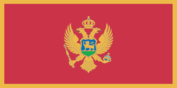
a red field bordered by a narrow golden-yellow stripe with the Montenegrin coat of arms centered; the arms consist of a double-headed golden eagle - symbolizing the unity of church and state - surmounted by a crown; the eagle holds a golden scepter in its right claw and a blue orb in its left; the breast shield over the eagle shows a golden lion passant on a green field in front of a blue sky; the lion is symbol of episcopal authority and harks back to the three and a half centuries that Montenegro was ruled as a theocracy
Government type
republic
Independence
3 June 2006 (from Serbia and Montenegro)
International law organization participation
has not submitted an ICJ jurisdiction declaration; accepts ICC jurisdiction
International organization participation
CE, CEI, EAPC, EBRD, FAO, IAEA, IBRD, ICAO, ICC (NGOs), ICRM, IDA, IFC, IFRCS, IHO (pending member), ILO, IMF, IMO, IMSO, Interpol, IOC, IOM, IPU, ISO (correspondent), ITSO, ITU, ITUC (NGOs), MIGA, NAM (observer), OIF (observer), OPCW, OSCE, PCA, PFP, SELEC, UN, UNCTAD, UNESCO, UNHCR, UNIDO, UNMIL, UNWTO, UPU, WCO, WHO, WIPO, WMO, WTO
Judicial branch
Constitutional Court (five judges serve nine-year terms); Supreme Court (judges have life tenure)
Legal system
civil law
Legislative branch
- unicameral Assembly (81 seats; members elected by direct vote to serve four-year terms) last held on 14 October 2012 (next to be held by 2016) percent of vote by party - Coalition for European Montenegro 45.6%, Democratic Front 22.8%, SNP 11.1%, Positive Montenegro 8.2%, Bosniak Party, 4.2%, other (including Albanian and Croatian minority parties) 8.1%; seats by party - Coalition for European Montenegro 39, Democratic Front 20, SNP 9, Positive Montenegro 7, Bosniak Party 3, Albanian and Croatian minority parties 3
- election results
- percent of vote by party - Coalition for European Montenegro 45.6%, Democratic Front 22.8%, SNP 11.1%, Positive Montenegro 8.2%, Bosniak Party, 4.2%, other (including Albanian and Croatian minority parties) 8.1%; seats by party - Coalition for European Montenegro 39, Democratic Front 20, SNP 9, Positive Montenegro 7, Bosniak Party 3, Albanian and Croatian minority parties 3
- elections
- last held on 14 October 2012 (next to be held by 2016)
National anthem
- "Oj, svijetla majska zoro" (Oh, Bright Dawn of May) Sekula DRLJEVIC/unknown, arranged by Zarko MIKOVIC adopted 2004; the anthem's music is based on a Montenegrin folk song
- lyrics/music
- Sekula DRLJEVIC/unknown, arranged by Zarko MIKOVIC
- name
- "Oj, svijetla majska zoro" (Oh, Bright Dawn of May)
National holiday
National Day, 13 July (1878)
National symbol(s)
double-headed eagle
Political parties and leaders
Albanian Alternative or AA [Vesel SINISHTAJ]; Bosniak Party or BS [Rafet HUSOVIC]; Coalition for European Montenegro (bloc) [Milo DJUKANOVIC] (includes Democratic Party of Socialists or DPS [Milo DJUKANOVIC], Social Democratic Party or SDP [Ranko KRIVOKAPIC], and the Liberal Party of Montenegro or LP [Andrija POPOVIC]); Croatian Civic Initiative or HGI [Marija VUCINOVIC]; Democratic Center or DC [Goran BATRICEVIC]; Democratic Front (bloc) [Miodrag LEKIC] (includes New Serb Democracy or NOVA [Andrija POPOVIC], Movement for Change or PZP [Nebojsa MEDOJEVIC], a dissident faction of the Socialist People's Party, and the Democratic Party of Unity [Zoran ZIZIC]); Democratic League-Party of Democratic Prosperity [Mehmet BARDHIJ]; Democratic Serbian Party of Montenegro or DSS [Ranko KADIC]; Democratic Union of Albanians or DUA [Mehmet ZENKA]; FORCA [Nazif CUNGU]; People's Party of Montenegro or NS [Predrag POPOVIC]; Positive Montenegro [Darko PAJOVIC]; Socialist People's Party or SNP [Srdjan MILIC]
Suffrage
18 years of age; universal
Economy
Agriculture - products
tobacco, potatoes, citrus fruits, olives, grapes; sheep
Budget
- $1.7 billion $1.9 billion (2011 est.)
- expenditures
- $1.9 billion (2011 est.)
- revenues
- $1.7 billion
Budget surplus (+) or deficit (-)
-4.6% of GDP (2011 est.)
Commercial bank prime lending rate
9.69% (31 December 2011 est.) 9.53% (31 December 2010 est.)
Current account balance
-$1.927 billion (2011 est.) -$1.102 billion (2007 est.)
Debt - external
$1.2 billion (2011 est.) $650 million (2006 est.)
Distribution of family income - Gini index
24.3 (2010) 30 (2003)
Economy - overview
Montenegro's economy is transitioning to a market system, but the state sector remains large and additional institutional changes are needed. The economy relies heavily on tourism and the export of refined metals. Unprofitable state-owned enterprises weigh on public finances. Montenegro severed its economy from federal control and from Serbia during the MILOSEVIC era and maintained its own central bank, adopted the deutsch mark, then the euro - rather than the Yugoslav dinar - as official currency, collected customs tariffs, and managed its own budget. The dissolution of the loose political union between Serbia and Montenegro in 2006 led to separate membership in several international financial institutions, such as the European Bank for Reconstruction and Development. In January 2007, Montenegro joined the World Bank and IMF. Montenegro became the 156th member of World Trade Organization in December 2011. The European Council (EC) granted candidate country status to Montenegro at the December 2010 session. Montenegro began negotiations to join the EC in June, 2012, having met the conditions set down by the European Council, which called on Montenegro to take steps to fight corruption and organized crime. Unemployment and regional disparities in development are key political and economic problems. Montenegro has privatized its large aluminum complex - the dominant industry - as well as most of its financial sector, and has begun to attract foreign direct investment in the tourism sector. The global financial crisis had a significant negative impact on the economy, due to the ongoing credit crunch, a decline in the real estate sector, and a fall in aluminum exports. In 2012, real GDP growth slipped to 0.2%, reflecting the general downturn in most of Europe.
Exchange rates
euros (EUR) per US dollar - 0.7838 (2012 est.) 0.7185 (2011 est.) 755 (2010 est.) 0.7198 (2009 est.) 0.6827 (2008 est.)
Exports
$640 million (2011 est.) $171.3 million (2003)
Exports - partners
Serbia 17.5%, Hungary 16.9%, Croatia 10.1% (2011 est.)
Fiscal year
calendar year
GDP - composition by sector
- 0.8% 11.3% 87.9% (2011)
- agriculture
- 0.8%
- industry
- 11.3%
- services
- 87.9% (2011)
GDP - per capita (PPP)
$11,700 (2012 est.) $11,700 (2011 est.) $11,000 (2010 est.) data are in 2012 US dollars
GDP - real growth rate
0.2% (2012 est.) 2.5% (2011 est.) 2.5% (2010 est.)
GDP (official exchange rate)
$4.332 billion (2012 est.)
GDP (purchasing power parity)
$7.288 billion (2012 est.) $7.273 billion (2011 est.) $7.099 billion (2010 est.) data are in 2012 US dollars
Imports
$2.5 billion (2011 est.) $601.7 million (2003)
Imports - partners
Serbia 28.4%, Greece 7.9%, Bosnia and Herzegovina 7.6% (2011 est.)
Inflation rate (consumer prices)
3% (2011) 3.4% (2007)
Investment (gross fixed)
22% of GDP (2011 est.)
Labor force
251,300 (2011 est.)
Labor force - by occupation
- 6.3% 20.9% 72.8% (2011 est.)
- agriculture
- 6.3%
- industry
- 20.9%
- services
- 72.8% (2011 est.)
Market value of publicly traded shares
$3.322 billion (31 December 2011) $3.604 billion (31 December 2010) $4.289 billion (31 December 2009)
Population below poverty line
6.6% (2010 est.)
Public debt
45% of GDP (2011 est.) 38% of GDP (2006 est.) data cover general government debt, and includes debt instruments issued (or owned) by government entities other than the treasury; the data include treasury debt held by foreign entities; the data include debt issued by subnational entities, as well as intra-governmental debt; intra-governmental debt consists of treasury borrowings from surpluses in the social funds, such as for retirement, medical care, and unemployment; debt instruments for the social funds are not sold at public auctions
Reserves of foreign exchange and gold
$400 million (31 December 2011)
Stock of broad money
$1.982 billion (31 December 2011 est.) $2.01 billion (31 December 2010 est.)
Stock of domestic credit
$3.29 billion (31 December 2009) $3.771 billion (31 December 2008)
Stock of narrow money
$749 million (31 December 2011 est.) $783.3 million (31 December 2010 est.)
Taxes and other revenues
39.2% of GDP (2011 est.)
Unemployment rate
11.5% (2011 est.) 14.7% (2007 est.)
Energy
Carbon dioxide emissions from consumption of energy
1.941 million Mt (2010 est.)
Crude oil - exports
0 bbl/day (2009 est.)
Crude oil - imports
0 bbl/day (2009 est.)
Crude oil - production
0 bbl/day (2011 est.)
Crude oil - proved reserves
0 bbl (1 January 2012 est.)
Electricity - consumption
4.1 billion kWh (2010 est.)
Electricity - exports
0 kWh (2010 est.)
Electricity - from fossil fuels
24.2% of total installed capacity (2009 est.)
Electricity - from hydroelectric plants
75.8% of total installed capacity (2009 est.)
Electricity - from nuclear fuels
0% of total installed capacity (2009 est.)
Electricity - from other renewable sources
0% of total installed capacity (2009 est.)
Electricity - imports
1.5 billion kWh (2010 est.)
Electricity - installed generating capacity
868,000 kW (2009 est.)
Electricity - production
2.621 billion kWh (2009 est.)
Natural gas - consumption
0 cu m (2010 est.)
Natural gas - exports
0 cu m (2010 est.)
Natural gas - imports
0 cu m (2010 est.)
Natural gas - production
0 cu m (2010 est.)
Natural gas - proved reserves
0 cu m (1 January 2012 est.)
Refined petroleum products - consumption
4,446 bbl/day (2011 est.)
Refined petroleum products - exports
0 bbl/day (2008 est.)
Refined petroleum products - imports
3,666 bbl/day (2008 est.)
Refined petroleum products - production
0 bbl/day (2008 est.)
Communications
Broadcast media
state-funded national radio-TV broadcaster operates 2 terrestrial TV networks, 1 satellite TV channel, and 2 radio networks; 4 public TV stations and some 20 private TV stations; 14 local public radio stations and more than 40 private radio stations (2007)
Internet country code
.me
Internet hosts
10,088 (2012)
Internet users
280,000 (2009)
Telephone system
- modern telecommunications system with access to European satellites GSM mobile-cellular service, available through multiple providers with national coverage, is growing country code - 382; 2 international switches connect the national system
- domestic
- GSM mobile-cellular service, available through multiple providers with national coverage, is growing
- general assessment
- modern telecommunications system with access to European satellites
- international
- country code - 382; 2 international switches connect the national system
Telephones - main lines in use
169,500 (2010)
Telephones - mobile cellular
1.17 million (2010)
Transportation
Airports
5 (2012)
Airports - with paved runways
- 1 (2012)
- 1,524 to 2,437 m
- 1
- 2,438 to 3,047 m
- 2
- 914 to 1,523 m
- 1
- total
- 5
- under 914 m
- 1 (2012)
Airports - with unpaved runways
- 1 (2010)
- 914 to 1,523 m
- 1 (2010)
- total
- 1
Heliports
1 (2012)
Merchant marine
- cargo 1, passenger/cargo 1 4 (Bahamas 2, Honduras 1, Slovakia 1) (2010)
- registered in other countries
- 4 (Bahamas 2, Honduras 1, Slovakia 1) (2010)
- total
- 2
Ports and terminals
Bar
Railways
- 250 km 250 km 1.435-m gauge (169 km electrified) (2007)
- total
- 250 km
Roadways
- 7,624 km 5,097 km 2,527 km (2008)
- total
- 7,624 km
- unpaved
- 2,527 km (2008)
Military and Security
Manpower fit for military service
- 149,159 131,823 (2010 est.)
- females age 16-49
- 131,823 (2010 est.)
- males age 16-49
- 149,159
Manpower reaching militarily significant age annually
- 3,120 3,677 (2010 est.)
- female
- 3,677 (2010 est.)
- male
- 3,120
Military branches
- Armed Forces of the Republic of Montenegro: Army of Montenegro (includes Montenegrin Navy (Mornarica Crne Gore, MCG)), Air Force (2011)
- Armed Forces of the Republic of Montenegro
- Army of Montenegro (includes Montenegrin Navy (Mornarica Crne Gore, MCG)), Air Force (2011)
Military service age and obligation
compulsory national military service abolished August 2006
Transnational Issues
Disputes - international
none
Refugees and internally displaced persons
- 9,367 (Kosovo) (2011)
- refugees (country of origin)
- 9,367 (Kosovo) (2011)