2018 Edition
CIA World Factbook 2018 Archive (Wayback Machine)
Introduction
Background
The Mongols gained fame in the 13th century when under Chinggis KHAAN they established a huge Eurasian empire through conquest. After his death the empire was divided into several powerful Mongol states, but these broke apart in the 14th century. The Mongols eventually retired to their original steppe homelands and in the late 17th century came under Chinese rule. Mongolia declared its independence from the Manchu-led Qing Empire in 1911 and achieved limited autonomy until 1919, when it again came under Chinese control. The Mongolian Revolution of 1921 ended Chinese dominance, and a communist regime, the Mongolian People’s Republic, took power in 1924.The modern country of Mongolia, however, represents only part of the Mongols' historical homeland; today, more ethnic Mongolians live in the Inner Mongolia Autonomous Region in the People's Republic of China than in Mongolia. Since the country's peaceful democratic revolution in 1990, the ex-communist Mongolian People's Revolutionary Party (MPRP) - which took the name Mongolian People’s Party (MPP) in 2010 - has competed for political power with the Democratic Party (DP) and several other smaller parties, including a new party formed by former President ENKHBAYAR, which confusingly adopted for itself the MPRP name. In the country's most recent parliamentary elections in June 2016, Mongolians handed the MPP overwhelming control of Parliament, largely pushing out the DP, which had overseen a sharp decline in Mongolia’s economy during its control of Parliament in the preceding years. Mongolians elected a DP member, Khaltmaa BATTULGA, as president in 2017.
Geography
Area
- land
- 1,553,556 sq km
- total
- 1,564,116 sq km
- water
- 10,560 sq km
Area Comparative
slightly smaller than Alaska; more than twice the size of Texas
Climate
desert; continental (large daily and seasonal temperature ranges)
Coastline
0 km (landlocked)
Elevation
- elevation extremes
- 560 m lowest point: Hoh Nuur
- mean elevation
- 1,528 m
- note
- 4374 highest point: Nayramadlin Orgil (Khuiten Peak)
Environment Current Issues
limited natural freshwater resources in some areas; the burning of soft coal in power plants and the lack of enforcement of environmental laws leads to air pollution in Ulaanbaatar; deforestation and overgrazing increase soil erosion from wind and rain; water pollution; desertification and mining activities have a deleterious effect on the environment
Environment International Agreements
- party to
- Biodiversity, Climate Change, Climate Change-Kyoto Protocol, Desertification, Endangered Species, Environmental Modification, Hazardous Wastes, Law of the Sea, Ozone Layer Protection, Ship Pollution, Wetlands, Whaling
- signed, but not ratified
- none of the selected agreements
Geographic Coordinates
46 00 N, 105 00 E
Geography Note
landlocked; strategic location between China and Russia
Irrigated Land
840 sq km (2012)
Land Boundaries
- border countries (2)
- China 4630 km, Russia 3452 km
- total
- 8,082 km
Land Use
- arable land: 0.4% (2011 est.) / permanent crops: 0% (2011 est.) / permanent pasture: 72.6% (2011 est.)
- agricultural land
- 73% (2011 est.)
- forest
- 7% (2011 est.)
- other
- 20% (2011 est.)
Location
Northern Asia, between China and Russia
Map References
Asia
Maritime Claims
- note
- none (landlocked)
Natural Hazards
dust storms; grassland and forest fires; drought; "zud," which is harsh winter conditions
Natural Resources
oil, coal, copper, molybdenum, tungsten, phosphates, tin, nickel, zinc, fluorspar, gold, silver, iron
Population Distribution
sparsely distributed population throughout the country; the capital of Ulaanbaatar and the northern city of Darhan support the highest population densities
Terrain
vast semidesert and desert plains, grassy steppe, mountains in west and southwest; Gobi Desert in south-central
People and Society
Age Structure
- 0-14 years
- 27% (male 427,225 /female 410,579)
- 15-24 years
- 15.67% (male 246,198 /female 240,040)
- 25-54 years
- 45.49% (male 683,475 /female 728,149)
- 55-64 years
- 7.43% (male 105,085 /female 125,502)
- 65 years and over
- 4.42% (male 55,447 /female 81,728) (2018 est.)
Birth Rate
18.2 births/1,000 population (2018 est.)
Children Under The Age Of 5 Years Underweight
1.6% (2013)
Contraceptive Prevalence Rate
54.6% (2013)
Death Rate
6.3 deaths/1,000 population (2018 est.)
Dependency Ratios
- elderly dependency ratio
- 5.8 (2015 est.)
- potential support ratio
- 17.3 (2015 est.)
- total dependency ratio
- 48.5 (2015 est.)
- youth dependency ratio
- 42.7 (2015 est.)
Drinking Water Source
- improved: urban: 66.4% of population
- rural: 59.2% of population
- total: 64.4% of population
- unimproved: urban: 33.6% of population
- rural: 40.8% of population
- total: 35.6% of population (2015 est.)
Education Expenditures
5.2% of GDP (2016)
Ethnic Groups
Khalkh 81.9%, Kazak 3.8%, Dorvod 2.7%, Bayad 2.1%, Buryat-Bouriates 1.7%, Zakhchin 1.2%, Dariganga 1%, Uriankhai 1%, other 4.6% (2010 est.)
Health Expenditures
4.7% of GDP (2014)
Hiv Aids Adult Prevalence Rate
<.1% (2017 est.)
Hiv Aids Deaths
<100 (2017 est.)
Hiv Aids People Living With Hiv Aids
<1000 (2017 est.)
Hospital Bed Density
7 beds/1,000 population (2012)
Infant Mortality Rate
- female
- 17.3 deaths/1,000 live births (2018 est.)
- male
- 23.5 deaths/1,000 live births (2018 est.)
- total
- 20.5 deaths/1,000 live births (2018 est.)
Languages
Mongolian 90% (official) (Khalkha dialect is predominant), Turkic, Russian (1999)
Life Expectancy At Birth
- female
- 74.7 years (2018 est.)
- male
- 66 years (2018 est.)
- total population
- 70.2 years (2018 est.)
Literacy
- definition
- age 15 and over can read and write (2015 est.)
- female
- 98.6% (2015 est.)
- male
- 98.2% (2015 est.)
- total population
- 98.4% (2015 est.)
Major Urban Areas Population
1.52 million ULAANBAATAR (capital) (2018)
Maternal Mortality Rate
44 deaths/100,000 live births (2015 est.)
Median Age
- female
- 29.6 years (2018 est.)
- male
- 28 years
- total
- 28.8 years
Mother S Mean Age At First Birth
- 20.5 years (2008 est.)
- note
- median age at first birth among women 20-24
Nationality
- adjective
- Mongolian
- noun
- Mongolian(s)
Net Migration Rate
-0.8 migrant(s)/1,000 population (2017 est.)
Obesity Adult Prevalence Rate
20.6% (2016)
Physicians Density
3.26 physicians/1,000 population (2015)
Population
- 3,103,428 (July 2018 est.)
- note
- Mongolia is one of the least densely populated countries in the world (2 people per sq km); twice as many ethnic Mongols (some 6 million) live in Inner Mongolia (Nei Mongol) in neighboring China
Population Growth Rate
1.11% (2018 est.)
Religions
Buddhist 53%, Muslim 3%, Shamanist 2.9%, Christian 2.2%, other 0.4%, none 38.6% (2010 est.)
Sanitation Facility Access
- improved: urban: 66.4% of population (2015 est.)
- rural: 42.6% of population (2015 est.)
- total: 59.7% of population (2015 est.)
- unimproved: urban: 33.6% of population (2015 est.)
- rural: 57.4% of population (2015 est.)
- total: 40.3% of population (2015 est.)
School Life Expectancy Primary To Tertiary Education
- female
- 16 years (2015)
- male
- 14 years (2015)
- total
- 15 years (2015)
Sex Ratio
- 0-14 years
- 1.04 male(s)/female (2017 est.)
- 15-24 years
- 1.02 male(s)/female (2017 est.)
- 25-54 years
- 0.94 male(s)/female (2017 est.)
- 55-64 years
- 0.85 male(s)/female (2017 est.)
- 65 years and over
- 0.69 male(s)/female (2017 est.)
- at birth
- 1.04 male(s)/female (2017 est.)
- total population
- 0.96 male(s)/female (2017 est.)
Total Fertility Rate
2.04 children born/woman (2018 est.)
Unemployment Youth Ages 15 24
- female
- 22.1% (2016 est.)
- male
- 20% (2016 est.)
- total
- 20.8% (2016 est.)
Urbanization
- rate of urbanization
- 1.63% annual rate of change (2015-20 est.)
- urban population
- 68.4% of total population (2018)
Government
Administrative Divisions
21 provinces (aymguud, singular - aymag) and 1 municipality* (singular - hot); Arhangay, Bayanhongor, Bayan-Olgiy, Bulgan, Darhan-Uul, Dornod, Dornogovi, Dundgovi, Dzavhan (Zavkhan), Govi-Altay, Govisumber, Hentiy, Hovd, Hovsgol, Omnogovi, Orhon, Ovorhangay, Selenge, Suhbaatar, Tov, Ulaanbaatar*, Uvs
Capital
- daylight saving time
- +1hr, begins last Saturday in March; ends last Saturday in September
- geographic coordinates
- 47 55 N, 106 55 E
- name
- Ulaanbaatar
- note
- Mongolia has two time zones - Ulaanbaatar Time (8 hours in advance of UTC) and Hovd Time (7 hours in advance of UTC)
- time difference
- UTC+8 (13 hours ahead of Washington, DC, during Standard Time)
Citizenship
- citizenship by birth
- no
- citizenship by descent only
- both parents must be citizens of Mongolia; one parent if born within Mongolia
- dual citizenship recognized
- no
- residency requirement for naturalization
- 5 years
Constitution
- amendments
- proposed by the State Great Hural, by the president of the republic, by the government, or by petition submitted to the State Great Hural by the Constitutional Court; conducting referenda on proposed amendments requires at least two-thirds majority vote of the State Great Hural; passage of amendments by the State Great Hural requires at least three-quarters majority vote; passage by referendum requires majority participation of qualified voters and a majority of votes; amended 1999, 2001 (2017)
- history
- several previous; latest adopted 13 January 1992, effective 12 February 1992 (2017)
Country Name
- conventional long form
- none
- conventional short form
- Mongolia
- etymology
- the name means "Land of the Mongols" in Latin; the Mongolian name Mongol Uls translates as "Mongol State"
- former
- Outer Mongolia, Mongolian People's Republic
- local long form
- none
- local short form
- Mongol Uls
Diplomatic Representation From The Us
- chief of mission
- Ambassador (vacant); Charge d'Affaires Manuel MICALLER (since November 2017)
- embassy
- Denver Street #3, 11th Micro Region, Big Ring Road, Ulaanbaatar, 14190 Mongolia
- FAX
- [976] 7007-6016
- mailing address
- P.O. Box 341, Ulaanbaatar 14192
- telephone
- [976] 7007-6001
Diplomatic Representation In The Us
- chancery
- 2833 M Street NW, Washington, DC 20007
- chief of mission
- Ambassador Yondon OTGONBAYAR (since 28 March 2018)
- consulate(s) general
- New York, San Francisco
- FAX
- [1] (202) 298-9227
- telephone
- [1] (202) 333-7117
Executive Branch
- cabinet
- Cabinet nominated by the prime minister in consultation with the president, confirmed by the State Great Hural (parliament)
- chief of state
- President Khaltmaa BATTULGA (since 10 July 2017)
- election results
- Khaltmaa BATTULGA elected president in second round; percent of vote in first round - Khaltmaa BATTULGA (DP) 38.1%, Miyegombo ENKHBOLD (MPP) 30.3%, Sainkhuu GANBAATAR (MPRP) 30.2%, invalid 1.4%; percent of vote in second round - Khaltmaa BATTULGA 55.2%, Miyegombo ENKHBOLD 44.8%
- elections/appointments
- presidential candidates nominated by political parties represented in the State Great Hural and directly elected by simple majority popular vote for a 4-year term (eligible for a second term); election last held on 26 June 2017 with a runoff held 7 July 2017 (next to be held in 2021); following legislative elections, the leader of the majority party or majority coalition usually elected prime minister by the State Great Hural
- head of government
- Prime Minister Ukhnaa KHURELSUKH (since 4 October 2017); Deputy Prime Minister Ulziisaikhan ENKHTUVSHUN (since 18 October 2017); note - Prime Minister Jargaltulga ERDENEBAT (since 8 July 2016) was voted out of office by the Parliament on 7 September 2017
Flag Description
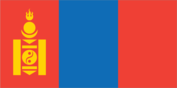
three, equal vertical bands of red (hoist side), blue, and red; centered on the hoist-side red band in yellow is the national emblem ("soyombo" - a columnar arrangement of abstract and geometric representation for fire, sun, moon, earth, water, and the yin-yang symbol); blue represents the sky, red symbolizes progress and prosperity
Government Type
semi-presidential republic
Independence
29 December 1911 (independence declared from China; in actuality, autonomy attained); 11 July 1921 (from China)
International Law Organization Participation
has not submitted an ICJ jurisdiction declaration; accepts ICCt jurisdiction
International Organization Participation
ADB, ARF, CD, CICA, CP, EBRD, EITI (compliant country), FAO, G-77, IAEA, IBRD, ICAO, ICC (NGOs), ICCt, ICRM, IDA, IFAD, IFC, IFRCS, ILO, IMF, IMO, IMSO, Interpol, IOC, IOM, IPU, ISO, ITSO, ITU, ITUC, MIGA, MINURSO, MONUSCO, NAM, OPCW, OSCE, SCO (observer), UN, UNAMID, UNCTAD, UNESCO, UNIDO, UNISFA, UNMISS, UNWTO, UPU, WCO, WHO, WIPO, WMO, WTO
Judicial Branch
- highest courts
- Supreme Court (consists of the Chief Justice and 24 judges organized into civil, criminal, and administrative chambers); Constitutional Court or Tsets (consists of the chairman and 8 members)
- judge selection and term of office
- Supreme Court chief justice and judges appointed by the president upon recommendation by the General Council of Courts - a 14-member body of judges and judicial officials - to the State Great Hural; appointment is for life; chairman of the Constitutional Court elected from among its members; members appointed from nominations by the State Great Hural - 3 each by the president, the State Great Hural, and the Supreme Court; appointment is 6 years; chairmanship limited to a single renewable 3-year term
- subordinate courts
- aimag (provincial) and capital city appellate courts; soum, inter-soum, and district courts; Administrative Cases Courts
Legal System
civil law system influenced by Soviet and Romano-Germanic legal systems; constitution ambiguous on judicial review of legislative acts
Legislative Branch
- description
- unicameral State Great Hural or Ulsyn Ikh Khural (76 seats; members directly elected in single-seat constituencies by simple majority vote; each constituency requires at least 50% voter participation for the poll to be valid; members serve 4-year terms)
- election results
- percent of vote by party - MPP 45.1%, DP 33.1%, MPRP 8.0%, independent 4.8%, other 9.0%; seats by party - MPP 65, DP 9, MPRP 1, independent 1; composition - men 63, women 13, percent of women 17.1%
- elections
- last held on 29 June 2016 (next to be held in June 2020)
National Anthem
- lyrics/music
- Tsendiin DAMDINSUREN/Bilegiin DAMDINSUREN and Luvsanjamts MURJORJ
- name
- "Mongol ulsyn toriin duulal" (National Anthem of Mongolia)
- note
- music adopted 1950, lyrics adopted 2006; lyrics altered on numerous occasions
National Holiday
Naadam (games) holiday (commemorates independence from China in the 1921 Revolution), 11-15 JulyConstitution Day (marks the date that the Mongolian People's Republic was created under a new constitution), 26 November (1924)
National Symbol S
soyombo emblem; national colors: red, blue, yellow
Political Parties And Leaders
Democratic Party or DP [Sodnomzundui ERDENE]Mongolian National Democratic Party or MNDP [Bayanjargal TSOGTGEREL]Mongolian People's Party or MPP [Miyegombo ENKHBOLD]Mongolian People's Revolutionary Party or MPRP [Nambar ENKHBAYAR]
Suffrage
18 years of age; universal
Economy
Agriculture Products
wheat, barley, vegetables, forage crops; sheep, goats, cattle, camels, horses
Budget
- expenditures
- 3.681 billion (2017 est.)
- revenues
- 2.967 billion (2017 est.)
Budget Surplus Or Deficit
-6.4% (of GDP) (2017 est.)
Central Bank Discount Rate
- 11% (25 December 2017)
- 14% (19 December 2016)
Commercial Bank Prime Lending Rate
- 20.01% (31 December 2017 est.)
- 19.74% (31 December 2016 est.)
Current Account Balance
- -$1.155 billion (2017 est.)
- -$700 million (2016 est.)
Debt External
- $25.33 billion (31 December 2017 est.)
- $24.63 billion (31 December 2016 est.)
Distribution Of Family Income Gini Index
- 34 (2017)
- 36.5 (2008)
Economy Overview
Foreign direct investment in Mongolia's extractive industries – which are based on extensive deposits of copper, gold, coal, molybdenum, fluorspar, uranium, tin, and tungsten - has transformed Mongolia's landlocked economy from its traditional dependence on herding and agriculture. Exports now account for more than 40% of GDP. Mongolia depends on China for more than 60% of its external trade - China receives some 90% of Mongolia's exports and supplies Mongolia with more than one-third of its imports. Mongolia also relies on Russia for 90% of its energy supplies, leaving it vulnerable to price increases. Remittances from Mongolians working abroad, particularly in South Korea, are significant.Soviet assistance, at its height one-third of GDP, disappeared almost overnight in 1990 and 1991 at the time of the dismantlement of the USSR. The following decade saw Mongolia endure both deep recession, because of political inaction, and natural disasters, as well as strong economic growth, because of market reforms and extensive privatization of the formerly state-run economy. The country opened a fledgling stock exchange in 1991. Mongolia joined the WTO in 1997 and seeks to expand its participation in regional economic and trade regimes.Growth averaged nearly 9% per year in 2004-08 largely because of high copper prices globally and new gold production. By late 2008, Mongolia was hit by the global financial crisis and Mongolia's real economy contracted 1.3% in 2009. In early 2009, the IMF reached a $236 million Stand-by Arrangement with Mongolia and it emerged from the crisis with a stronger banking sector and better fiscal management. In October 2009, Mongolia passed long-awaited legislation on an investment agreement to develop the Oyu Tolgoi (OT) mine, among the world's largest untapped copper-gold deposits. However, a dispute with foreign investors developing OT called into question the attractiveness of Mongolia as a destination for foreign investment. This caused a severe drop in FDI, and a slowing economy, leading to the dismissal of Prime Minister Norovyn ALTANKHUYAG in November 2014. The economy had grown more than 10% per year between 2011 and 2013 - largely on the strength of commodity exports and high government spending - before slowing to 7.8% in 2014, and falling to the 2% level in 2015. Growth rebounded from a brief 1.6% contraction in the third quarter of 2016 to 5.8% during the first three quarters of 2017, largely due to rising commodity prices.The May 2015 agreement with Rio Tinto to restart the OT mine and the subsequent $4.4 billion finance package signing in December 2015 stemmed the loss of investor confidence. The current government has made restoring investor trust and reviving the economy its top priority, but has failed to invigorate the economy in the face of the large drop-off in foreign direct investment, mounting external debt, and a sizeable budget deficit. Mongolia secured a $5.5 billion financial assistance package from the IMF and a host of international creditors in May 2017, which is expected to improve Mongolia’s long-term fiscal and economic stability as long as Ulaanbaatar can advance the agreement’s difficult contingent reforms, such as consolidating the government’s off-balance sheet liabilities and rehabilitating the Mongolian banking sector.
Exchange Rates
- togrog/tugriks (MNT) per US dollar -
- 2,378.1 (2017 est.)
- 2,140.3 (2016 est.)
- 2,140.3 (2015 est.)
- 1,970.3 (2014 est.)
- 1,817.9 (2013 est.)
Exports
- $5.834 billion (2017 est.)
- $4.916 billion (2016 est.)
Exports Commodities
copper, apparel, livestock, animal products, cashmere, wool, hides, fluorspar, other nonferrous metals, coal, crude oil
Exports Partners
China 85%, UK 10.7% (2017)
Fiscal Year
calendar year
Gdp Composition By End Use
- exports of goods and services
- 59.5% (2017 est.)
- government consumption
- 12.3% (2017 est.)
- household consumption
- 49.2% (2017 est.)
- imports of goods and services
- -57.1% (2017 est.)
- investment in fixed capital
- 23.8% (2017 est.)
- investment in inventories
- 12.4% (2017 est.)
Gdp Composition By Sector Of Origin
- agriculture
- 12.1% (2017 est.)
- industry
- 38.2% (2017 est.)
- services
- 49.7% (2017 est.)
Gdp Official Exchange Rate
$11.14 billion (2017 est.) (2017 est.)
Gdp Per Capita Ppp
- $13,000 (2017 est.)
- $12,500 (2016 est.)
- $12,600 (2015 est.)
- note
- data are in 2017 dollars
Gdp Purchasing Power Parity
- $39.73 billion (2017 est.)
- $37.81 billion (2016 est.)
- $37.38 billion (2015 est.)
- note
- data are in 2017 dollars
Gdp Real Growth Rate
- 5.1% (2017 est.)
- 1.2% (2016 est.)
- 2.4% (2015 est.)
Gross National Saving
- 26.9% of GDP (2017 est.)
- 23.1% of GDP (2016 est.)
- 22.4% of GDP (2015 est.)
Household Income Or Consumption By Percentage Share
- highest 10%
- 5.7% (2017)
- lowest 10%
- 5.7% (2017)
Imports
- $4.345 billion (2017 est.)
- $3.466 billion (2016 est.)
Imports Commodities
machinery and equipment, fuel, cars, food products, industrial consumer goods, chemicals, building materials, cigarettes and tobacco, appliances, soap and detergent
Imports Partners
China 32.6%, Russia 28.1%, Japan 8.4%, US 4.8%, South Korea 4.6% (2017)
Industrial Production Growth Rate
-1% (2017 est.)
Industries
construction and construction materials; mining (coal, copper, molybdenum, fluorspar, tin, tungsten, gold); oil; food and beverages; processing of animal products, cashmere and natural fiber manufacturing
Inflation Rate Consumer Prices
- 4.6% (2017 est.)
- 0.5% (2016 est.)
Labor Force
1.241 million (2017 est.)
Labor Force By Occupation
- agriculture
- 31.1%
- industry
- 18.5%
- services
- 50.5% (2016)
Market Value Of Publicly Traded Shares
- $632.6 million (31 December 2015 est.)
- $766.1 million (31 December 2014 est.)
- $1.095 billion (31 December 2013 est.)
Population Below Poverty Line
29.6% (2016 est.)
Public Debt
- 91.4% of GDP (2017 est.)
- 90% of GDP (2016 est.)
Reserves Of Foreign Exchange And Gold
- $3.016 billion (31 December 2017 est.)
- $1.296 billion (31 December 2016 est.)
Stock Of Broad Money
- $1.164 billion (31 December 2017 est.)
- $862.7 million (31 December 2016 est.)
Stock Of Direct Foreign Investment Abroad
- $495 million (31 December 2017 est.)
- $455.2 million (31 December 2016 est.)
Stock Of Direct Foreign Investment At Home
- $18.02 billion (31 December 2017 est.)
- $16.28 billion (31 December 2016 est.)
Stock Of Domestic Credit
- $7.542 billion (31 December 2017 est.)
- $7.312 billion (31 December 2016 est.)
Stock Of Narrow Money
- $1.164 billion (31 December 2017 est.)
- $862.7 million (31 December 2016 est.)
Taxes And Other Revenues
26.6% (of GDP) (2017 est.)
Unemployment Rate
- 8% (2017 est.)
- 7.9% (2016 est.)
Energy
Carbon Dioxide Emissions From Consumption Of Energy
19.86 million Mt (2017 est.)
Crude Oil Exports
14,360 bbl/day (2015 est.)
Crude Oil Imports
0 bbl/day (2015 est.)
Crude Oil Production
20,000 bbl/day (2017 est.)
Crude Oil Proved Reserves
NA bbl (1 January 2017)
Electricity Access
- electrification - rural areas
- 73% (2013)
- electrification - total population
- 90% (2013)
- electrification - urban areas
- 98% (2013)
- population without electricity
- 300,000 (2013)
Electricity Consumption
5.932 billion kWh (2016 est.)
Electricity Exports
51 million kWh (2015 est.)
Electricity From Fossil Fuels
87% of total installed capacity (2016 est.)
Electricity From Hydroelectric Plants
2% of total installed capacity (2017 est.)
Electricity From Nuclear Fuels
0% of total installed capacity (2017 est.)
Electricity From Other Renewable Sources
11% of total installed capacity (2017 est.)
Electricity Imports
1.446 billion kWh (2016 est.)
Electricity Installed Generating Capacity
1.134 million kW (2016 est.)
Electricity Production
5.339 billion kWh (2016 est.)
Natural Gas Consumption
0 cu m (2017 est.)
Natural Gas Exports
0 cu m (2017 est.)
Natural Gas Imports
0 cu m (2017 est.)
Natural Gas Production
0 cu m (2017 est.)
Natural Gas Proved Reserves
0 cu m (1 January 2014 est.)
Refined Petroleum Products Consumption
27,000 bbl/day (2016 est.)
Refined Petroleum Products Exports
0 bbl/day (2015 est.)
Refined Petroleum Products Imports
24,190 bbl/day (2015 est.)
Refined Petroleum Products Production
0 bbl/day (2015 est.)
Communications
Broadband Fixed Subscriptions
- subscriptions per 100 inhabitants
- 9 (2017 est.)
- total
- 285,093 (2017 est.)
Broadcast Media
following a law passed in 2005, Mongolia's state-run radio and TV provider converted to a public service provider; also available are 69 radio and 131 TV stations, including multi-channel satellite and cable TV providers; transmissions of multiple international broadcasters are available (2017)
Internet Country Code
.mn
Internet Users
- percent of population
- 22.3% (July 2016 est.)
- total
- 674,949 (July 2016 est.)
Telephone System
- domestic
- very low fixed-line teledensity; there are four mobile-cellular providers and subscribership is increasing (2016)
- general assessment
- network is improving with international direct dialing available in many areas; a fiber-optic network has been installed that is improving broadband and communication services between major urban centers with multiple companies providing inter-city fiber-optic cable services (2016)
- international
- country code - 976; satellite earth stations - 7 (2016)
Telephones Fixed Lines
- subscriptions per 100 inhabitants
- 10 (2017 est.)
- total subscriptions
- 292,594 (2017 est.)
Telephones Mobile Cellular
- subscriptions per 100 inhabitants
- 127 (2017 est.)
- total subscriptions
- 3,886,167 (2017 est.)
Transportation
Airports
44 (2013)
Airports With Paved Runways
- 1,524 to 2,437 m
- 3 (2017)
- 2,438 to 3,047 m
- 10 (2017)
- over 3,047 m
- 2 (2017)
- total
- 15 (2017)
Airports With Unpaved Runways
- 1,524 to 2,437 m
- 24 (2013)
- 2,438 to 3,047 m
- 2 (2013)
- over 3,047 m
- 2 (2013)
- total
- 29 (2013)
- under 914 m
- 1 (2013)
Civil Aircraft Registration Country Code Prefix
JU (2016)
Heliports
1 (2013)
Merchant Marine
- by type
- bulk carrier 8, container ship 5, general cargo 101, oil tanker 67, other 80 (2017)
- total
- 261 (2017)
National Air Transport System
- annual freight traffic on registered air carriers
- 7,130,148 mt-km (2015)
- annual passenger traffic on registered air carriers
- 541,129 (2015)
- inventory of registered aircraft operated by air carriers
- 12 (2015)
- number of registered air carriers
- 3 (2015)
Railways
- broad gauge
- 1,815 km 1.520-m gauge (2016)
- note
- national operator Ulaanbaatar Railway is jointly owned by the Mongolian Government and by the Russian State Railway
- total
- 1,815 km (2016)
Roadways
- paved
- 4,800 km (2013)
- total
- 49,249 km (2013)
- unpaved
- 44,449 km (2013)
Waterways
580 km (the only waterway in operation is Lake Hovsgol) (135 km); Selenge River (270 km) and Orhon River (175 km) are navigable but carry little traffic; lakes and rivers ice free from May to September) (2010)
Military and Security
Military Branches
Mongolian Armed Forces (Mongol ulsyn zevsegt huchin): Mongolian Army, Mongolian Air Force (2016)
Military Expenditures
- 0.72% of GDP (2017)
- 0.92% of GDP (2016)
- 0.87% of GDP (2015)
- 0.86% of GDP (2014)
- 0.82% of GDP (2013)
Military Service Age And Obligation
18-27 years of age for compulsory and voluntary military service; 1-year conscript service obligation in army or air forces or police for males only; after conscription, soldiers can contract into military service for 2 or 4 years; citizens can also voluntarily join the armed forces (2017)
Transnational Issues
Disputes International
none
Refugees And Internally Displaced Persons
- stateless persons
- 17 (2017)